You're viewing free preview questions — 6 questions previewing here — subscribe to unlock 138 more, plus the Full Question Bank, Mock Papers & Worksheets.Upgrade
Back

Orbits, gravity and satellites — Free MYP4 Physics Practice Questions

Free questions

Open in full, with answers, mark scheme and examiner insights.

Question 1Criterion A · Band 1-4 · Easy · 4 marksrevisionprep.com

Role of gravity in maintaining orbits

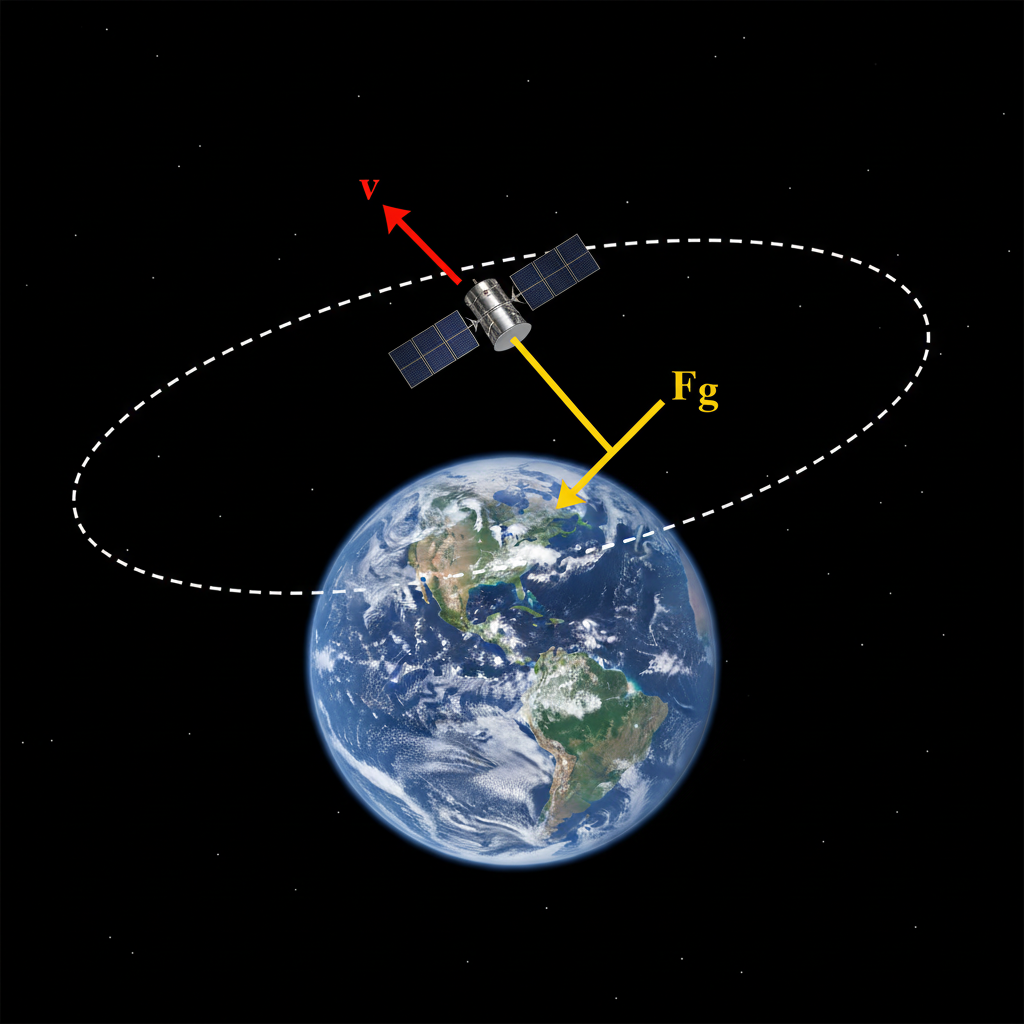
The diagram shows a satellite in a circular orbit around Earth. The velocity vv is along the orbit and the gravitational force FgF_g points towards Earth's centre.
Question diagram
(a)
State the force that keeps the satellite in its orbit. [1]Criterion A (i) · Level 1-2
(b)
Explain why the satellite moves in a circle instead of falling straight down to Earth. [2]Criterion A (i) · Level 3-4
(c)
Describe the path of the satellite if gravity were suddenly removed. [1]Criterion A (ii) · Level 3-4

revisionprep.com

Summary Answer

Not available for this question.

Model Answer

Not available for this question.

Marking Scheme

Not available for this question.

Examiner Insights

Not available for this question.

Question 2Criterion A + D · Band 3-4 · Easy · 5 marksrevisionprep.com

Orbital types: Geostationary, Low Earth orbit
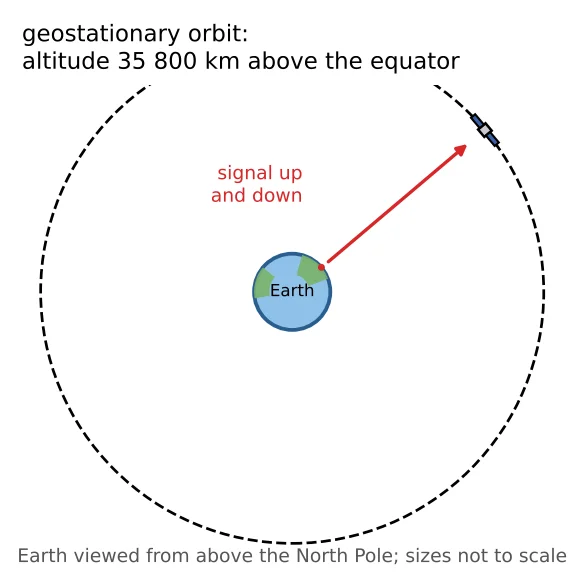
The diagram shows a geostationary satellite 35 800 km above the equator, used for television and telephone links. Radio signals travel at 3.0×10⁵ km s−13.0 \times 10^{5} \text{ km s}^{-1}.
Question diagram
(a)
Calculate the time for a signal to travel from the ground up to the satellite and back down. [2]Criterion A (ii) · Level 3-4
(b)
Explain why this delay is a problem for telephone calls but not for television. [1]Criterion A (iii) · Level 3-4
(c)
Outline why geostationary orbit is described as a limited resource. [2]Criterion D (ii) · Level 3-4

revisionprep.com

Summary Answer

Not available for this question.

Model Answer

Not available for this question.

Marking Scheme

Not available for this question.

Examiner Insights

Not available for this question.

Question 3Criterion A + D · Band 1-6 · Medium · 6 marksrevisionprep.com

Basic idea of Kepler’s Laws of Planetary Motion
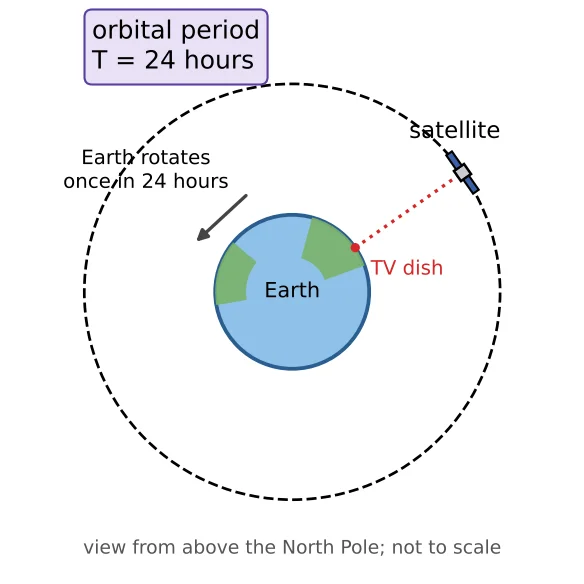
The diagram shows a geostationary satellite, which orbits once every 24 hours so that it stays above one point on the equator. The Moon orbits Earth at 384 000 km from its centre with a period of 27.3 days.
Question diagram
(a)
Explain why a geostationary satellite must have a period of 24 hours. [1]Criterion A (i) · Level 1-2
(b)
Use Kepler's third law and the Moon's data to show that the geostationary orbit is about 42 000 km from Earth's centre. [3]Criterion A (ii) · Level 5-6
(c)
Outline one benefit and one limitation of geostationary satellites for television. [2]Criterion D (i) · Level 3-4

revisionprep.com

Summary Answer

Not available for this question.

Model Answer

Not available for this question.

Marking Scheme

Not available for this question.

Examiner Insights

Not available for this question.

Question 4Criterion C + A · Band 3-6 · Medium · 8 marksrevisionprep.com

Orbital distance, speed and period

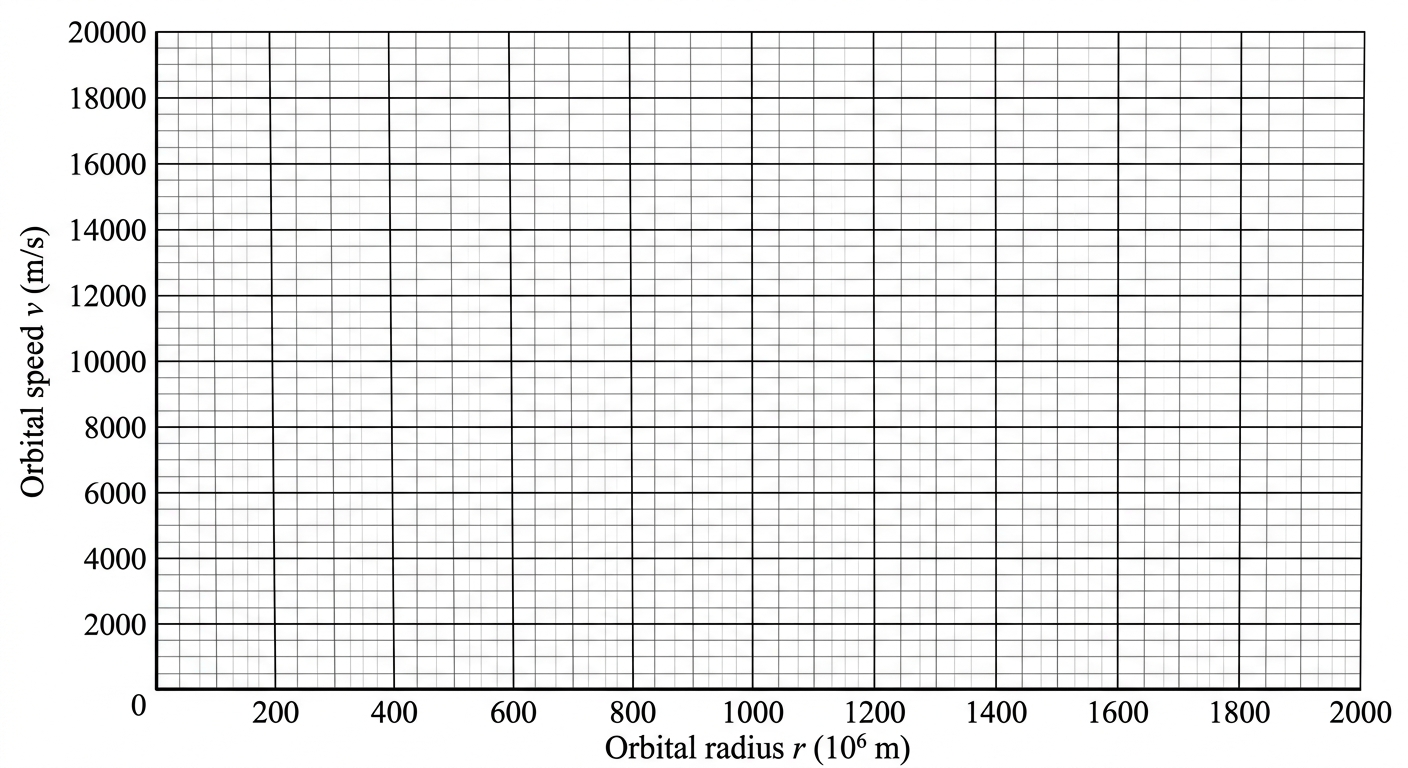
The table shows data for Jupiter's four largest moons. The grid is provided. (1 day = 86 400 s)

MoonIoEuropaGanymedeCallisto
Orbital radius rr / 10610^{6} m42267110701883
Orbital period TT / days1.773.557.1516.7
Question diagram
(a)
Calculate the orbital speed of Io and of Callisto using v=2πrTv = \dfrac{2\pi r}{T}. [3]Criterion A (ii) · Level 3-4
(b)
Europa's speed is 13 700 m s−113\,700 \text{ m s}^{-1} and Ganymede's is 10 900 m s−110\,900 \text{ m s}^{-1}. Plot orbital speed against orbital radius for all four moons and draw a smooth curve. [2]Criterion C (i) · Level 3-4
(c)
Describe the relationship shown by your graph. [1]Criterion C (ii) · Level 3-4
(d)
Calculate vrv\sqrt{r} for Io and Callisto, with rr in 10610^{6} m. Hence state how vv depends on rr. [2]Criterion C (ii) · Level 5-6

revisionprep.com

Summary Answer

Not available for this question.

Model Answer

Not available for this question.

Marking Scheme

Not available for this question.

Examiner Insights

Not available for this question.

Question 5Criterion B · Band 3-8 · Challenge · 10 marksrevisionprep.com

Concept of orbit (elliptical paths)

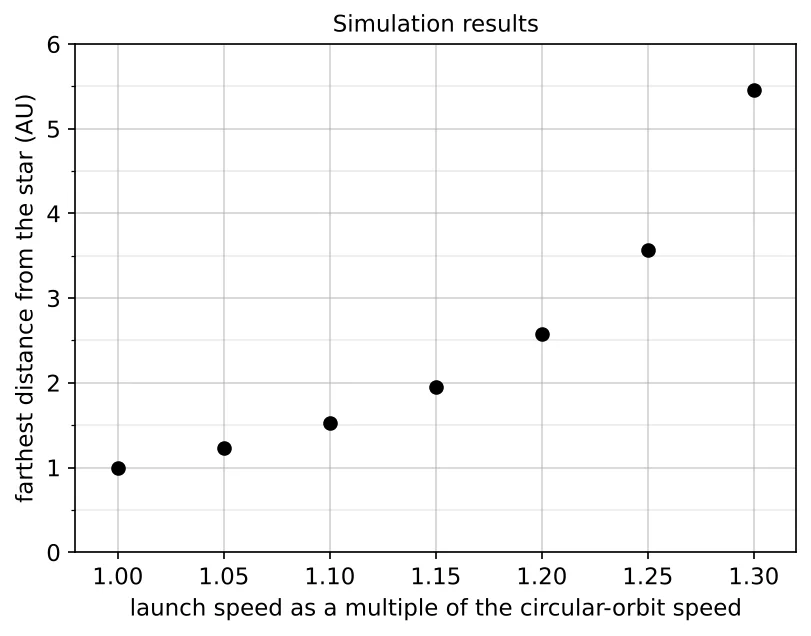
A student uses a computer simulation of a planet and a star. The planet starts 1.0 AU from the star and is launched at right angles to the line joining them. The student changes the launch speed, written as a multiple of the speed needed for a circular orbit, and reads off the farthest distance the planet reaches from the star. The graph shows the results.
Question diagram
(a)
Identify the independent variable and the dependent variable, and state two variables the student must keep the same. [3]Criterion B (iii) · Level 3-4
(b)
The points on the graph rise more and more steeply. Explain how this should affect where the student places extra launch speeds, and suggest two launch speeds to add. [3]Criterion B (iv) · Level 5-6
(c)
Above a certain launch speed the planet never returns to the star. Describe how the student should use the simulation to find this speed as accurately as possible without knowing it in advance. [4]Criterion B (iv) · Level 7-8

revisionprep.com

Summary Answer

Not available for this question.

Model Answer

Not available for this question.

Marking Scheme

Not available for this question.

Examiner Insights

Not available for this question.

Question 6Criterion D + A · Band 1-8 · Challenge · 7 marksrevisionprep.com

Definition of satellites

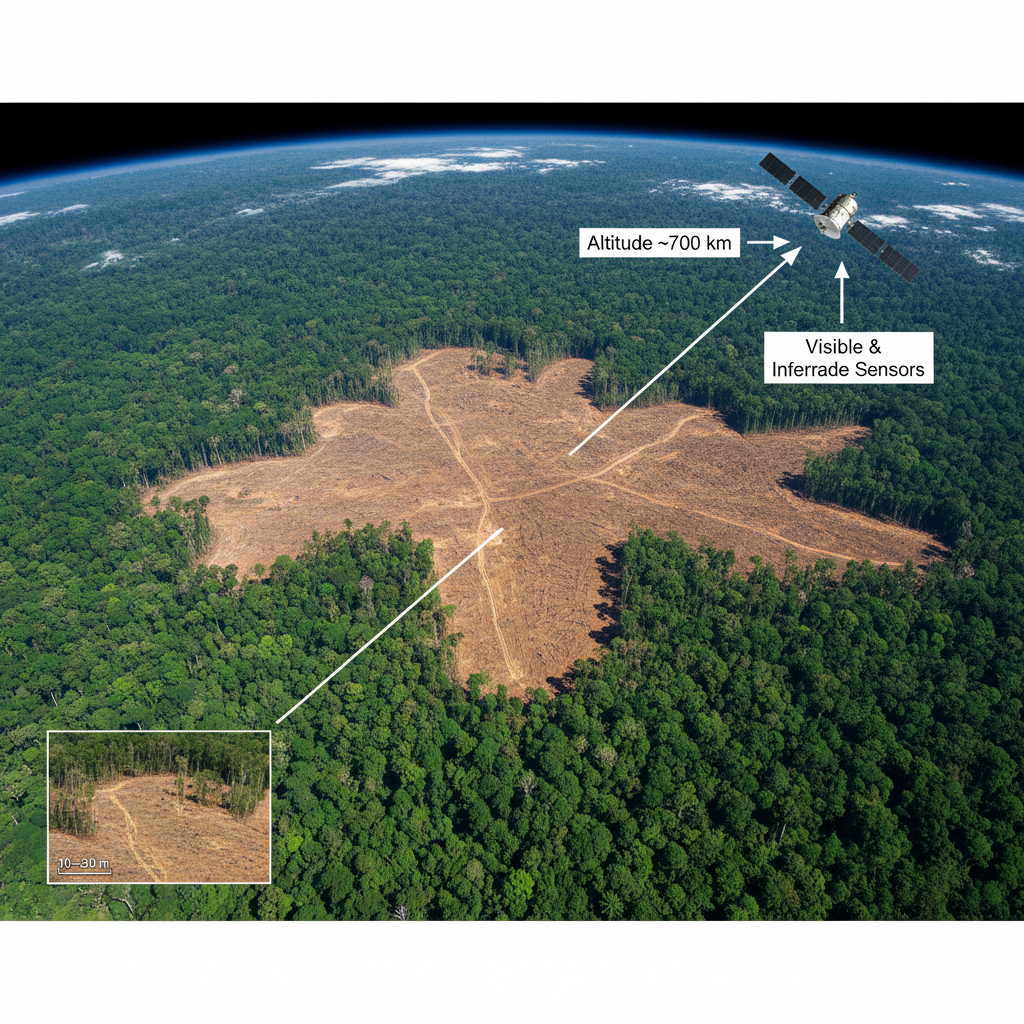
The diagram shows a satellite in low Earth orbit about 700 km above the Amazon rainforest. Its visible and infrared sensors can see details down to 10 to 30 m across. The images are used by governments, environmental groups and companies.
Question diagram
(a)
State why a satellite in orbit is useful for monitoring a forest the size of the Amazon. [1]Criterion A (i) · Level 1-2
(b)
Explain why the satellite may fail to detect a few trees cut down inside the forest. [2]Criterion A (ii) · Level 3-4
(c)
Discuss the benefits and risks of using satellite images to monitor the rainforest and the people who live there. [4]Criterion D (i), D (ii) · Level 7-8

revisionprep.com

Summary Answer

Not available for this question.

Model Answer

Not available for this question.

Marking Scheme

Not available for this question.

Examiner Insights

Not available for this question.

That's every free question here — 6 of 144.

+138 more questions, plus Mock Papers & Worksheets, are waiting in Premium.

Upgrade