You're viewing free preview questions — 6 questions previewing here — subscribe to unlock 96 more, plus the Full Question Bank, Mock Papers & Worksheets.Upgrade
Back

Stars and their life cycle — Free MYP4 Physics Practice Questions

Free questions

Open in full, with answers, mark scheme and examiner insights.

Question 1Criterion A · Band 1-4 · Easy · 5 marksrevisionprep.com

The Sun: composition and structure

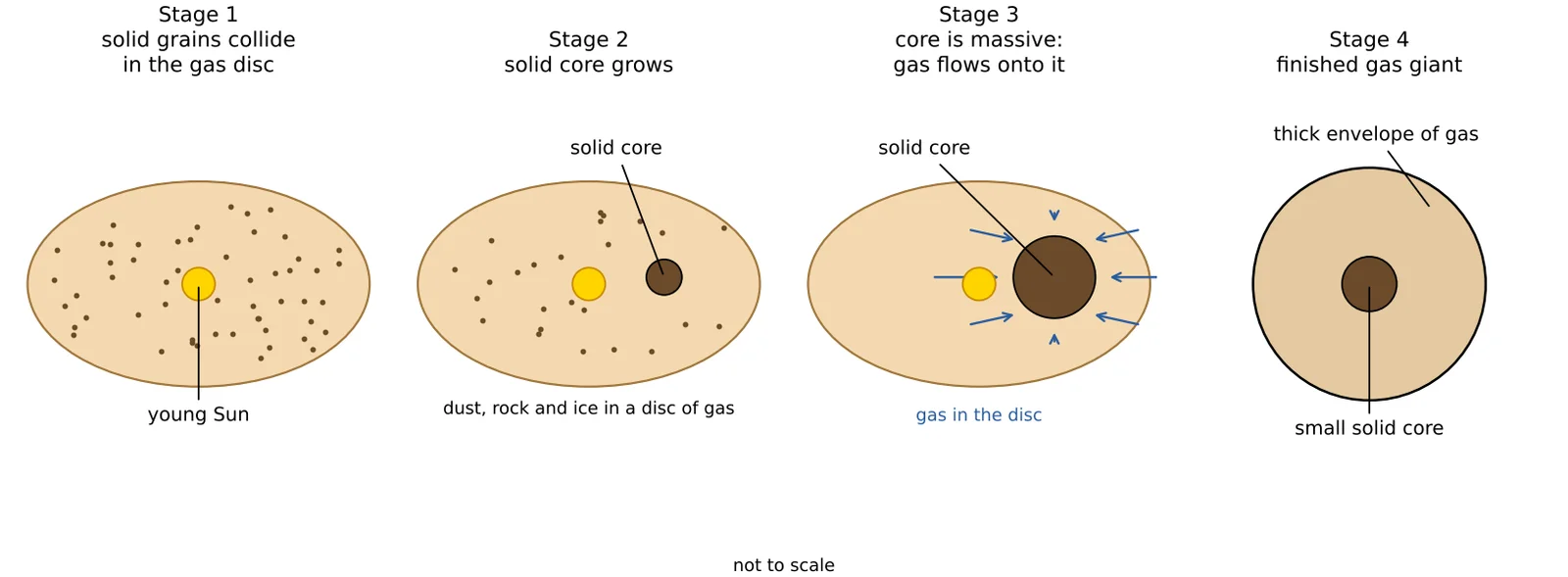
The diagram shows four stages in the formation of a gas giant such as Jupiter: a solid core of rock and ice grows first, then rapidly pulls in gas from the surrounding disc.
Question diagram
(a)
State the two gases that made up most of the disc around the young Sun. [1]Criterion A (i) · Level 1-2
(b)
Explain why the core had to grow large before the planet could gather a thick envelope of gas. [2]Criterion A (ii) · Level 3-4
(c)
Explain why gas giants have a composition similar to the Sun's, while Earth does not. [2]Criterion A (iii) · Level 3-4

revisionprep.com

Summary Answer

Not available for this question.

Model Answer

Not available for this question.

Marking Scheme

Not available for this question.

Examiner Insights

Not available for this question.

Question 2Criterion A · Band 1-4 · Easy · 5 marksrevisionprep.com

Role of stars in element formation

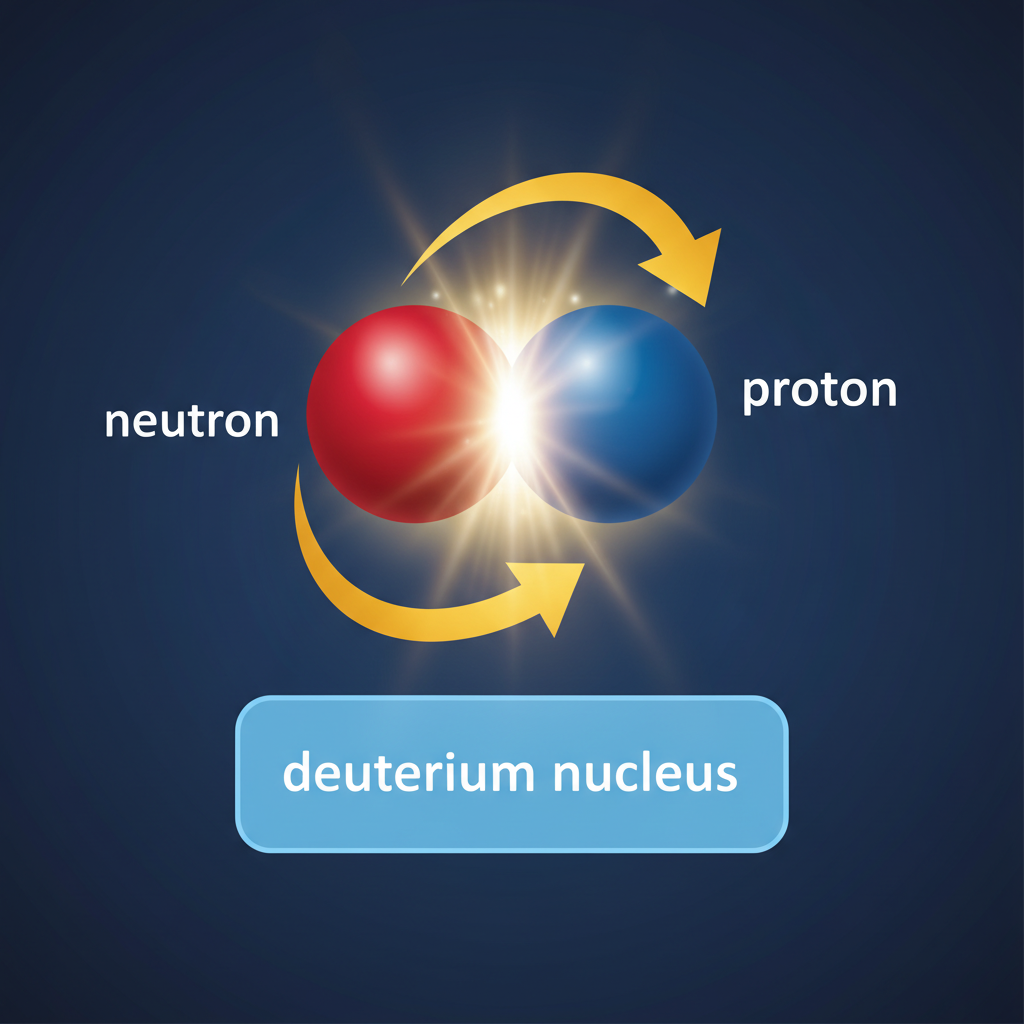
The diagram shows a neutron and a proton joining to form a deuterium nucleus.
Question diagram
(a)
State the charge of a deuterium nucleus and the element it belongs to. [2]Criterion A (i) · Level 1-2
(b)
Explain why forming deuterium is an important step in making helium. [2]Criterion A (ii) · Level 3-4
(c)
In the first second after the Big Bang, deuterium could not survive. Suggest why. [1]Criterion A (iii) · Level 3-4

revisionprep.com

Summary Answer

Not available for this question.

Model Answer

Not available for this question.

Marking Scheme

Not available for this question.

Examiner Insights

Not available for this question.

Question 3Criterion A + C · Band 3-6 · Medium · 6 marksrevisionprep.com

The Sun: composition and structure

Saturn has a mass of 5.7×10265.7 \times 10^{26} kg and a volume of 8.3×10²³ m38.3 \times 10^{23} \text{ m}^3. It is made mostly of hydrogen and helium. Water has a density of 1000 kg m−31000 \text{ kg m}^{-3}. A website claims: Saturn would float in a big enough bath of water.
(a)
Calculate the average density of Saturn. [2]Criterion A (ii) · Level 3-4
(b)
Explain why Saturn's density is so low. [2]Criterion A (ii) · Level 3-4
(c)
Evaluate the website's claim. [2]Criterion C (iv) · Level 5-6

revisionprep.com

Summary Answer

Not available for this question.

Model Answer

Not available for this question.

Marking Scheme

Not available for this question.

Examiner Insights

Not available for this question.

Question 4Criterion C + A · Band 1-6 · Medium · 7 marksrevisionprep.com

Nuclear Reactions in Stars - fusion

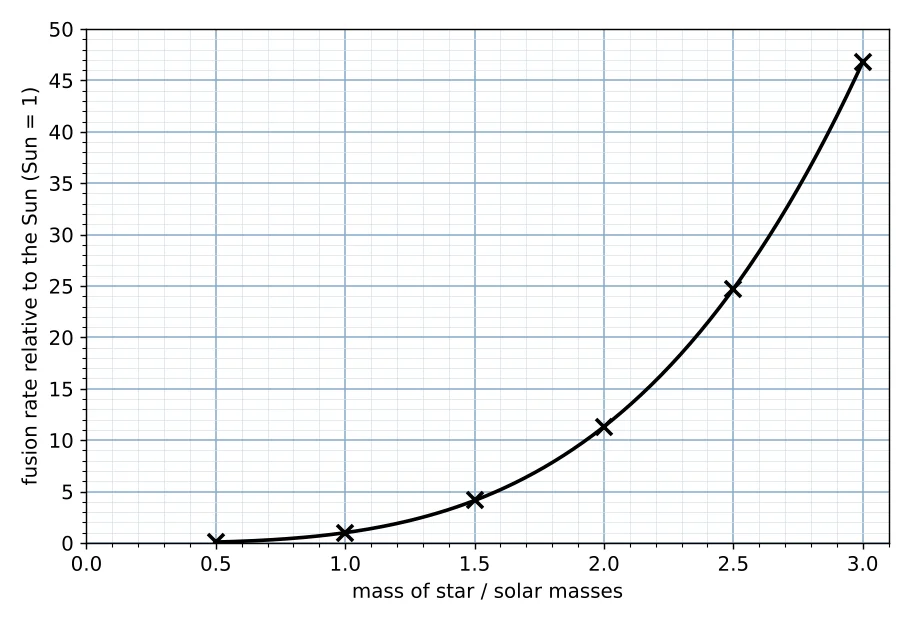
The graph shows how the rate of fusion in a star's core depends on the star's mass. Rates are given relative to the Sun (Sun = 1).
Question diagram
(a)
Write down the fusion rate of a star of 2.0 solar masses. [1]Criterion C (ii) · Level 1-2
(b)
Describe the relationship shown. [1]Criterion C (ii) · Level 3-4
(c)
Explain why more massive stars have much higher fusion rates. [3]Criterion A (ii) · Level 5-6
(d)
A star of 3.0 solar masses has three times as much hydrogen as the Sun. Use the graph to deduce whether it will live longer or shorter than the Sun, and by roughly what factor. [2]Criterion C (ii) · Level 5-6

revisionprep.com

Summary Answer

Not available for this question.

Model Answer

Not available for this question.

Marking Scheme

Not available for this question.

Examiner Insights

Not available for this question.

Question 5Criterion D + A · Band 3-8 · Challenge · 9 marksrevisionprep.com

Life cycle of stars

Astronomers plan to search for life on planets around other stars. On Earth, simple life appeared within about 1 billion years of the planet forming, and animals took about 4 billion years. The table gives data for three types of star.

Type of starMass compared with the SunTime on main sequence / billion yearsShare of all starsRadiation flaresBlue giant150.01very rarevery strong radiationSun-like110about 7%occasionalRed dwarf0.2more than 500about 75%frequent and strong\begin{array}{|l|c|c|c|c|}\hline \text{Type of star} & \text{Mass compared with the Sun} & \text{Time on main sequence / billion years} & \text{Share of all stars} & \text{Radiation flares} \\ \hline \text{Blue giant} & 15 & 0.01 & \text{very rare} & \text{very strong radiation} \\ \hline \text{Sun-like} & 1 & 10 & \text{about 7\%} & \text{occasional} \\ \hline \text{Red dwarf} & 0.2 & \text{more than 500} & \text{about 75\%} & \text{frequent and strong} \\ \hline\end{array}
(a)
Explain why a planet around a blue giant is unlikely to develop life like that on Earth. [3]Criterion A (iii) · Level 5-6
(b)
Use the table to outline one reason for searching around red dwarfs and one reason against it. [2]Criterion D (i) · Level 3-4
(c)
A telescope has time to study only 200 star systems. Dr Rao, an astrobiologist, wants to study red dwarfs. Dr Lim, an astronomer, wants to study Sun-like stars. Evaluate their arguments and recommend how the telescope time should be used. [4]Criterion D (ii), D (iii) · Level 7-8

revisionprep.com

Summary Answer

Not available for this question.

Model Answer

Not available for this question.

Marking Scheme

Not available for this question.

Examiner Insights

Not available for this question.

Question 6Criterion B + C · Band 3-8 · Challenge · 9 marksrevisionprep.com

Supernova (basic concept)

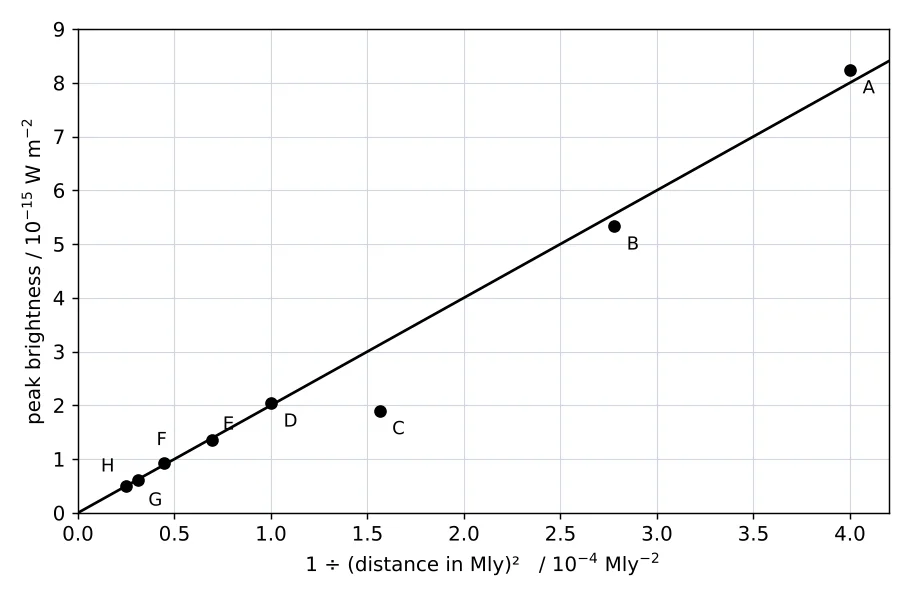
One type of supernova is thought to reach the same true peak power every time. If this is correct, the peak brightness seen from Earth should be directly proportional to 1÷d21 \div d^{2}, where dd is the distance to the supernova. The graph shows the peak brightness of eight supernovae, A to H, in galaxies whose distances are known. The line is the line of best fit through the origin.
Question diagram
(a)
Describe the pattern in the graph, and identify the anomalous result. [2]Criterion C (ii) · Level 3-4
(b)
Design an investigation to find out whether the anomalous result is caused by an error in measurement or by a real difference in that supernova. [4]Criterion B (ii), B (iii) · Level 5-6
(c)
If the faint supernova C were used to find the distance to its own galaxy, assuming it has the usual peak brightness, the distance would come out 28% too large. Evaluate how reliable these supernovae are for measuring distances. Suggest one improvement to the data collection. [3]Criterion B (iv) · Level 7-8

revisionprep.com

Summary Answer

Not available for this question.

Model Answer

Not available for this question.

Marking Scheme

Not available for this question.

Examiner Insights

Not available for this question.

That's every free question here — 6 of 102.

+96 more questions, plus Mock Papers & Worksheets, are waiting in Premium.

Upgrade