You're viewing free preview questions — 6 questions previewing here — subscribe to unlock 161 more, plus the Full Question Bank, Mock Papers & Worksheets.Upgrade
Back

The Solar System — Free MYP4 Physics Practice Questions

Free questions

Open in full, with answers, mark scheme and examiner insights.

Question 1Criterion A · Band 1-4 · Easy · 4 marksrevisionprep.com

Formation of the solar system (nebular hypothesis – basic idea)

The Solar System formed from a cloud of gas and dust called the solar nebula.
(a)
Describe the two main structures that formed as the collapsing nebula rotated. [2]Criterion A (i) · Level 1-2
(b)
Explain how planetesimals grew into planets. [2]Criterion A (i) · Level 3-4

revisionprep.com

Summary Answer

Not available for this question.

Model Answer

Not available for this question.

Marking Scheme

Not available for this question.

Examiner Insights

Not available for this question.

Question 2Criterion A · Band 1-4 · Easy · 4 marksrevisionprep.com

Gas giants:Jupiter, Saturn

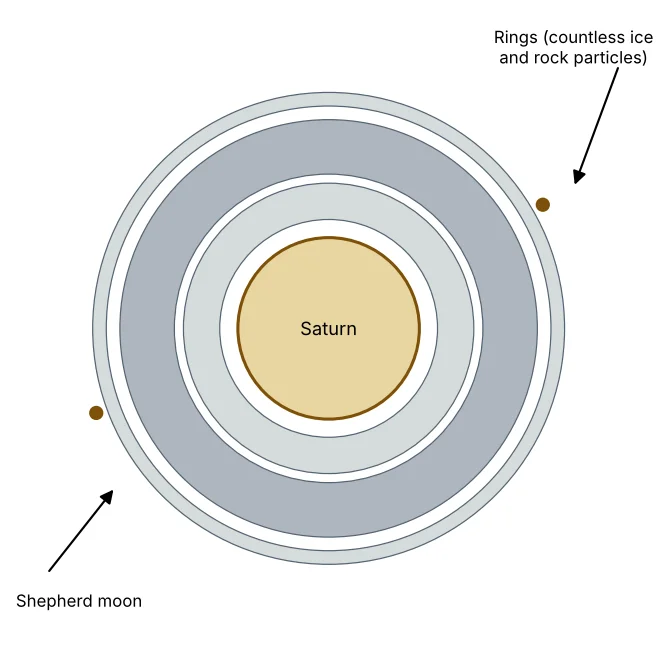
The diagram shows Saturn's rings, made of countless ice and rock particles. Small 'shepherd moons' orbit near the edges of some rings.
Question diagram
(a)
Describe how a ring particle's speed depends on its distance from Saturn. [1]Criterion A (i) · Level 1-2
(b)
Explain why the ring particles have not gathered together into one moon. [2]Criterion A (iii) · Level 3-4
(c)
Suggest how the gravity of a shepherd moon can keep the edge of a ring sharp. [1]Criterion A (iii) · Level 3-4

revisionprep.com

Summary Answer

Not available for this question.

Model Answer

Not available for this question.

Marking Scheme

Not available for this question.

Examiner Insights

Not available for this question.

Question 3Criterion C + A · Band 3-6 · Medium · 9 marksrevisionprep.com

Definition of a solar system

TRAPPIST-1 is a small, cool star with seven known planets. The table gives the average distance of each planet from the star and its orbital period.

PlanetbcdefghDistance / AU0.0120.0160.0220.0290.0380.0470.062Period / days1.512.424.056.109.2112.3518.77\begin{array}{|l|c|c|c|c|c|c|c|}\hline \text{Planet} & \text{b} & \text{c} & \text{d} & \text{e} & \text{f} & \text{g} & \text{h} \\ \hline \text{Distance / AU} & 0.012 & 0.016 & 0.022 & 0.029 & 0.038 & 0.047 & 0.062 \\ \hline \text{Period / days} & 1.51 & 2.42 & 4.05 & 6.10 & 9.21 & 12.35 & 18.77 \\ \hline\end{array}

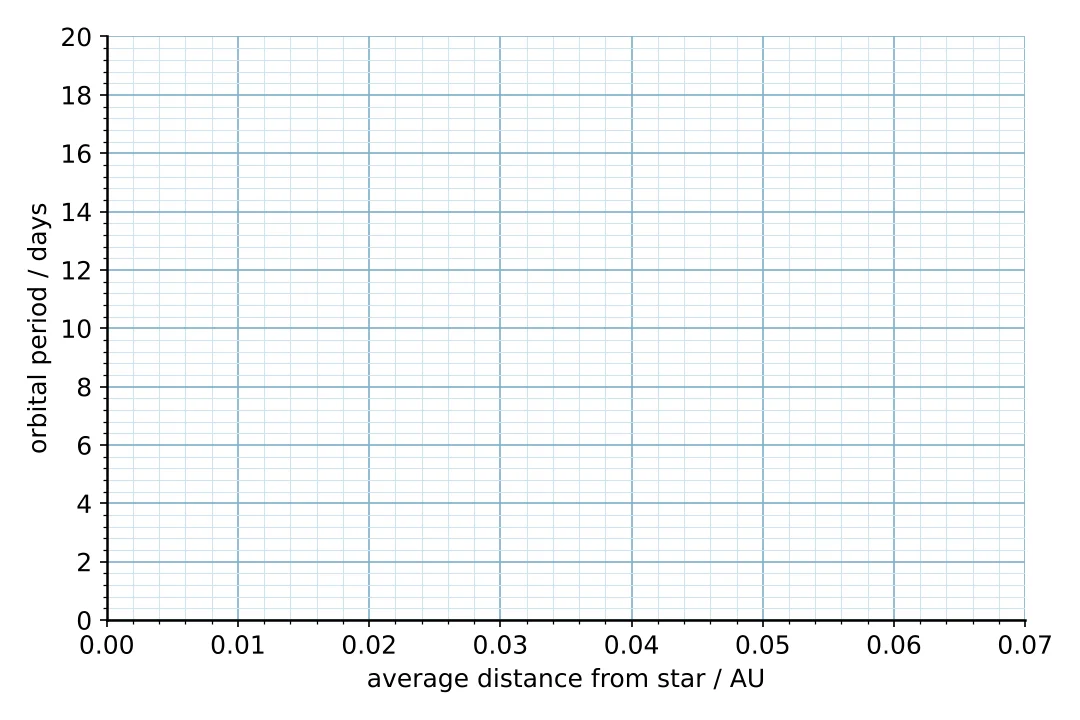
The grid is provided for your graph.
Question diagram
(a)
Plot a graph of orbital period against average distance on the grid and draw a smooth curve of best fit. [3]Criterion C (i) · Level 3-4
(b)
Describe the relationship shown by your graph. [2]Criterion C (ii) · Level 3-4
(c)
Mercury, the closest planet to the Sun, orbits at 0.39 AU. Compare the size of the TRAPPIST-1 system with our Solar System. [2]Criterion C (ii) · Level 5-6
(d)
Explain why TRAPPIST-1 and its planets are described as a solar system even though the star is very different from the Sun. [2]Criterion A (iii) · Level 5-6

revisionprep.com

Summary Answer

Not available for this question.

Model Answer

Not available for this question.

Marking Scheme

Not available for this question.

Examiner Insights

Not available for this question.

Question 4Criterion A · Band 3-6 · Medium · 5 marksrevisionprep.com

Ice giants: Uranus, Neptune

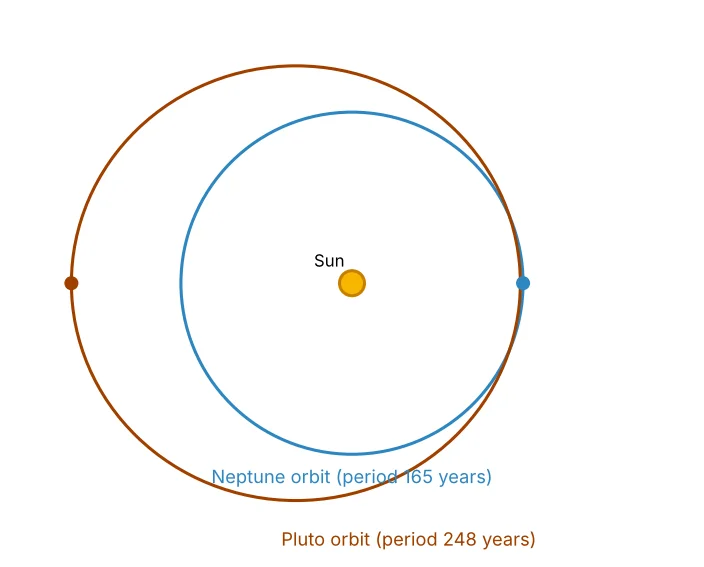
The diagram shows the orbits of Neptune (period 165 years) and Pluto (period 248 years). Pluto's orbit crosses inside Neptune's, yet the two never come close.
Question diagram
(a)
Show that Pluto makes 2 orbits in about the time Neptune makes 3. [2]Criterion A (ii) · Level 3-4
(b)
Explain why this timing means Neptune and Pluto never collide. [2]Criterion A (iii) · Level 5-6
(c)
Explain why Pluto crossing Neptune's orbit is evidence that Pluto is not a planet. [1]Criterion A (iii) · Level 5-6

revisionprep.com

Summary Answer

Not available for this question.

Model Answer

Not available for this question.

Marking Scheme

Not available for this question.

Examiner Insights

Not available for this question.

Question 5Criterion B + C · Band 3-8 · Challenge · 10 marksrevisionprep.com

Importance for life on Earth

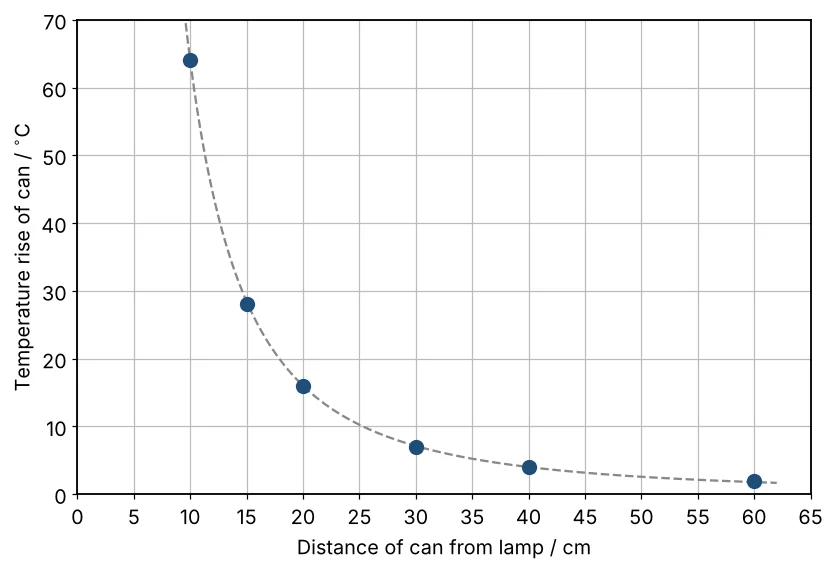
A student models a planet orbiting a star using a lamp as the star and a small black-painted metal can as the planet. A thermometer in the can measures the temperature rise of the can after 10 minutes. She places the can at different distances from the lamp. The graph shows her results.
Question diagram
(a)
Use the graph to show that doubling the distance from the lamp reduces the temperature rise to about one quarter. [2]Criterion C (ii) · Level 3-4
(b)
She now wants to find out whether a model atmosphere changes the temperature rise. She will wrap the can in a clear plastic bag filled with carbon dioxide, with the can 20 cm from the lamp. Formulate a testable hypothesis and explain it using scientific reasoning. [2]Criterion B (ii) · Level 5-6
(c)
Explain how she should keep two other variables constant in this new investigation. [2]Criterion B (iii) · Level 5-6
(d)
Describe how she should carry out the investigation. Include how she will show that any difference is caused by the carbon dioxide and not just by the bag, how she will make the data reliable, and one safety precaution. [4]Criterion B (iv) · Level 7-8

revisionprep.com

Summary Answer

Not available for this question.

Model Answer

Not available for this question.

Marking Scheme

Not available for this question.

Examiner Insights

Not available for this question.

Question 6Criterion D + A · Band 1-8 · Challenge · 6 marksrevisionprep.com

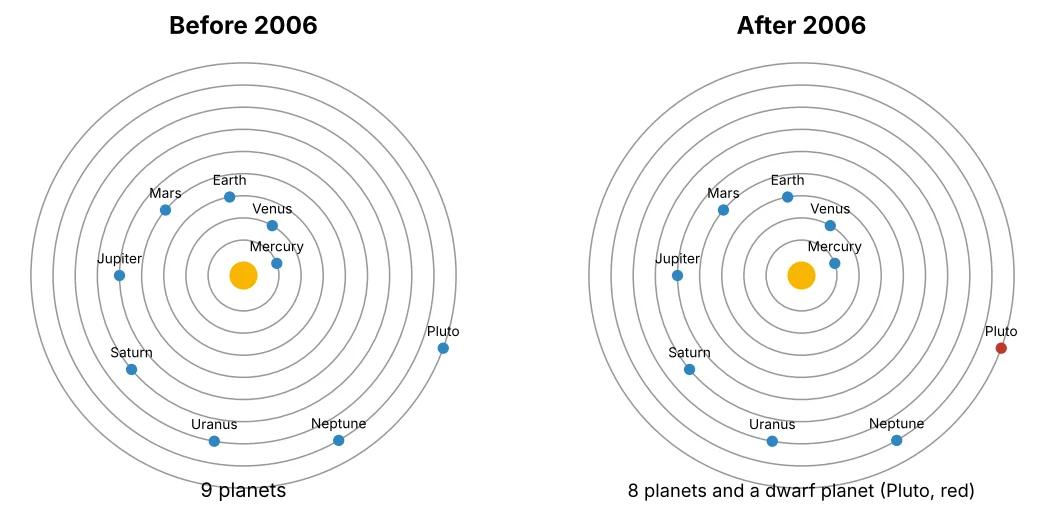
Definition of a planet

The diagram shows the Solar System as described before and after 2006, when the IAU reclassified Pluto as a dwarf planet.
Question diagram
(a)
State the criterion Pluto fails to meet. [1]Criterion A (i) · Level 1-2
(b)
Explain why astronomers needed a formal definition of a planet by 2006. [2]Criterion D (i) · Level 3-4
(c)
Discuss how Pluto's reclassification affected public understanding of science. [3]Criterion D (ii), D (iii) · Level 7-8

revisionprep.com

Summary Answer

Not available for this question.

Model Answer

Not available for this question.

Marking Scheme

Not available for this question.

Examiner Insights

Not available for this question.

That's every free question here — 6 of 167.

+161 more questions, plus Mock Papers & Worksheets, are waiting in Premium.

Upgrade