You're viewing free preview questions — 6 questions previewing here — subscribe to unlock 233 more, plus the Full Question Bank, Mock Papers & Worksheets.Upgrade
Back

Magnetism, electromagnetism and induction — Free MYP4 Physics Practice Questions

Free questions

Open in full, with answers, mark scheme and examiner insights.

Question 1Criterion A · Band 1-4 · Easy · 5 marksrevisionprep.com

Magnetic Materials / Temporary and Permanent Magnets
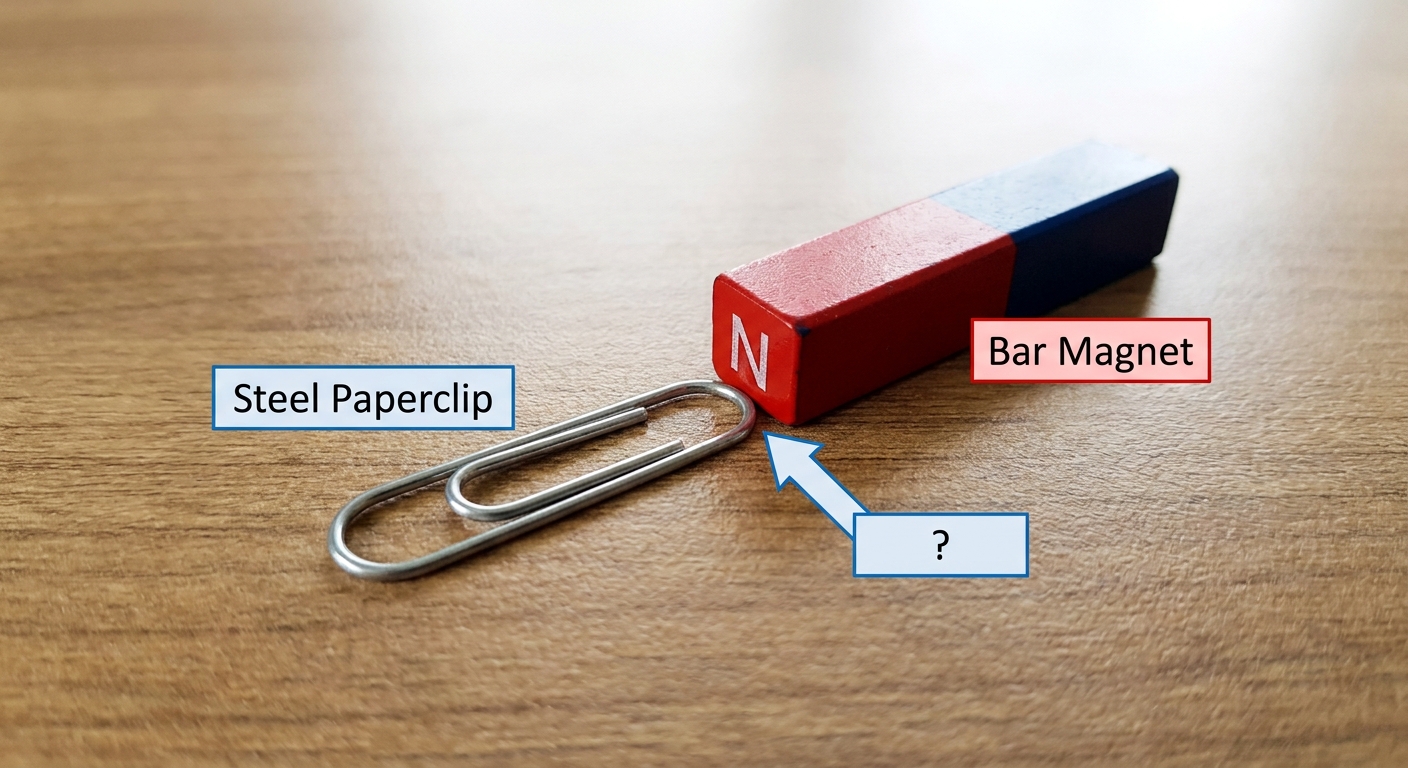
The photograph shows a steel paperclip touching the north pole of a bar magnet. The arrow labelled ? points to the end of the paperclip that touches the magnet.
Question diagram
(a)
State the magnetic pole induced at the end of the paperclip marked ?. [1]Criterion A (ii) · Level 1-2
(b)
Explain, using the idea of magnetic domains, how the paperclip becomes a magnet. [2]Criterion A (i) · Level 3-4
(c)
A second paperclip is hung from the free end of the first one, and it stays there. Explain why. [2]Criterion A (ii) · Level 3-4

revisionprep.com

Summary Answer

Not available for this question.

Model Answer

Not available for this question.

Marking Scheme

Not available for this question.

Examiner Insights

Not available for this question.

Question 2Criterion A · Band 1-2 · Easy · 4 marksrevisionprep.com

Transformers and their working

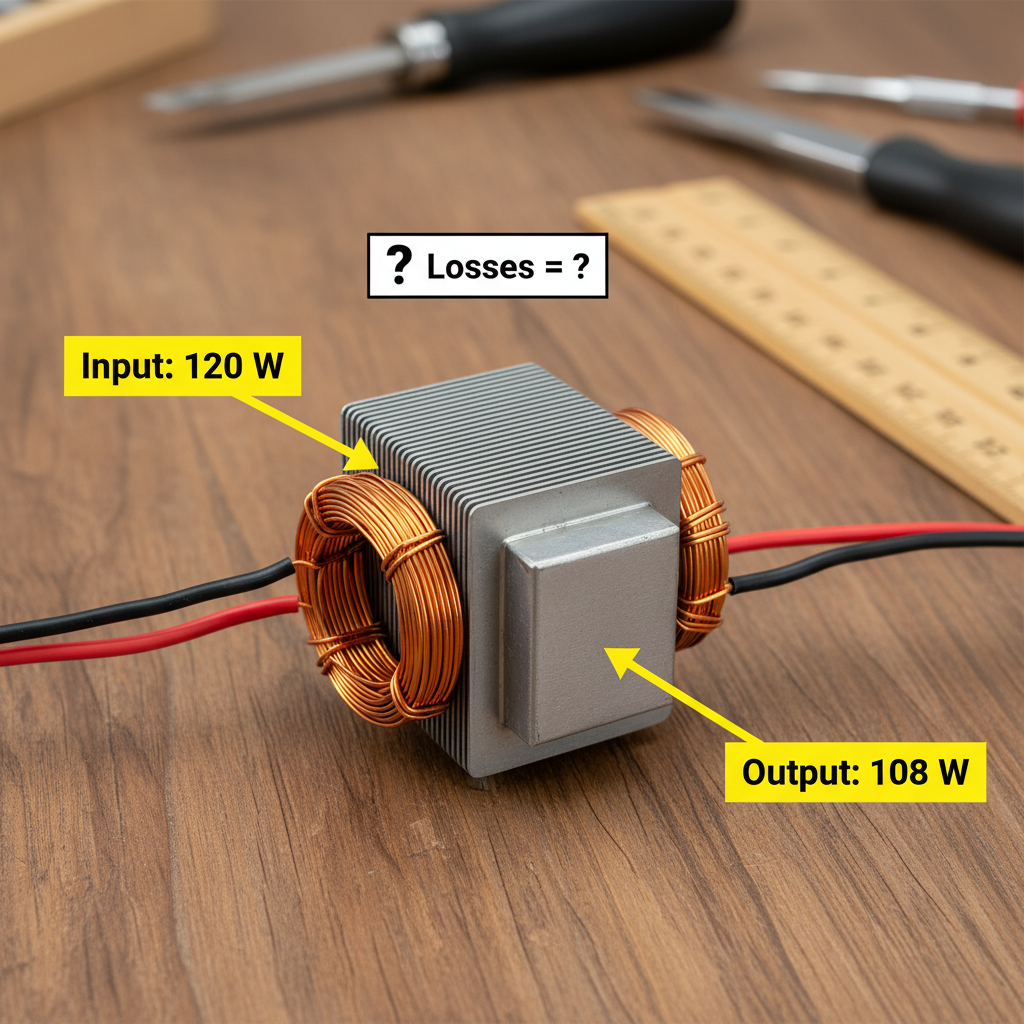
The photograph shows a small transformer made for a school project, with an input power of 120 W and an output power of 108 W.
Question diagram
(a)
Calculate the efficiency of the transformer. [2]Criterion A (ii) · Level 1-2
(b)
Calculate the energy wasted in one hour of use, in joules. [2]Criterion A (ii) · Level 1-2

revisionprep.com

Summary Answer

Not available for this question.

Model Answer

Not available for this question.

Marking Scheme

Not available for this question.

Examiner Insights

Not available for this question.

Question 3Criterion C + A · Band 3-6 · Medium · 9 marksrevisionprep.com

Force acting on current carrying wire in external magnetic field
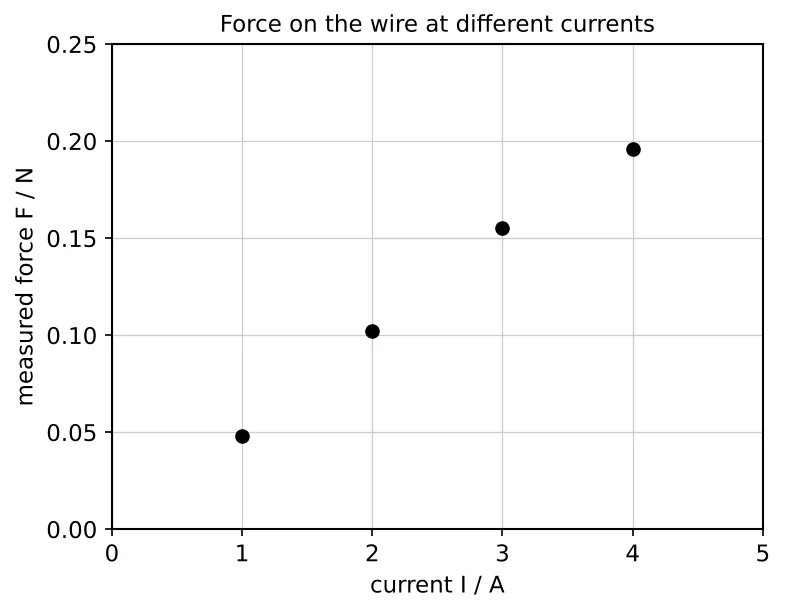
The graph and table show the results of a student's test of F=BILF = BIL. A stiff wire of length L=0.10L = 0.10 m lies at right angles to a uniform field of B=0.50B = 0.50 T between the poles of a magnet resting on a digital balance. She varies the current II and finds the force from the change in the balance reading.

I / A1.02.03.04.0Measured F / N0.0480.1020.1550.196\begin{array}{|l|c|c|c|c|}\hline \text{I / A} & 1.0 & 2.0 & 3.0 & 4.0 \\ \hline \text{Measured F / N} & 0.048 & 0.102 & 0.155 & 0.196 \\ \hline\end{array}
Question diagram
(a)
Calculate the force predicted by F=BILF = BIL for each current. [2]Criterion A (ii) · Level 3-4
(b)
Calculate the percentage difference between the measured and predicted force for 1.0 A and for 4.0 A. [2]Criterion C (i) · Level 3-4
(c)
Evaluate whether the results support F=BILF = BIL. [3]Criterion C (iii) · Level 5-6
(d)
The measured values are sometimes above and sometimes below the predictions. State what type of error this suggests, and suggest one improvement to reduce it. [2]Criterion C (iv), C (v) · Level 5-6

revisionprep.com

Summary Answer

Not available for this question.

Model Answer

Not available for this question.

Marking Scheme

Not available for this question.

Examiner Insights

Not available for this question.

Question 4Criterion B + A · Band 3-6 · Medium · 7 marksrevisionprep.com

The motor effect: Fleming's left-hand rule and the DC motor
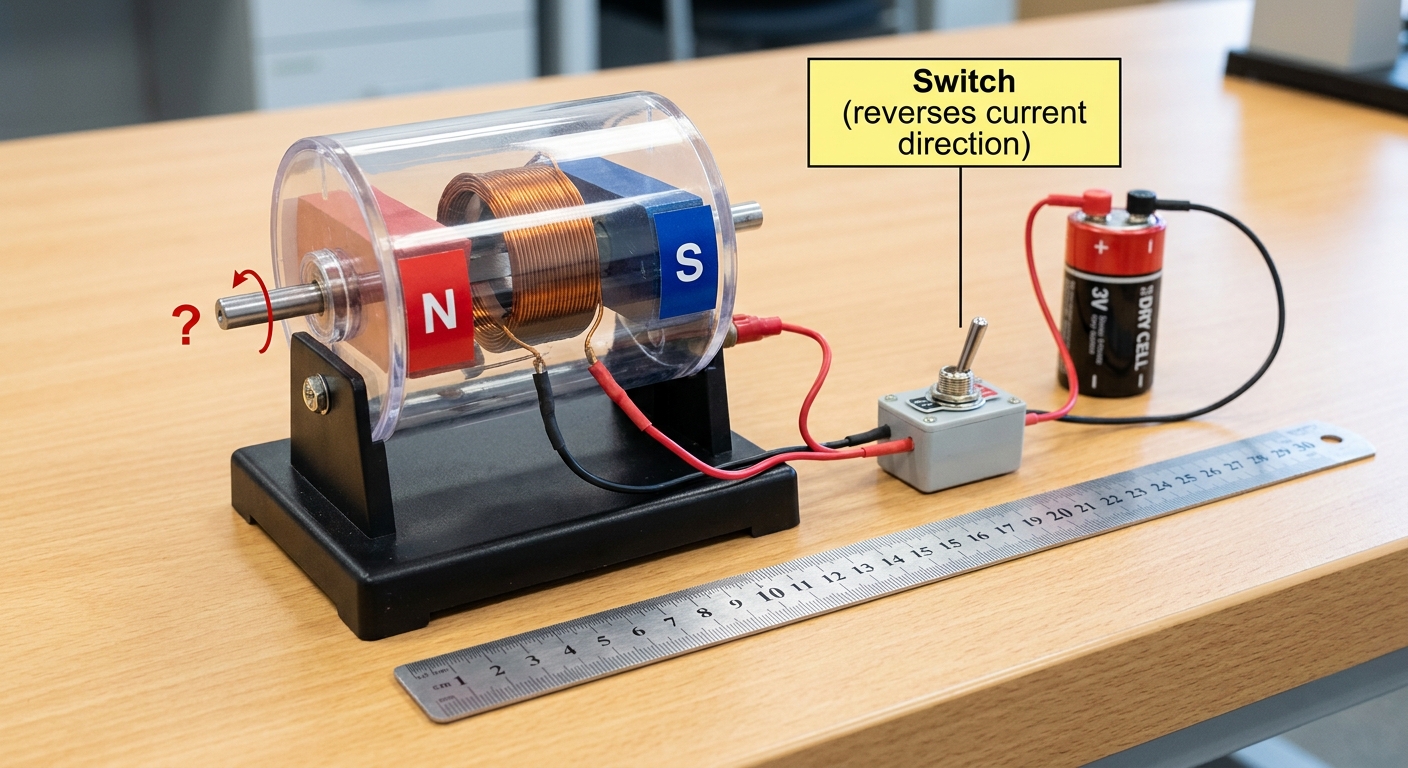
The photograph shows a simple d.c. motor connected to a battery through a switch that reverses the direction of the current. A student wants to test the hypothesis: "Reversing the current through the coil reverses the direction of rotation."
Question diagram
(a)
Explain why the hypothesis is reasonable, using Fleming's left-hand rule. [2]Criterion A (i) · Level 3-4
(b)
Identify the independent and dependent variables and one control variable. [2]Criterion B (iii) · Level 3-4
(c)
Explain how the student should observe and record the direction of rotation reliably, and how she could extend the investigation to test the effect of the magnet. [3]Criterion B (iii), B (iv) · Level 5-6

revisionprep.com

Summary Answer

Not available for this question.

Model Answer

Not available for this question.

Marking Scheme

Not available for this question.

Examiner Insights

Not available for this question.

Question 5Criterion A · Band 3-8 · Challenge · 10 marksrevisionprep.com

Magnetic Field Around a Bar Magnet

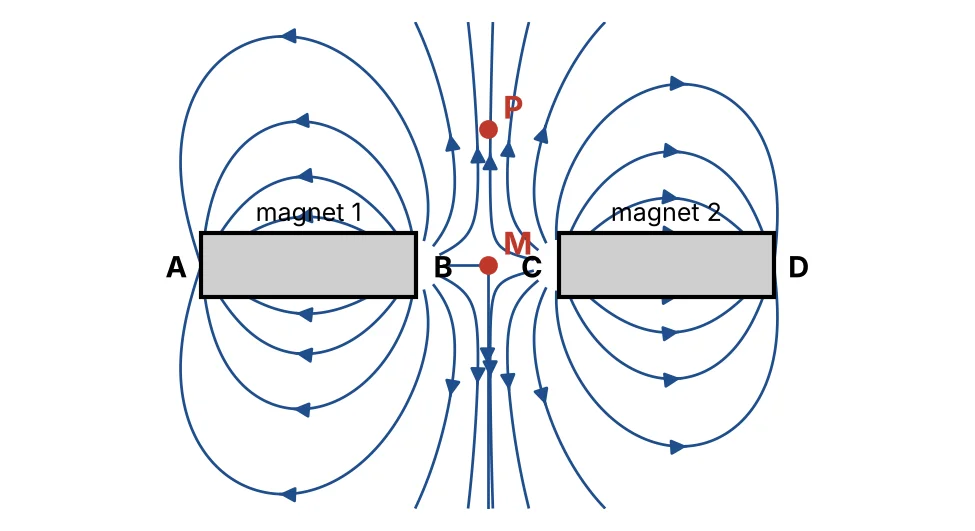
Two identical bar magnets lie on a table in line, with a gap between them, as drawn. The diagram shows the pattern of the magnetic field lines, with arrows for direction. Point M is midway between the magnets and point P is directly above M. The ends of the magnets are labelled A, B, C and D, and their poles are not marked.
Question diagram
(a)
Identify the poles at ends A, B, C and D, using only the arrows on the field lines, and give your reason. [2]Criterion A (i) · Level 3-4
(b)
Explain why the field lines between B and C bend away from the line joining them, and why field lines never cross. [2]Criterion A (ii) · Level 5-6
(c)
The magnetic field of the magnets is zero at M. Explain why, and describe how a plotting compass placed at M behaves. [3]Criterion A (ii) · Level 5-6
(d)
A student says: "The field is zero at M, so a long iron nail laid along the line from M to P would not become magnetised." Evaluate this claim. [3]Criterion A (iii) · Level 7-8

revisionprep.com

Summary Answer

Not available for this question.

Model Answer

Not available for this question.

Marking Scheme

Not available for this question.

Examiner Insights

Not available for this question.

Question 6Criterion D + A · Band 3-8 · Challenge · 10 marksrevisionprep.com

Magnetic field of a current-carrying wire and solenoid
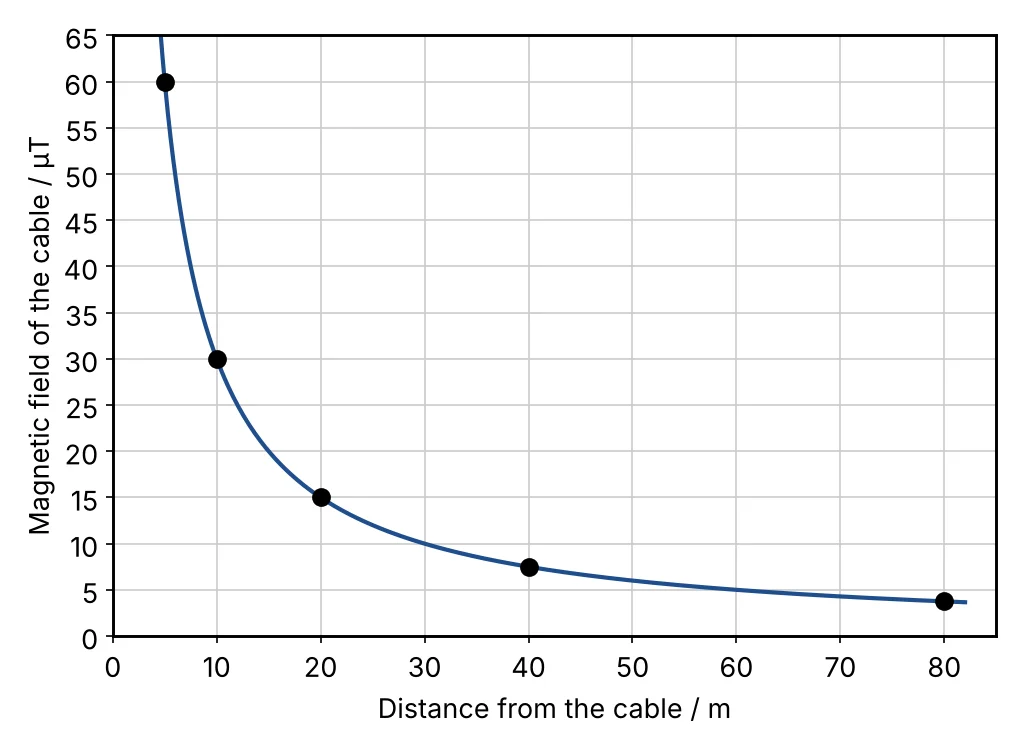
A proposed undersea d.c. power cable will carry a current of 1500 A along the sea bed. The graph shows hypothetical values of the magnetic field of the cable at different distances from it. The Earth's own magnetic field at the site is about 50 μT. A ship's magnetic compass can be read correctly only if the field of the cable at the compass is below 10% of the Earth's field.
Question diagram
(a)
Describe the shape of the magnetic field around a straight cable carrying a current, and state how the strength of the field changes with distance from the cable. [2]Criterion A (i) · Level 3-4
(b)
Use the graph to determine the smallest distance from the cable at which a compass can be read correctly, and show that the field halves each time the distance doubles. [3]Criterion D (i) · Level 5-6
(c)
In a shipping lane the water is 25 m deep and the compass is 8 m above the water. Determine the field of the cable at the compass, say whether the compass can be read correctly, and suggest one change to the cable that would reduce the field. [2]Criterion D (i) · Level 5-6
(d)
Two routes are proposed. Evaluate the routes from economic, safety and environmental perspectives, and recommend one, stating a condition if needed. FeatureRoute ARoute BPositionthrough the shipping lane12 km from the lane, through a marine reserveLength of cable / km4055Cost / million dollars80110\begin{array}{|l|c|c|}\hline \text{Feature} & \text{Route A} & \text{Route B} \\ \hline \text{Position} & \text{through the shipping lane} & \text{12 km from the lane, through a marine reserve} \\ \hline \text{Length of cable / km} & 40 & 55 \\ \hline \text{Cost / million dollars} & 80 & 110 \\ \hline\end{array} [3]Criterion D (ii), D (iii) · Level 7-8

revisionprep.com

Summary Answer

Not available for this question.

Model Answer

Not available for this question.

Marking Scheme

Not available for this question.

Examiner Insights

Not available for this question.

That's every free question here — 6 of 239.

+233 more questions, plus Mock Papers & Worksheets, are waiting in Premium.

Upgrade