You're viewing free preview questions — 5 questions previewing here — subscribe to unlock 72 more, plus the Full Question Bank, Mock Papers & Worksheets.Upgrade
Everyday Applications and Safety — Free MYP4 Physics Practice Questions

1QuestionHousehold Wiring and Power RatingsConcept Practice
2 marks~3 minCriterion A
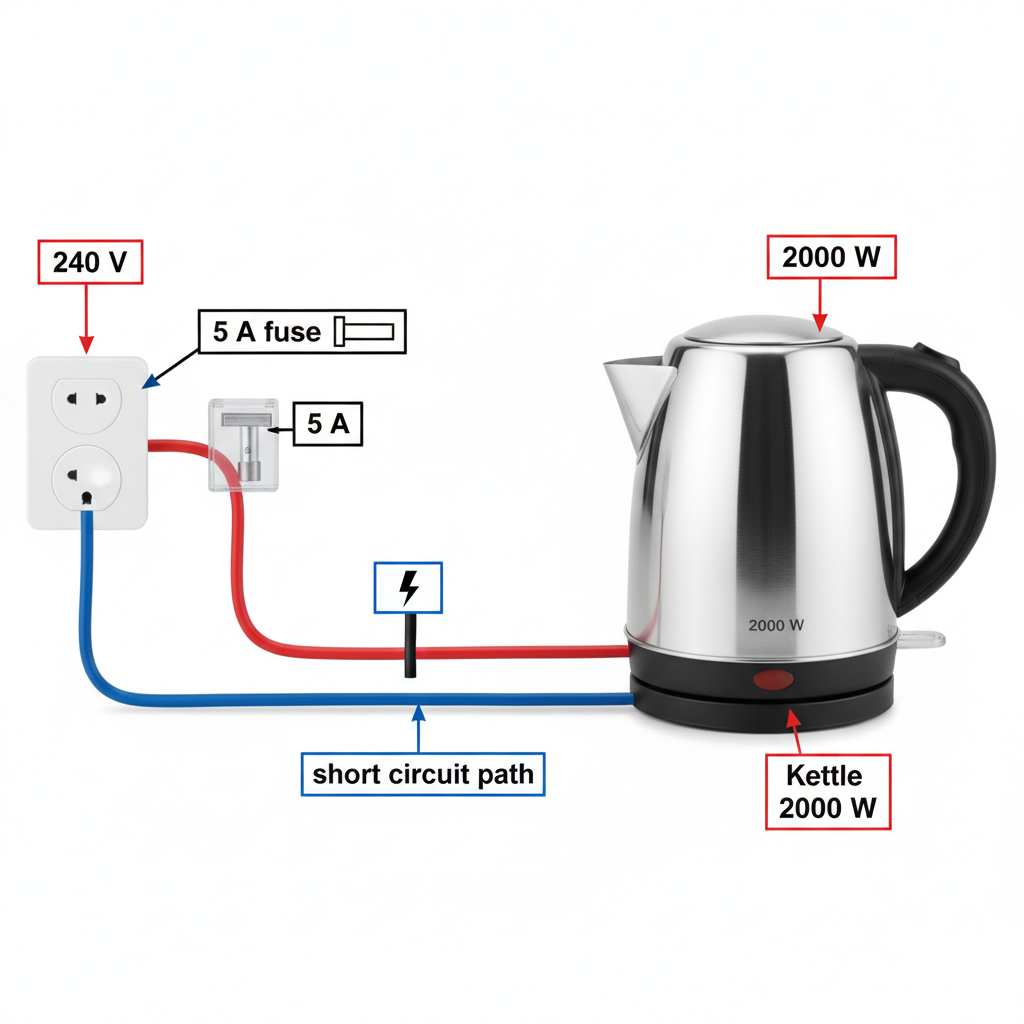
A household circuit contains a 5 A fuse connected to a 240 V kettle rated at 2000 W. A short circuit develops inside the kettle.
a
Calculate the normal operating current of the kettle. [1]
b
Explain why the short circuit causes the fuse to blow. [1]

Solutions
2QuestionDangers of Overloading and Short CircuitsAssessment Practice
4 marks~6 minCriterion C
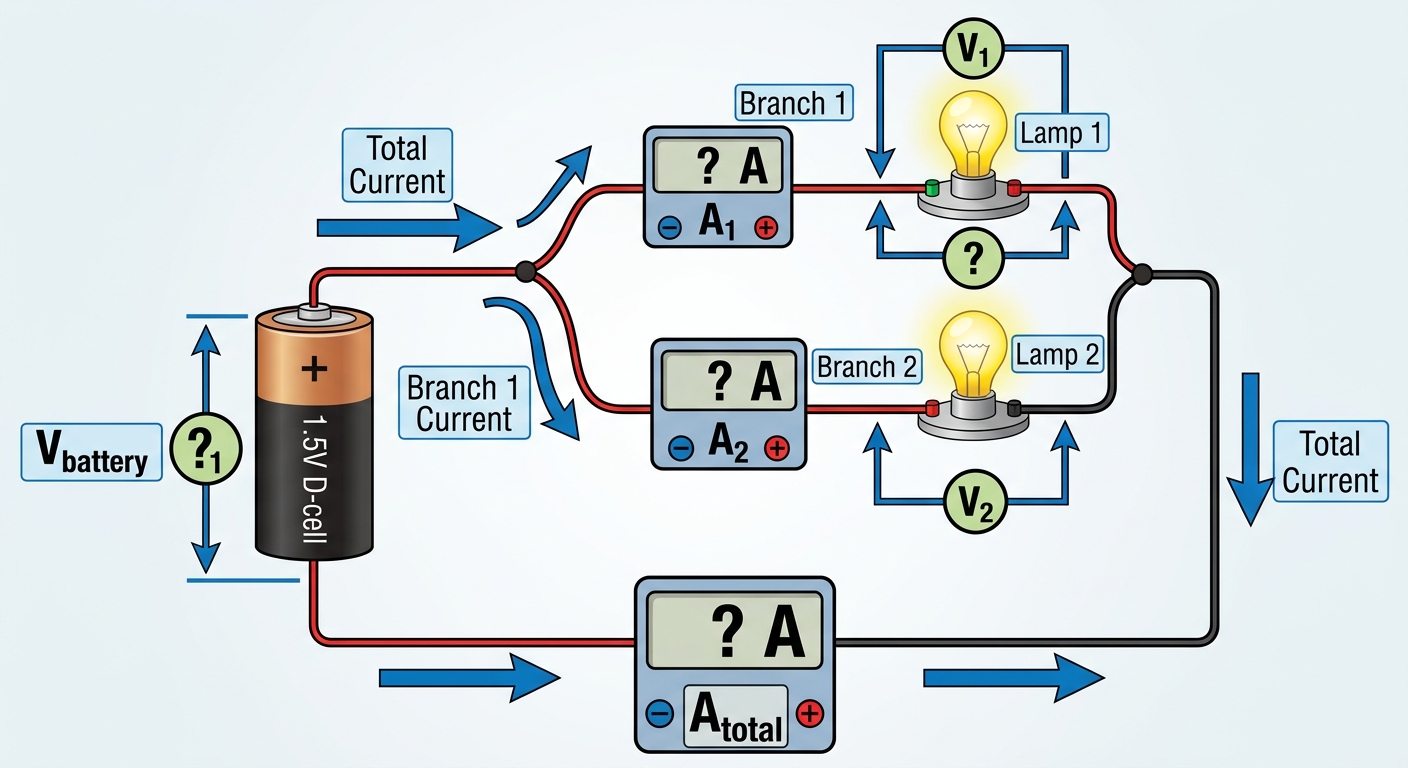
A house is wired so that two lamps, Lamp 1 (60 W) and Lamp 2 (100 W), are connected in parallel across a 230 V mains supply. Each branch has its own switch.
a
State the voltage across each lamp. [1]
b
The total current drawn from the supply is 0.70 A. Lamp 1 draws 0.26 A. Deduce the current through Lamp 2. [1]
c
A student claims that parallel wiring is always preferable to series wiring for domestic appliances. Discuss this claim, referring to at least two electrical properties of parallel circuits. [2]
Solutions
3QuestionHousehold Wiring and Power RatingsAssessment Practice
5 marks~8 minCriterion B
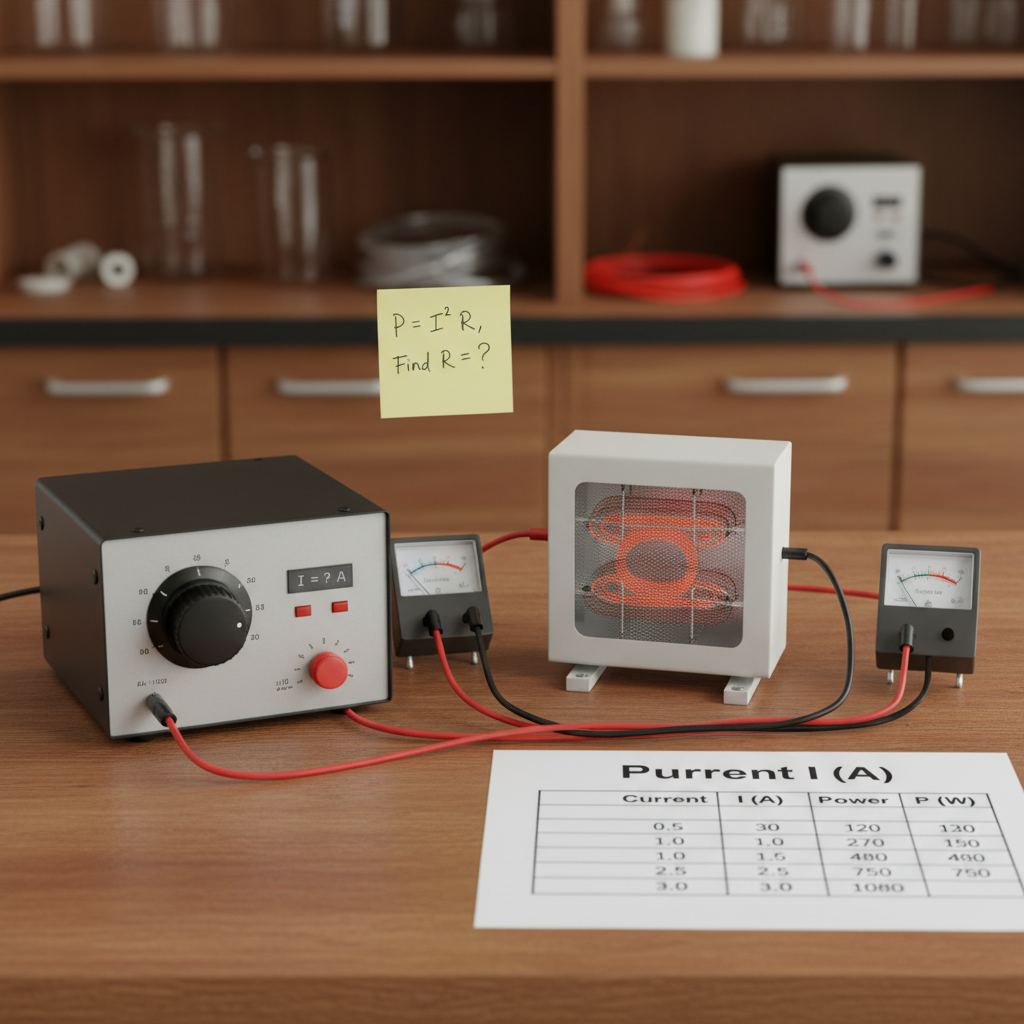
A student investigates a fixed-resistance household heater connected to a variable power supply. Current and power are recorded below.
(A): 0.5, 1.0, 1.5, 2.0, 2.5, 3.0
(W): 30, 120, 270, 480, 750, 1080
(A): 0.5, 1.0, 1.5, 2.0, 2.5, 3.0
(W): 30, 120, 270, 480, 750, 1080
a
Calculate for each data point and show that is proportional to . [2]
b
Use the relationship to determine the resistance of the heater. Show your working and include units. [2]
c
The heater is rated as safe up to 1000 W. Analyse whether operating the heater at A poses a safety risk, and justify your reasoning using your calculated value of . [1]
Solutions
4QuestionDangers of Overloading and Short CircuitsAssessment Practice
6 marks~9 minCriterion D
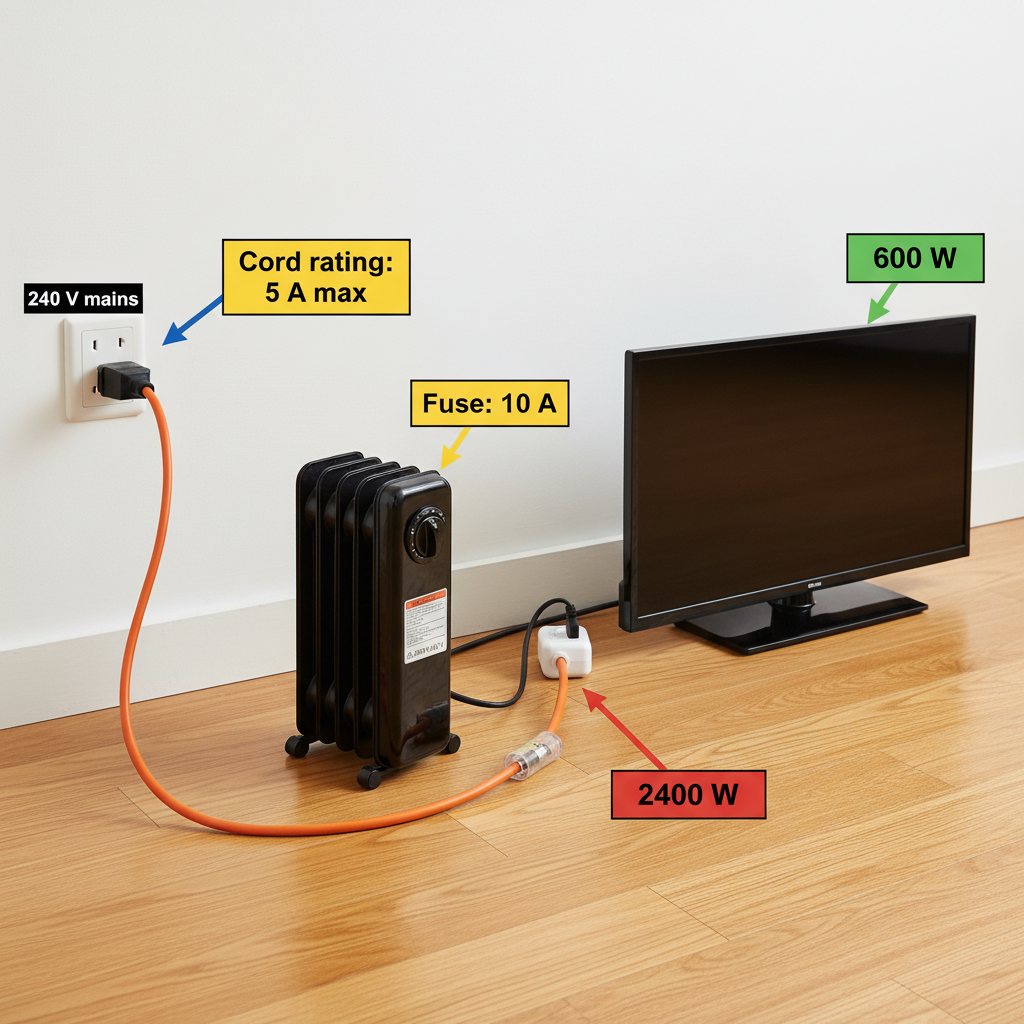
A household extension cord is rated for a maximum current of 5 A. It is protected by a 10 A fuse and powers a 2400 W heater and a 600 W television, both connected to a 240 V mains supply.
a
Calculate the total current drawn by the heater and television when both are operating. [2]
b
Deduce whether the 10 A fuse provides adequate protection for the extension cord. [2]
c
Evaluate the effectiveness of using only a fuse to protect against all electrical hazards in this circuit, referring to both overload and short-circuit conditions. [2]
Solutions
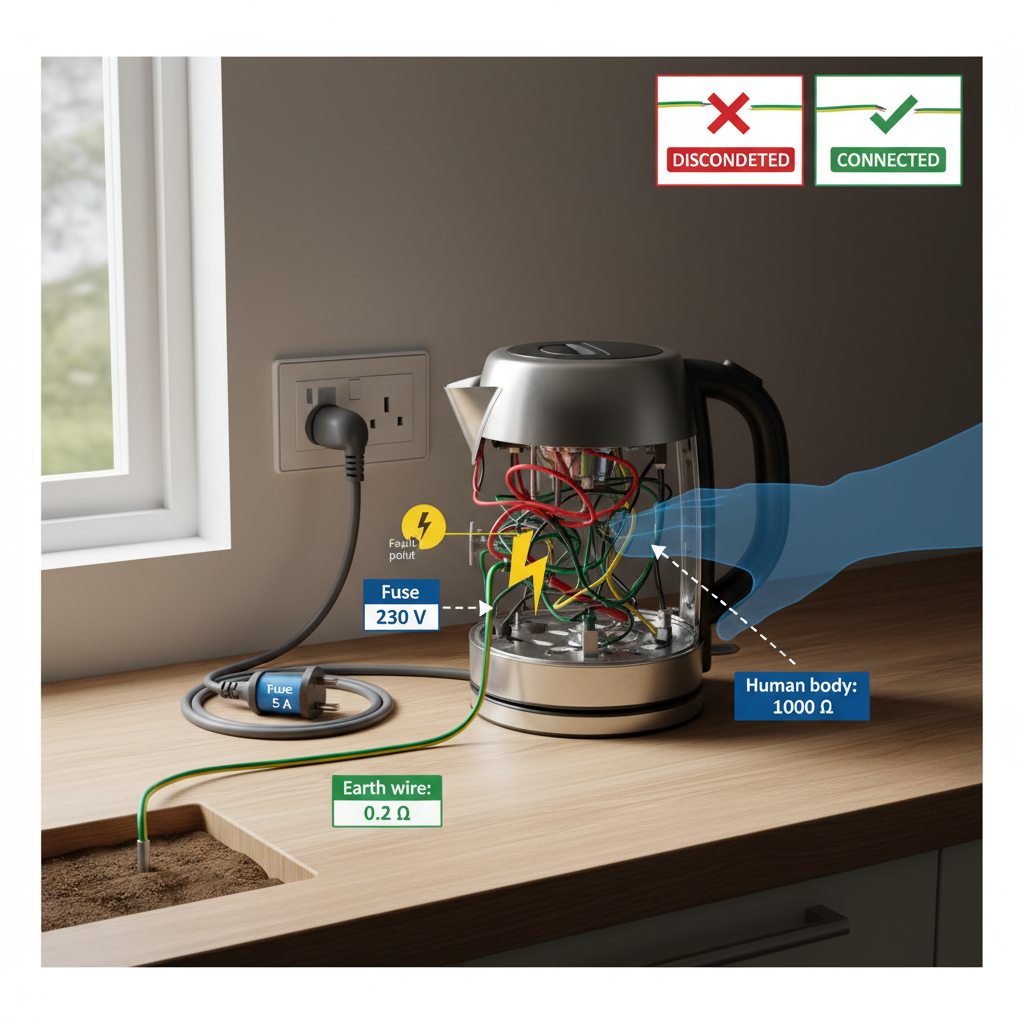
5QuestionEarth Wires and Electrical GroundingAssessment Practice
10 marks~15 minCriterion A
A student investigates the safety of a metal-cased electrical appliance. A fault causes the live wire to touch the metal casing. The circuit contains:
- mains voltage:
- appliance wiring resistance:
- earth wire resistance:
- human body resistance:
- fuse rating: (in the live wire)
- mains voltage:
- appliance wiring resistance:
- earth wire resistance:
- human body resistance:
- fuse rating: (in the live wire)
a
The earth wire is disconnected. A person touches the metal casing and becomes the only path to earth. Calculate the current through the person. [2]
b
The earth wire is reconnected. The earth wire and the person now form two parallel paths between the casing and earth. Calculate the current through the earth wire and the current through the person. Show your working clearly. [3]
c
Using your results from (a) and (b), analyse why connecting the earth wire protects the user. In your answer, refer to the path of least resistance, current division, and the fuse rating. [5]
Solutions
That's every free question here — 5 of 77.
+72 more questions, plus Mock Papers & Worksheets, are waiting in Premium.