You're viewing free preview questions — 6 questions previewing here — subscribe to unlock 70 more, plus the Full Question Bank, Mock Papers & Worksheets.Upgrade
Back

Balanced and unbalanced forces — Free MYP4 Physics Practice Questions

Free questions

Open in full, with answers, mark scheme and examiner insights.

Question 1Criterion A · Band 1-2 · Easy · 4 marksrevisionprep.com

Identifying Balanced and Unbalanced Force Scenarios
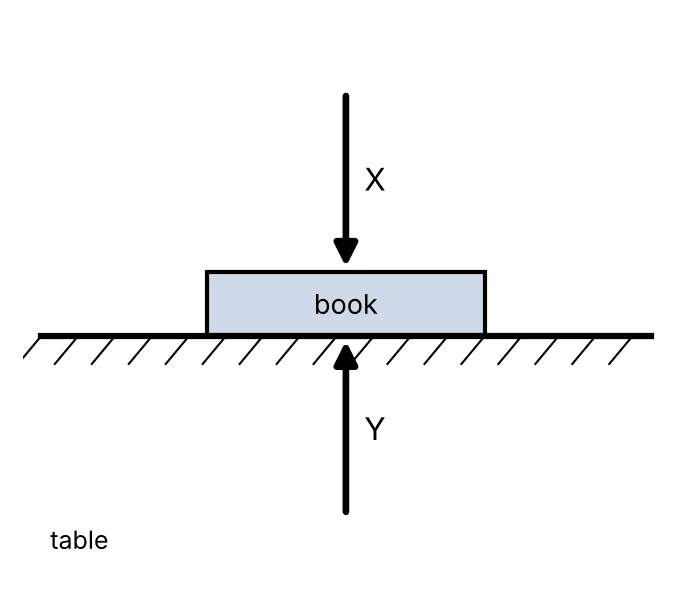
The diagram shows a textbook of mass 1.2 kg resting on a horizontal desk. Two forces, X and Y, act on the book. Take g=9.8 N kg−1g = 9.8\ \text{N kg}^{-1}.
Question diagram
(a)
Identify forces X and Y and state the object that exerts each force. [2]Criterion A (i) · Level 1-2
(b)
Calculate the size of each force. [1]Criterion A (ii) · Level 1-2
(c)
State why X and Y are not a Newton's third law pair. [1]Criterion A (ii) · Level 1-2

revisionprep.com

Summary Answer

Not available for this question.

Model Answer

Not available for this question.

Marking Scheme

Not available for this question.

Examiner Insights

Not available for this question.

Question 2Criterion A + C · Band 1-4 · Easy · 6 marksrevisionprep.com

Friction and Its Role in Balance

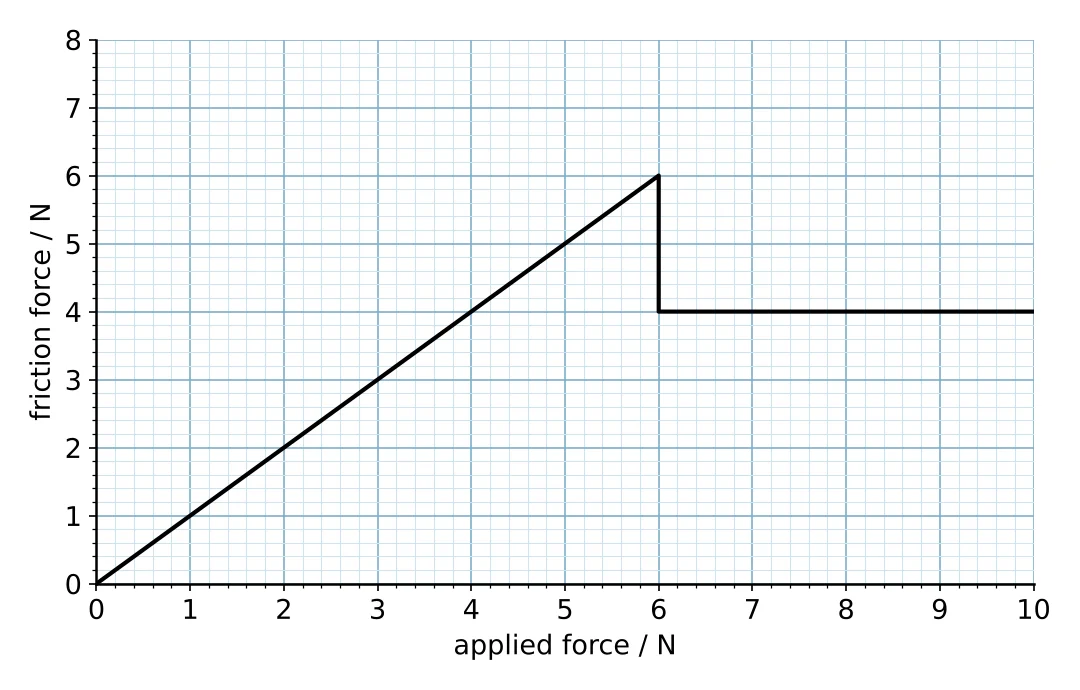
A box of mass 2.0 kg rests on a horizontal surface. The applied horizontal force on it is slowly increased from 0 to 10 N. The graph shows how the friction force changes.
Question diagram
(a)
State the maximum static friction force. [1]Criterion C (ii) · Level 1-2
(b)
State the kinetic friction force. [1]Criterion C (ii) · Level 1-2
(c)
Explain why the friction force equals the applied force for applied forces below 6.0 N. [2]Criterion A (i) · Level 3-4
(d)
Calculate the acceleration of the box when the applied force is 9.0 N. [2]Criterion A (ii) · Level 3-4

revisionprep.com

Summary Answer

Not available for this question.

Model Answer

Not available for this question.

Marking Scheme

Not available for this question.

Examiner Insights

Not available for this question.

Question 3Criterion C + A · Band 3-6 · Medium · 8 marksrevisionprep.com

Motion of Objects Under Balanced Forces

A trolley rolls down a ramp of fixed angle. A friction pad is adjusted so that the trolley always moves down the ramp at constant velocity. The table shows the friction force needed for different total masses.
(a)
Plot a graph of friction force against total mass. [3]Criterion C (i) · Level 3-4
(b)
Determine the gradient of your graph and write an equation linking the friction force FF to the mass mm. [2]Criterion C (ii) · Level 3-4
(c)
Explain why the friction force must increase in proportion to the mass for the velocity to stay constant. [2]Criterion A (i) · Level 5-6
(d)
Predict the friction force needed for a total mass of 0.60 kg. [1]Criterion C (ii) · Level 3-4

revisionprep.com

Summary Answer

Not available for this question.

Model Answer

Not available for this question.

Marking Scheme

Not available for this question.

Examiner Insights

Not available for this question.

Question 4Criterion A · Band 3-6 · Medium · 6 marksrevisionprep.com

Calculating resultant force

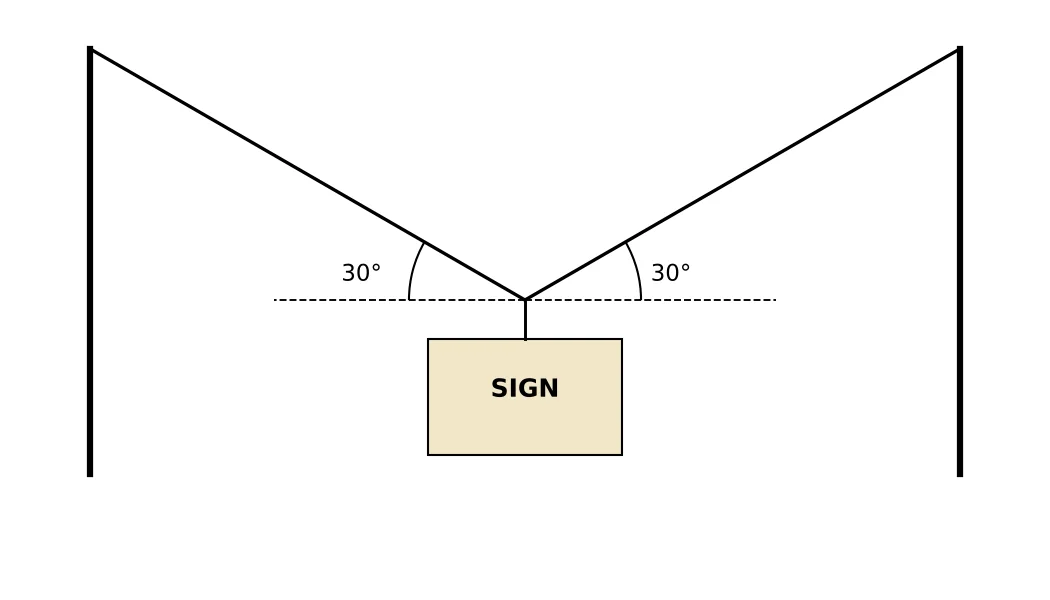
The diagram shows a sign of weight 120 N hanging at rest from two identical ropes, one on each side. Each rope makes an angle of 30° with the horizontal.
Question diagram
(a)
Explain why the vertical components of the tensions in the two ropes must add up to 120 N. [2]Criterion A (iii) · Level 3-4
(b)
Calculate the vertical component of the tension in each rope. [2]Criterion A (ii) · Level 3-4
(c)
The ropes are tightened so that each makes an angle of 10° with the horizontal. The vertical component of each tension must still be 60 N. Explain why each tension is now much larger than before. [2]Criterion A (iii) · Level 5-6

revisionprep.com

Summary Answer

Not available for this question.

Model Answer

Not available for this question.

Marking Scheme

Not available for this question.

Examiner Insights

Not available for this question.

Question 5Criterion B + C · Band 5-8 · Challenge · 10 marksrevisionprep.com

Identifying Balanced and Unbalanced Force Scenarios
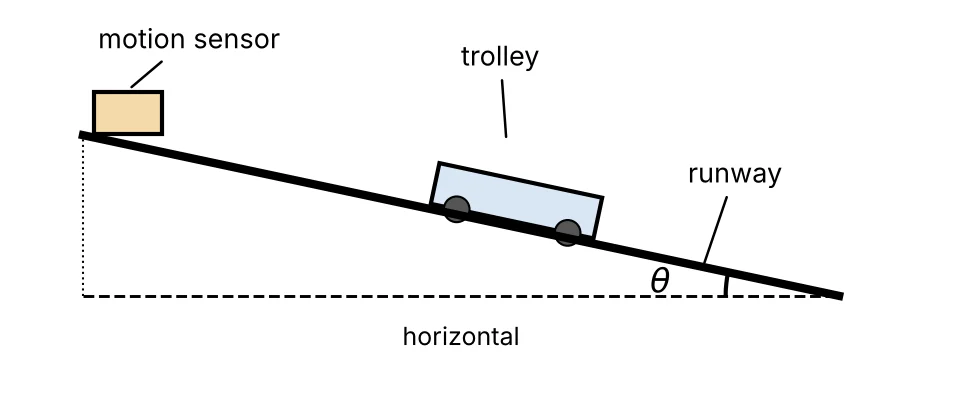
A student wants to find the tilt of a runway at which a trolley, given a gentle push, rolls down at constant velocity. At that tilt the forces on the trolley are balanced. A motion sensor at the top of the runway records the velocity of the trolley, and she reads the angle θ\theta of the runway with a protractor. She wants to find out whether adding mass to the trolley changes the angle needed. The trolley has a mass of 0.50 kg and she has four 0.25 kg masses.

Added mass (kg)00.250.500.751.00Angle θ (°)4.14.33.94.24.0\begin{array}{|l|c|c|c|c|c|}\hline \text{Added mass (kg)} & 0 & 0.25 & 0.50 & 0.75 & 1.00 \\ \hline \text{Angle $\theta$ (°)} & 4.1 & 4.3 & 3.9 & 4.2 & 4.0 \\ \hline\end{array}
Question diagram
(a)
Formulate a hypothesis for how the angle θ\theta will change as mass is added to the trolley. Explain your hypothesis using scientific reasoning. [2]Criterion B (ii) · Level 5-6
(b)
Identify the independent variable, the dependent variable and two control variables. State how she will decide that the trolley is moving at constant velocity. [3]Criterion B (iii) · Level 5-6
(c)
Describe how she should collect enough data to test the hypothesis and make the results reliable. [2]Criterion B (iv) · Level 5-6
(d)
The table shows her results. The protractor can be read to the nearest 0.5°. Evaluate whether the results support your hypothesis in (a), and give one reason why this method might not show a small effect of mass. [3]Criterion C (iii), C (iv) · Level 7-8

revisionprep.com

Summary Answer

Not available for this question.

Model Answer

Not available for this question.

Marking Scheme

Not available for this question.

Examiner Insights

Not available for this question.

Question 6Criterion D + A · Band 3-8 · Challenge · 10 marksrevisionprep.com

Effect of Unbalanced Forces on Motion

A freight train travels at 25 m s⁻¹ along a straight track that crosses a road at a level crossing. The table shows hypothetical data for the train.

QuantityValueMass of train (kg)2000000Maximum braking force (N)400000\begin{array}{|l|c|}\hline \text{Quantity} & \text{Value} \\ \hline \text{Mass of train (kg)} & 2000000 \\ \hline \text{Maximum braking force (N)} & 400000 \\ \hline\end{array}
(a)
Calculate the greatest deceleration of the train. [2]Criterion A (ii) · Level 3-4
(b)
Calculate the time the train takes to stop from 25 m s⁻¹ and the distance it travels while stopping. Use the average speed of the train. [3]Criterion D (i) · Level 5-6
(c)
The driver sees a car stopped on the level crossing 500 m ahead. Explain, using your answers, what happens, and why this makes level crossings dangerous. [2]Criterion D (i) · Level 5-6
(d)
A town must make a busy level crossing safer. Its options are (1) a bridge over the track, (2) automatic barriers with flashing lights, or (3) a lower train speed limit. Evaluate these options from two different perspectives and make a justified recommendation. [3]Criterion D (ii), D (iii) · Level 7-8

revisionprep.com

Summary Answer

Not available for this question.

Model Answer

Not available for this question.

Marking Scheme

Not available for this question.

Examiner Insights

Not available for this question.

That's every free question here — 6 of 76.

+70 more questions, plus Mock Papers & Worksheets, are waiting in Premium.

Upgrade