You're viewing free preview questions — 5 questions previewing here — subscribe to unlock 98 more, plus the Full Question Bank, Mock Papers & Worksheets.Upgrade
Balanced vs Unbalanced Forces — Free MYP4 Physics Practice Questions

1QuestionCalculating Net Force in One and Two DimensionsAssessment Practice
6 marks~9 minCriterion B
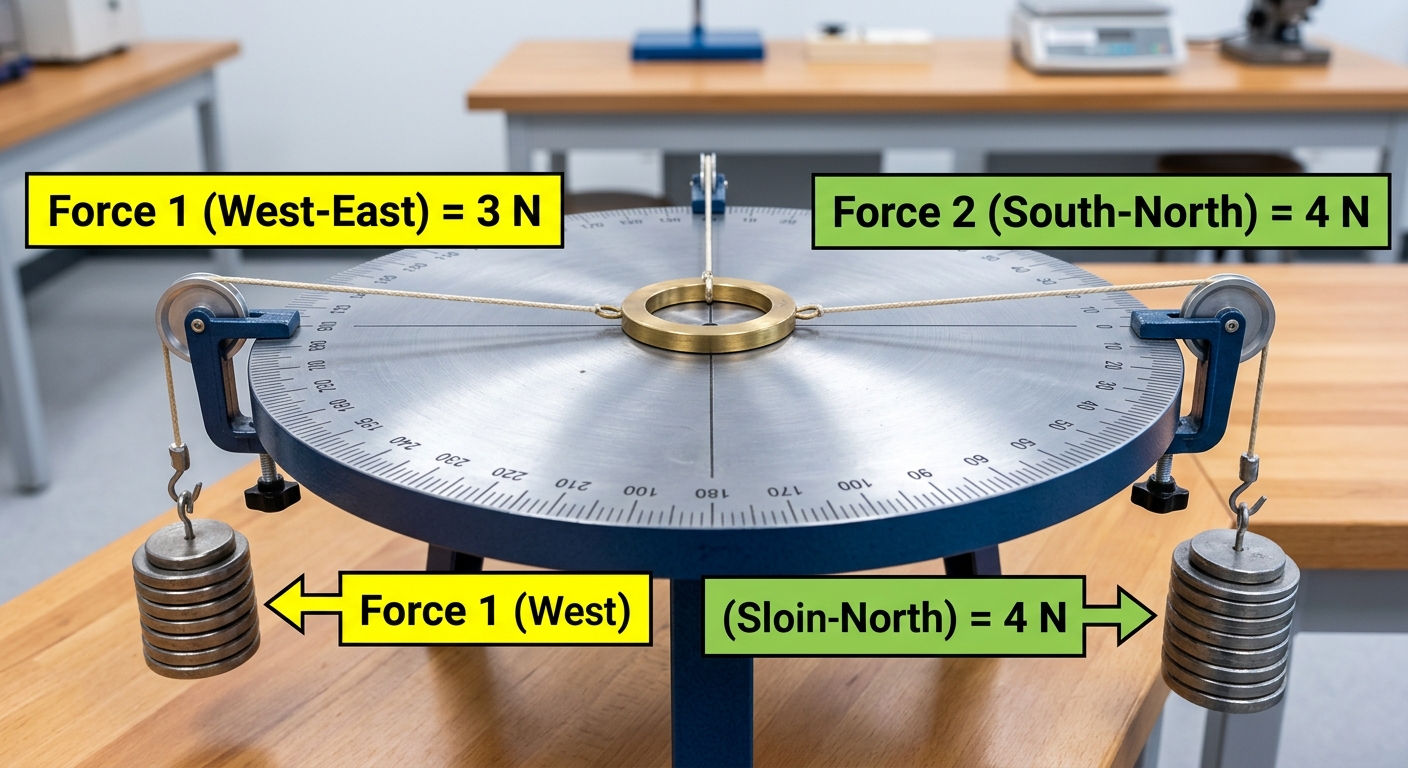
A student uses a force table to investigate how two perpendicular forces combine. Forces are applied to a central ring, and the resultant magnitude is measured. The recorded data are:
| Force (N) | 3 | 6 | 5 | 9 |
|---|---|---|---|---|
| Force (N) | 4 | 8 | 12 | 12 |
| Resultant (N) | 5 | 10 | 13 | 15 |
a
Analyse the data to deduce the mathematical relationship between , , and . Support your answer with calculations from at least two data sets. [2]
b
Apply your relationship to predict the resultant force when perpendicular forces of 8 N and 15 N act on the ring. Show your substitution and result. [2]
c
A technician claims that doubling both perpendicular forces always doubles the resultant. Evaluate this claim using your relationship, and state whether the claim holds for all pairs of perpendicular forces or only for specific cases. [2]

Solutions
2QuestionHooke's Law and turning effectAssessment Practice
9 marks~14 minCriterion C
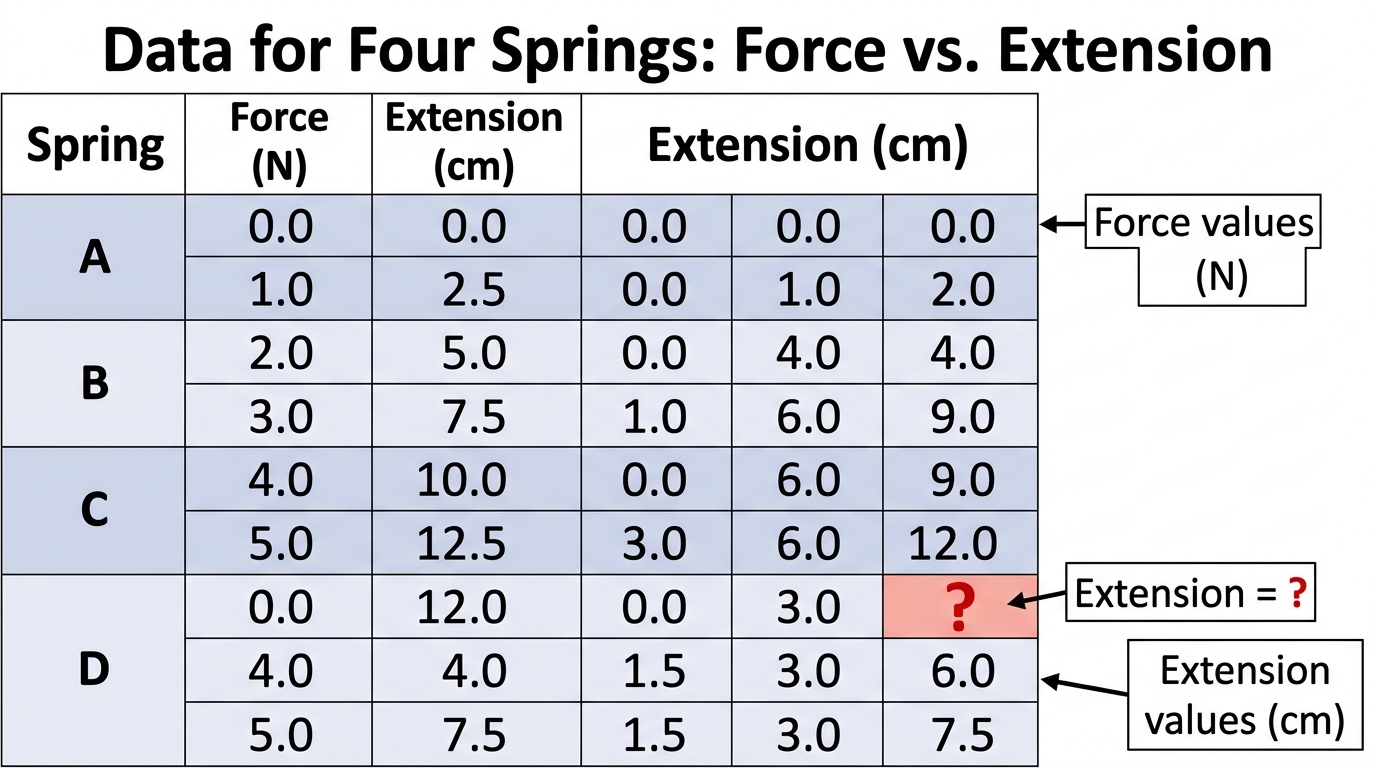
A student investigates how three springs (A, B, C) stretch under applied forces by hanging masses and measuring extension with a ruler.
Spring A — Force (N): 0.0, 1.0, 2.0, 3.0, 4.0, 5.0 | Extension (cm): 0.0, 2.5, 5.0, 7.5, 10.0, 12.5
Spring B — Force (N): 0.0, 1.0, 2.0, 3.0, 4.0, 5.0 | Extension (cm): 0.0, 1.0, 4.0, 9.0, 16.0, 25.0
Spring C — Force (N): 0.0, 1.0, 2.0, 3.0, 4.0, 5.0 | Extension (cm): 0.0, 3.0, 6.0, 9.0, 12.0, 15.0
Spring A — Force (N): 0.0, 1.0, 2.0, 3.0, 4.0, 5.0 | Extension (cm): 0.0, 2.5, 5.0, 7.5, 10.0, 12.5
Spring B — Force (N): 0.0, 1.0, 2.0, 3.0, 4.0, 5.0 | Extension (cm): 0.0, 1.0, 4.0, 9.0, 16.0, 25.0
Spring C — Force (N): 0.0, 1.0, 2.0, 3.0, 4.0, 5.0 | Extension (cm): 0.0, 3.0, 6.0, 9.0, 12.0, 15.0
a
Construct a graph of extension (cm) against force (N) for all three springs on the same axes. [3]
b
Calculate the spring constant (in N/cm) for Spring A. Show your working. [2]
c
A fourth spring, Spring D, has a spring constant of N/cm. Using Hooke's law, calculate the extension of Spring D when a force of 3.5 N is applied. Then evaluate whether Spring B could be described by the same law at 3.5 N, justifying your answer with reference to your graph and the pattern in Spring B's data. [4]
Solutions
3QuestionHooke's Law and turning effectAssessment Practice
10 marks~15 minCriterion C
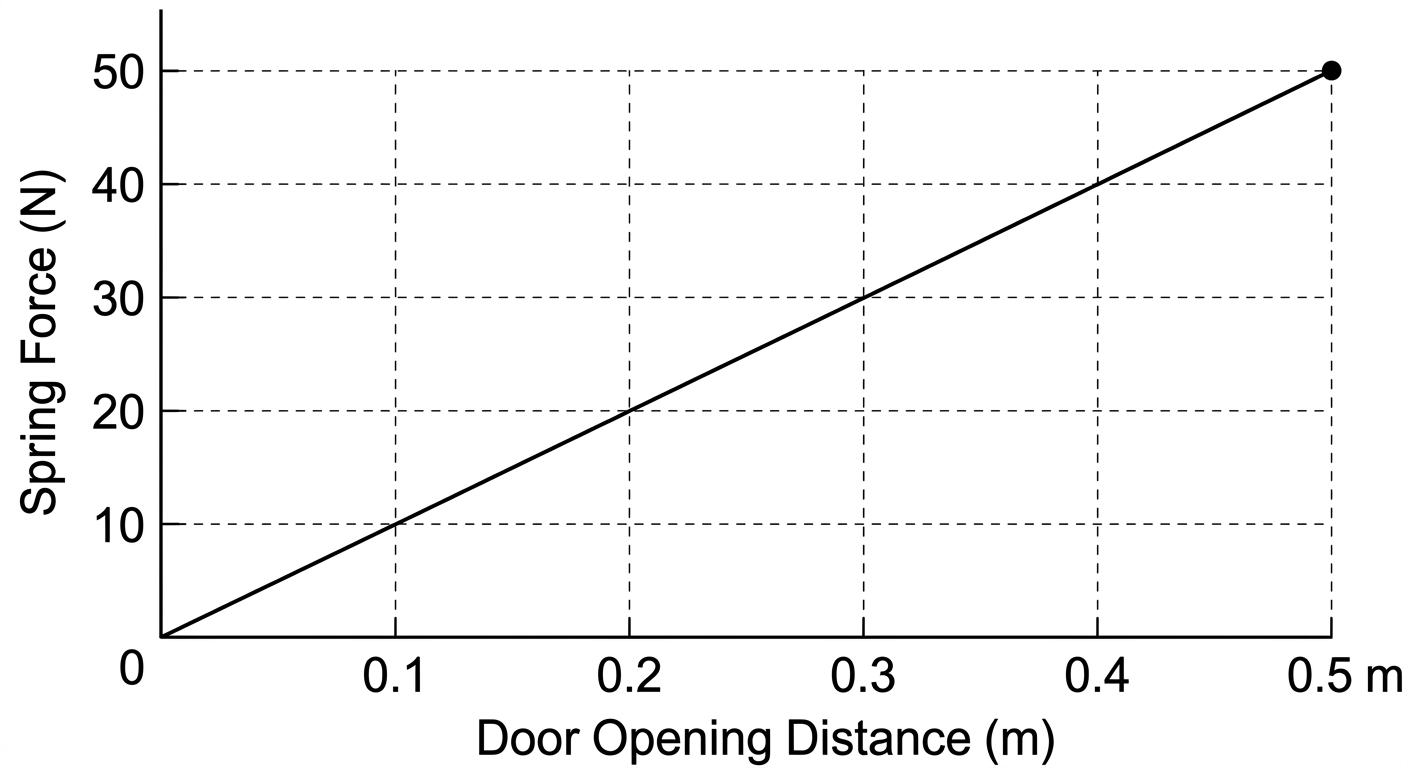
A spring-loaded door closer resists opening by compressing a spring. The graph below shows the spring force as a function of door opening distance.
The force is applied at 0.8 m from the hinge. Assume the hinge is frictionless and the spring force acts perpendicular to the door throughout.
The force is applied at 0.8 m from the hinge. Assume the hinge is frictionless and the spring force acts perpendicular to the door throughout.
a
State Hooke's Law and use the graph to determine the spring constant , including units. [3]
b
Calculate the torque exerted on the door when the spring is compressed by 0.5 m. Show your working. [3]
c
A student claims: "Because the spring force increases linearly with compression, the torque must also increase linearly as the door opens." Evaluate this claim, considering how the angle between the spring force and the door changes as the door opens wider. [4]
Solutions
4QuestionIdentifying Balanced and Unbalanced Force ScenariosAssessment Practice
12 marks~18 minCriterion A
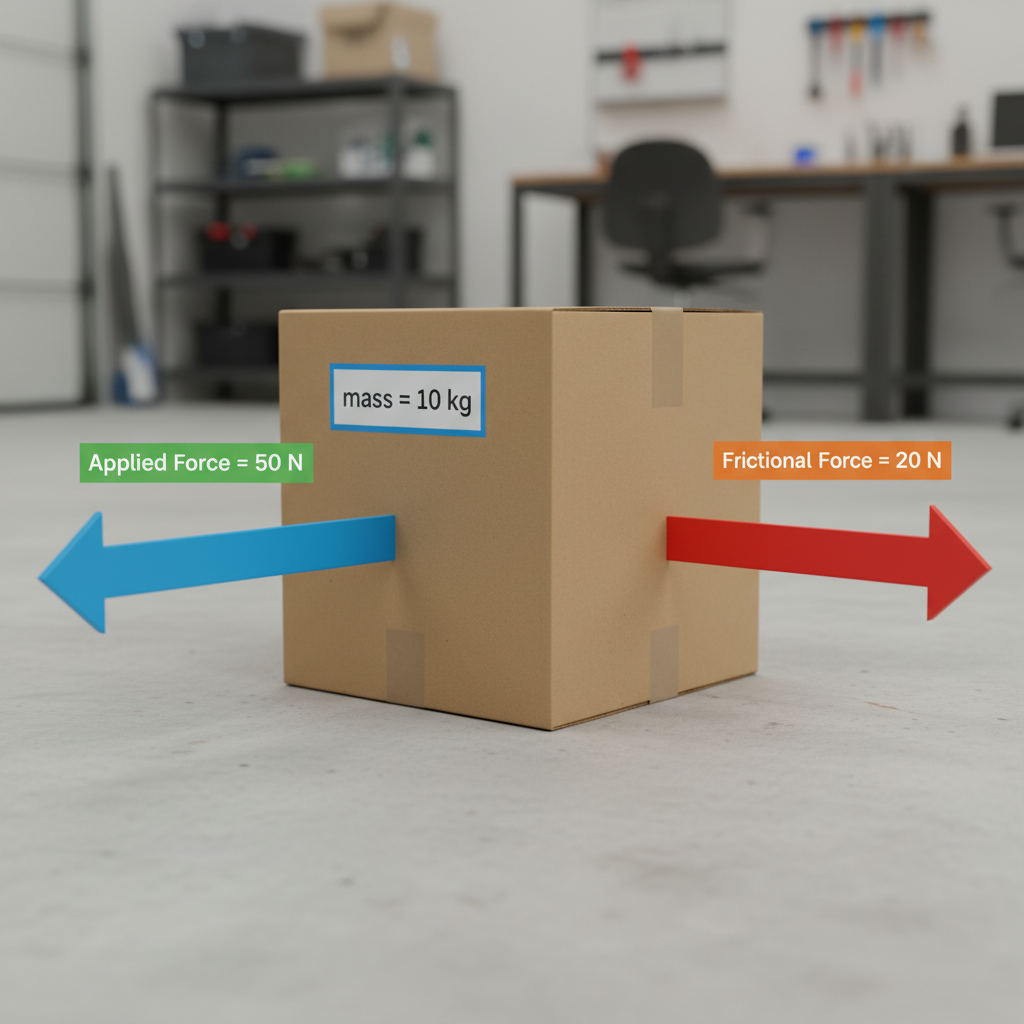
A 10 kg storage crate is pushed horizontally across a warehouse floor. Two horizontal forces act on it:
- Applied force to the right
- Frictional force to the left
The crate starts from rest.
- Applied force to the right
- Frictional force to the left
The crate starts from rest.
a
Deduce the net horizontal force acting on the crate, including its direction. [2]
b
Calculate the acceleration of the crate during the first 3 seconds, stating its direction. [3]
c
At , the applied force is removed. Analyse how the motion of the crate changes after this moment, justifying your answer with Newton's laws and a calculation of the new acceleration. [7]
Solutions
5QuestionHooke's Law and turning effectAssessment Practice
12 marks~18 minCriterion D
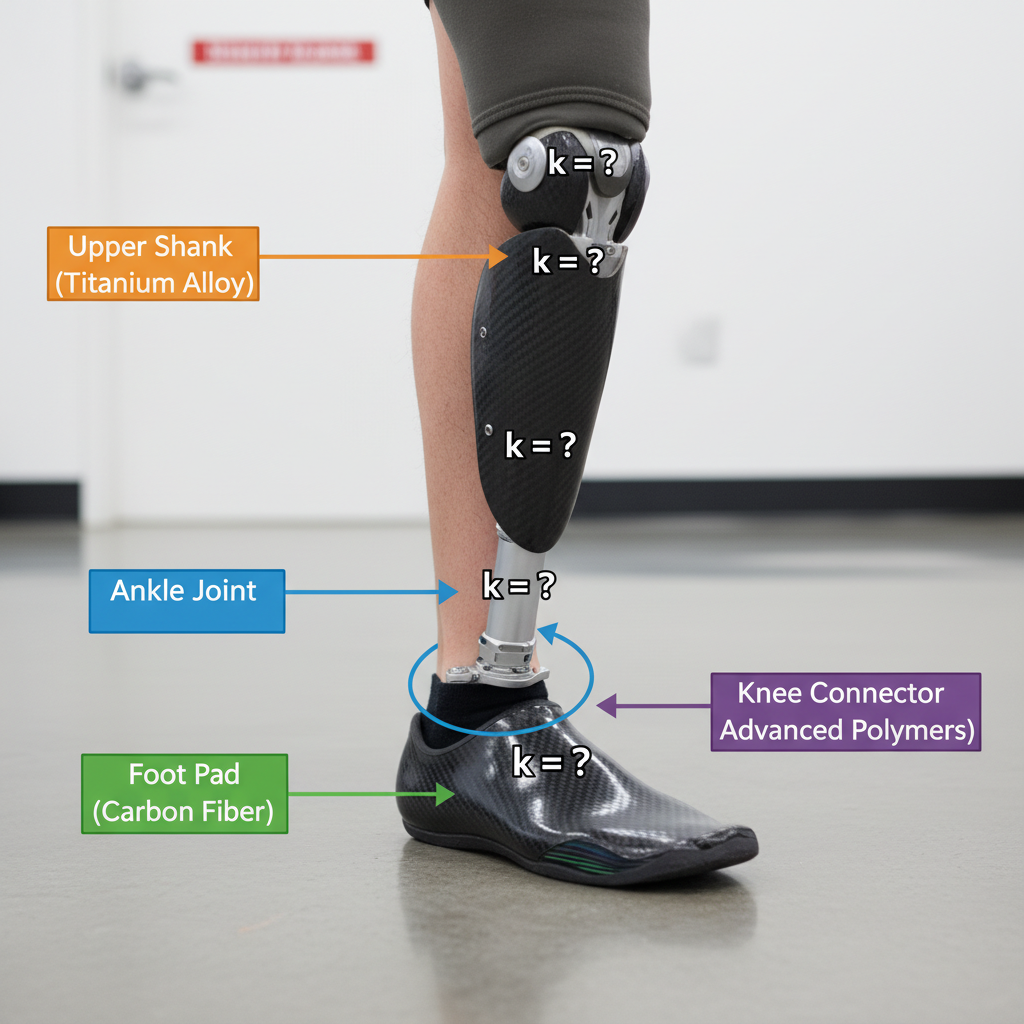
A sports-medicine engineer is designing a running blade prosthetic for a below-knee amputee. The blade is modelled as a spring with spring constant . During a stride, the blade compresses by under the athlete's weight. Carbon-fibre blades cost approximately 15 000 dollars; polypropylene alternatives cost approximately 800 dollars but have a lower, less tunable .
a
State Hooke's Law and calculate the restoring force the blade exerts during compression. [2]
b
Analyse how the choice of spring constant influences both the biomechanical performance and the manufacturing cost of a prosthetic running blade. [4]
c
Evaluate the ethical and environmental implications of the cost gap between carbon-fibre and polypropylene prosthetic blades, considering equity of access and the environmental impact of each material across its full lifecycle. [6]
Solutions
That's every free question here — 5 of 103.
+98 more questions, plus Mock Papers & Worksheets, are waiting in Premium.