You're viewing free preview questions — 5 questions previewing here — subscribe to unlock 58 more, plus the Full Question Bank, Mock Papers & Worksheets.Upgrade
Friction Air Resistance and Terminal Velocity — Free MYP4 Physics Practice Questions

1QuestionTerminal Velocity in Free Fall - Basic LevelConcept Practice
2 marks~3 minCriterion D
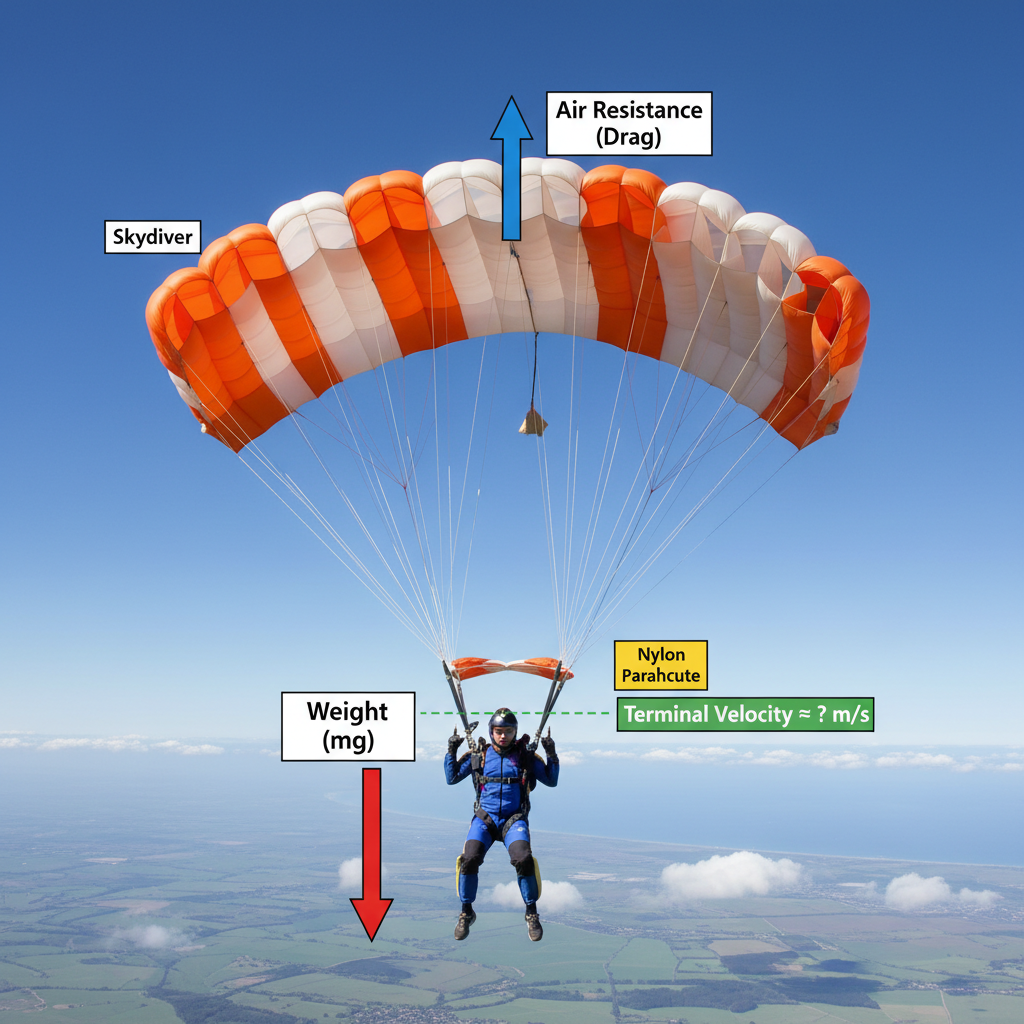
A skydiver jumps from an airplane and uses a parachute to slow their descent. The parachute is made of nylon, a synthetic material. Outline one potential environmental impact associated with the production or disposal of nylon parachutes.

Solutions
2QuestionApplications in Engineering and SportsAssessment Practice
3 marks~5 minCriterion A
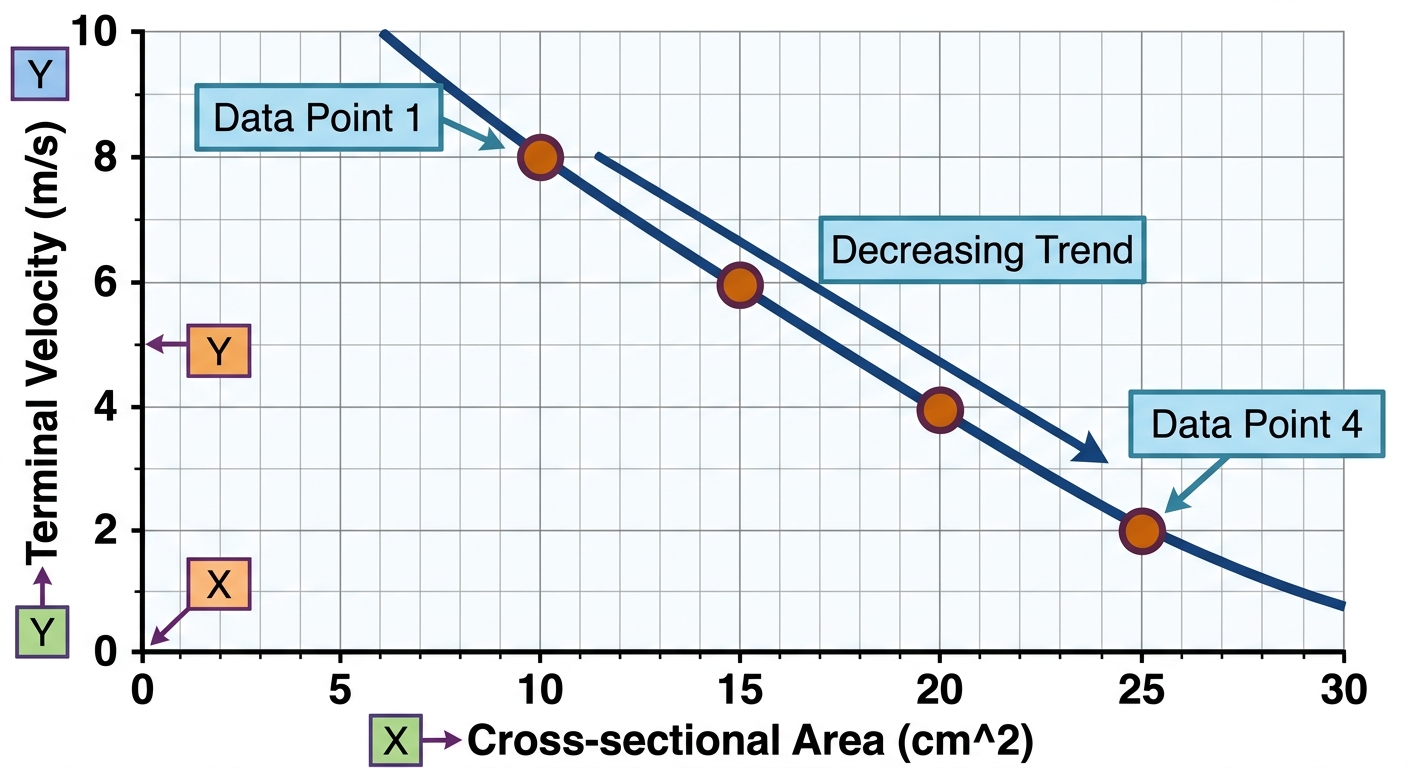
A badminton shuttlecock falls vertically from rest. A graph of cross-sectional area against terminal velocity shows that as cross-sectional area increases, terminal velocity decreases.
Explain why a shuttlecock with a larger cross-sectional area reaches a lower terminal velocity. [3]
Explain why a shuttlecock with a larger cross-sectional area reaches a lower terminal velocity. [3]
Solutions
3QuestionTerminal Velocity in Free Fall - Basic LevelConcept Practice
2 marks~3 minCriterion A
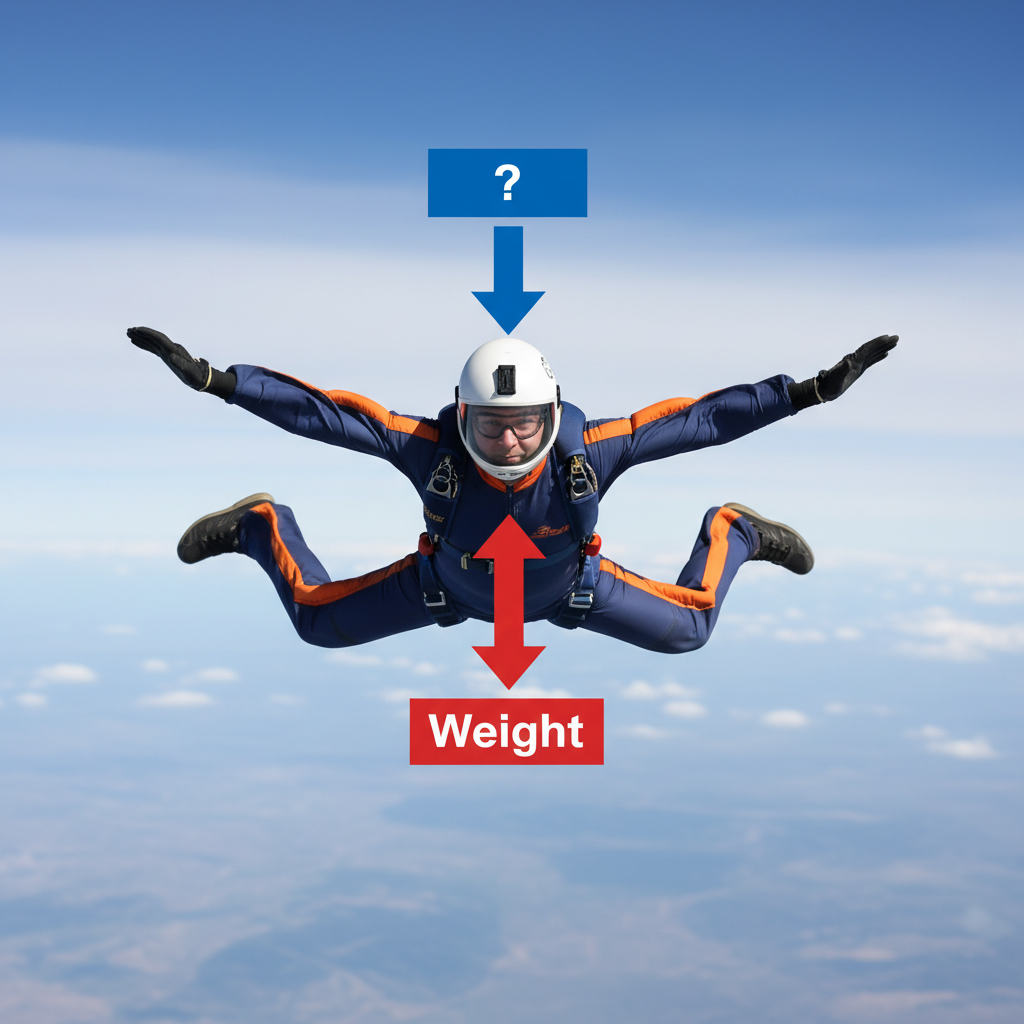
A skydiver falls vertically. A diagram shows two forces acting on the skydiver: a downward arrow labelled weight and an upward arrow labelled F.
a
Identify the force F. [1]
b
The skydiver reaches terminal velocity. Explain why the skydiver's acceleration is zero at this point. [1]
Solutions
4QuestionTerminal Velocity in Free Fall - Basic LevelAssessment Practice
12 marks~18 minCriterion C
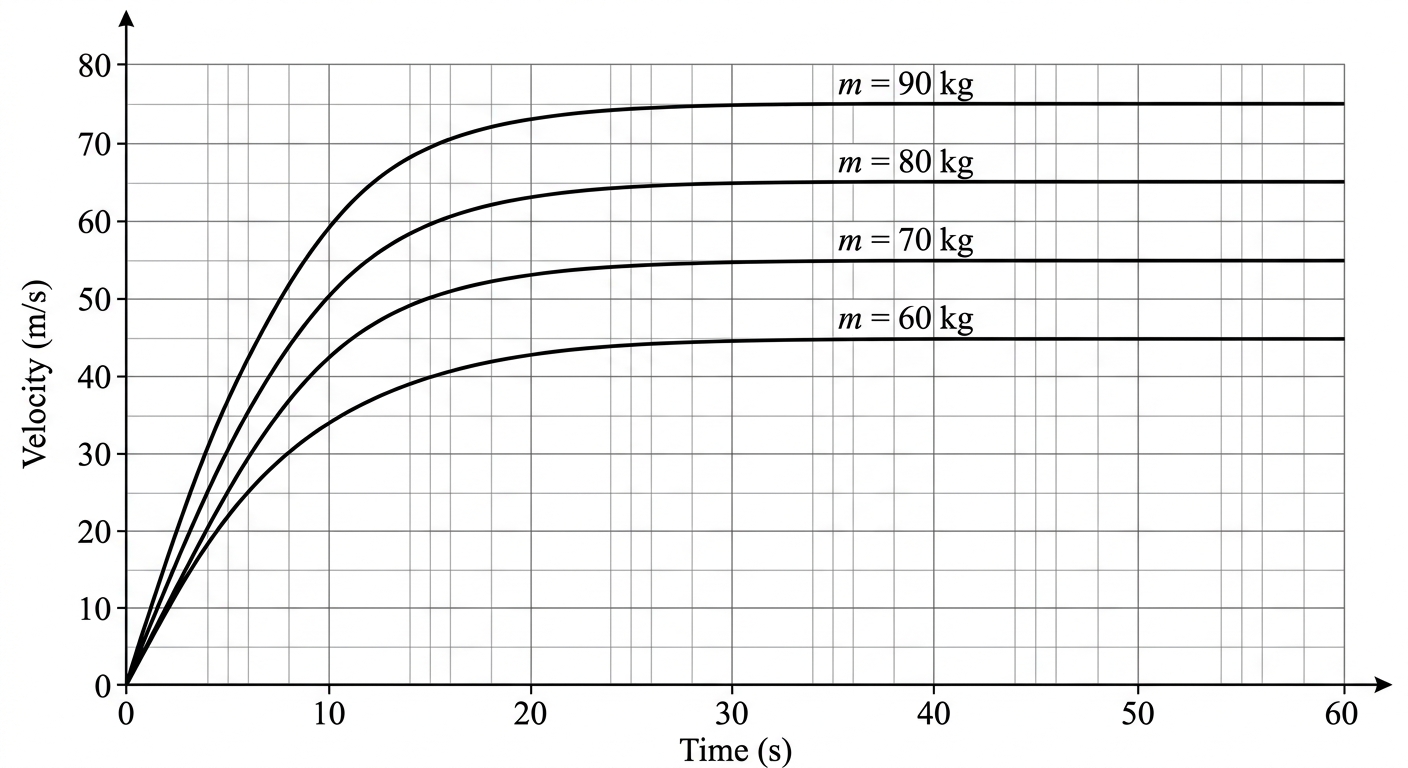
Four skydivers of different masses jump simultaneously from the same aircraft at the same altitude. A classmate claims that all skydivers must reach the same terminal velocity because gravitational acceleration is identical for all falling objects. The velocity–time graph shows each skydiver's motion from the moment of jumping until they open their parachutes. All skydivers adopt the same body position throughout free fall.
a
Explain why a skydiver reaches terminal velocity during free fall. [3]
b
Interpret the graph to evaluate the classmate's claim. [4]
c
Analyse how a skydiver could use body position to deliberately alter their terminal velocity during a jump, referring to the forces involved. [5]
Solutions
5QuestionApplications in Engineering and SportsAssessment Practice
12 marks~18 minCriterion D
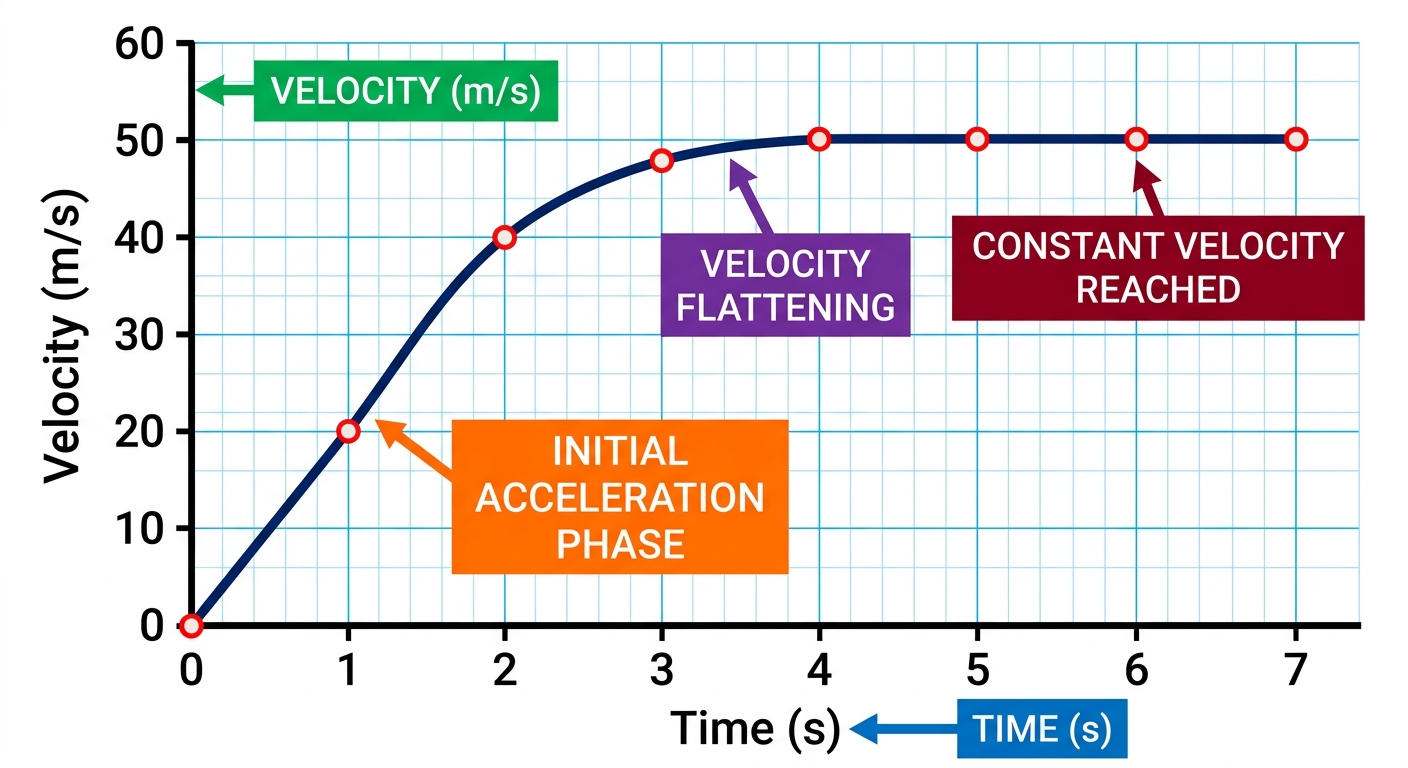
A skydiver of mass 75 kg jumps from a stationary aircraft. The table below shows the skydiver's velocity at one-second intervals. Air resistance is not negligible. .
| Time (s) | 0 | 1 | 2 | 3 | 4 | 5 | 6 | 7 |
|---|---|---|---|---|---|---|---|---|
| Velocity (m s) | 0 | 20 | 40 | 48 | 50 | 50 | 50 | 50 |
a
Calculate the skydiver's acceleration during the first two seconds and explain why this value is less than . [3]
b
Analyse how the forces acting on the skydiver change between s and s, and deduce the magnitude of the air resistance force at terminal velocity. [5]
c
Evaluate how well the data supports the physics model of terminal velocity. In your evaluation, consider whether terminal velocity has been reached, what the data reveals about the relationship between speed and air resistance, and at least one limitation of the dataset. [4]
Solutions
That's every free question here — 5 of 63.
+58 more questions, plus Mock Papers & Worksheets, are waiting in Premium.