You're viewing free preview questions — 6 questions previewing here — subscribe to unlock 59 more, plus the Full Question Bank, Mock Papers & Worksheets.Upgrade
Back

Momentum — Free MYP4 Physics Practice Questions

Free questions

Open in full, with answers, mark scheme and examiner insights.

Question 1Criterion A · Band 3-4 · Easy · 4 marksrevisionprep.com

Momentum: p = mv

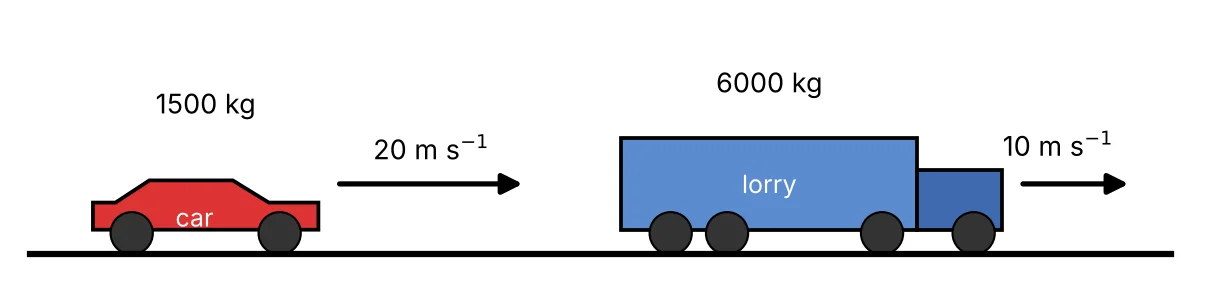
A car and a lorry travel along a straight road in the same direction. Their masses and velocities are shown.
Question diagram
(a)
Calculate the momentum of the car. [2]Criterion A (ii) · Level 3-4
(b)
Calculate the momentum of the lorry and state how many times greater it is than the momentum of the car. [2]Criterion A (ii) · Level 3-4

revisionprep.com

Summary Answer

Not available for this question.

Model Answer

Not available for this question.

Marking Scheme

Not available for this question.

Examiner Insights

Not available for this question.

Question 2Criterion A + C · Band 3-4 · Easy · 4 marksrevisionprep.com

Force and rate of change of momentum; crumple zones, airbags and seat belts
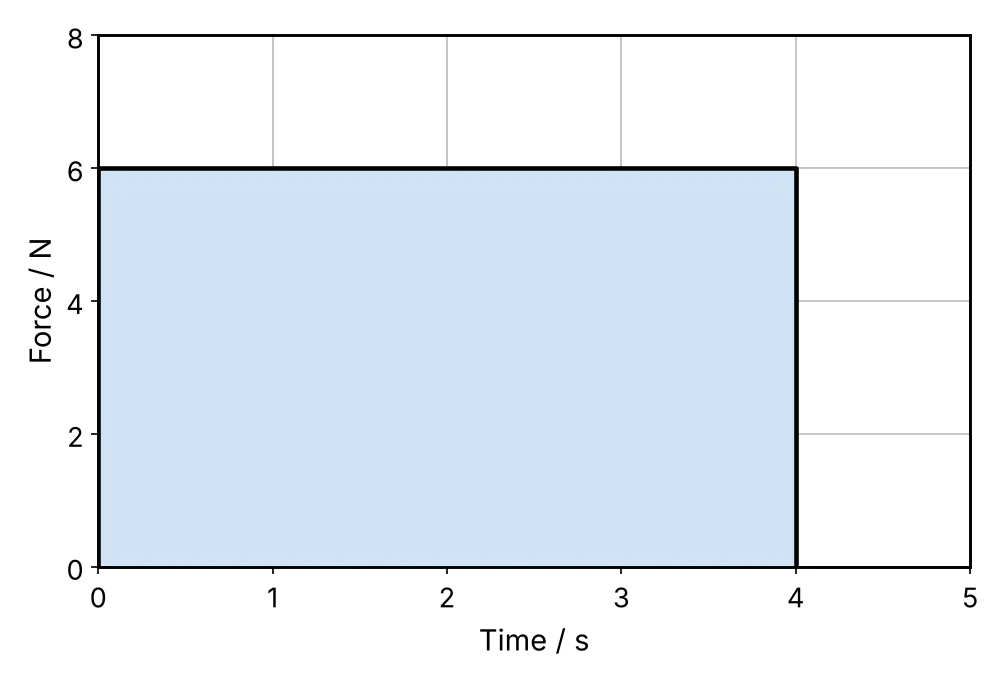
A constant force acts on a trolley of mass 3.0 kg that starts from rest. The force-time graph is shown.
Question diagram
(a)
Calculate the impulse of the force. [2]Criterion C (ii) · Level 3-4
(b)
Calculate the velocity of the trolley after 4.0 s. [2]Criterion A (ii) · Level 3-4

revisionprep.com

Summary Answer

Not available for this question.

Model Answer

Not available for this question.

Marking Scheme

Not available for this question.

Examiner Insights

Not available for this question.

Question 3Criterion C + A · Band 3-6 · Medium · 6 marksrevisionprep.com

Momentum: p = mv

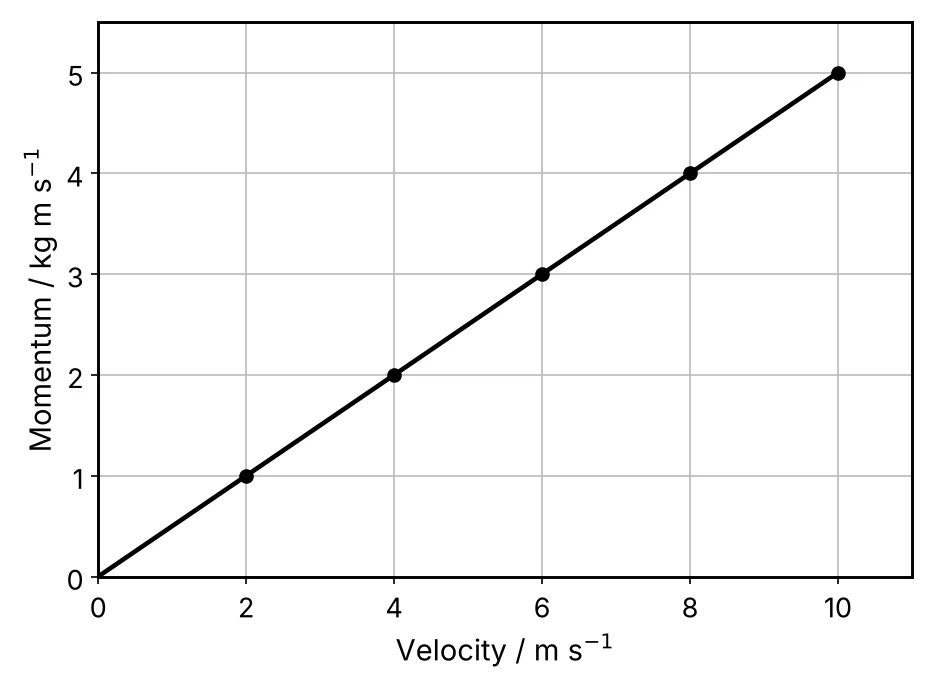
A student measures the momentum of a trolley at different velocities. Her results are plotted on the graph.
Question diagram
(a)
Determine the momentum of the trolley when its velocity is 6.0 m s⁻¹. [1]Criterion C (ii) · Level 3-4
(b)
Calculate the gradient of the line and state what it represents. [3]Criterion C (ii) · Level 5-6
(c)
Calculate the velocity of the trolley when its momentum is 4.0 kg m s⁻¹. [2]Criterion A (ii) · Level 3-4

revisionprep.com

Summary Answer

Not available for this question.

Model Answer

Not available for this question.

Marking Scheme

Not available for this question.

Examiner Insights

Not available for this question.

Question 4Criterion D + A · Band 3-6 · Medium · 9 marksrevisionprep.com

Force and rate of change of momentum; crumple zones, airbags and seat belts
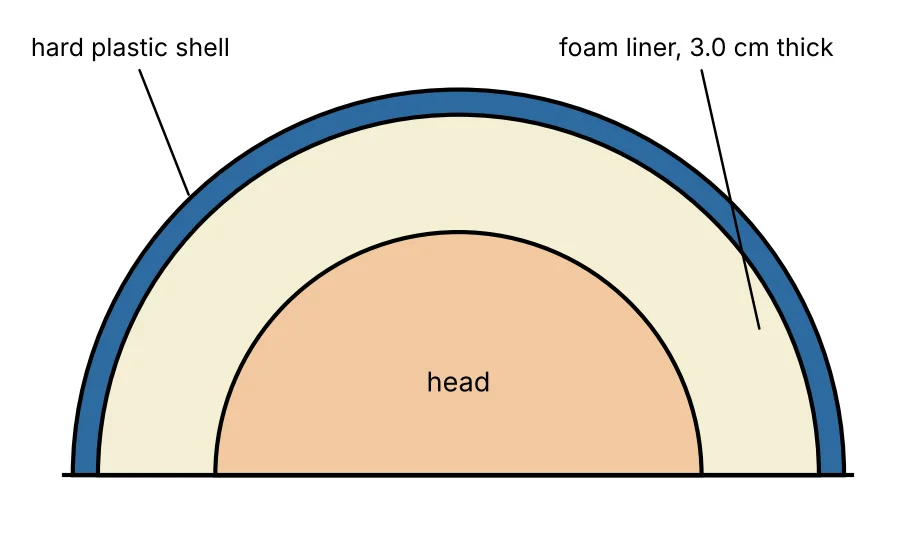
The diagram shows a cross-section of a cycle helmet. A cyclist's head of mass 4.5 kg hits the ground at 5.0 m s⁻¹.
Question diagram
(a)
Explain how the foam liner reduces the force on the cyclist's head. [3]Criterion D (i) · Level 3-4
(b)
Without a helmet the head stops in 0.0050 s. With the helmet it stops in 0.025 s. Calculate the average force on the head in each case. [3]Criterion A (ii) · Level 5-6
(c)
Evaluate why a cycle helmet should be replaced after a crash. [3]Criterion D (ii) · Level 5-6

revisionprep.com

Summary Answer

Not available for this question.

Model Answer

Not available for this question.

Marking Scheme

Not available for this question.

Examiner Insights

Not available for this question.

Question 5Criterion B + C · Band 3-8 · Challenge · 10 marksrevisionprep.com

Conservation of momentum

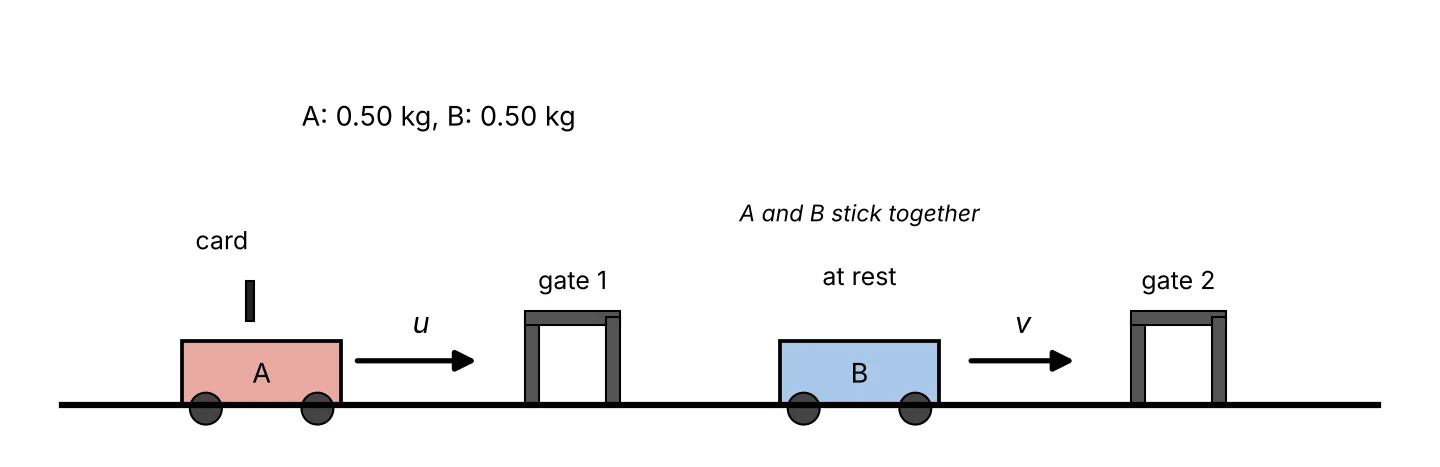
A student tests whether momentum is conserved when two trolleys stick together. Trolley A (0.50 kg) carries a card and moves at speed u through gate 1 before hitting stationary trolley B (0.50 kg). The joined trolleys then pass gate 2 at speed v. She repeats the test with three starting speeds.

Runu / m s⁻¹v / m s⁻¹10.400.1920.800.3731.200.54\begin{array}{|l|c|c|}\hline \text{Run} & \text{u / m s⁻¹} & \text{v / m s⁻¹} \\ \hline 1 & 0.40 & 0.19 \\ \hline 2 & 0.80 & 0.37 \\ \hline 3 & 1.20 & 0.54 \\ \hline\end{array}
Question diagram
(a)
State a testable hypothesis for this investigation and explain it using the conservation of momentum. [3]Criterion B (ii) · Level 5-6
(b)
Explain how the two light gates and the card are used to find u and v. [2]Criterion B (iii) · Level 3-4
(c)
Calculate the percentage difference between the momentum before and the momentum after the collision for each run. [2]Criterion C (i) · Level 3-4
(d)
The student concludes that momentum was conserved within experimental error. Evaluate this conclusion, and design a change to the method that tests your explanation. [3]Criterion B (iv) · Level 7-8

revisionprep.com

Summary Answer

Not available for this question.

Model Answer

Not available for this question.

Marking Scheme

Not available for this question.

Examiner Insights

Not available for this question.

Question 6Criterion A + D · Band 1-8 · Challenge · 10 marksrevisionprep.com

Collisions and explosions

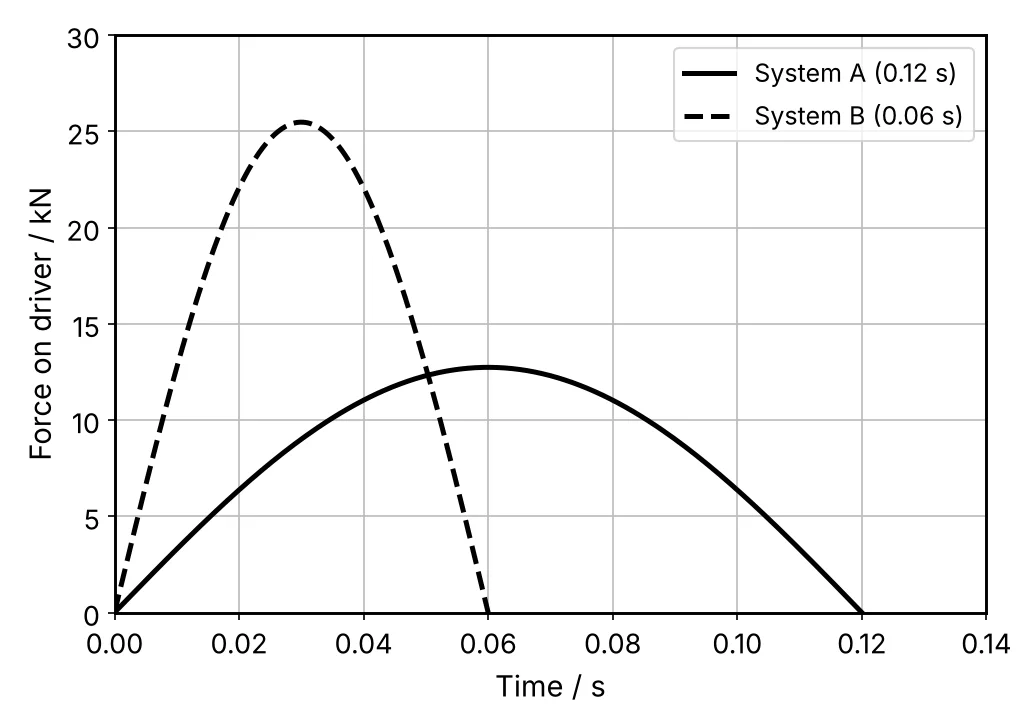
The image shows a crash test in which a 70 kg driver dummy travelling at 50 km h⁻¹ (13.9 m s⁻¹) comes to rest in a head-on collision. With the high-performance airbag (system A) the dummy stops in 0.12 s; with the standard airbag (system B) it stops in 0.06 s. The graph in the image shows the force on the driver for each system.
Question diagram
(a)
Calculate the change in momentum of the dummy. [2]Criterion A (ii) · Level 1-2
(b)
Calculate the average force on the dummy for each system. [2]Criterion A (ii) · Level 3-4
(c)
Explain why the areas under the two curves on the force-time graph should be equal. [2]Criterion A (iii) · Level 5-6
(d)
System A is more expensive. Evaluate whether a car maker should fit system A instead of system B, considering safety, cost and the limits of the physics model. [4]Criterion D (ii) · Level 7-8

revisionprep.com

Summary Answer

Not available for this question.

Model Answer

Not available for this question.

Marking Scheme

Not available for this question.

Examiner Insights

Not available for this question.

That's every free question here — 6 of 65.

+59 more questions, plus Mock Papers & Worksheets, are waiting in Premium.

Upgrade