You're viewing free preview questions — 6 questions previewing here — subscribe to unlock 64 more, plus the Full Question Bank, Mock Papers & Worksheets.Upgrade
Back

Heat transfer: conduction, convection and radiation — Free MYP4 Physics Practice Questions

Free questions

Open in full, with answers, mark scheme and examiner insights.

Question 1Criterion D · Band 1-2 · Easy · 2 marksrevisionprep.com

Conduction in Solids and Thermal Conductors

A homeowner is deciding whether to add a 5 cm layer of expanded polystyrene foam to the inside of a concrete wall. Polystyrene has a thermal conductivity of 0.035 W m⁻¹ °C⁻¹; concrete has a thermal conductivity of 1.4 W m⁻¹ °C⁻¹.
(a)
Calculate how many times better concrete conducts than polystyrene. [1]Criterion D (iii) · Level 1-2
(b)
State the effect of the polystyrene layer on the rate of energy loss through the wall. [1]Criterion D (i) · Level 1-2

revisionprep.com

Summary Answer

Not available for this question.

Model Answer

Not available for this question.

Marking Scheme

Not available for this question.

Examiner Insights

Not available for this question.

Question 2Criterion A + D · Band 3-4 · Easy · 8 marksrevisionprep.com

Radiation and Emission of Infrared Energy

A solar water-heating panel on a roof has these features:

1. a metal plate painted matt black, with copper pipes carrying water fixed to it
2. a sheet of glass above the plate, with a layer of still air between the glass and the plate
3. a thick layer of foam insulation behind the plate
(a)
Explain why the plate is painted matt black. [2]Criterion A (i), A (ii) · Level 3-4
(b)
Explain why the pipes are made of copper. [2]Criterion D (i) · Level 3-4
(c)
Explain how the glass sheet and the foam layer each reduce energy loss from the hot plate. Name the method of energy transfer reduced in each case. [4]Criterion A (ii) · Level 3-4

revisionprep.com

Summary Answer

Not available for this question.

Model Answer

Not available for this question.

Marking Scheme

Not available for this question.

Examiner Insights

Not available for this question.

Question 3Criterion B · Band 1-6 · Medium · 8 marksrevisionprep.com

Radiation and Emission of Infrared Energy

The diagram shows a Leslie cube seen from above. It is a hollow metal cube filled with hot water at 80 °C. Each vertical face has a different surface: matt black (W), shiny black (X), matt white (Y) and shiny silver (Z). An infrared detector 10 cm away measures the radiation emitted by the face in front of it.

A student wants to investigate how the type of surface affects the rate of infrared emission.
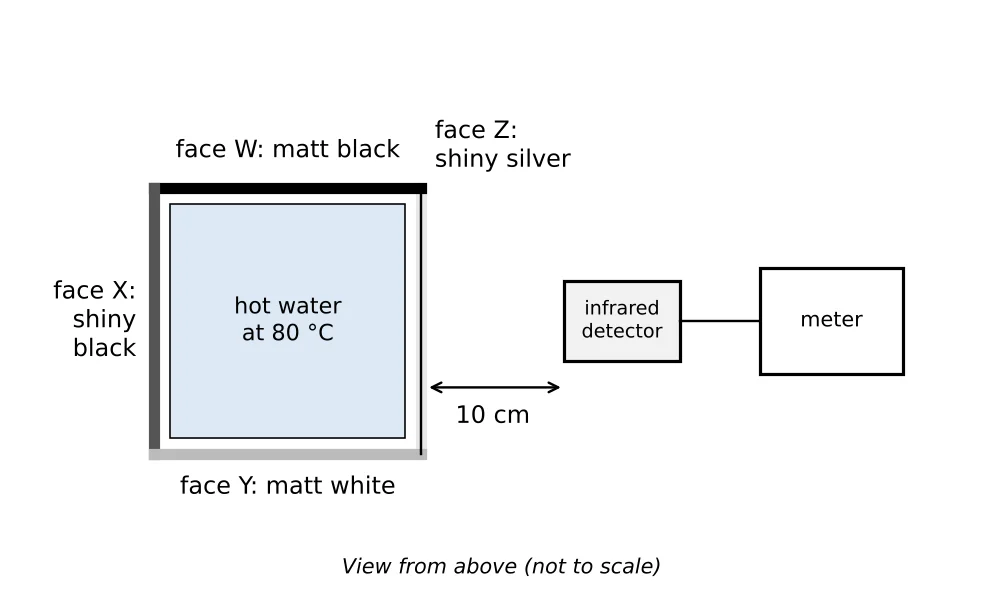
Question diagram
(a)
Formulate a hypothesis for this investigation and explain it using scientific reasoning. [2]Criterion B (ii) · Level 5-6
(b)
Identify the independent and dependent variables. [1]Criterion B (iii) · Level 1-2
(c)
Explain why the readings for all four faces should be taken within a short time, one after another, and how the student could check this has been done fairly. [2]Criterion B (iii) · Level 5-6
(d)
Identify one other control variable and explain how it would be controlled. [2]

(e) Describe one safety precaution for this investigation. [1]
Criterion B (iii) · Level 3-4

revisionprep.com

Summary Answer

Not available for this question.

Model Answer

Not available for this question.

Marking Scheme

Not available for this question.

Examiner Insights

Not available for this question.

Question 4Criterion A + C · Band 1-6 · Medium · 7 marksrevisionprep.com

Insulation Techniques and Practical Applications
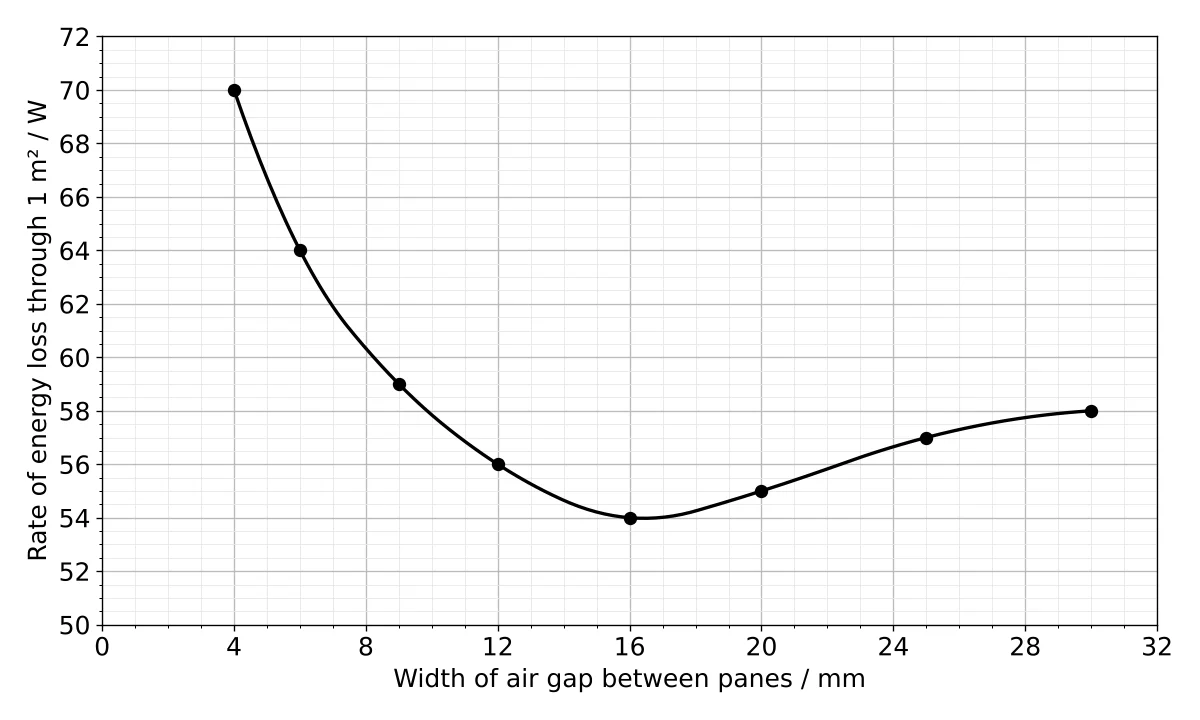
The graph shows how the rate of energy loss through 1 m² of a double-glazed window depends on the width of the air gap between the two panes. The temperature difference across the window is 20 °C in every case.
Question diagram
(a)
Use the graph to state the width of air gap that gives the lowest rate of energy loss. [1]Criterion C (ii) · Level 1-2
(b)
Explain why the rate of energy loss falls as the gap increases from 4 mm to 16 mm. [2]Criterion A (ii) · Level 5-6
(c)
Suggest why the rate of energy loss increases when the gap is wider than 16 mm. [2]Criterion A (ii) · Level 5-6
(d)
A single-glazed window loses 115 W through 1 m² under the same conditions. Calculate the percentage reduction in energy loss when it is replaced by double glazing with the best gap width. [2]Criterion C (i) · Level 3-4

revisionprep.com

Summary Answer

Not available for this question.

Model Answer

Not available for this question.

Marking Scheme

Not available for this question.

Examiner Insights

Not available for this question.

Question 5Criterion A · Band 3-8 · Challenge · 10 marksrevisionprep.com

Conduction in Solids and Thermal Conductors
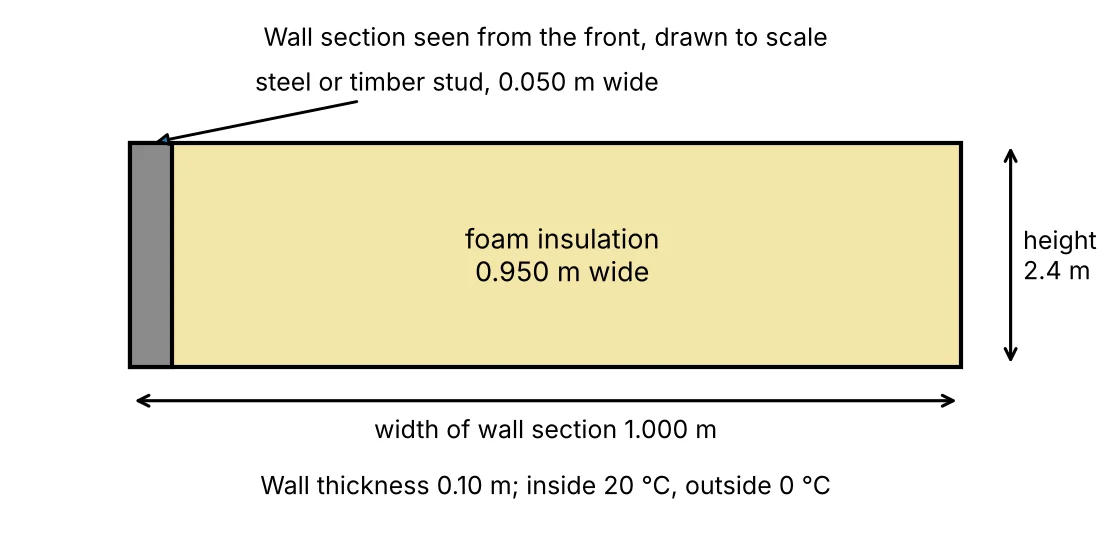
A section of an outside wall is 1.000 m wide and 2.4 m high. It is built from insulating foam with one vertical stud, 0.050 m wide, as drawn to scale. The wall is 0.10 m thick, the inside is at 20 °C and the outside is at 0 °C. The rate of energy transfer by conduction through a layer is P=kAΔTLP = \frac{kA\Delta T}{L}, where kk is the thermal conductivity, AA the area, ΔT\Delta T the temperature difference and LL the thickness.

Materialk / W m⁻¹ °C⁻¹steel50timber0.13foam0.035\begin{array}{|l|c|}\hline \text{Material} & \text{k / W m⁻¹ °C⁻¹} \\ \hline \text{steel} & 50 \\ \hline \text{timber} & 0.13 \\ \hline \text{foam} & 0.035 \\ \hline\end{array}
Question diagram
(a)
Calculate the rate of energy transfer through the steel stud. [2]Criterion A (ii) · Level 3-4
(b)
Calculate the rate of energy transfer through (i) a timber stud of the same size and (ii) the foam in the rest of the section. [3]Criterion A (ii) · Level 5-6
(c)
Calculate the total rate of energy transfer through the section of wall with a steel stud, and the percentage of it that passes through the steel stud. [2]Criterion A (ii) · Level 5-6
(d)
A builder says: "Foam is such a good insulator that a wall with steel studs will keep the heat in just as well as one with timber studs." Evaluate this claim using your results, and suggest one change to the design with a reason. [3]Criterion A (iii) · Level 7-8

revisionprep.com

Summary Answer

Not available for this question.

Model Answer

Not available for this question.

Marking Scheme

Not available for this question.

Examiner Insights

Not available for this question.

Question 6Criterion C + A · Band 3-8 · Challenge · 10 marksrevisionprep.com

Convection in Liquids and Gases

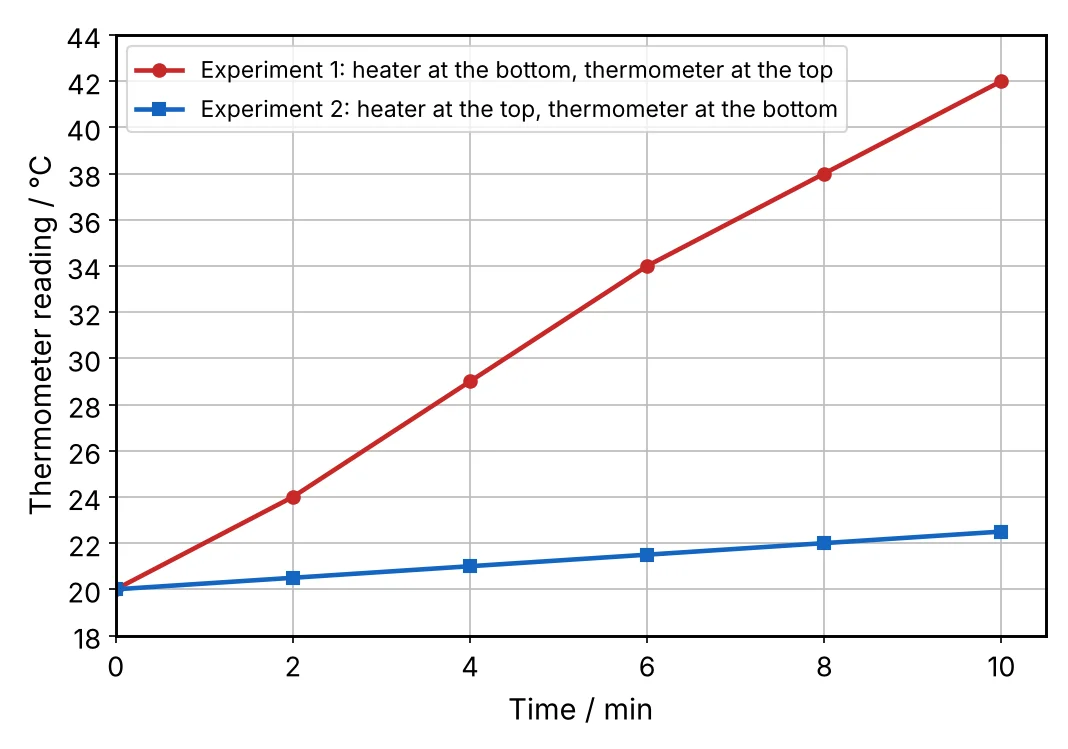
A student fills two identical tanks with 2.0 kg of water at 20 °C. In experiment 1 a 500 W heater is fixed at the bottom of one tank and a thermometer is held near the top. In experiment 2 the same heater is fixed at the top of the other tank and a thermometer is held near the bottom. Both heaters are switched on for 10 minutes. The graph shows the thermometer readings.
Question diagram
(a)
Use the graph to calculate the mean rate of rise of temperature, in °C min⁻¹, in each experiment. [2]Criterion C (i) · Level 3-4
(b)
Explain, in terms of density and the movement of the water, why the thermometer near the top warms so much faster in experiment 1. [3]Criterion A (ii) · Level 5-6
(c)
State two weaknesses in the way the temperature was measured, with one improvement for each. [2]Criterion C (iv), C (v) · Level 5-6
(d)
The student concludes: "Convection transfers energy 9 times faster than conduction in water." Evaluate this conclusion. [3]Criterion C (iii) · Level 7-8

revisionprep.com

Summary Answer

Not available for this question.

Model Answer

Not available for this question.

Marking Scheme

Not available for this question.

Examiner Insights

Not available for this question.

That's every free question here — 6 of 70.

+64 more questions, plus Mock Papers & Worksheets, are waiting in Premium.

Upgrade