You're viewing free preview questions — 5 questions previewing here — subscribe to unlock 121 more, plus the Full Question Bank, Mock Papers & Worksheets.Upgrade
Energy in Cells: Respiration and Photosynthesis — Free MYP5 Biology Practice Questions

1QuestionAerobic vs Anaerobic RespirationConcept Practice
2 marks~3 minCriterion A
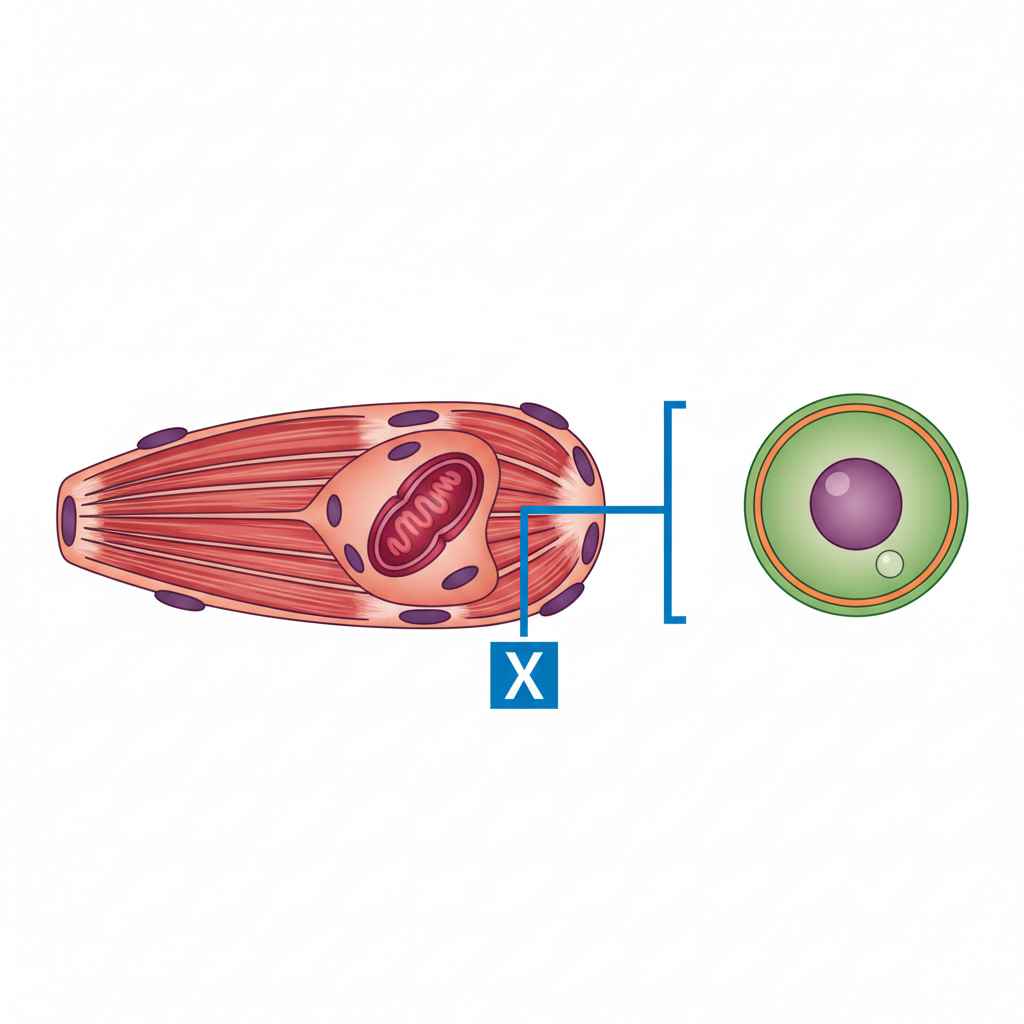
The diagram shows a muscle cell (left) and a yeast cell (right). Structure X is labelled inside the muscle cell.
a
Identify structure X. [1]
b
During intense exercise, muscle cells switch from aerobic to anaerobic respiration. Explain why structure X becomes less active under these conditions. [1]

Solutions
2QuestionAerobic vs Anaerobic RespirationAssessment Practice
4 marks~6 minCriterion A
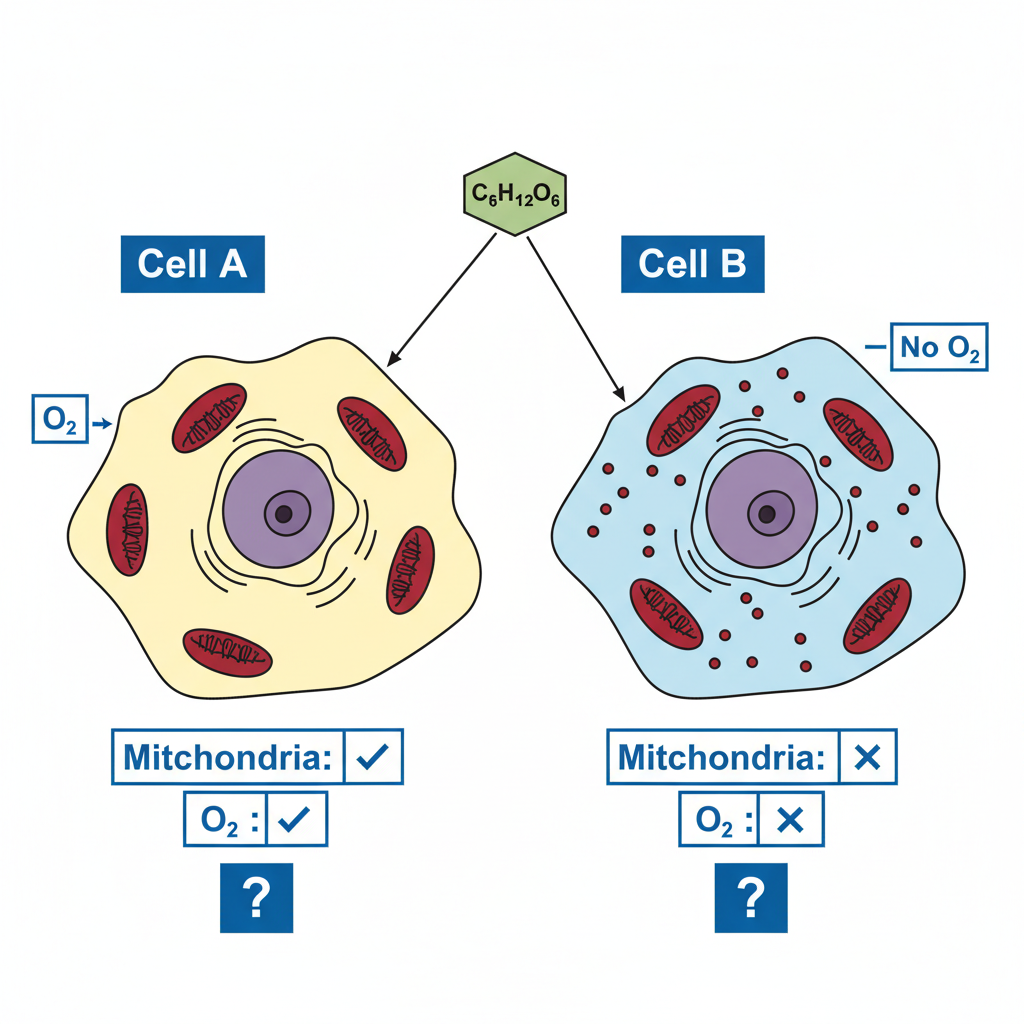
A diagram shows two cells undergoing respiration. Cell A contains mitochondria and has access to oxygen; Cell B lacks mitochondria and has no oxygen available.
a
Identify the type of respiration occurring in each cell and state where in the cell each process takes place. [1]
b
Explain why Cell A produces 36 ATP per glucose molecule whereas Cell B produces only 2 ATP per glucose molecule. In your answer, refer to the role of oxygen in the electron transport chain. [2]
c
A student claims that anaerobic respiration is "simply a less efficient version of the same process." Evaluate this claim. [1]
Solutions
3QuestionAerobic vs Anaerobic RespirationAssessment Practice
5 marks~8 minCriterion C
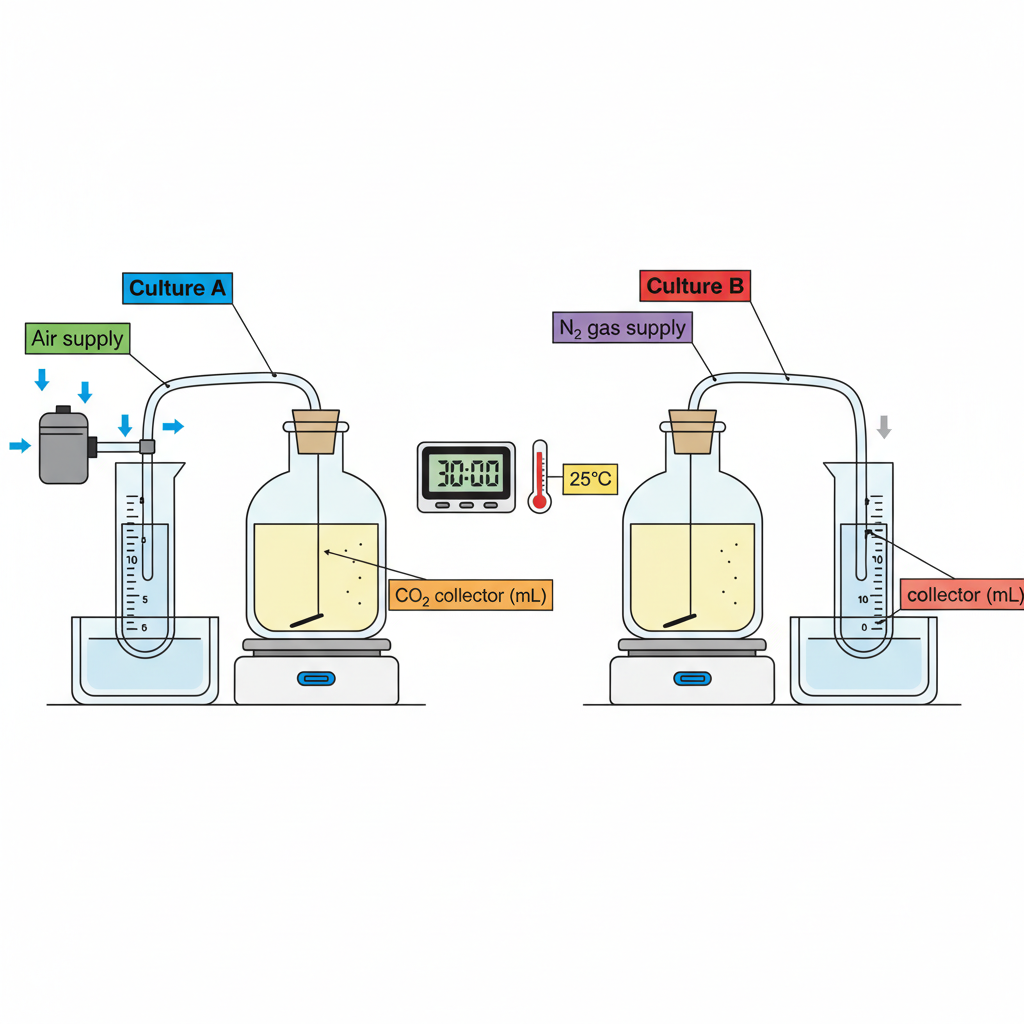
A student investigates how oxygen availability affects respiration in yeast. Culture A receives air (aerobic); Culture B receives nitrogen gas (anaerobic). Both cultures are otherwise identical. Carbon dioxide volume is recorded every five minutes.
The student's hypothesis states: "Anaerobic respiration produces more CO per glucose molecule than aerobic respiration."
| Time (min) | 5 | 10 | 15 | 20 | 25 | 30 |
|---|---|---|---|---|---|---|
| CO produced (mL) — Culture A | 2.1 | 4.5 | 6.8 | 9.0 | 11.3 | 13.5 |
| CO produced (mL) — Culture B | 1.8 | 3.9 | 5.7 | 7.8 | 9.6 | 11.7 |
The student's hypothesis states: "Anaerobic respiration produces more CO per glucose molecule than aerobic respiration."
a
State the balanced chemical equations for aerobic respiration and for anaerobic respiration (alcoholic fermentation) in yeast. [2]
b
Using your equations from (a), deduce how many CO molecules are released per glucose molecule in each pathway, and identify which pathway yields more CO per glucose. [1]
c
Evaluate the extent to which the experimental data supports or refutes the student's hypothesis, incorporating your answer from (b). [2]
Solutions
4QuestionAerobic vs Anaerobic RespirationAssessment Practice
5 marks~8 minCriterion C
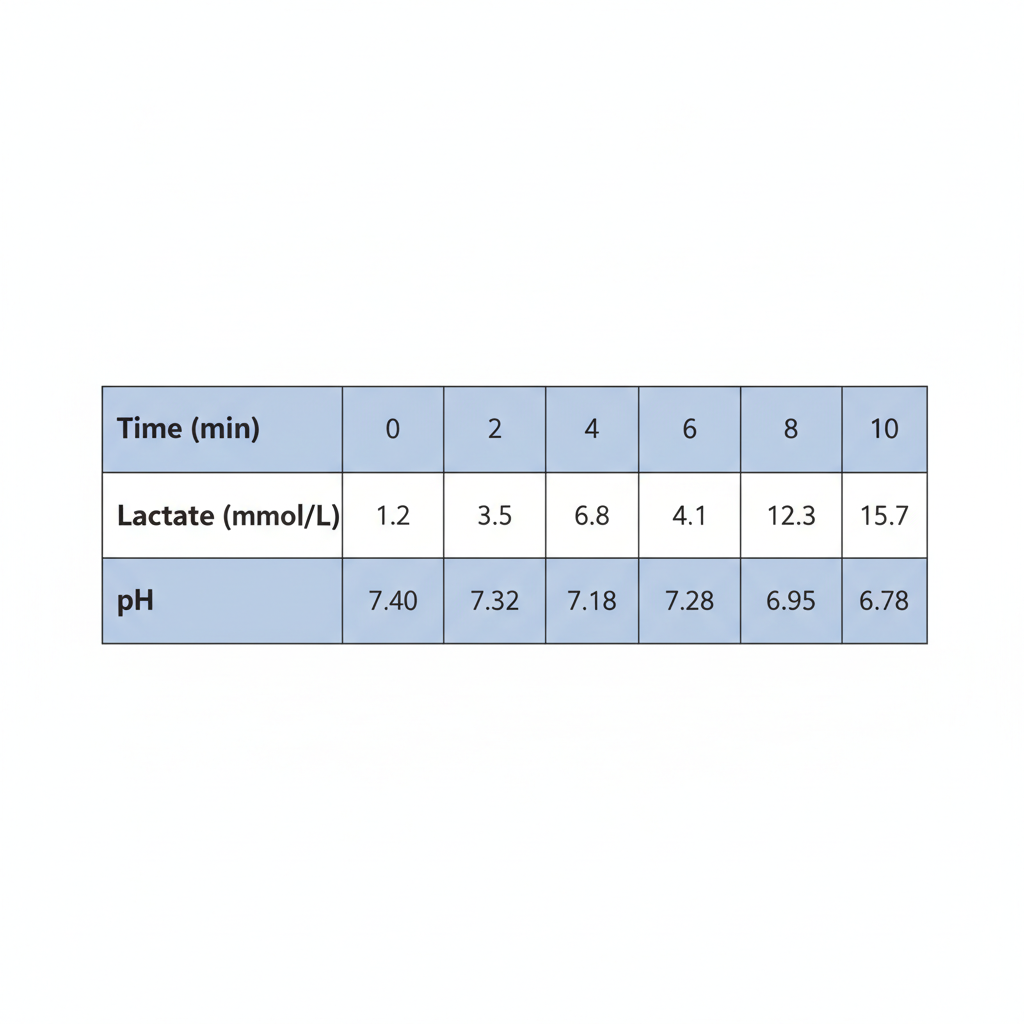
During 10 minutes of high-intensity exercise, the following measurements were recorded from human muscle tissue:
| Time (min) | 0 | 2 | 4 | 6 | 8 | 10 |
|---|---|---|---|---|---|---|
| Lactate (mmol/L) | 1.2 | 3.5 | 6.8 | 4.1 | 12.3 | 15.7 |
| pH | 7.40 | 7.32 | 7.18 | 7.28 | 6.95 | 6.78 |
a
Describe the overall trends in lactate concentration and pH across the 10-minute period. [2]
b
The data point at 6 minutes shows a lactate concentration of 4.1 mmol/L and a pH of 7.28. Explain why both values are anomalous in the context of anaerobic respiration. [2]
c
A student suggests that a brief recovery interval at 5 minutes could account for the anomalous values at 6 minutes. Evaluate this suggestion using your knowledge of lactate metabolism and pH regulation during exercise. [1]
Solutions
5QuestionAerobic vs Anaerobic RespirationAssessment Practice
8 marks~12 minCriterion D
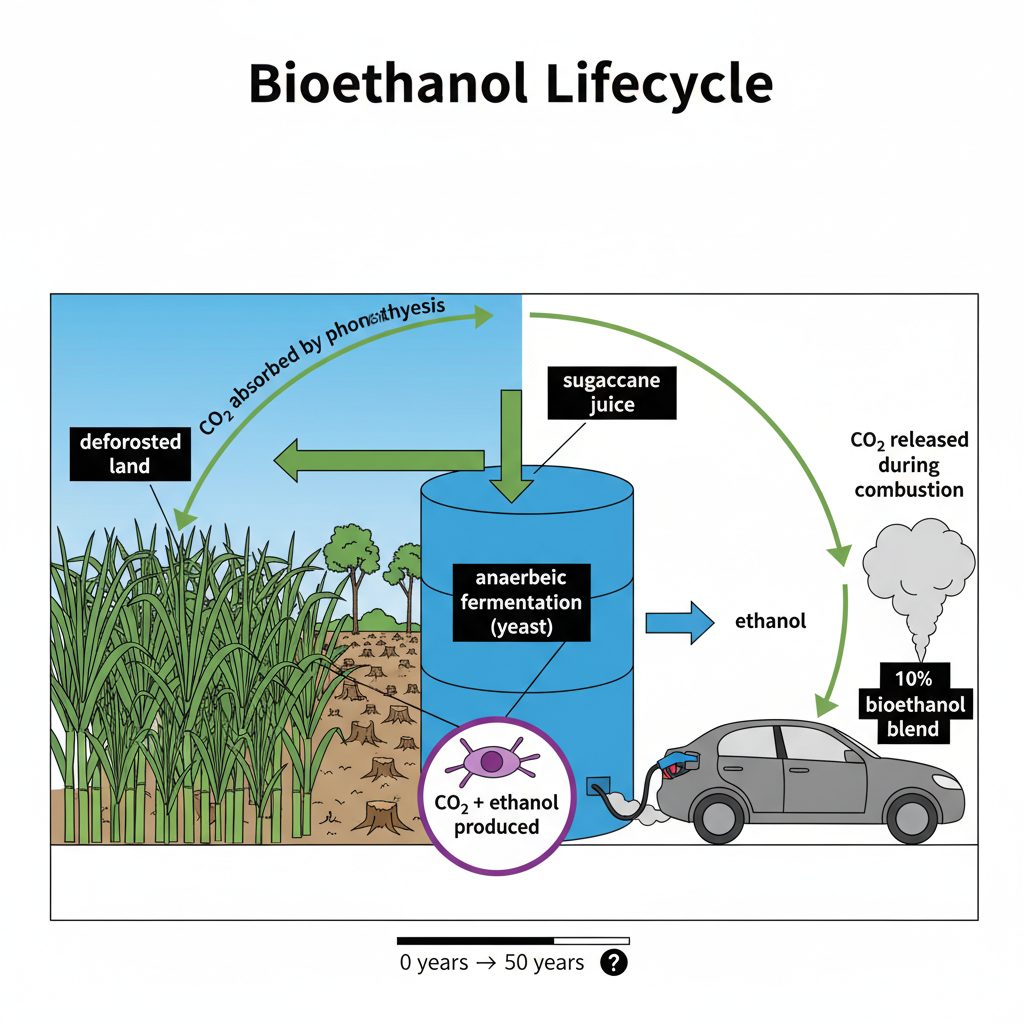
A national government proposes blending 10% bioethanol — produced from sugarcane fermentation — into gasoline. Supporters claim the policy is carbon-neutral because CO2 released during combustion is reabsorbed by new sugarcane growth. Critics counter that large-scale monoculture requires deforestation and heavy fertilizer use, releasing nitrous oxide (N2O), a greenhouse gas with approximately 300 times the global warming potential of CO2.
a
Describe the process of anaerobic respiration in yeast that produces ethanol, including the correct word or chemical equation. [2]
b
Analyse the CO2 lifecycle of sugarcane bioethanol, considering both combustion emissions and photosynthetic reabsorption. [2]
c
Evaluate the carbon-neutrality assumption over a 50-year timescale, incorporating land-use change, N2O emissions, and the factors identified in part (b). [4]
Solutions
That's every free question here — 5 of 126.
+121 more questions, plus Mock Papers & Worksheets, are waiting in Premium.