You're viewing free preview questions — 6 questions previewing here — subscribe to unlock 74 more, plus the Full Question Bank, Mock Papers & Worksheets.Upgrade
Back

Adaptation — Free MYP5 Biology Practice Questions

Free questions

Open in full, with answers, mark scheme and examiner insights.

Question 1Criterion A · Band 3-4 · Easy · 4 marksrevisionprep.com

Structural Adaptations in Organisms

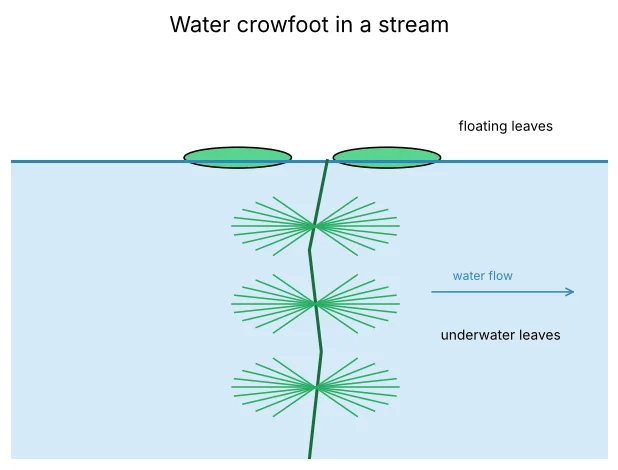
Water crowfoot (Ranunculus aquatilis) grows in streams. One plant produces two kinds of leaf: broad, flat leaves that float on the surface, and finely divided, thread-like leaves that stay under the water.

The diagram shows the two kinds of leaf.
Question diagram
(a)
Explain two advantages of finely divided leaves for a plant living under flowing water. [2]Criterion A (ii) · Level 3-4
(b)
Suggest why the floating leaves are broad and flat. [1]Criterion A (ii) · Level 3-4
(c)
Both leaf types grow from the same plant and carry the same genes. Suggest what causes the two leaf types to develop differently. [1]Criterion A (iii) · Level 3-4

revisionprep.com

Summary Answer

Not available for this question.

Model Answer

Not available for this question.

Marking Scheme

Not available for this question.

Examiner Insights

Not available for this question.

Question 2Criterion A · Band 1-4 · Easy · 3 marksrevisionprep.com

Behavioral Adaptations

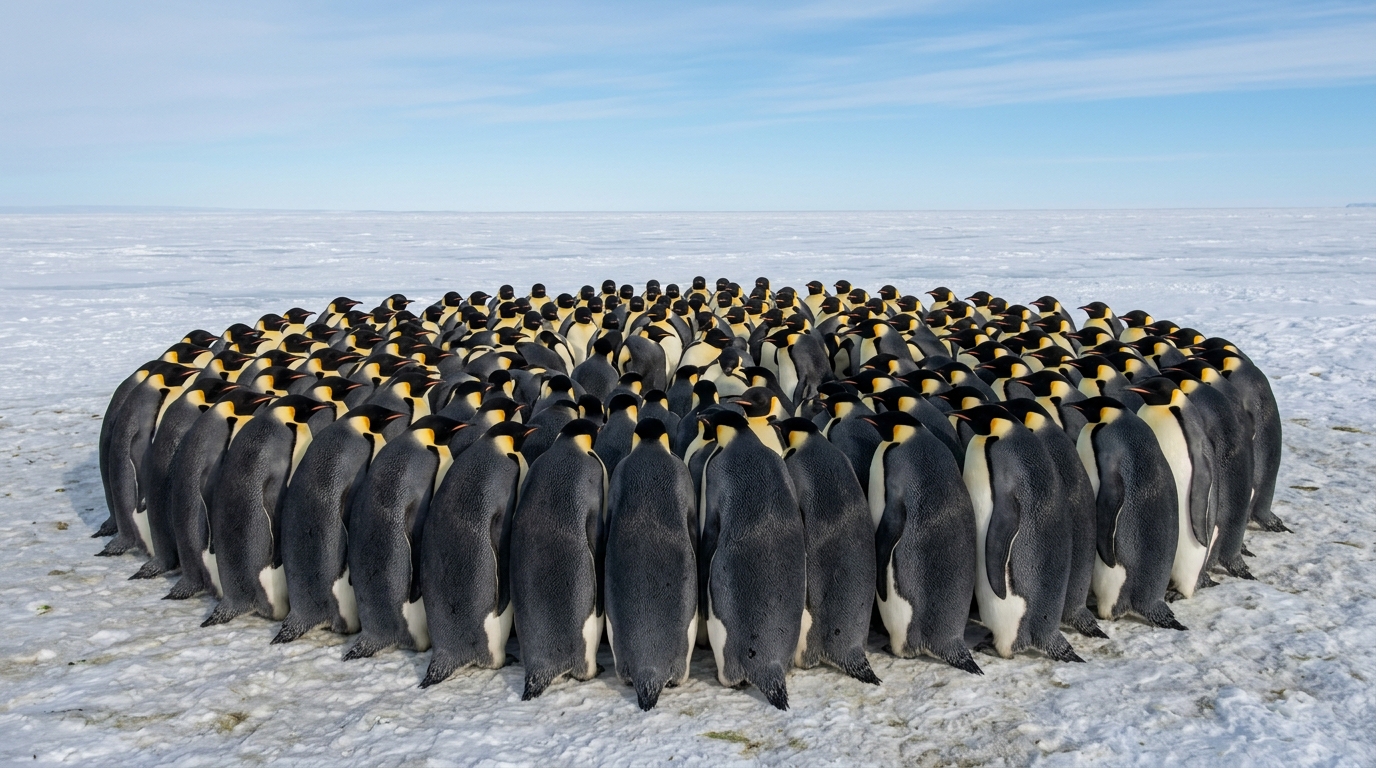
The photograph shows emperor penguins (Aptenodytes forsteri) huddling on Antarctic sea ice in winter, when air temperatures fall below −40 °C. Over several hours, penguins slowly move from the edge of the huddle to the centre and back again.
Question diagram
(a)
Identify the type of adaptation shown in the photograph. [1]Criterion A (i) · Level 1-2
(b)
Explain how huddling reduces heat loss from each penguin. [2]Criterion A (ii) · Level 3-4

revisionprep.com

Summary Answer

Not available for this question.

Model Answer

Not available for this question.

Marking Scheme

Not available for this question.

Examiner Insights

Not available for this question.

Question 3Criterion B + C · Band 3-6 · Medium · 8 marksrevisionprep.com

Structural Adaptations in Organisms

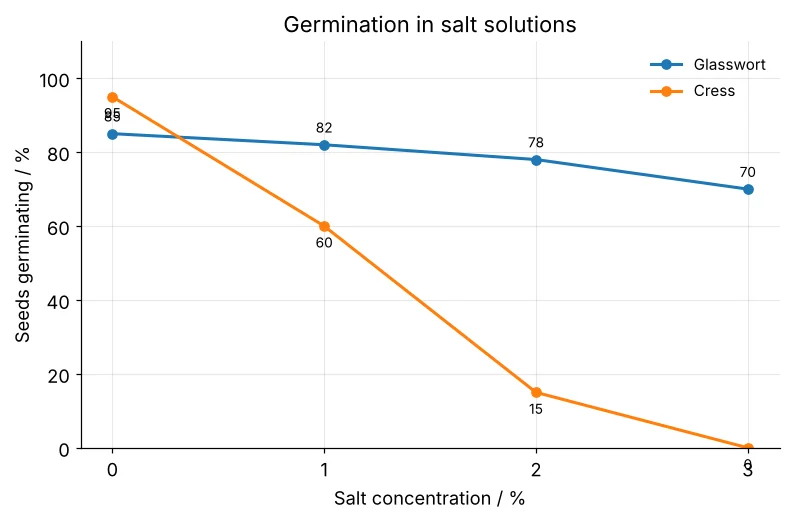
Glasswort is a plant that grows in salt marshes, which are flooded by seawater. A student compared the germination of glasswort seeds with that of cress, a garden plant, in different concentrations of salt solution. 50 seeds of each were used at each concentration.

Salt concentration / %0123Glasswort seeds germinating / %85827870Cress seeds germinating / %9560150\begin{array}{|l|c|c|c|c|}\hline \text{Salt concentration / \%} & 0 & 1 & 2 & 3 \\ \hline \text{Glasswort seeds germinating / \%} & 85 & 82 & 78 & 70 \\ \hline \text{Cress seeds germinating / \%} & 95 & 60 & 15 & 0 \\ \hline\end{array}

The graph shows these data.
Question diagram
(a)
Formulate a hypothesis that this investigation tests, and explain it using scientific reasoning. [2]Criterion B (ii) · Level 5-6
(b)
Identify the independent variable, the dependent variable and two control variables. [3]Criterion B (iii) · Level 3-4
(c)
Compare the effect of salt on the germination of the two species. [2]Criterion C (ii) · Level 3-4
(d)
Suggest one improvement to the investigation. [1]Criterion C (v) · Level 5-6

revisionprep.com

Summary Answer

Not available for this question.

Model Answer

Not available for this question.

Marking Scheme

Not available for this question.

Examiner Insights

Not available for this question.

Question 4Criterion D + A · Band 1-6 · Medium · 6 marksrevisionprep.com

Behavioral Adaptations

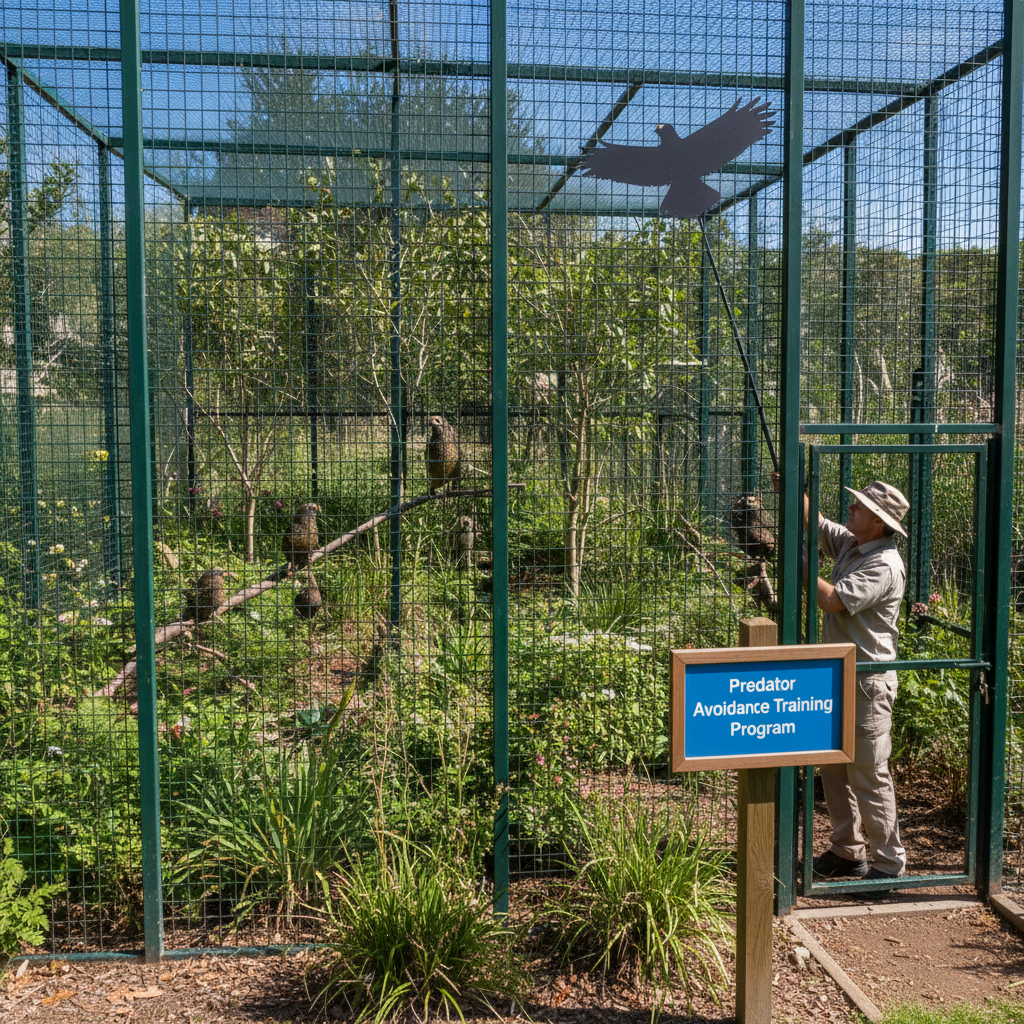
The image shows a predator-avoidance training aviary at a zoo. Captive-bred birds of an endangered species are shown a model hawk while a recording of their own species' alarm call is played. After training, the birds hide when they see a hawk shape. They are then released into the wild.
Question diagram
(a)
Identify the type of behaviour the birds develop during training. [1]Criterion A (i) · Level 1-2
(b)
Explain why captive-bred birds may need this training before release. [2]Criterion D (i) · Level 3-4
(c)
Discuss whether this training programme is ethically justified. [3]Criterion D (ii) · Level 5-6

revisionprep.com

Summary Answer

Not available for this question.

Model Answer

Not available for this question.

Marking Scheme

Not available for this question.

Examiner Insights

Not available for this question.

Question 5Criterion C · Band 3-8 · Challenge · 7 marksrevisionprep.com

Structural Adaptations in Organisms

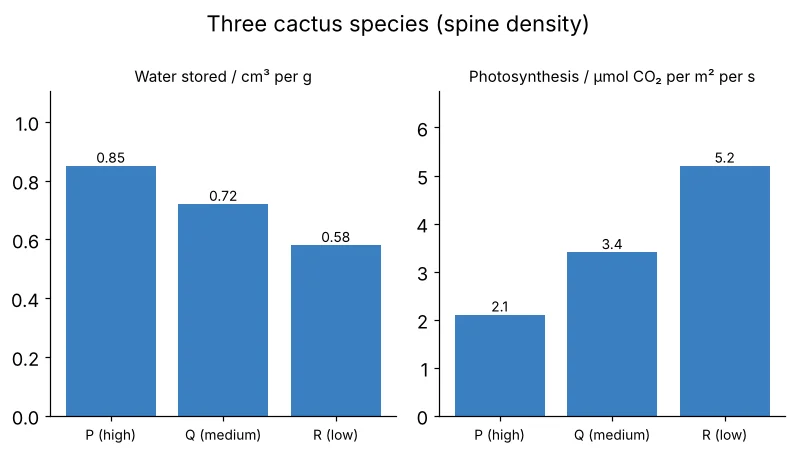
Three cactus species from the same desert were compared. Each value is the mean of five plants.

SpeciesSpine densityWater stored / cm³ per g of tissueRate of photosynthesis / µmol CO₂ per m² per sPhigh0.852.1Qmedium0.723.4Rlow0.585.2\begin{array}{|l|c|c|c|}\hline \text{Species} & \text{Spine density} & \text{Water stored / cm³ per g of tissue} & \text{Rate of photosynthesis / µmol CO₂ per m² per s} \\ \hline \text{P} & \text{high} & 0.85 & 2.1 \\ \hline \text{Q} & \text{medium} & 0.72 & 3.4 \\ \hline \text{R} & \text{low} & 0.58 & 5.2 \\ \hline\end{array}

A student's hypothesis was: 'Denser spines help a cactus keep more water, but reduce its rate of photosynthesis.'

The graph shows these data.
Question diagram
(a)
Describe how water stored and rate of photosynthesis change as spine density increases. [2]Criterion C (ii) · Level 3-4
(b)
Explain how denser spines could cause both of these changes. [2]Criterion C (ii) · Level 5-6
(c)
Evaluate whether the data support the student's hypothesis. [3]Criterion C (iii) · Level 7-8

revisionprep.com

Summary Answer

Not available for this question.

Model Answer

Not available for this question.

Marking Scheme

Not available for this question.

Examiner Insights

Not available for this question.

Question 6Criterion A + D · Band 3-8 · Challenge · 8 marksrevisionprep.com

Adaptation to Changing Environments

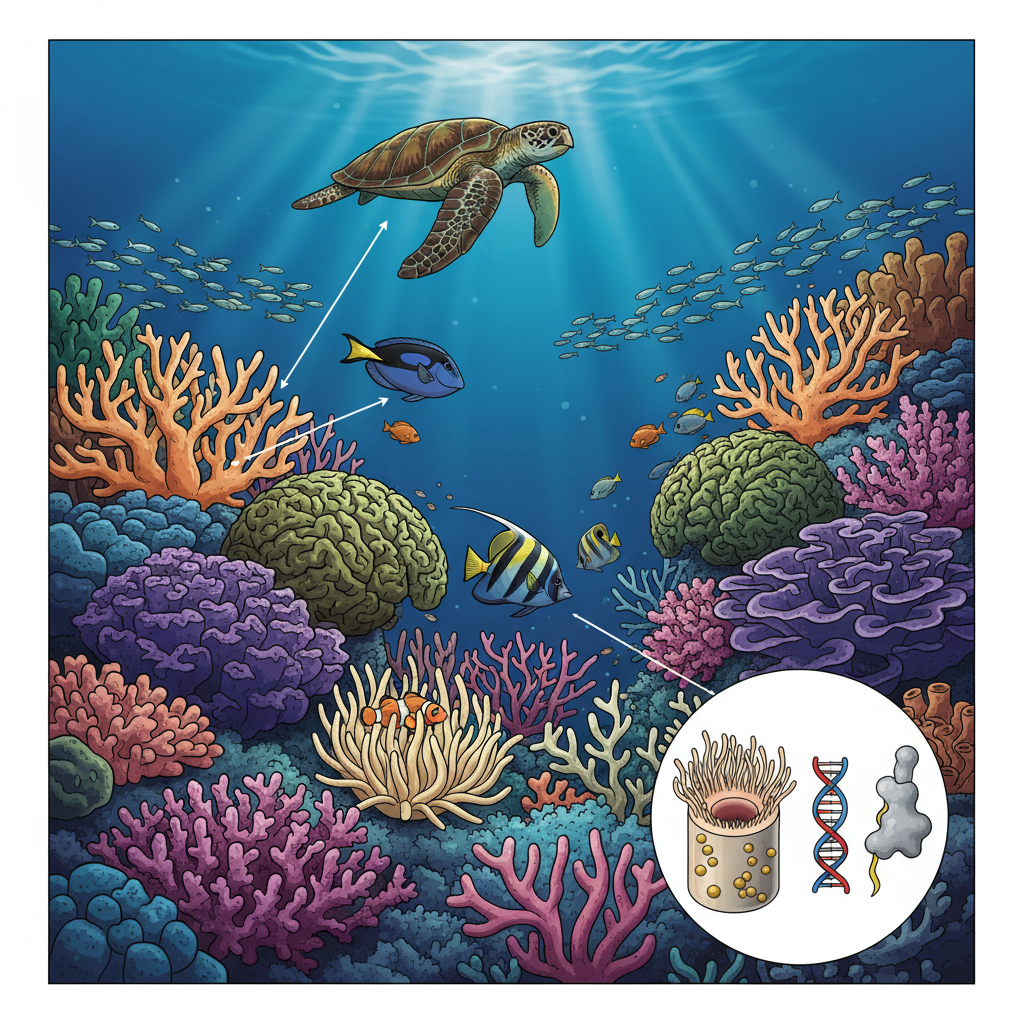
The image shows a coral reef with an inset showing a coral polyp and DNA. Corals depend on algae living inside their tissues for most of their food. When seawater stays too warm, corals expel the algae and turn white (bleaching); if this lasts, the corals die. Scientists are breeding corals from naturally heat-tolerant colonies, and some propose using gene editing, to release more heat-tolerant corals onto damaged reefs.
Question diagram
(a)
Explain why repeated bleaching events can kill corals. [2]Criterion A (ii) · Level 3-4
(b)
Suggest why most wild coral populations are unlikely to adapt naturally to warming in time. [2]Criterion A (iii) · Level 5-6
(c)
Discuss whether releasing bred or gene-edited heat-tolerant corals is a good solution. [4]Criterion D (i), D (ii) · Level 7-8

revisionprep.com

Summary Answer

Not available for this question.

Model Answer

Not available for this question.

Marking Scheme

Not available for this question.

Examiner Insights

Not available for this question.

That's every free question here — 6 of 80.

+74 more questions, plus Mock Papers & Worksheets, are waiting in Premium.

Upgrade