You're viewing free preview questions — 6 questions previewing here — subscribe to unlock 67 more, plus the Full Question Bank, Mock Papers & Worksheets.Upgrade
Back

Evidence of Evolution — Free MYP5 Biology Practice Questions

Free questions

Open in full, with answers, mark scheme and examiner insights.

Question 1Criterion A · Band 1-4 · Easy · 3 marksrevisionprep.com

Comparative Anatomy and Homologous Structures

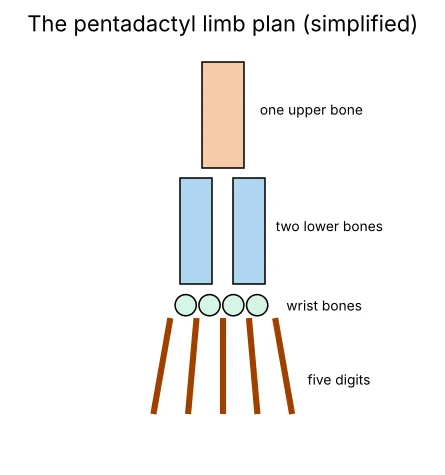
Vertebrate forelimbs share the same basic arrangement of bones (humerus, radius, ulna, carpals, metacarpals and phalanges), yet they perform very different functions.

The diagram shows the basic arrangement of bones.
Question diagram
(a)
Define the term homologous structure. [1]Criterion A (i) · Level 1-2
(b)
Using the forelimbs of two named vertebrates, explain how homologous structures provide evidence for common ancestry. [2]Criterion A (i) · Level 3-4

revisionprep.com

Summary Answer

Not available for this question.

Model Answer

Not available for this question.

Marking Scheme

Not available for this question.

Examiner Insights

Not available for this question.

Question 2Criterion A · Band 1-4 · Easy · 3 marksrevisionprep.com

Embryological Evidence of Evolution

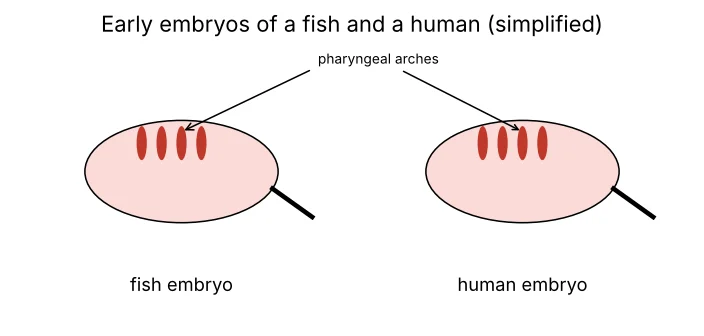
Early in development, the embryos of fish and humans both form pharyngeal arches: paired ridges in the neck region that develop from the same embryonic tissue. In fish they develop into the gills and their supports; in humans they form parts of the jaw, middle ear and throat.

The diagram shows the two embryos.
Question diagram
(a)
State the term for structures in different species that develop from the same embryonic origin. [1]Criterion A (i) · Level 1-2
(b)
Explain what the pharyngeal arches suggest about the evolutionary relationship between fish and humans. [2]Criterion A (ii) · Level 3-4

revisionprep.com

Summary Answer

Not available for this question.

Model Answer

Not available for this question.

Marking Scheme

Not available for this question.

Examiner Insights

Not available for this question.

Question 3Criterion B · Band 1-6 · Medium · 10 marksrevisionprep.com

Fossil Record and Evolutionary History
Soft tissue is rarely fossilised because it decomposes before it can be preserved. A student wants to model one condition that favours fossilisation: rapid, deep burial in sediment. She plans to bury identical pieces of fresh banana in trays of damp sand at different depths and leave them for 14 days.
(a)
State a research question for this investigation. [1]Criterion B (i) · Level 1-2
(b)
Formulate a hypothesis and explain it using scientific reasoning. [2]Criterion B (ii) · Level 5-6
(c)
Identify the independent and dependent variables, and describe how the dependent variable could be measured. [2]Criterion B (iii) · Level 3-4
(d)
Explain how two other variables would be controlled. [2]

(e) Explain how the student would collect sufficient data to draw a valid conclusion. [2]

(f) State one safety precaution, with a reason. [1]
Criterion B (iii) · Level 5-6

revisionprep.com

Summary Answer

Not available for this question.

Model Answer

Not available for this question.

Marking Scheme

Not available for this question.

Examiner Insights

Not available for this question.

Question 4Criterion D + A · Band 3-6 · Medium · 6 marksrevisionprep.com

Biogeography and Species Distribution

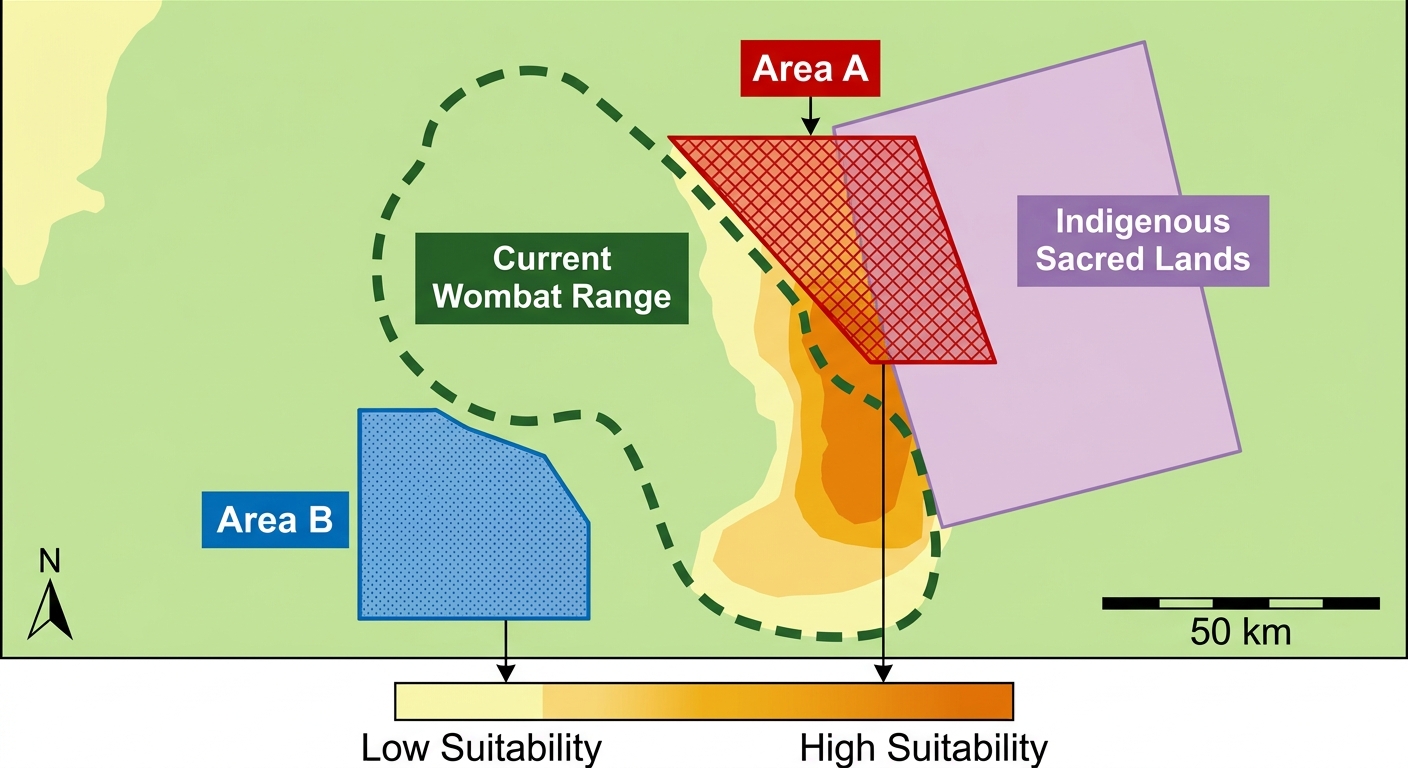
The northern hairy-nosed wombat is a critically endangered marsupial found only in Queensland, Australia. The map shows its current range, a computer prediction of habitat suitability, and two areas, A and B, proposed for a new population. Area A overlaps land that is sacred to an Indigenous community.
Question diagram
(a)
Using the map, give two reasons why Area A is predicted to be better habitat than Area B. [2]Criterion D (i) · Level 3-4
(b)
Explain why establishing a second population is important for a species found only in one small area. [1]Criterion A (ii) · Level 3-4
(c)
Discuss the implications of choosing Area A rather than Area B. Refer to ecological and cultural perspectives. [3]Criterion D (ii) · Level 5-6

revisionprep.com

Summary Answer

Not available for this question.

Model Answer

Not available for this question.

Marking Scheme

Not available for this question.

Examiner Insights

Not available for this question.

Question 5Criterion A + D · Band 1-8 · Challenge · 9 marksrevisionprep.com

Fossil Record and Evolutionary History

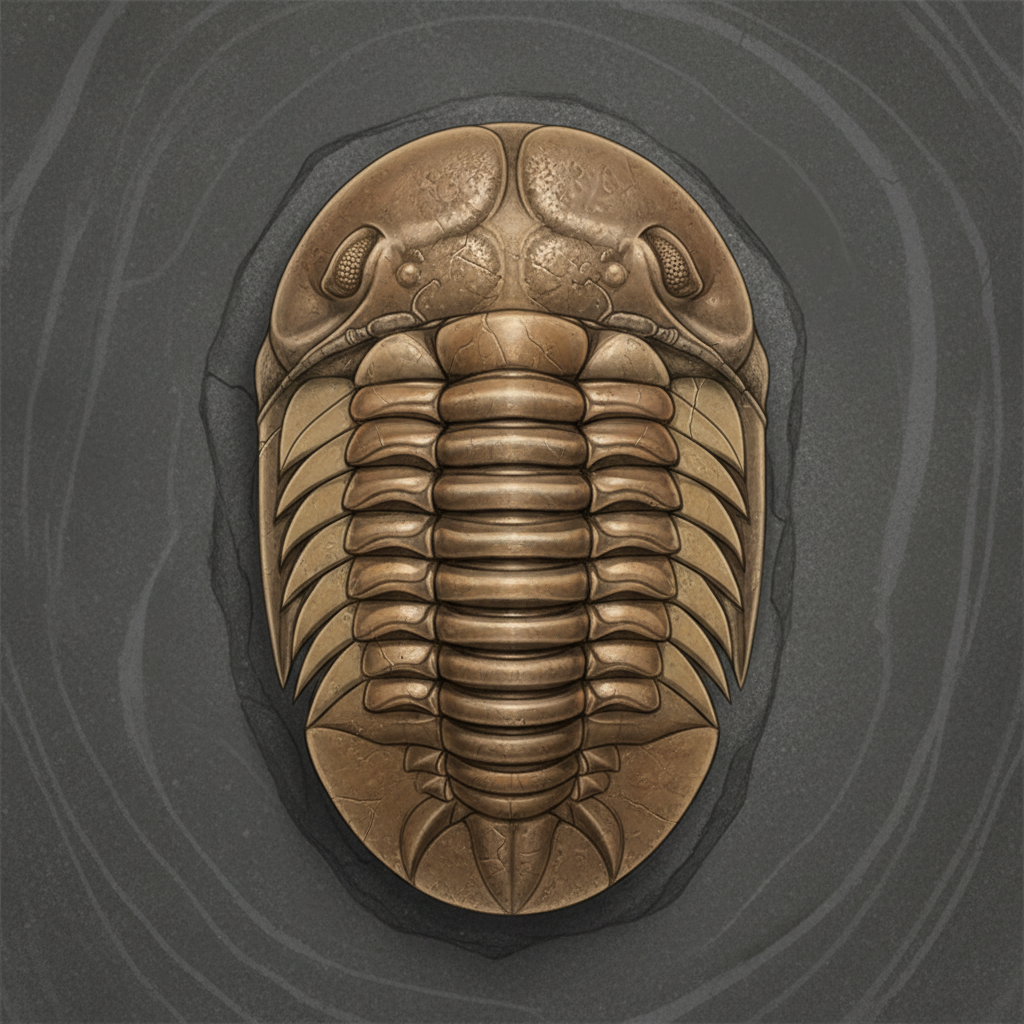
The photograph shows a fossil trilobite, an extinct marine arthropod with a hard exoskeleton. Trilobite fossils are found in rocks from about 521 to 252 million years old. Many individual trilobite species existed for only a few million years but lived in seas across large parts of the world.
Question diagram
(a)
State the type of fossil shown in the photograph. [1]Criterion A (i) · Level 1-2
(b)
Suggest why trilobites are far more common in the fossil record than the soft-bodied worms that lived in the same seas. [2]Criterion A (ii) · Level 3-4
(c)
Explain why a trilobite species with these features is useful as an index fossil for dating rock layers. [2]Criterion A (i) · Level 5-6
(d)
No trilobite fossils are found in rocks younger than 252 million years. State what this shows about trilobites. [1]

(e) Fossil trilobites are widely sold to collectors. Discuss the implications of allowing fossils to be sold commercially, considering at least two perspectives. [3]
Criterion A (iii) · Level 1-2

revisionprep.com

Summary Answer

Not available for this question.

Model Answer

Not available for this question.

Marking Scheme

Not available for this question.

Examiner Insights

Not available for this question.

Question 6Criterion C · Band 3-8 · Challenge · 8 marksrevisionprep.com

Molecular Evidence and DNA Analysis

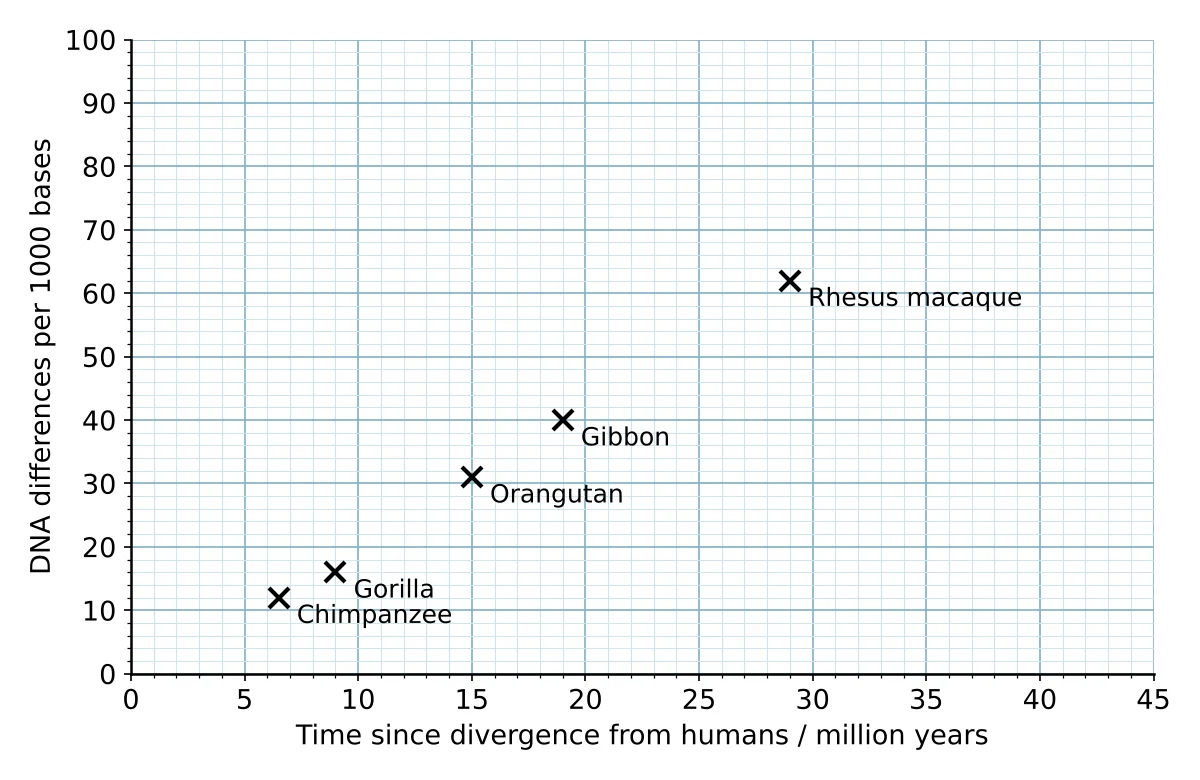
The graph shows the number of DNA differences per 1000 bases in a gene, between humans and five other primates, plotted against the time since each primate's lineage diverged from the human lineage. The divergence times come from fossil evidence.
Question diagram
(a)
Describe the relationship shown in the graph. [2]Criterion C (ii) · Level 3-4
(b)
Draw a line of best fit through the origin and use it to calculate the rate at which DNA differences build up in this gene, in differences per 1000 bases per million years. [2]Criterion C (i) · Level 5-6
(c)
A capuchin monkey shows 80 DNA differences per 1000 bases from humans in this gene. Use your answer to (b) to estimate when the capuchin lineage diverged from the human lineage. [2]Criterion C (ii) · Level 5-6
(d)
Evaluate the reliability of this estimate. [2]Criterion C (iii) · Level 7-8

revisionprep.com

Summary Answer

Not available for this question.

Model Answer

Not available for this question.

Marking Scheme

Not available for this question.

Examiner Insights

Not available for this question.

That's every free question here — 6 of 73.

+67 more questions, plus Mock Papers & Worksheets, are waiting in Premium.

Upgrade