You're viewing free preview questions — 5 questions previewing here — subscribe to unlock 68 more, plus the Full Question Bank, Mock Papers & Worksheets.Upgrade
Evidence of Evolution — Free MYP5 Biology Practice Questions

1QuestionComparative Anatomy and Homologous StructuresConcept Practice
2 marks~3 minCriterion A
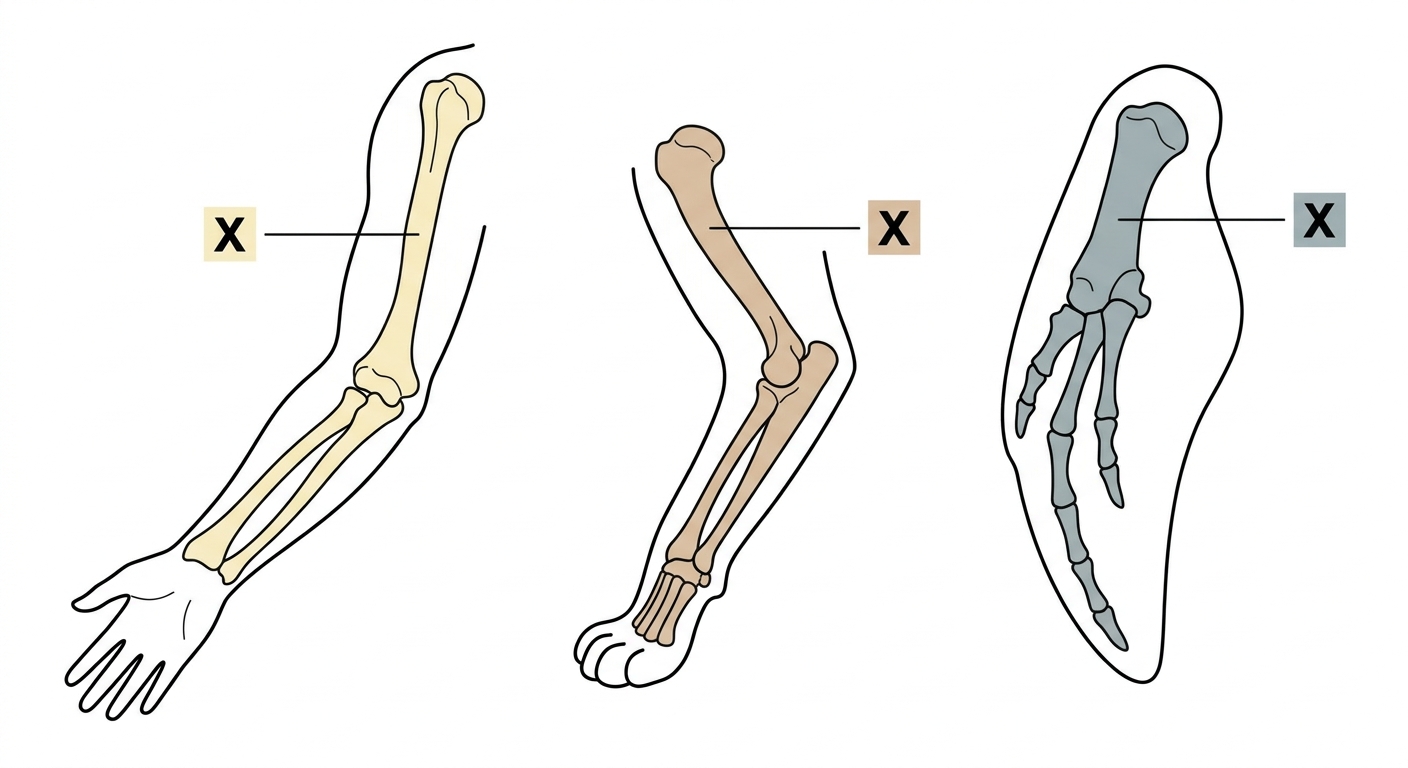
The diagram below shows the forelimb skeletons of a human, a cat, and a whale. Bone is labelled on the human arm.
a
Identify bone . [1]
b
Define the term homologous structure, referring to the limbs shown. [1]

Solutions
2QuestionBiogeography and Species DistributionAssessment Practice
2 marks~3 minCriterion D
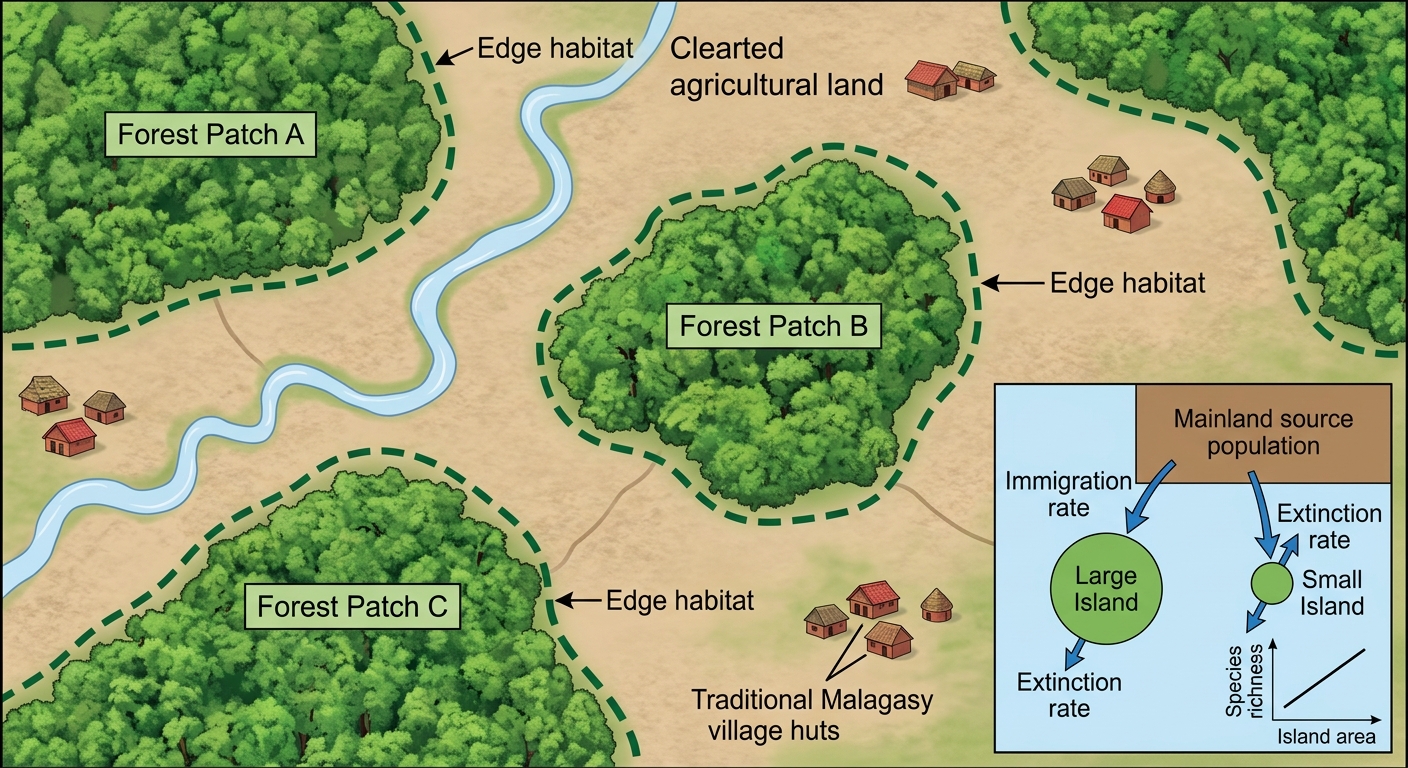
Madagascar's eastern rainforest exists as fragmented patches separated by degraded land. Conservation planners are proposing a wildlife corridor to reconnect these fragments.
a
Explain how the theory of island biogeography supports the use of a wildlife corridor to increase species richness in Madagascar's fragmented rainforest. [1]
b
Identify one ethical issue that could arise from establishing this corridor, and explain why it presents a conflict for conservation planners. [1]
Solutions
3QuestionBiogeography and Species DistributionAssessment Practice
3 marks~5 minCriterion C
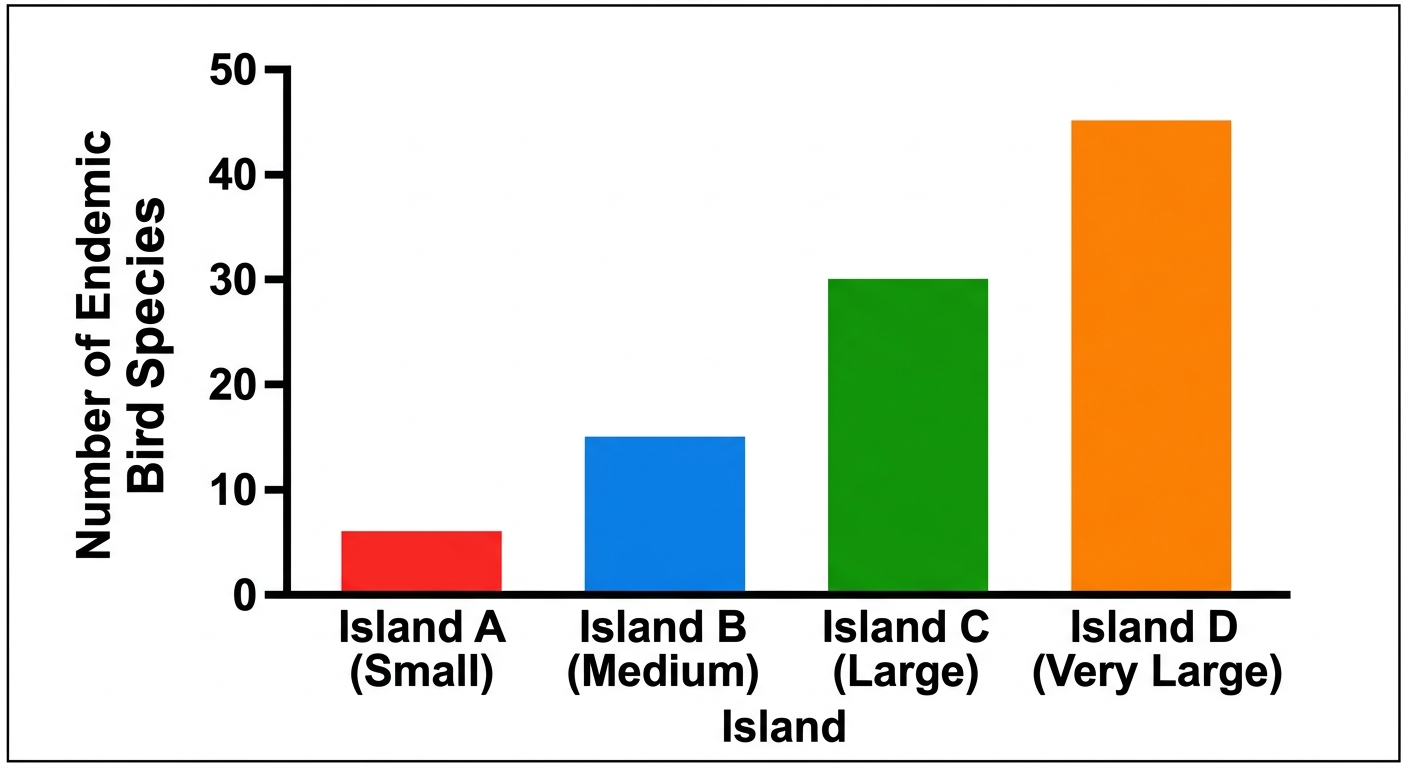
The bar graph below shows the number of endemic bird species recorded on four Pacific islands of different land areas: Guam (549 km²), Fiji (18 274 km²), New Caledonia (18 575 km²), and Hawaii (28 313 km²).
a
Describe the relationship between island area and number of endemic bird species shown in the graph. [1]
b
Explain how greater habitat diversity on larger islands increases the number of endemic species. [1]
c
Analyse how geographic isolation within large islands drives adaptive radiation, and assess whether island area alone is sufficient to explain differences in endemic species richness. [1]
Solutions
4QuestionBiogeography and Species DistributionAssessment Practice
8 marks~12 minCriterion D
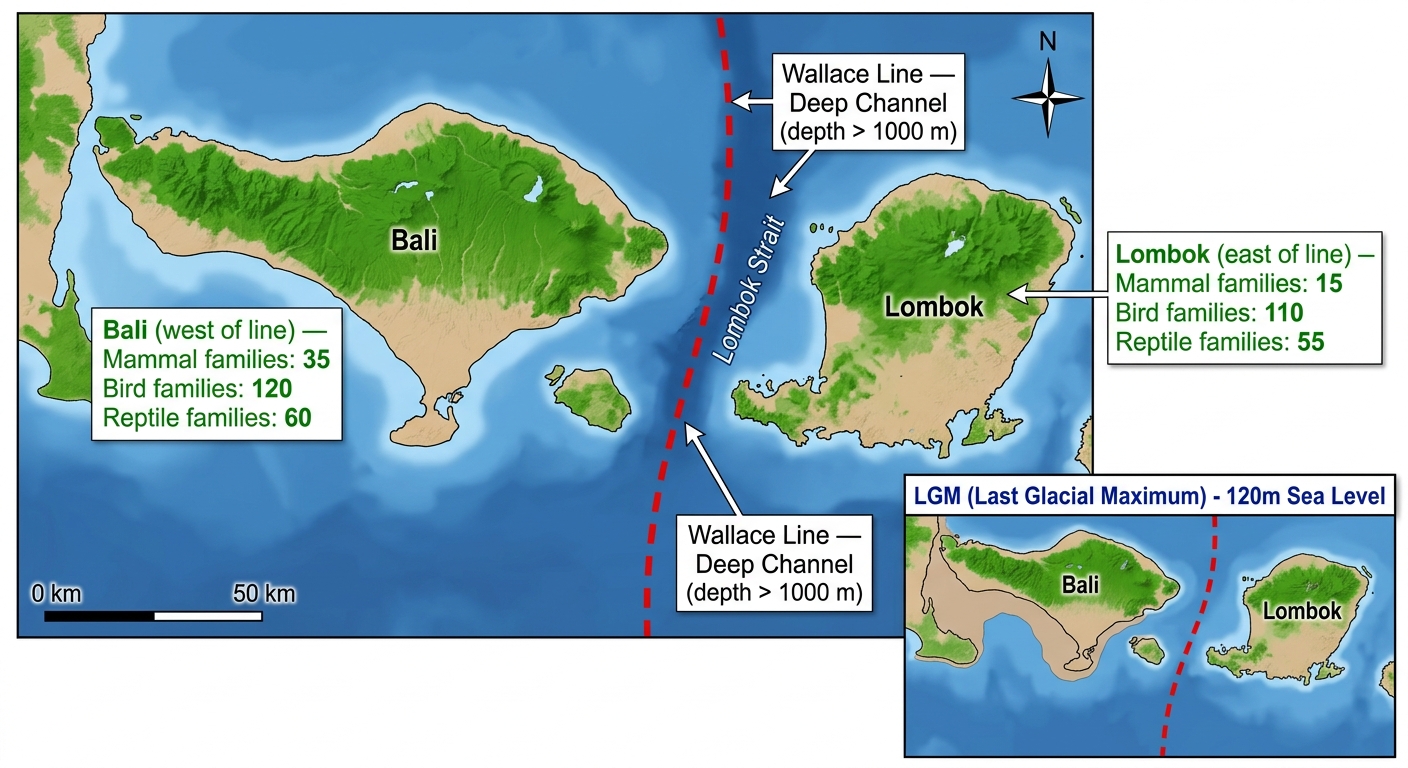
The Wallace Line runs through a deep-water channel separating Bali and Lombok in Indonesia. Even when sea levels dropped 120 m during the last ice age, land bridges formed west of the line but the deep channel remained unbridged.
Native family counts per island:
Bali (west): Mammals 35 · Birds 120 · Reptiles 60
Lombok (east): Mammals 15 · Birds 110 · Reptiles 55
Native family counts per island:
Bali (west): Mammals 35 · Birds 120 · Reptiles 60
Lombok (east): Mammals 15 · Birds 110 · Reptiles 55
a
Identify the pattern in species distribution shown by the data above. [2]
b
A fossil marsupial is discovered on one of the islands. Deduce which side of the Wallace Line it most likely came from, using the ice-age sea-level data to support your reasoning. [3]
c
Justify why marsupials are found on one side of the Wallace Line and not the other, by analysing the roles of plate tectonic history and the deep-water channel as a dispersal barrier. [3]
Solutions
5QuestionBiogeography and Species DistributionAssessment Practice
12 marks~18 minCriterion C
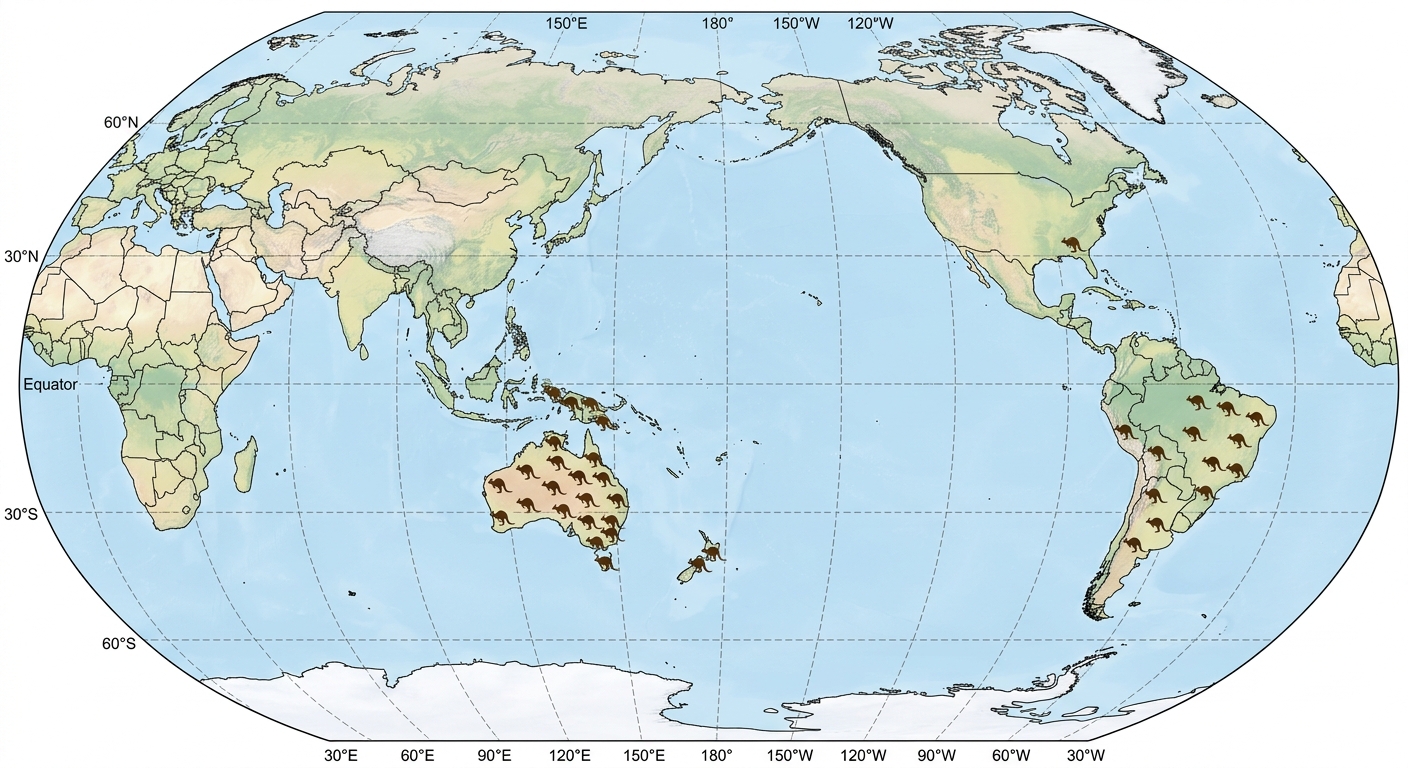
The diagram below shows the global distribution of marsupial species, with shading indicating species richness across continents.
Use the diagram and your knowledge of biogeography and evolution to answer the following questions.
Use the diagram and your knowledge of biogeography and evolution to answer the following questions.
a
Describe the distribution pattern of marsupial species shown in the diagram. [2]
b
Explain how the presence of marsupials on both Australia and South America supports the concept of common descent. [3]
c
Analyse how the breakup of the supercontinent Gondwana accounts for the current distribution of marsupials, including why Australian and South American marsupials have diverged so markedly from one another. [4]
d
Evaluate the reliability of biogeographical evidence alone for establishing evolutionary relationships between species, referring to at least one specific complicating factor. [3]
Solutions
That's every free question here — 5 of 73.
+68 more questions, plus Mock Papers & Worksheets, are waiting in Premium.