You're viewing free preview questions — 4 questions previewing here — subscribe to unlock 100 more, plus the Full Question Bank, Mock Papers & Worksheets.Upgrade
Making and Testing Salts — Free MYP5 Chemistry Practice Questions

1QuestionFiltering Crystallizing and Drying a SaltConcept Practice
2 marks~3 minCriterion A
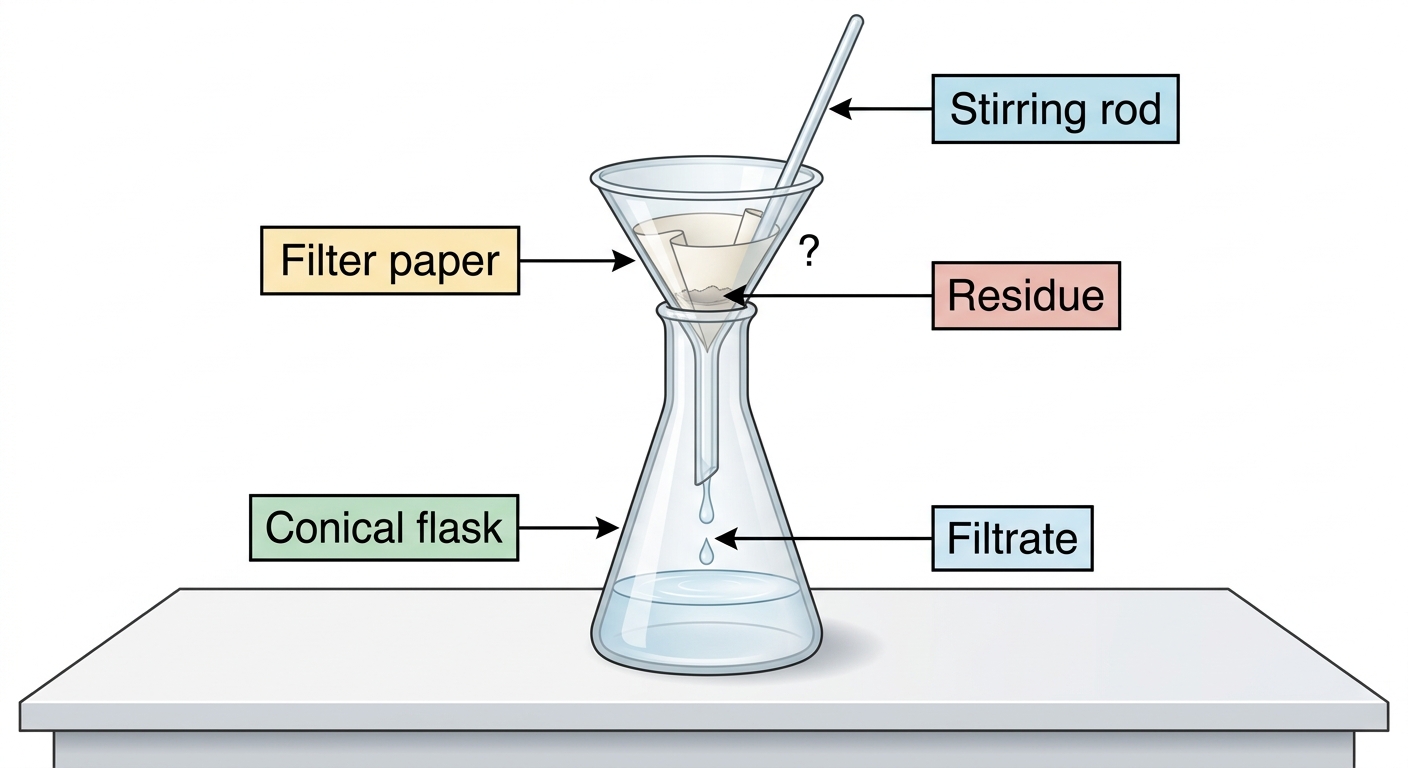
During the preparation of copper sulfate crystals, a student sets up a filtration apparatus to remove excess copper oxide from sulfuric acid.
a
Identify the piece of equipment that holds the filter paper and directs the filtrate into the collection vessel below. [1]
b
Explain why filtration alone is insufficient to obtain pure, dry copper sulfate crystals from the filtrate. [1]

Solutions
2QuestionPreparing Soluble Salts Using Different MethodsAssessment Practice
6 marks~9 minCriterion C
A student adds 0.5 M sodium hydroxide (NaOH) solution in 2 mL increments to 25 mL of 0.5 M hydrochloric acid (HCl), stirring continuously. The pH is recorded after each addition. The resulting titration curve is shown below.
[See graph: pH vs. Volume of NaOH added (mL)]
The curve starts at , rises gradually to approximately at 24 mL, then rises sharply to between 24 mL and 26 mL, before levelling off near .
[See graph: pH vs. Volume of NaOH added (mL)]
The curve starts at , rises gradually to approximately at 24 mL, then rises sharply to between 24 mL and 26 mL, before levelling off near .
a
Construct a calculation to determine the volume of NaOH solution required to completely neutralize the HCl. [2]
b
The student repeats the experiment using 0.5 M potassium hydroxide (KOH) instead of NaOH. Justify whether the volume of KOH required to reach the equivalence point would differ from your answer in part (a). [2]
c
The student claims that adding 30 mL of NaOH instead of 25 mL produces a stronger salt solution. Evaluate this claim, using the pH data and your knowledge of the products formed. [2]
Solutions
3QuestionTesting Salts for Solubility and IdentityAssessment Practice
8 marks~12 minCriterion D
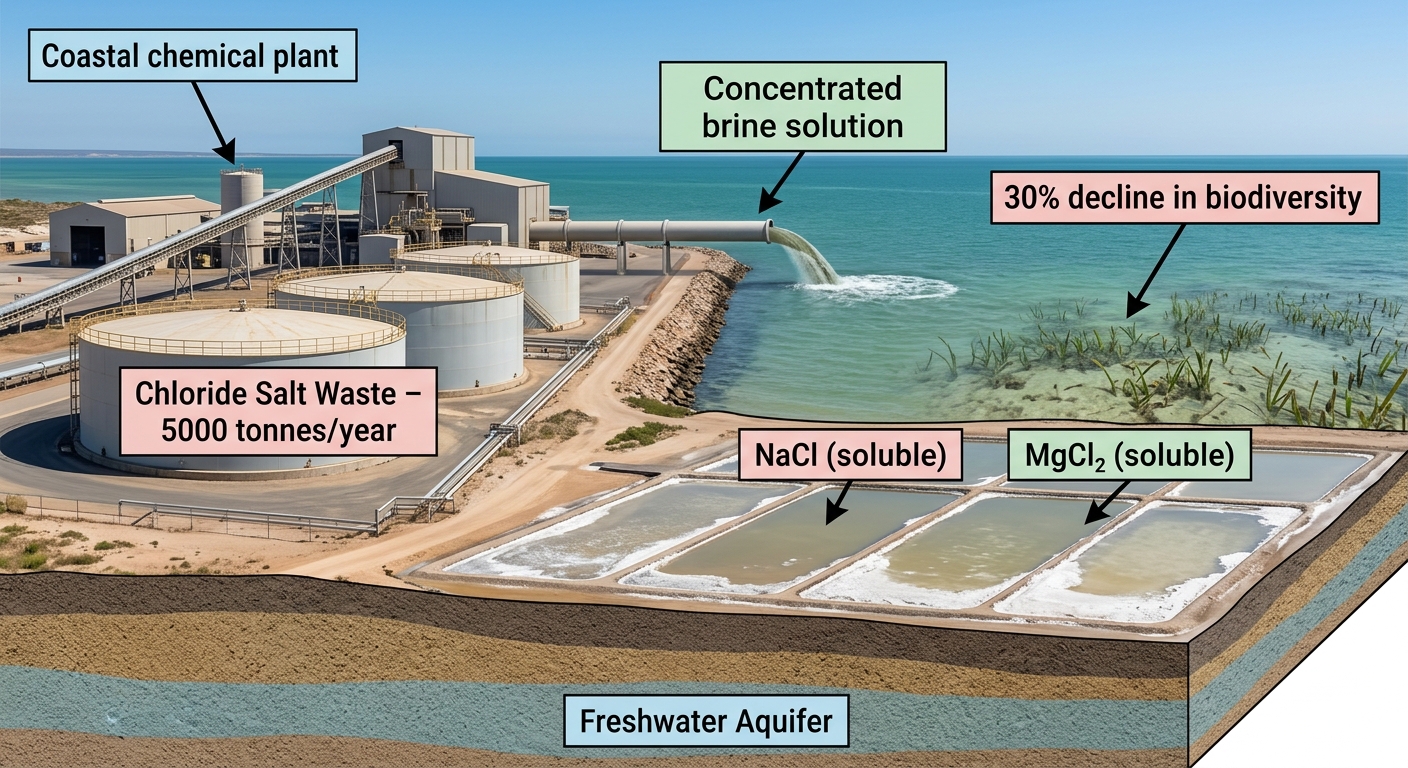
A coastal chemical plant generates 5000 tonnes of salt waste annually — primarily and — dissolved in seawater and discharged as brine into the ocean, causing a 30% decline in local seagrass biodiversity. The company proposes instead evaporating the brine in land-based ponds to produce solid salt for sale as road de-icer. These ponds would be constructed above a freshwater aquifer.
a
Using solubility rules, deduce whether and will precipitate during evaporation in the ponds. [2]
b
Identify one environmental factor not described above that could affect the pond system, and explain how it would alter the risk to the aquifer. [2]
c
Evaluate the trade-offs between ocean discharge and the evaporation pond system, considering environmental, economic, and societal factors. In your answer, discuss why solubility data alone is insufficient to inform this decision. [4]
Solutions
4QuestionPreparing Soluble Salts Using Different MethodsAssessment Practice
6 marks~9 minCriterion B
A student prepares copper(II) sulfate crystals by reacting copper(II) oxide with excess sulfuric acid. The table below shows results from five trials.
| Mass of CuO (g) | 2 | 4 | 6 | 8 | 10 |
|---|---|---|---|---|---|
| Mass of CuSO crystals (g) | 4.8 | 9.6 | 14.4 | 14.4 | 14.4 |
a
Interpret the pattern shown in the data. [2]
b
Deduce the mass of CuSO crystals produced when 5 g of CuO is used, and justify your reasoning using the data. [2]
c
Analyse why the mass of crystals does not increase beyond 6 g of CuO, identifying which reagent limits the reaction and explaining the chemical reason for this behaviour. [2]
Solutions
That's every free question here — 4 of 104.
+100 more questions, plus Mock Papers & Worksheets, are waiting in Premium.