You're viewing free preview questions — 4 questions previewing here — subscribe to unlock 75 more, plus the Full Question Bank, Mock Papers & Worksheets.Upgrade
Neutralization Reactions — Free MYP5 Chemistry Practice Questions

1QuestionDefinition and Real-Life Examples of NeutralizationConcept Practice
3 marks~5 minCriterion A
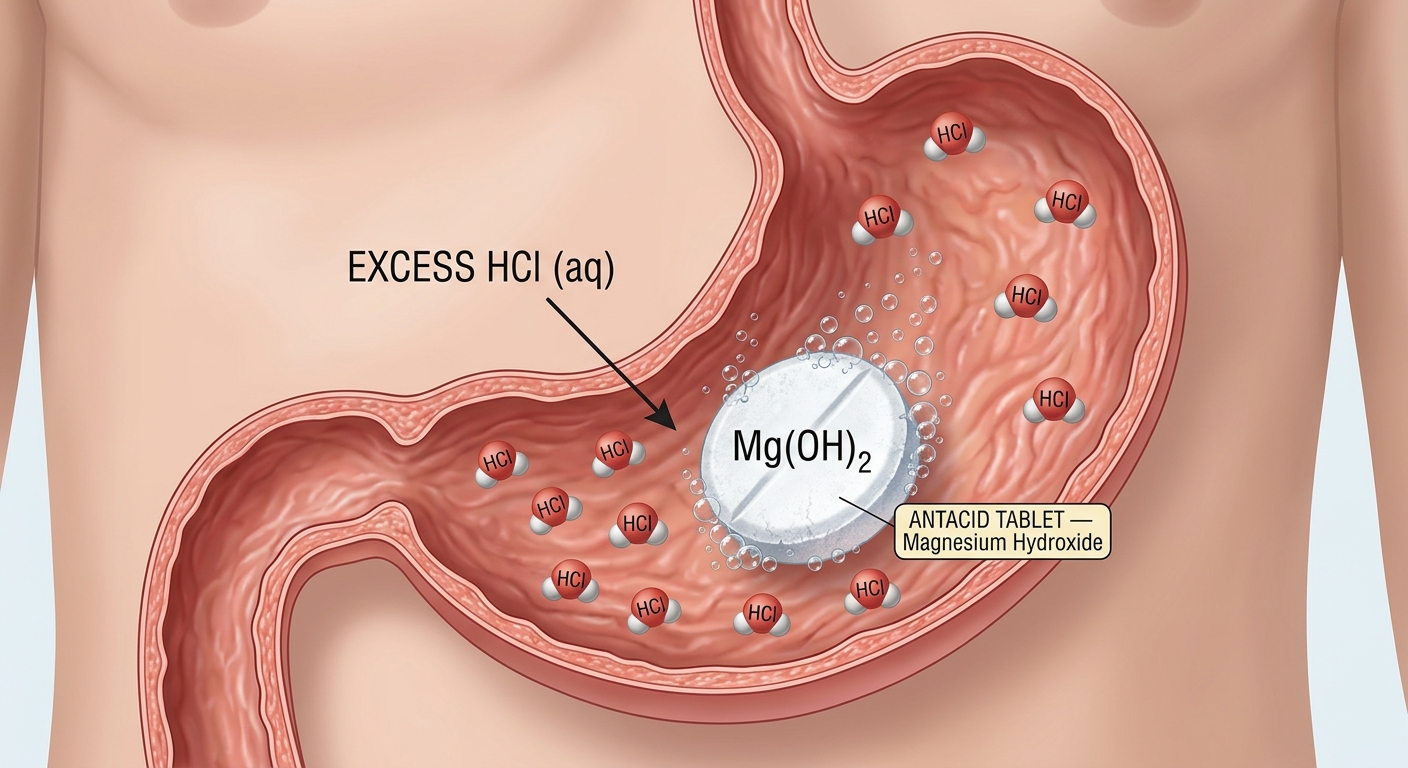
When a patient takes an antacid tablet containing magnesium hydroxide, it reacts with excess hydrochloric acid in the stomach. The reaction reduces stomach acidity and relieves discomfort.
a
Construct the word equation for the neutralization reaction between magnesium hydroxide and hydrochloric acid. [1]
b
Explain why this reaction is classified as a neutralization, referring to the nature of the reactants and the products formed. [2]

Solutions
2QuestionDefinition and Real-Life Examples of NeutralizationAssessment Practice
5 marks~8 minCriterion C
A student investigates the claim that "one antacid tablet completely neutralizes stomach acid." One tablet is added to 100 mL of 0.1 M HCl (simulated stomach acid) and pH is recorded every minute for 10 minutes.
| Time (min) | 0 | 1 | 2 | 3 | 4 | 5 | 6 | 7 | 8 | 9 | 10 |
|---|---|---|---|---|---|---|---|---|---|---|---|
| pH | 1.0 | 1.5 | 2.2 | 3.0 | 3.8 | 4.2 | 4.4 | 4.5 | 4.5 | 4.5 | 4.5 |
a
Define complete neutralization, stating the products formed and the expected final pH. [1]
b
Using the data, identify the final equilibrium pH and explain what it indicates about the extent of the reaction. [2]
c
Evaluate the claim that the tablet completely neutralizes the acid. Justify your conclusion using specific evidence from the data. [2]
Solutions
3QuestionDefinition and Real-Life Examples of NeutralizationAssessment Practice
6 marks~9 minCriterion D
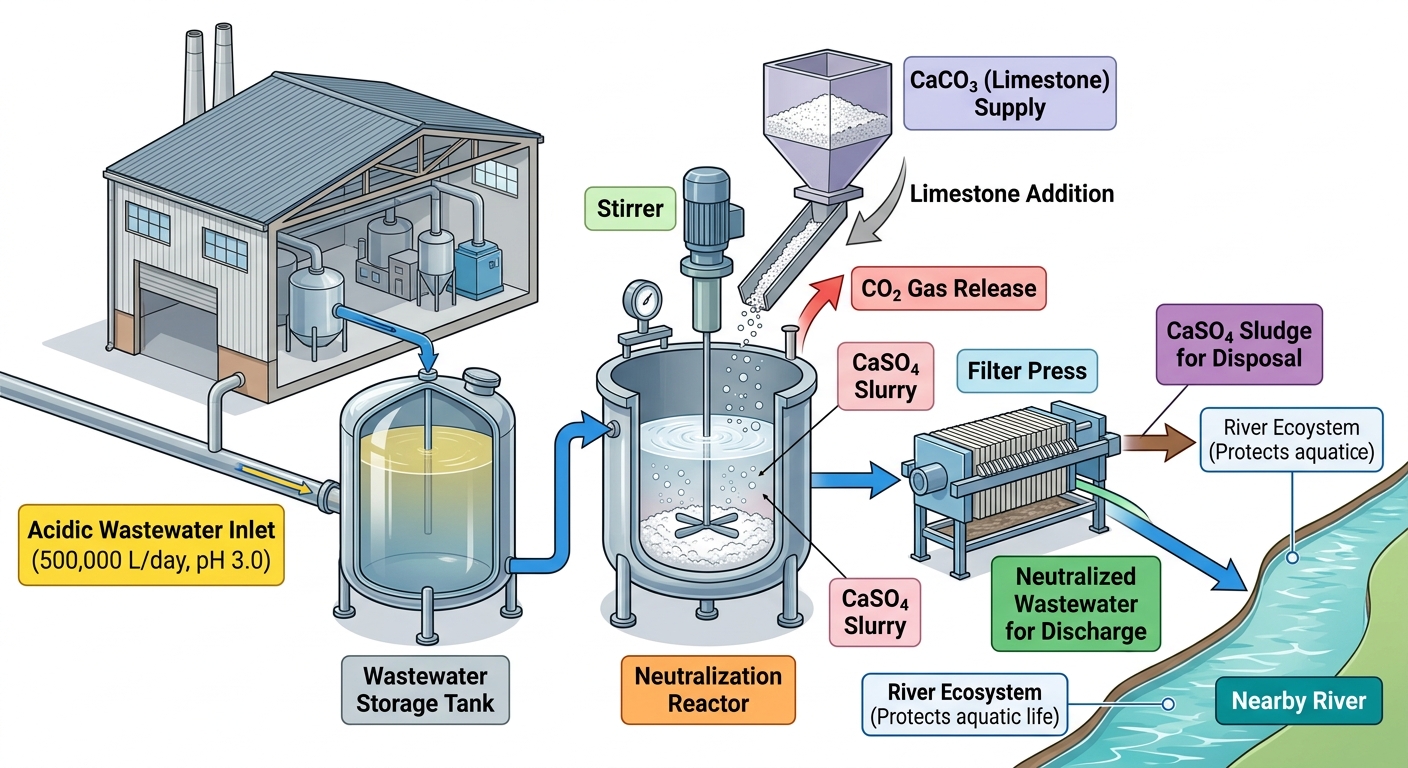
A metal processing factory produces 500,000 litres of acidic wastewater daily at pH 3.0. To neutralise the acid before discharge, the factory uses calcium carbonate (limestone):
The process protects a nearby river but produces CO and generates calcium sulfate sludge requiring landfill disposal.
The process protects a nearby river but produces CO and generates calcium sulfate sludge requiring landfill disposal.
a
State one benefit of this neutralisation process for the river ecosystem. [1]
b
Explain how the by-products of this reaction create new environmental problems. [2]
c
Evaluate whether calcium carbonate is a sustainable long-term solution for this factory, comparing it to at least one alternative treatment method. [3]
Solutions
4QuestionDefinition and Real-Life Examples of NeutralizationAssessment Practice
7 marks~11 minCriterion B
A student investigates the hypothesis: "The type of acid used in a neutralization reaction determines the salt produced." Three acids — hydrochloric acid (), sulfuric acid (), and nitric acid () — are each reacted with sodium hydroxide () solution. All solutions are prepared at 0.1 mol/L. The neutralized solutions are evaporated to obtain solid salts.
a
Construct a list of all materials and chemicals required for this experiment. [2]
b
Outline a step-by-step procedure that controls all relevant variables. [2]
c
Identify the independent variable and the dependent variable. [1]
d
Explain how two controlled variables make this experiment a fair test. [2]
Solutions
That's every free question here — 4 of 79.
+75 more questions, plus Mock Papers & Worksheets, are waiting in Premium.