You're viewing free preview questions — 6 questions previewing here — subscribe to unlock 61 more, plus the Full Question Bank, Mock Papers & Worksheets.Upgrade
Back

Chemical Formulas and Equations — Free MYP5 Chemistry Practice Questions

Free questions

Open in full, with answers, mark scheme and examiner insights.

Question 1Criterion A · Band 3-4 · Easy · 7 marksrevisionprep.com

Writing Chemical Formulas of Compounds

The diagram shows the electron arrangements of a sodium atom (11 protons) and a chlorine atom (17 protons), and the ions formed when one electron is transferred.
(a)
State the charge on each ion formed and explain, using the diagram, why each ion has this charge. [3]Criterion A (i) · Level 3-4
(b)
Explain why the formula of sodium chloride is NaCl\mathrm{NaCl} and not NaCl2\mathrm{NaCl_{2}}. [2]Criterion A (i) · Level 3-4
(c)
Oxygen atoms gain two electrons to form oxide ions. Deduce the formula of sodium oxide and justify your answer using ionic charges. [2]Criterion A (ii) · Level 3-4

revisionprep.com

Summary Answer

Not available for this question.

Model Answer

Not available for this question.

Marking Scheme

Not available for this question.

Examiner Insights

Not available for this question.

Question 2Criterion A · Band 1-2 · Easy · 4 marksrevisionprep.com

Word Equations and Symbol Equations

When a small piece of calcium is dropped into water, it fizzes and the water turns cloudy. The products are calcium hydroxide and hydrogen.
(a)
Write down the word equation for this reaction. [1]Criterion A (i) · Level 1-2
(b)
State one piece of information that a balanced symbol equation gives but a word equation does not. [1]Criterion A (i) · Level 1-2
(c)
A student writes: calcium + water → calcium hydroxide. Explain why this word equation is incomplete. [2]Criterion A (ii) · Level 1-2

revisionprep.com

Summary Answer

Not available for this question.

Model Answer

Not available for this question.

Marking Scheme

Not available for this question.

Examiner Insights

Not available for this question.

Question 3Criterion B · Band 3-6 · Medium · 9 marksrevisionprep.com

Word Equations and Symbol Equations

Bath bombs fizz in water because sodium hydrogencarbonate reacts with citric acid:

sodium hydrogencarbonate + citric acid → sodium citrate + water + carbon dioxide

A student says: "When a bath bomb fizzes, mass is lost, so mass is not conserved in this reaction." You are asked to plan an investigation to test this claim.
(a)
Explain the problem that the investigation needs to test. [2]Criterion B (i) · Level 3-4
(b)
Formulate a testable hypothesis for an open beaker and for a sealed container, and explain it using the word equation. [2]Criterion B (ii) · Level 5-6
(c)
Explain how you would manipulate the independent variable, measure the dependent variable and control two other variables. [3]Criterion B (iii) · Level 5-6
(d)
Outline how you would collect sufficient data, and state one safety precaution. [2]Criterion B (iii), B (iv) · Level 5-6

revisionprep.com

Summary Answer

Not available for this question.

Model Answer

Not available for this question.

Marking Scheme

Not available for this question.

Examiner Insights

Not available for this question.

Question 4Criterion A · Band 1-6 · Medium · 6 marksrevisionprep.com

Identifying Reactants and Products

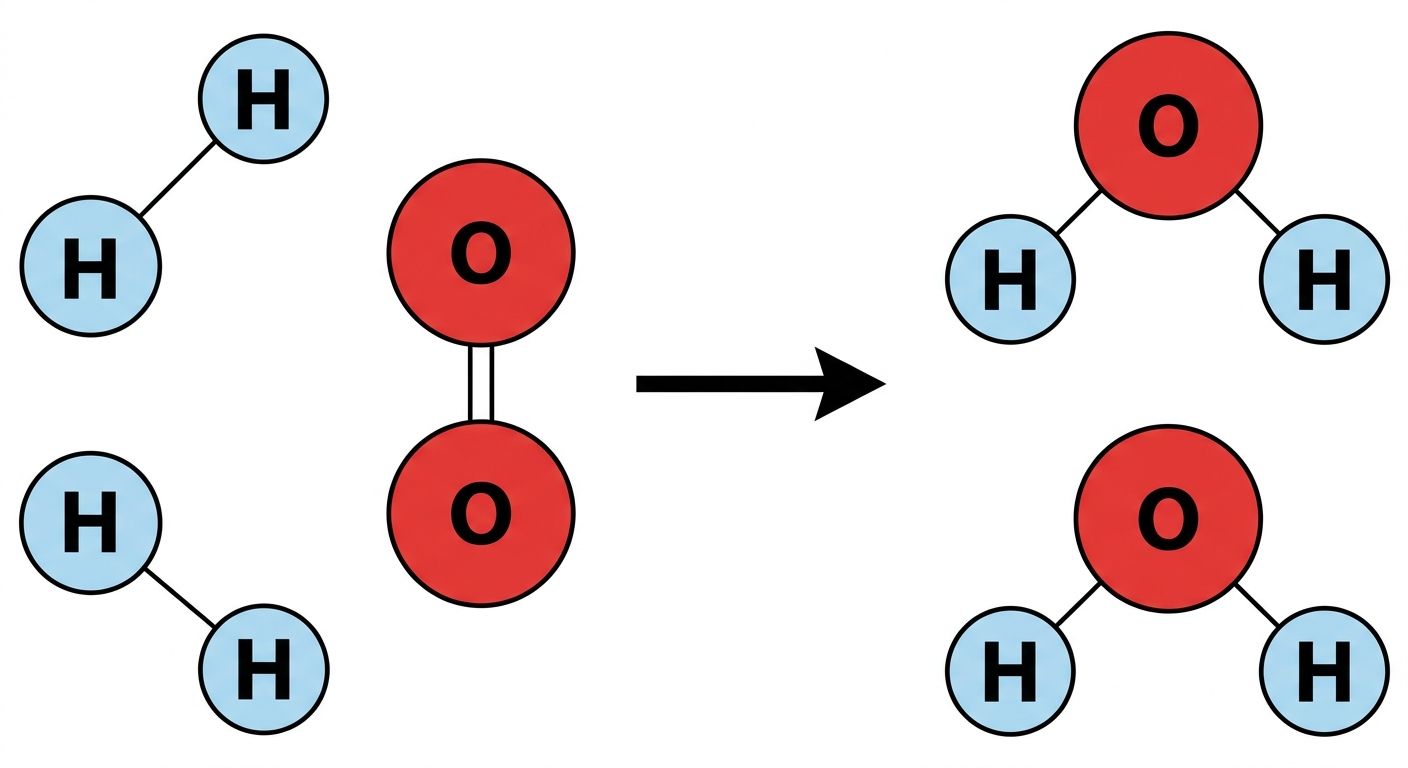
The diagram shows the particles before and after a reaction between hydrogen and oxygen.
Question diagram
(a)
Identify the reactants and the product shown in the diagram. [1]Criterion A (i) · Level 1-2
(b)
Deduce the balanced symbol equation shown by the diagram. [1]Criterion A (ii) · Level 3-4
(c)
Explain what the diagram shows about what happens to atoms and bonds in a chemical reaction, and why mass is conserved. [2]Criterion A (i) · Level 3-4
(d)
Three O2\mathrm{O_{2}} molecules, instead of one, are mixed with two H2\mathrm{H_{2}} molecules. Deduce the particles present after the reaction. [2]Criterion A (iii) · Level 5-6

revisionprep.com

Summary Answer

Not available for this question.

Model Answer

Not available for this question.

Marking Scheme

Not available for this question.

Examiner Insights

Not available for this question.

Question 5Criterion C · Band 3-8 · Challenge · 12 marksrevisionprep.com

Writing Chemical Formulas of Compounds

A student heats different masses of iron powder with an excess of sulfur. After each reaction the unreacted sulfur is removed and the black iron sulfide is weighed.

Mass of iron / gMass of iron sulfide / g0.560.881.121.761.682.402.243.522.804.40\begin{array}{|l|c|}\hline \text{Mass of iron / g} & \text{Mass of iron sulfide / g} \\ \hline 0.56 & 0.88 \\ \hline 1.12 & 1.76 \\ \hline 1.68 & 2.40 \\ \hline 2.24 & 3.52 \\ \hline 2.80 & 4.40 \\ \hline\end{array}

Relative atomic masses: Fe = 56, S = 32.
(a)
Plot a graph of mass of iron sulfide against mass of iron, and draw a straight line of best fit through the origin. [3]Criterion C (i) · Level 5-6
(b)
Identify the anomalous result and suggest one reason for it. [2]Criterion C (iv) · Level 3-4
(c)
Determine the gradient of your line. [2]Criterion C (ii) · Level 5-6
(d)
Calculate the mass of iron sulfide that 1.00 g of iron would form if the product were FeS\mathrm{FeS}, and if it were Fe2S3\mathrm{Fe_{2}S_{3}}. [2]

(e) Evaluate the hypothesis that the product is FeS\mathrm{FeS} rather than Fe2S3\mathrm{Fe_{2}S_{3}}. [3]
Criterion C (i) · Level 5-6

revisionprep.com

Summary Answer

Not available for this question.

Model Answer

Not available for this question.

Marking Scheme

Not available for this question.

Examiner Insights

Not available for this question.

Question 6Criterion D + A · Band 1-8 · Challenge · 10 marksrevisionprep.com

State Symbols in Chemical Reactions

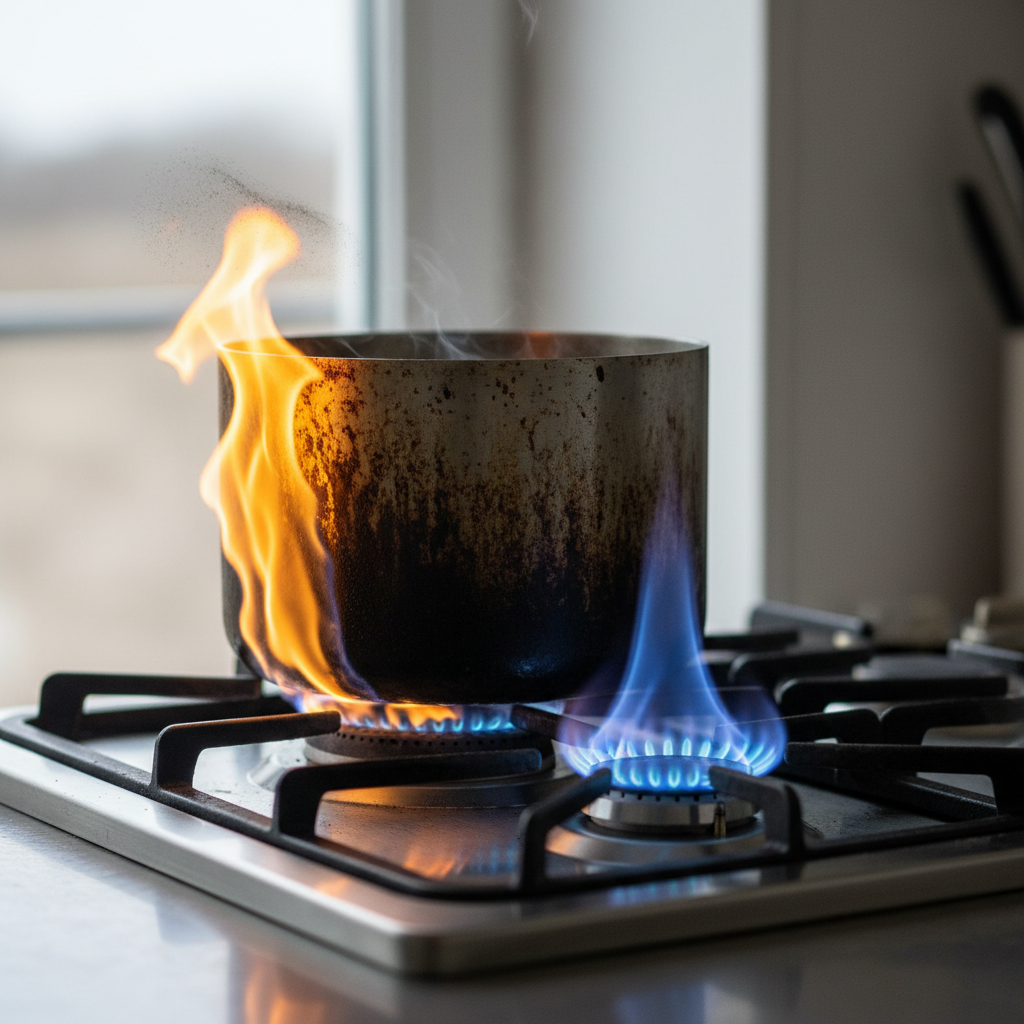
The photograph shows two burners on a gas cooker burning methane. One gives a clean blue flame. The other gives a yellow flame that leaves black soot on the pan, because its air supply is partly blocked.
Question diagram
(a)
Deduce the balanced symbol equation, including state symbols, for the incomplete combustion of methane to form carbon monoxide and water vapour. [2]Criterion A (ii) · Level 5-6
(b)
State the formula and state symbol of soot. [1]Criterion A (i) · Level 1-2
(c)
Explain why the yellow flame produces carbon monoxide and soot. [2]Criterion D (i) · Level 3-4
(d)
Some countries require a carbon monoxide alarm in every home with a gas cooker or boiler. Discuss whether this should be a legal requirement, referring to at least two perspectives. [5]Criterion D (ii), D (iii) · Level 7-8

revisionprep.com

Summary Answer

Not available for this question.

Model Answer

Not available for this question.

Marking Scheme

Not available for this question.

Examiner Insights

Not available for this question.

That's every free question here — 6 of 67.

+61 more questions, plus Mock Papers & Worksheets, are waiting in Premium.

Upgrade