You're viewing free preview questions — 6 questions previewing here — subscribe to unlock 88 more, plus the Full Question Bank, Mock Papers & Worksheets.Upgrade
Back

Reactivity series and displacement — Free MYP5 Chemistry Practice Questions

Free questions

Open in full, with answers, mark scheme and examiner insights.

Question 1Criterion A · Band 1-2 · Easy · 2 marksrevisionprep.com

Corrosion and Methods of prevention

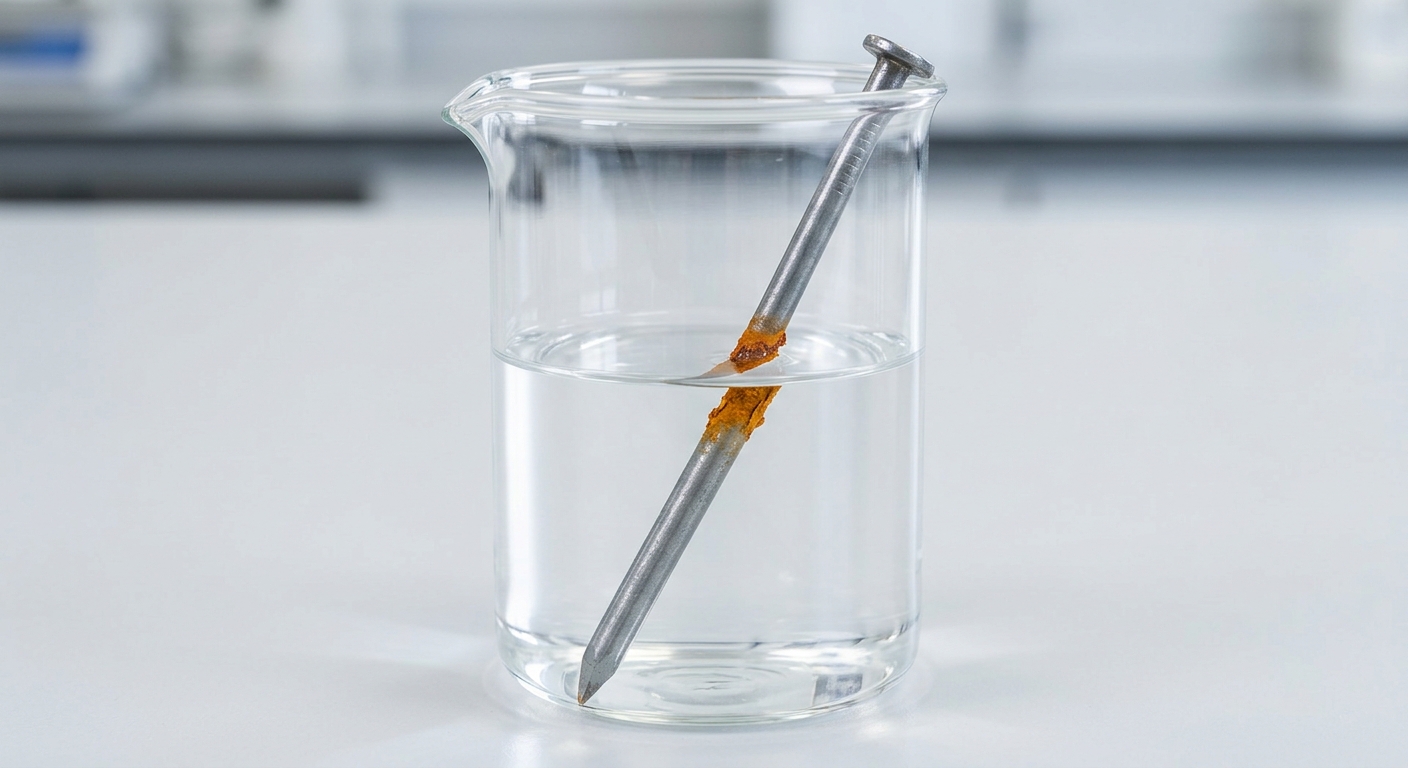
An iron nail is partially submerged in water open to the air. After several days, a reddish-brown deposit forms at the air-water interface.
Question diagram
(a)
State the chemical name of the reddish-brown deposit. [1]Criterion A (i) · Level 1-2
(b)
State the two essential conditions required for this deposit to form. [1]Criterion A (i) · Level 1-2

revisionprep.com

Summary Answer

Not available for this question.

Model Answer

Not available for this question.

Marking Scheme

Not available for this question.

Examiner Insights

Not available for this question.

Question 2Criterion A · Band 1-4 · Easy · 4 marksrevisionprep.com

Applications of Reactivity in Industry and Everyday Life
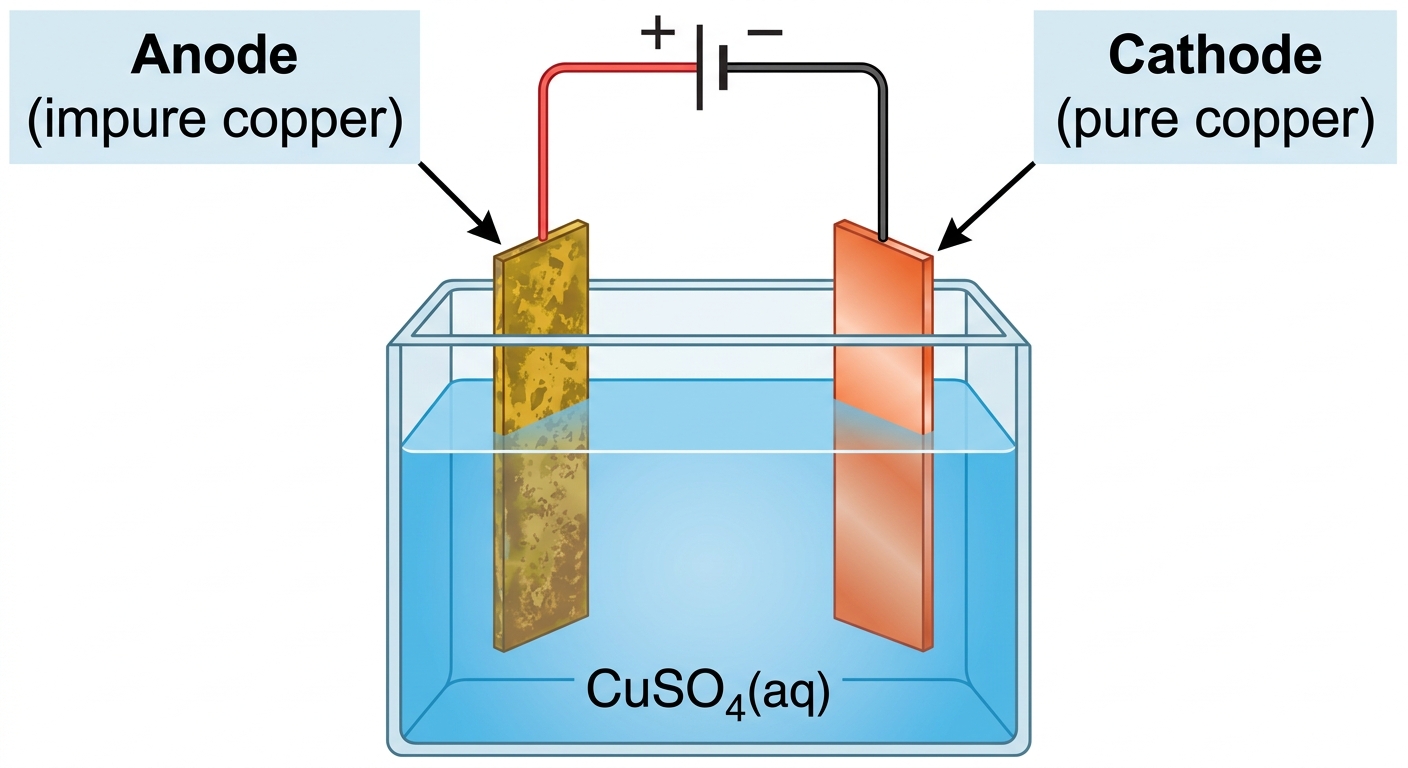
The diagram shows a cell used to purify copper. The anode is impure copper, the cathode is pure copper and the electrolyte is copper(II) sulfate solution. Impurities collect as a sludge below the anode.
Question diagram
(a)
Identify the substance deposited on the cathode. [1]Criterion A (i) · Level 1-2
(b)
Write the half-equation for the reaction at the anode. [1]Criterion A (ii) · Level 3-4
(c)
Explain why the copper deposited on the cathode is purer than the anode. [2]Criterion A (i) · Level 3-4

revisionprep.com

Summary Answer

Not available for this question.

Model Answer

Not available for this question.

Marking Scheme

Not available for this question.

Examiner Insights

Not available for this question.

Question 3Criterion D + A · Band 3-6 · Medium · 6 marksrevisionprep.com

Displacement Reactions Using Metals

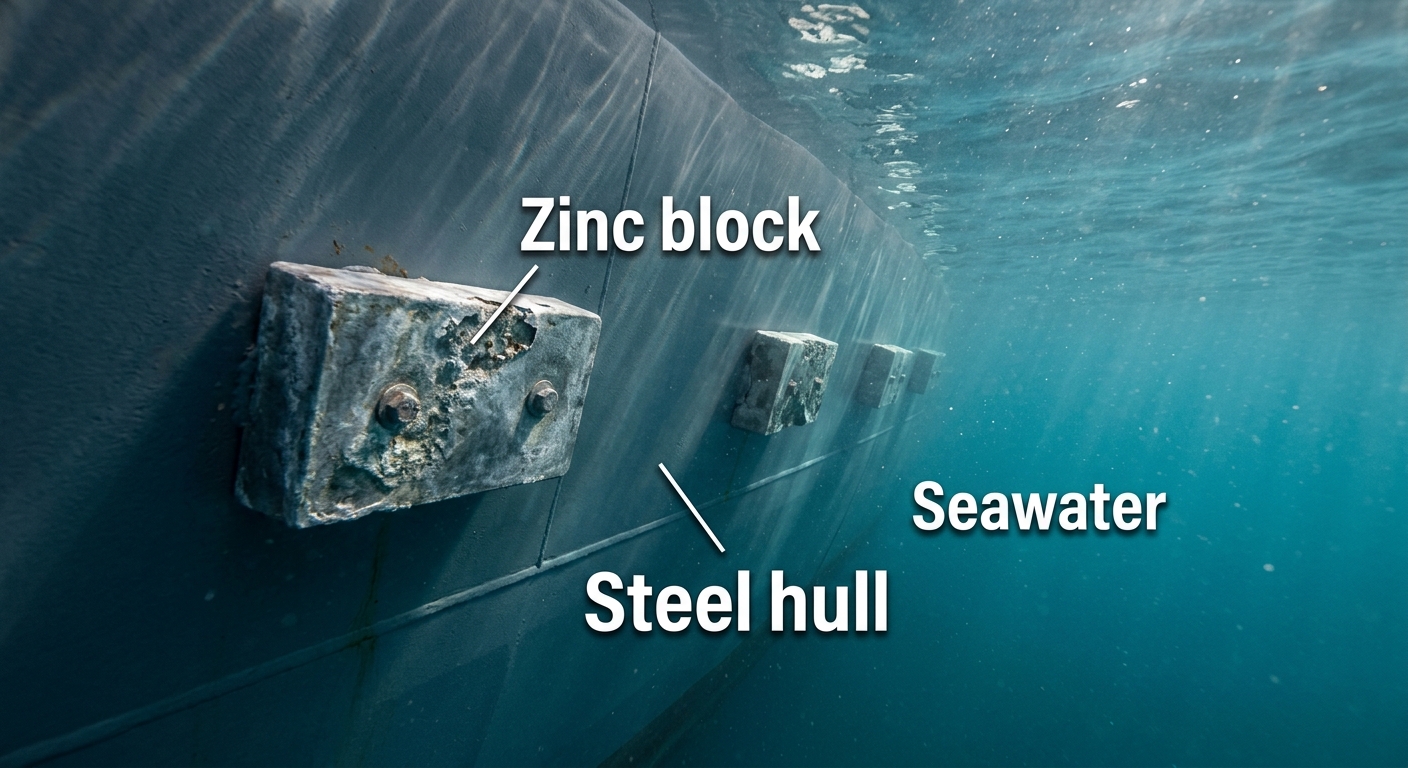
The photograph shows a zinc block bolted to the steel hull of a ship. A new block has a mass of 6.5 kg and loses about 1.3 kg each year. Blocks must be replaced before less than 25% of the original mass remains.
Question diagram
(a)
Explain why zinc blocks protect the steel hull. [1]Criterion A (i) · Level 3-4
(b)
Calculate how long, in years, a block can be left before it reaches 25% of its original mass. [2]Criterion D (i) · Level 5-6
(c)
The ship's owner can replace blocks every 3 years or every 4 years. Justify which interval should be chosen. [1]Criterion D (i) · Level 5-6
(d)
Discuss one implication of fitting zinc blocks for the marine environment around a busy harbour. [2]Criterion D (ii) · Level 5-6

revisionprep.com

Summary Answer

Not available for this question.

Model Answer

Not available for this question.

Marking Scheme

Not available for this question.

Examiner Insights

Not available for this question.

Question 4Criterion C · Band 3-6 · Medium · 5 marksrevisionprep.com

Predicting Products Based on Reactivity
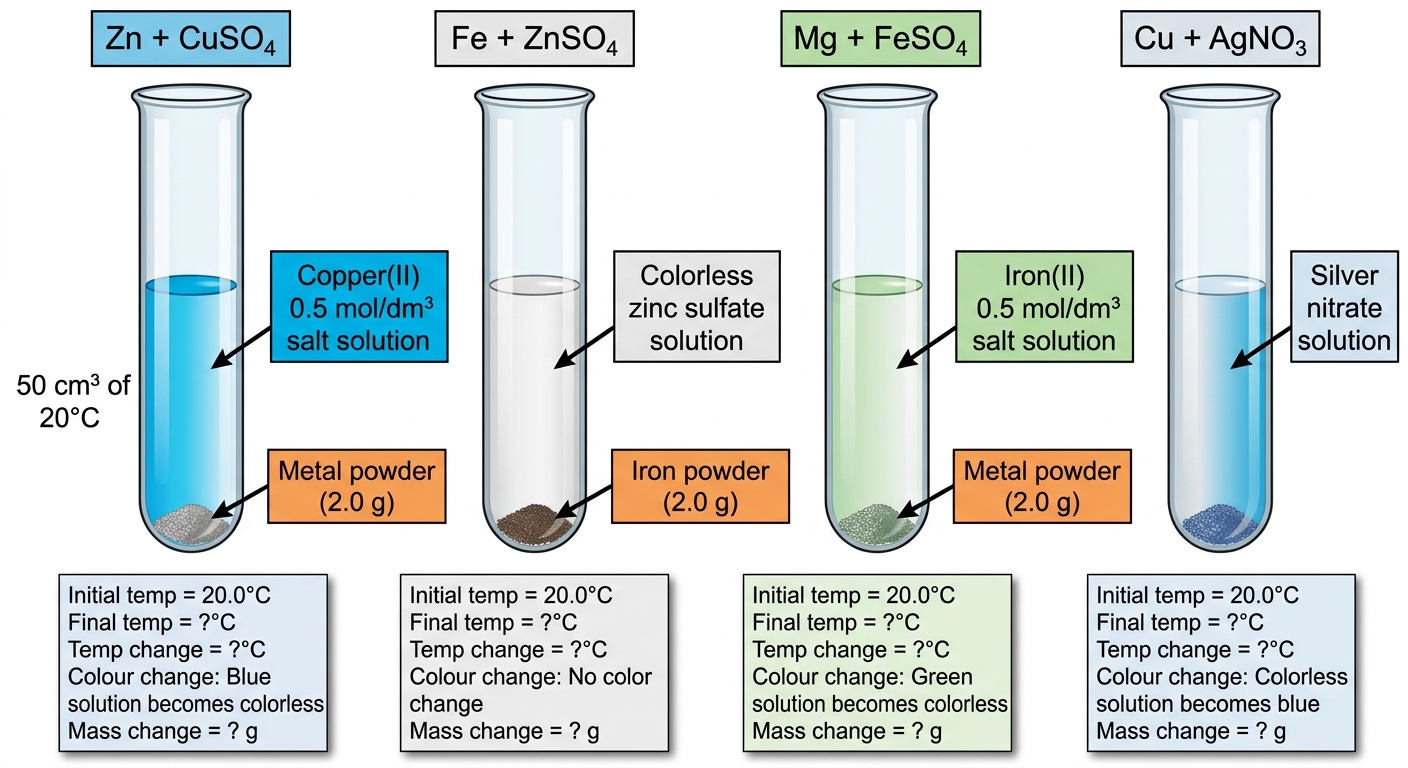
A student hypothesises: "When a more reactive metal is placed into a salt solution of a less reactive metal, the temperature rise is directly proportional to the difference in reactivity between the two metals." Four experiments are conducted, each using 50 cm350 \ \text{cm}^3 of 0.5 mol dm−30.5 \ \text{mol dm}^{-3} salt solution at 20.0∘C20.0^\circ\text{C} and 2.0 g2.0 \ \text{g} of metal powder.

ExperimentTemperature change (∘C)Colour changeZinc with copper(II) sulfate8.5blue to colourlessIron with zinc sulfate1.0noneMagnesium with iron(II) sulfate12.0green to colourlessCopper with silver nitrate7.0colourless to blue\begin{array}{|l|c|c|}\hline \text{Experiment} & \text{Temperature change ($^\circ\text{C}$)} & \text{Colour change} \\ \hline \text{Zinc with copper(II) sulfate} & 8.5 & \text{blue to colourless} \\ \hline \text{Iron with zinc sulfate} & 1.0 & \text{none} \\ \hline \text{Magnesium with iron(II) sulfate} & 12.0 & \text{green to colourless} \\ \hline \text{Copper with silver nitrate} & 7.0 & \text{colourless to blue} \\ \hline\end{array}
Question diagram
(a)
State the reactivity series order for the five metals involved and deduce which experiments should produce a displacement reaction. [2]Criterion C (ii) · Level 3-4
(b)
Identify the anomalous result and explain one possible reason for it. [1]Criterion C (iv) · Level 5-6
(c)
Evaluate whether the experimental data support the student's hypothesis. [2]Criterion C (iii) · Level 5-6

revisionprep.com

Summary Answer

Not available for this question.

Model Answer

Not available for this question.

Marking Scheme

Not available for this question.

Examiner Insights

Not available for this question.

Question 5Criterion B · Band 3-8 · Challenge · 9 marksrevisionprep.com

Reactivity of metals with water, acid and oxygen

Kofi wants to compare the reactivity of magnesium, zinc and iron by reacting each metal with dilute hydrochloric acid. He has a gas syringe, conical flasks with bungs and delivery tubes, a stopclock, a balance (±0.01 g), 1.0 mol dm⁻³ hydrochloric acid and powders of the three metals.
(a)
State a focused research question for this investigation. [1]Criterion B (i) · Level 3-4
(b)
Formulate a testable hypothesis and explain it using scientific reasoning. [2]Criterion B (ii) · Level 5-6
(c)
Identify the independent and dependent variables, and explain how two control variables will be kept the same. [3]Criterion B (iii) · Level 5-6
(d)
Describe a safe method that would collect sufficient, relevant data, including how many results will be recorded and how they will be repeated. [3]Criterion B (iv) · Level 7-8

revisionprep.com

Summary Answer

Not available for this question.

Model Answer

Not available for this question.

Marking Scheme

Not available for this question.

Examiner Insights

Not available for this question.

Question 6Criterion A + C · Band 3-8 · Challenge · 8 marksrevisionprep.com

The Reactivity Series of Metals

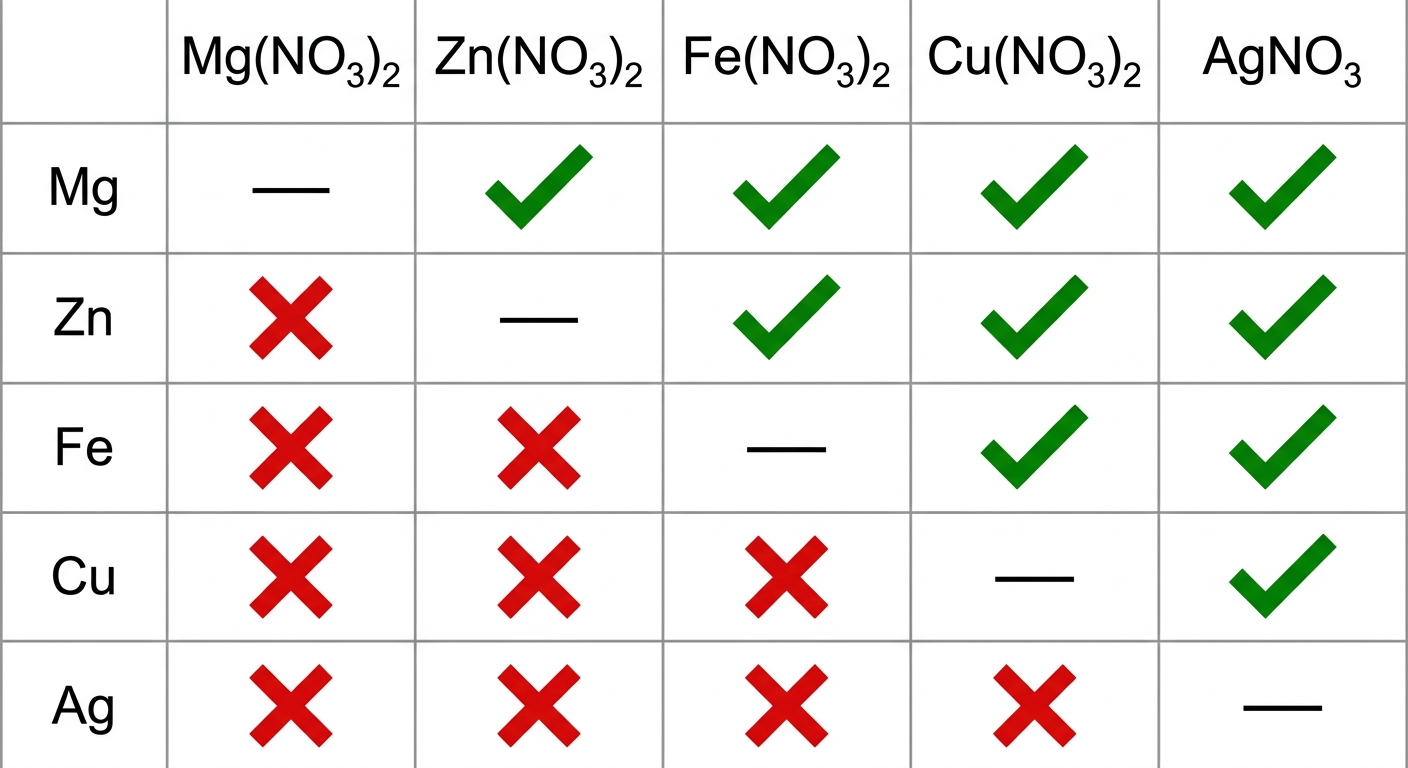
A student investigates displacement reactions by placing five metals into aqueous nitrate solutions of the same metals. The results are shown in the table: a tick means the metal displaced the other metal from solution, a cross means no reaction, and a dash means the metal was not tested in its own solution.

Metal added | Mg(NO₃)₂ | Zn(NO₃)₂ | Fe(NO₃)₂ | Cu(NO₃)₂ | AgNO₃
Mg:✓ ✓ ✓ ✓
Zn✗✓ ✓ ✓
Fe✗ ✗✓ ✓
Cu✗ ✗ ✗✓

Ag: ✗ ✗ ✗ ✗ |
Question diagram
(a)
Deduce the order of decreasing reactivity of the five metals and explain the pattern in the data that allows this order to be determined. [2]Criterion C (ii) · Level 3-4
(b)
Deduce whether a reaction occurs when zinc is placed into iron(II) nitrate solution, Fe(NO₃)₂(aq). Write the balanced chemical equation with state symbols if a reaction occurs, or state "no reaction." [2]Criterion A (ii) · Level 3-4
(c)
A student claims: "Any metal will displace any other metal from its nitrate solution, provided enough time is given." Evaluate this claim by referring to the reactivity order from (a) and explaining the electron transfer process that determines whether displacement occurs. [4]Criterion A (i) · Level 7-8

revisionprep.com

Summary Answer

Not available for this question.

Model Answer

Not available for this question.

Marking Scheme

Not available for this question.

Examiner Insights

Not available for this question.

That's every free question here — 6 of 94.

+88 more questions, plus Mock Papers & Worksheets, are waiting in Premium.

Upgrade