You're viewing free preview questions — 6 questions previewing here — subscribe to unlock 52 more, plus the Full Question Bank, Mock Papers & Worksheets.Upgrade
Back

Redox, electrolysis and cells — Free MYP5 Chemistry Practice Questions

Free questions

Open in full, with answers, mark scheme and examiner insights.

Question 1Criterion A · Band 3-4 · Easy · 3 marksrevisionprep.com

Redox Reactions

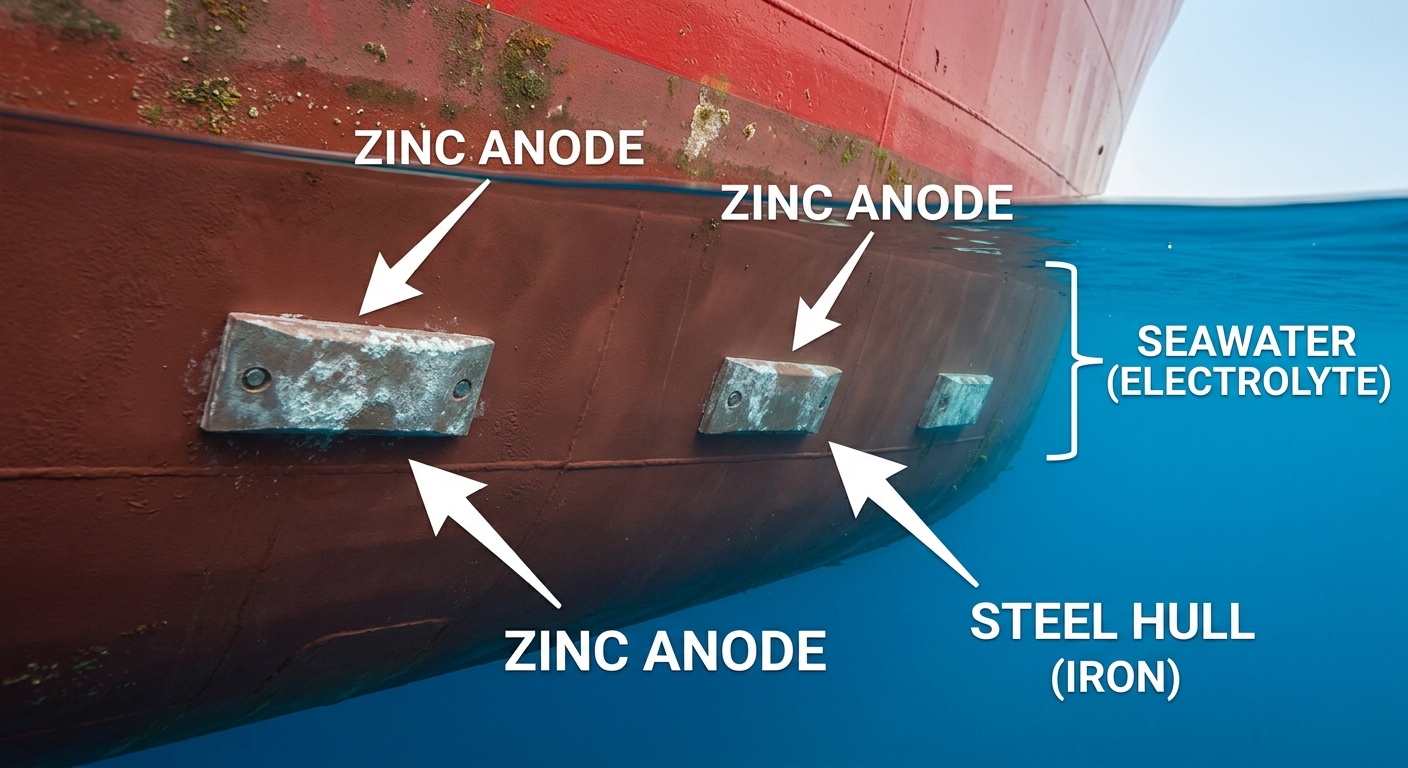
The photograph shows zinc blocks bolted to the steel hull of a ship below the waterline. Seawater is in contact with both metals.
Question diagram
(a)
Write the half-equation for the change that happens to the zinc. [1]Criterion A (ii) · Level 3-4
(b)
Explain, in terms of electrons, why the steel hull does not rust while the zinc blocks remain. [2]Criterion A (i) · Level 3-4

revisionprep.com

Summary Answer

Not available for this question.

Model Answer

Not available for this question.

Marking Scheme

Not available for this question.

Examiner Insights

Not available for this question.

Question 2Criterion A · Band 1-4 · Easy · 2 marksrevisionprep.com

Extraction of metals: carbon reduction and electrolysis
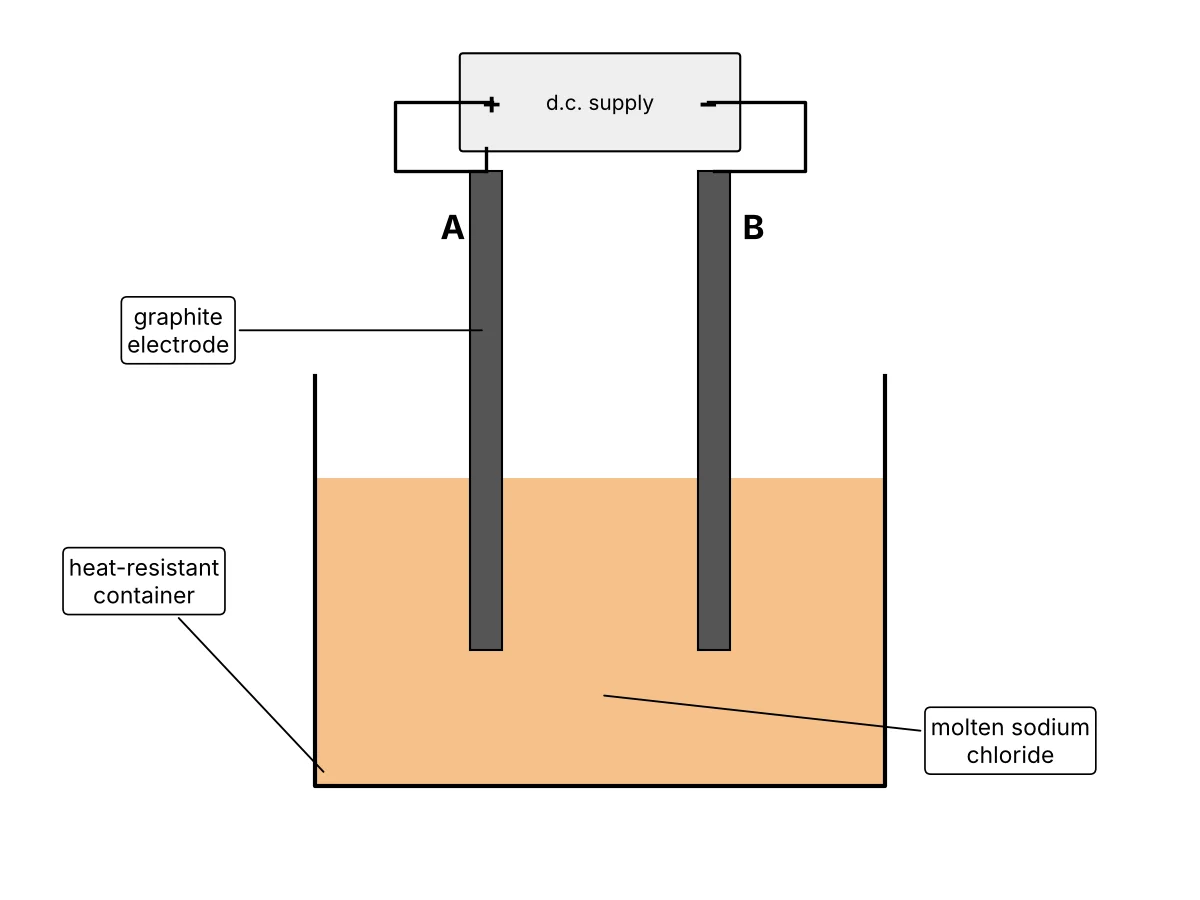
An electrolytic cell is used to decompose molten sodium chloride (NaCl\text{NaCl}). The cell contains a power source, two electrodes (A and B), and molten NaCl\text{NaCl} as the electrolyte. Electrode A is connected to the positive terminal of the power source; electrode B is connected to the negative terminal.
Question diagram
(a)
Deduce which electrode (A or B) is the cathode. [1]Criterion A (ii) · Level 1-2
(b)
Explain the direction of electron flow through the entire external circuit, from the power source to the electrodes. [1]Criterion A (i) · Level 3-4

revisionprep.com

Summary Answer

Not available for this question.

Model Answer

Not available for this question.

Marking Scheme

Not available for this question.

Examiner Insights

Not available for this question.

Question 3Criterion A · Band 1-6 · Medium · 7 marksrevisionprep.com

Redox Reactions

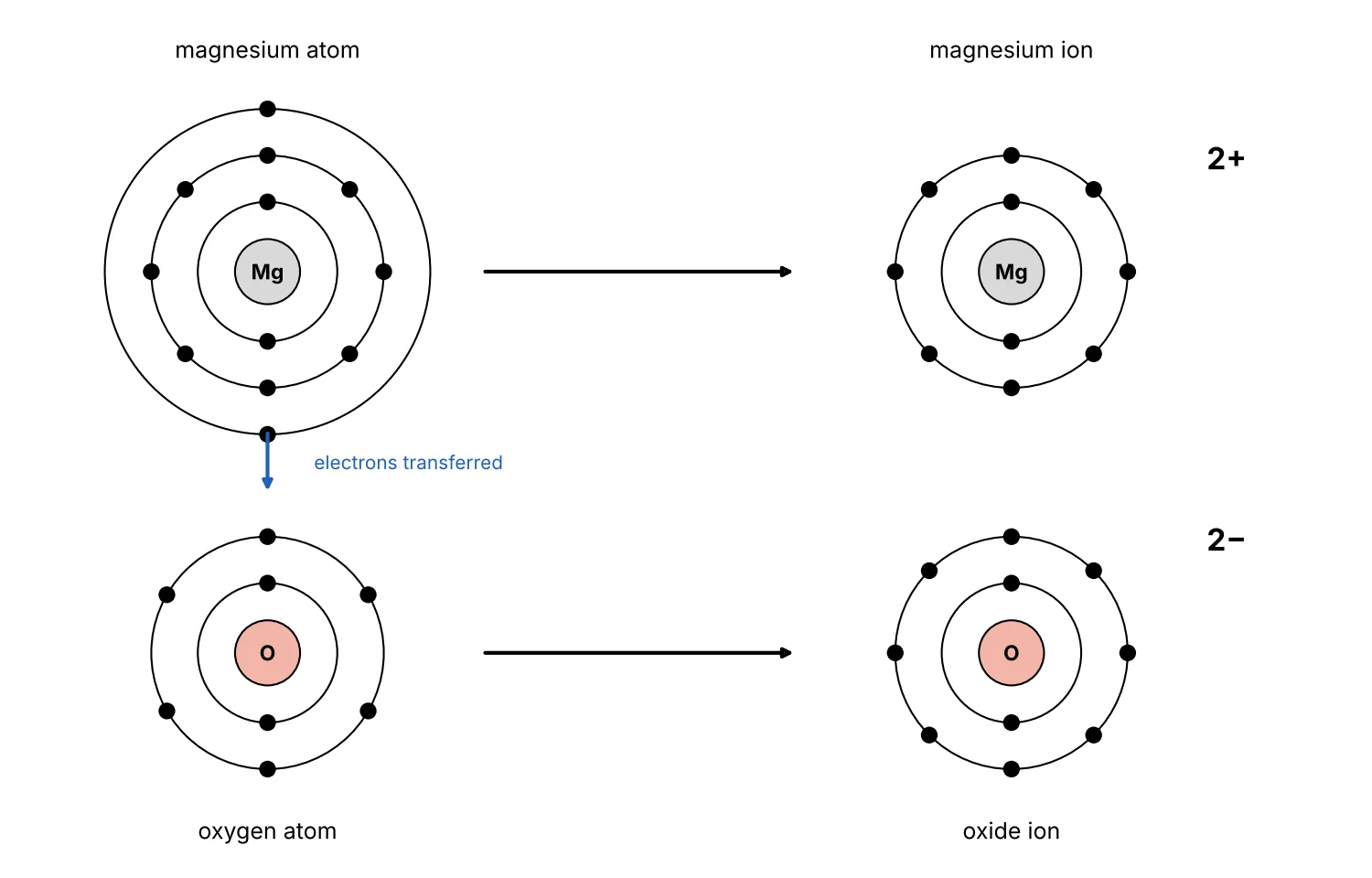
The diagram shows what happens to the electrons when magnesium burns in oxygen to form magnesium oxide.
Question diagram
(a)
Use the diagram to write the electron arrangement of a magnesium atom and of a magnesium ion. [2]Criterion A (ii) · Level 1-2
(b)
Write half-equations for the change to the magnesium atom and for the change to the oxygen atom. [2]Criterion A (ii) · Level 3-4
(c)
Identify the oxidising agent and give a reason. [1]Criterion A (ii) · Level 3-4
(d)
Explain why the formation of magnesium oxide is a redox reaction, using both the oxygen definition and the electron definition. [2]Criterion A (i) · Level 5-6

revisionprep.com

Summary Answer

Not available for this question.

Model Answer

Not available for this question.

Marking Scheme

Not available for this question.

Examiner Insights

Not available for this question.

Question 4Criterion B + A · Band 3-6 · Medium · 8 marksrevisionprep.com

Electrolysis of molten and aqueous compounds (electrodes and products)
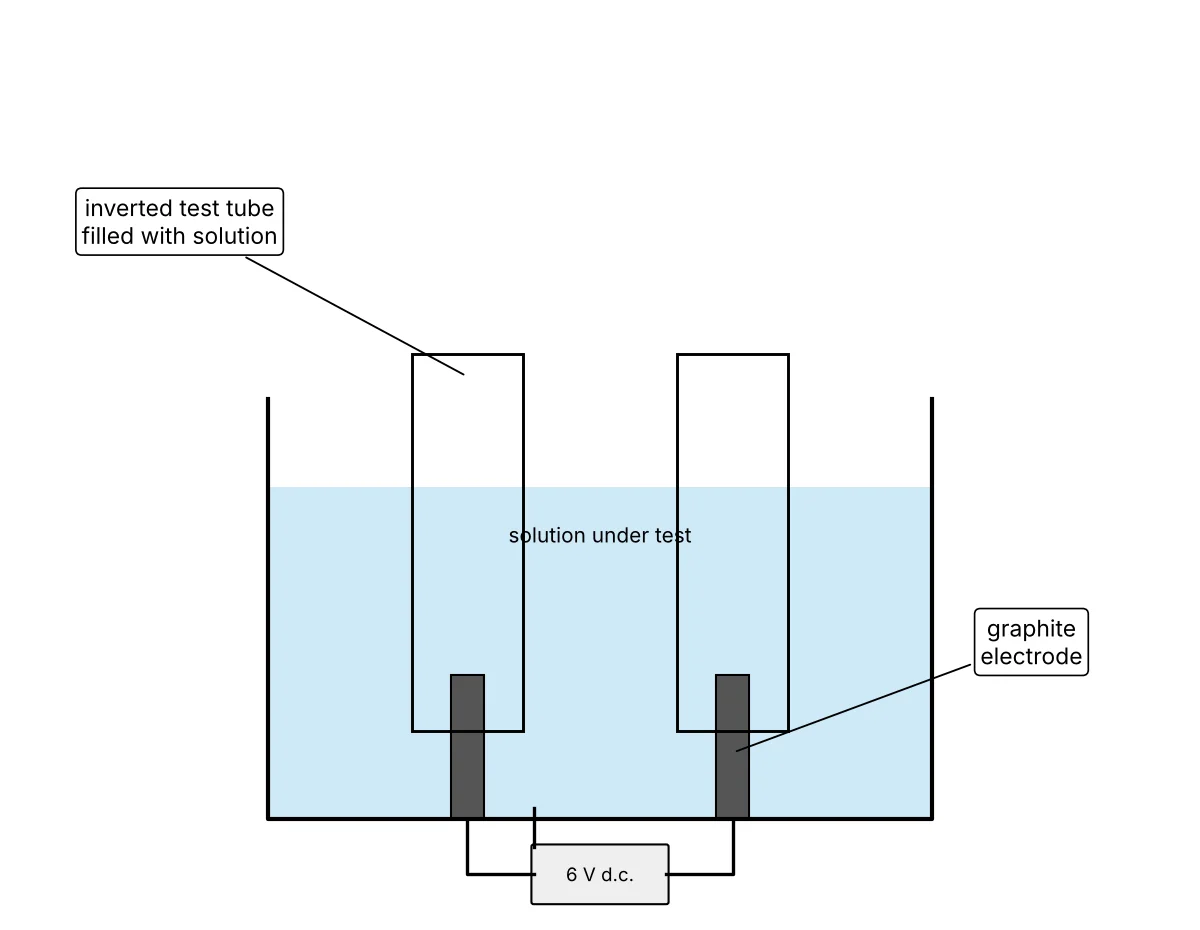
A student wants to find which product forms at each electrode when four aqueous solutions are electrolysed: copper(II) sulfate, sodium chloride, potassium iodide and dilute sulfuric acid. The apparatus is shown in the diagram.
Question diagram
(a)
Formulate a hypothesis for the product at the cathode for these solutions, and explain it using the reactivity series. [2]Criterion B (ii) · Level 5-6
(b)
Identify two variables that must be controlled, and state how each is kept the same. [2]Criterion B (iii) · Level 5-6
(c)
Describe how the student could identify each possible product, and give one safety precaution. [3]Criterion B (iv) · Level 5-6
(d)
Write the half-equation for the formation of copper at the cathode. [1]Criterion A (ii) · Level 3-4

revisionprep.com

Summary Answer

Not available for this question.

Model Answer

Not available for this question.

Marking Scheme

Not available for this question.

Examiner Insights

Not available for this question.

Question 5Criterion C + A · Band 3-8 · Challenge · 8 marksrevisionprep.com

Electrolysis of molten and aqueous compounds (electrodes and products)
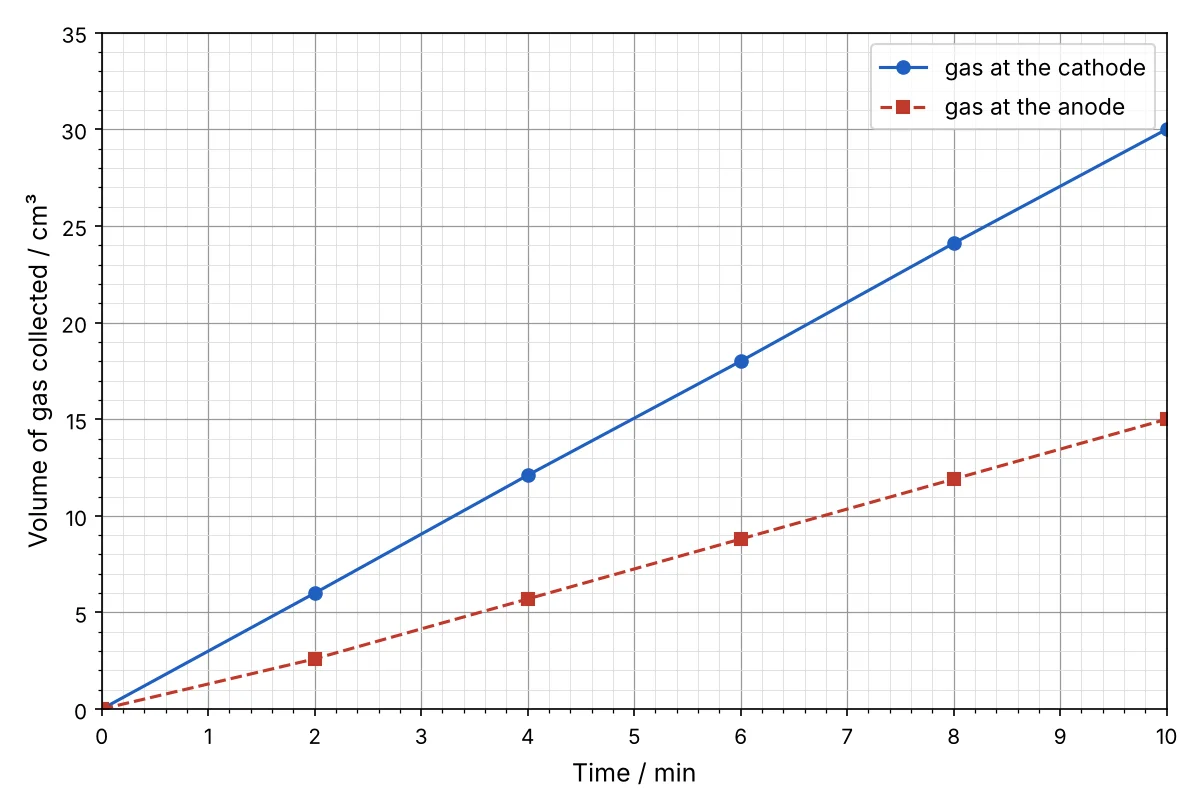
Dilute sulfuric acid is electrolysed using graphite electrodes. The gas formed at each electrode is collected and its volume read every 2 minutes. The graph shows the results, which are hypothetical. Hydrogen forms at the cathode and oxygen at the anode.
Question diagram
(a)
Write the half-equation for the formation of hydrogen at the cathode. [1]Criterion A (ii) · Level 3-4
(b)
Use the graph to find the volume of each gas after 8 minutes, and calculate the ratio volume of hydrogen : volume of oxygen. [2]Criterion C (i) · Level 3-4
(c)
Explain why the volume of hydrogen is twice the volume of oxygen. At the anode, 4OH⁻(aq) → O₂(g) + 2H₂O(l) + 4e⁻. [2]Criterion C (ii) · Level 5-6
(d)
After 2 minutes the ratio is 6.0 ÷ 2.6 = 2.31. A student says this shows the experiment is unreliable. Evaluate this claim and suggest an improvement. [3]Criterion C (iii) · Level 7-8

revisionprep.com

Summary Answer

Not available for this question.

Model Answer

Not available for this question.

Marking Scheme

Not available for this question.

Examiner Insights

Not available for this question.

Question 6Criterion D · Band 5-8 · Challenge · 6 marksrevisionprep.com

Electrochemical Cells

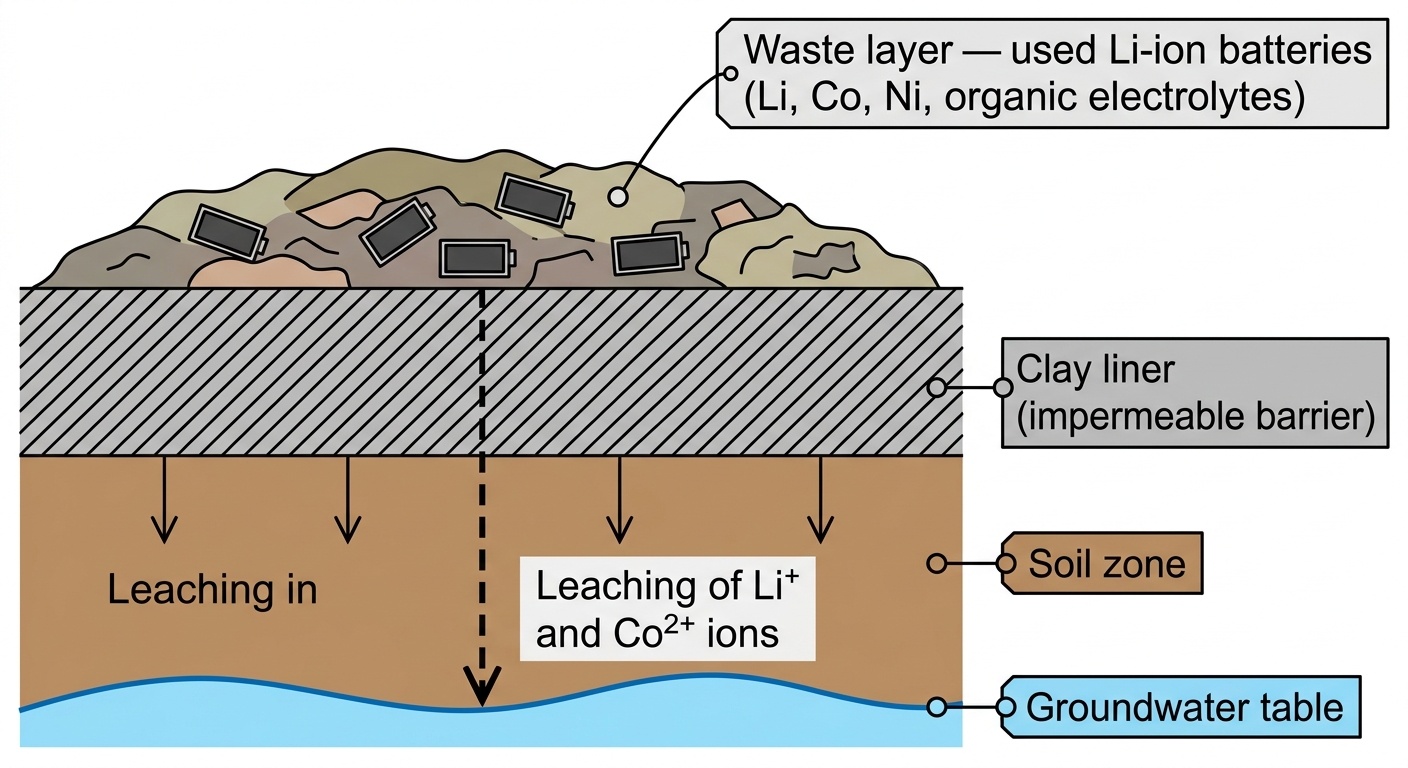
The diagram shows used lithium-ion batteries in a landfill site. The batteries contain lithium, cobalt, nickel and organic solvents. Current recycling recovers about 50% of the cobalt and less than 5% of the lithium. A model predicts groundwater contamination, assuming every used battery goes into household waste.
Question diagram
(a)
Explain why cobalt leaching into groundwater is a concern. [2]Criterion D (i) · Level 5-6
(b)
Using the recovery data, explain one limitation of current recycling in reducing harm from battery disposal. [2]Criterion D (ii) · Level 5-6
(c)
Discuss how the model's assumption affects the accuracy of its prediction. [2]Criterion D (ii) · Level 7-8

revisionprep.com

Summary Answer

Not available for this question.

Model Answer

Not available for this question.

Marking Scheme

Not available for this question.

Examiner Insights

Not available for this question.

That's every free question here — 6 of 58.

+52 more questions, plus Mock Papers & Worksheets, are waiting in Premium.

Upgrade