You're viewing free preview questions — 6 questions previewing here — subscribe to unlock 75 more, plus the Full Question Bank, Mock Papers & Worksheets.Upgrade
Back

Types of Reactions — Free MYP5 Chemistry Practice Questions

Free questions

Open in full, with answers, mark scheme and examiner insights.

Question 1Criterion A · Band 1-4 · Easy · 4 marksrevisionprep.com

Combination and Decomposition Reactions
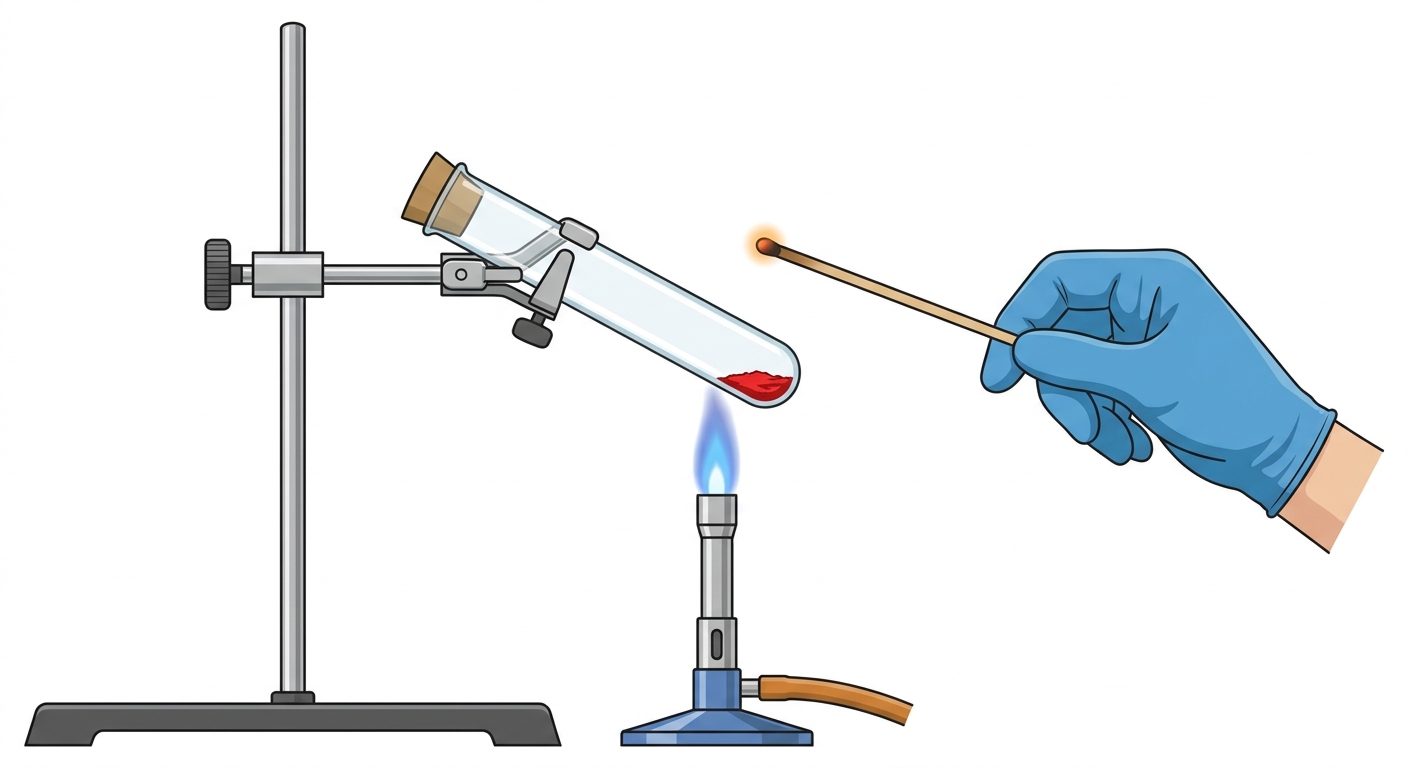
In 1774 Joseph Priestley heated red mercury(II) oxide, HgO, and collected a gas that made a glowing splint burst into flame. The diagram shows the same reaction carried out in a test tube. Silvery droplets collect on the cooler part of the tube.
Question diagram
(a)
Identify the two products of this reaction. [1]Criterion A (i) · Level 1-2
(b)
Write a balanced equation, with state symbols, for this reaction. [2]Criterion A (ii) · Level 3-4
(c)
Suggest why this reaction is now carried out only as a teacher demonstration in a fume cupboard. [1]Criterion A (ii) · Level 3-4

revisionprep.com

Summary Answer

Not available for this question.

Model Answer

Not available for this question.

Marking Scheme

Not available for this question.

Examiner Insights

Not available for this question.

Question 2Criterion A · Band 1-4 · Easy · 4 marksrevisionprep.com

Combustion Reactions Complete and Incomplete
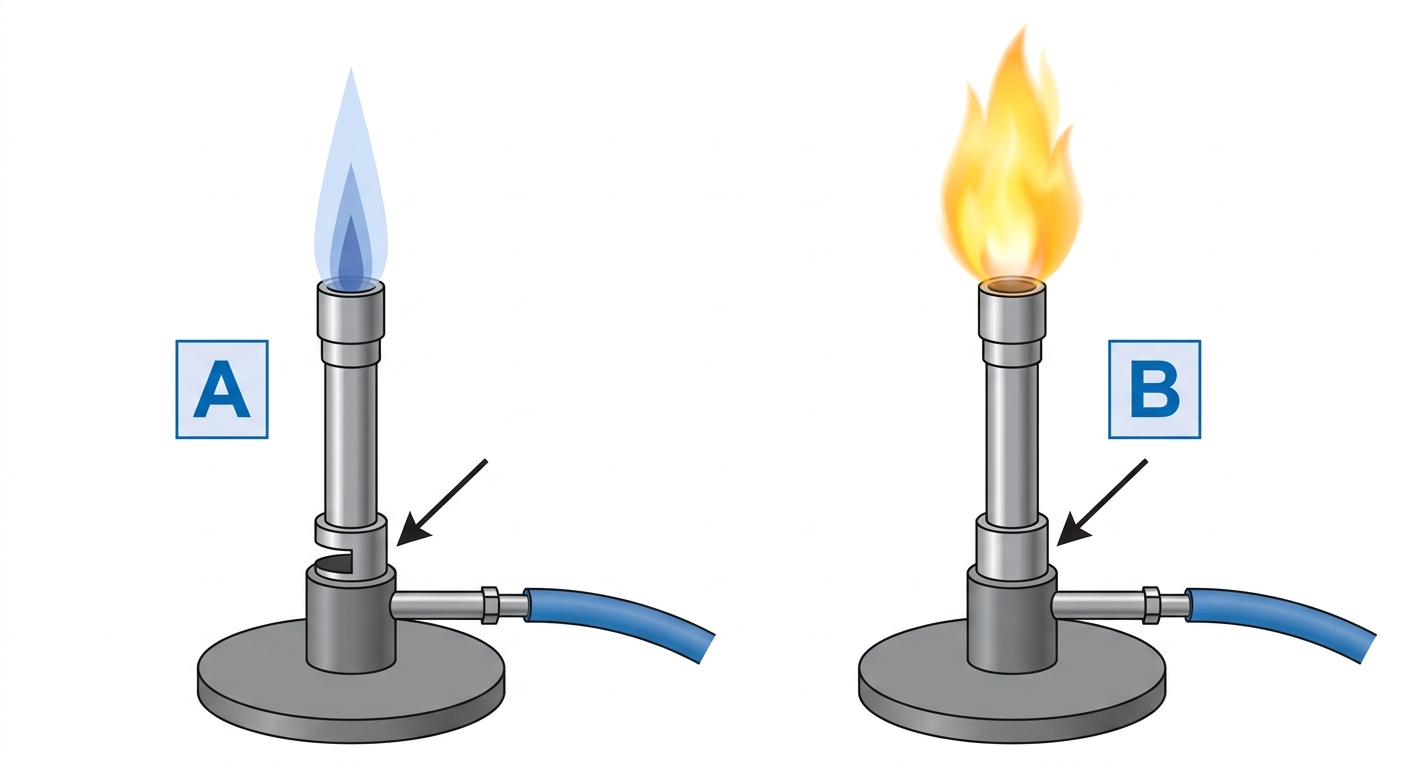
The diagram shows two Bunsen burners burning methane. In burner A the air hole is open; in burner B it is closed.
Question diagram
(a)
Identify which burner shows complete combustion. [1]Criterion A (i) · Level 1-2
(b)
Explain how opening the air hole changes the combustion of the gas. [2]Criterion A (ii) · Level 3-4
(c)
Explain why burner B leaves a black deposit on the base of a beaker held in its flame. [1]Criterion A (ii) · Level 3-4

revisionprep.com

Summary Answer

Not available for this question.

Model Answer

Not available for this question.

Marking Scheme

Not available for this question.

Examiner Insights

Not available for this question.

Question 3Criterion D + A · Band 3-6 · Medium · 8 marksrevisionprep.com

Single and Double Displacement Reactions

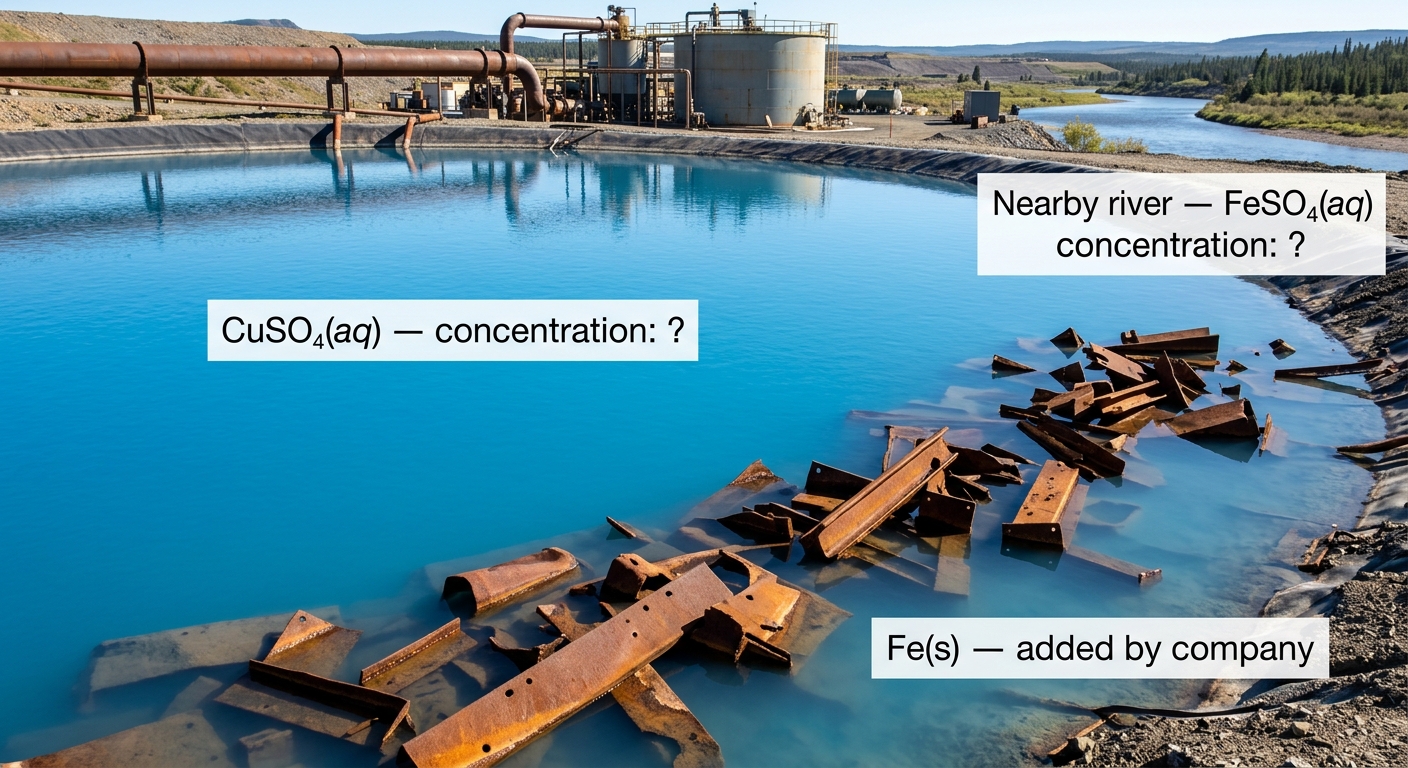
A mining company recovers copper from a pond of waste copper(II) sulfate solution by adding scrap iron, as shown in the photograph.

Fe(s) + CuSO₄(aq) → FeSO₄(aq) + Cu(s)

Relative atomic masses: Fe = 55.8, Cu = 63.5
Question diagram
(a)
Write the ionic equation, with state symbols, for this reaction. [1]Criterion A (ii) · Level 3-4
(b)
Identify the species that is reduced and explain your answer in terms of electrons. [1]Criterion A (ii) · Level 5-6
(c)
Calculate the minimum mass of iron, in kg, needed to recover 1.00 kg of copper. [2]Criterion D (i) · Level 3-4
(d)
Discuss one economic benefit and one environmental risk of this process. [3]

(e) Suggest why the company uses scrap iron rather than zinc, even though zinc is more reactive. [1]
Criterion D (ii) · Level 5-6

revisionprep.com

Summary Answer

Not available for this question.

Model Answer

Not available for this question.

Marking Scheme

Not available for this question.

Examiner Insights

Not available for this question.

Question 4Criterion A + D · Band 1-6 · Medium · 8 marksrevisionprep.com

Precipitation and Gas Formation Reactions
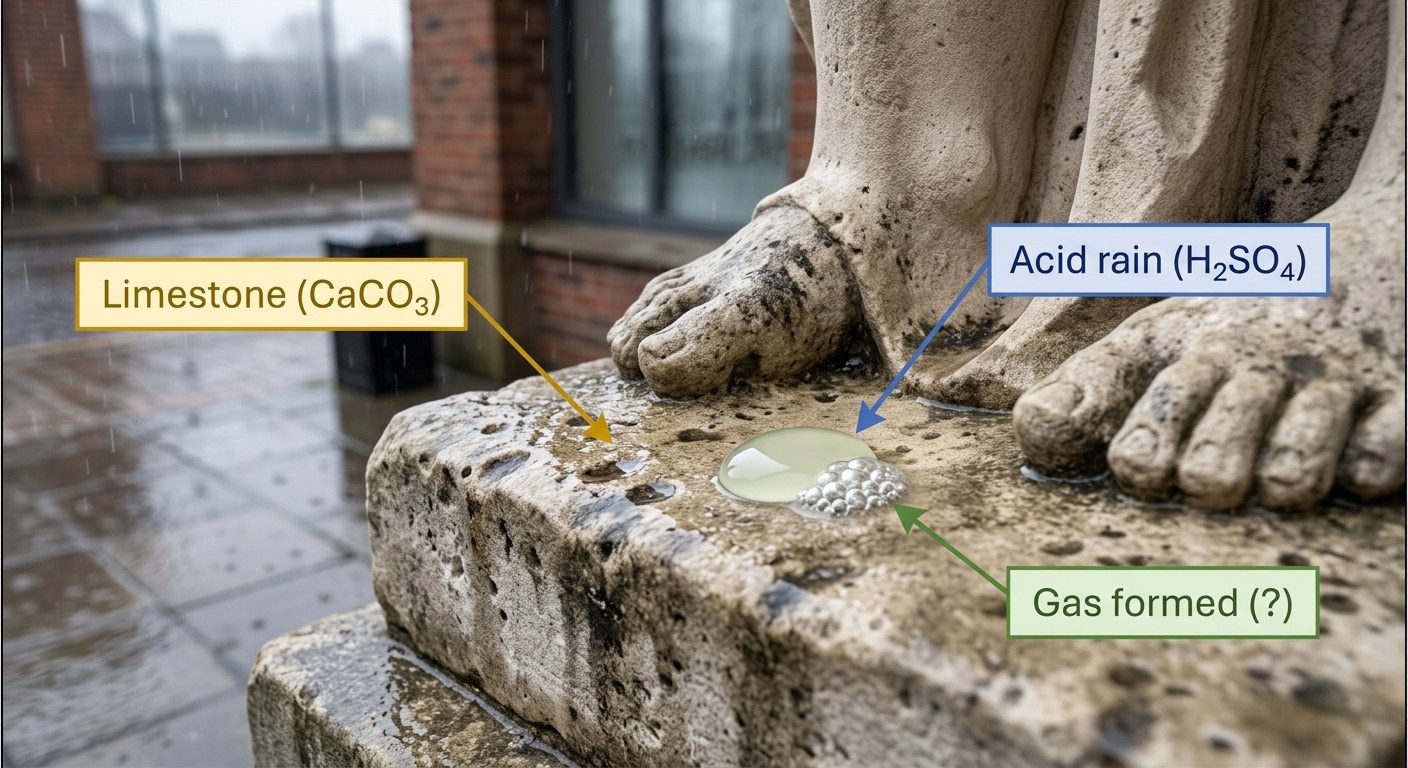
The photograph shows the base of a limestone statue in a city with acid rain. Limestone is calcium carbonate. Where acid rain containing sulfuric acid collects on the stone, small bubbles of gas form.
Question diagram
(a)
Write a balanced equation, with state symbols, for the reaction between sulfuric acid and calcium carbonate. [2]Criterion A (ii) · Level 3-4
(b)
Identify the gas in the bubbles and describe a test to confirm it. [2]Criterion A (i) · Level 1-2
(c)
Explain why the carved detail of the statue is gradually lost over many years. [1]Criterion D (i) · Level 3-4
(d)
Evaluate one method of protecting limestone monuments from acid rain. [3]Criterion D (ii) · Level 5-6

revisionprep.com

Summary Answer

Not available for this question.

Model Answer

Not available for this question.

Marking Scheme

Not available for this question.

Examiner Insights

Not available for this question.

Question 5Criterion B · Band 5-8 · Challenge · 10 marksrevisionprep.com

Combination and Decomposition Reactions

A student wants to answer the research question: How does the metal in a metal carbonate affect how quickly the carbonate decomposes when heated?

She has sodium carbonate, calcium carbonate, zinc carbonate and copper(II) carbonate, a Bunsen burner, boiling tubes, a delivery tube, limewater, a balance and a stopwatch.
(a)
Formulate a testable hypothesis for this investigation and explain it using scientific reasoning. [2]Criterion B (ii) · Level 5-6
(b)
Identify the independent and dependent variables, and two control variables, stating how each control variable will be kept the same. [3]Criterion B (iii) · Level 5-6
(c)
Design a method that would collect sufficient, relevant data. [4]Criterion B (iv) · Level 7-8
(d)
Identify one safety hazard specific to this method and explain how to reduce it. [1]Criterion B (iv) · Level 5-6

revisionprep.com

Summary Answer

Not available for this question.

Model Answer

Not available for this question.

Marking Scheme

Not available for this question.

Examiner Insights

Not available for this question.

Question 6Criterion C + B · Band 3-8 · Challenge · 9 marksrevisionprep.com

Observing chemical change: colour, gas, temperature, precipitate

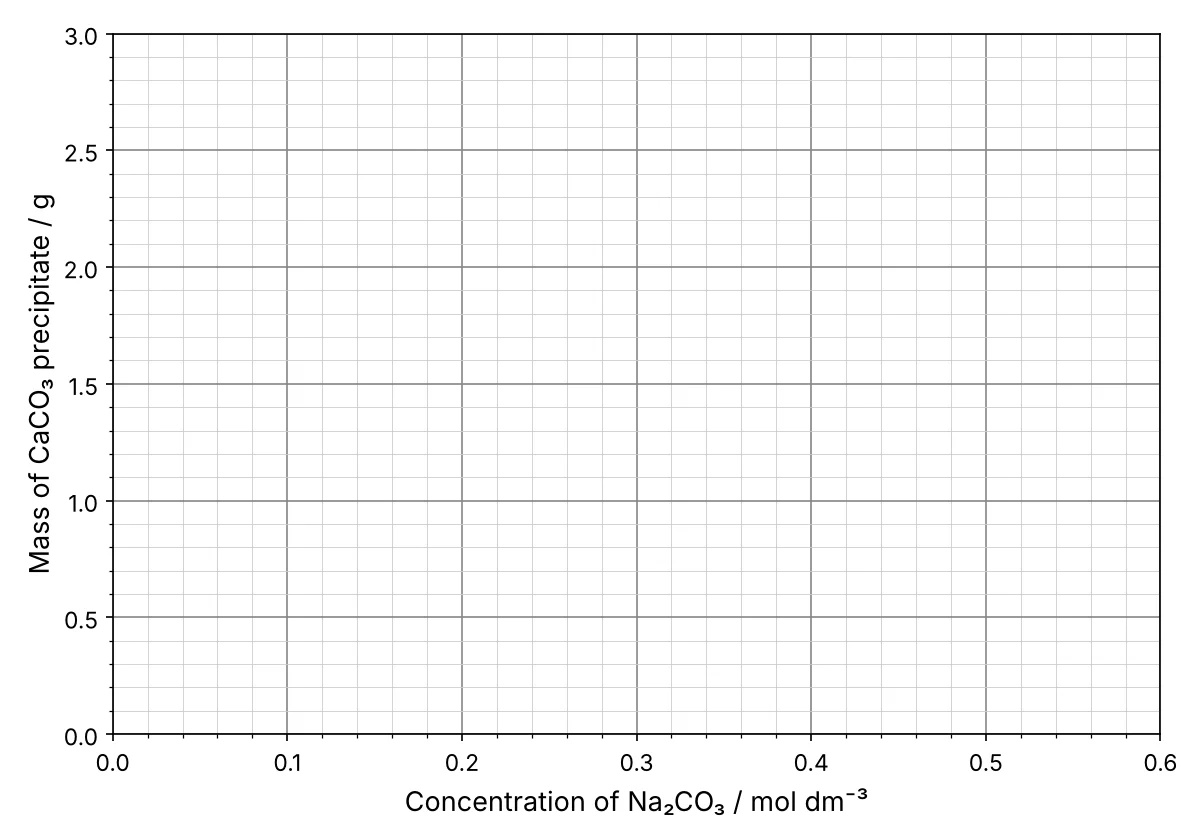
A student investigates how the concentration of sodium carbonate solution affects the mass of calcium carbonate precipitate formed.

Na₂CO₃(aq) + CaCl₂(aq) → CaCO₃(s) + 2NaCl(aq)

Each test uses 50.0 cm³ of sodium carbonate solution and 50.0 cm³ of 1.00 mol dm⁻³ calcium chloride solution.

Concentration of Na₂CO₃ (mol dm⁻³): 0.10, 0.20, 0.30, 0.40, 0.50

Mass of CaCO₃ (g): 0.50, 1.00, 1.50, 2.00, 2.50

Molar mass of CaCO₃ = 100.1 g mol⁻¹
Question diagram
(a)
Identify the independent variable, the dependent variable and two control variables, stating how each is kept the same. [3]Criterion B (iii) · Level 3-4
(b)
Plot the data on the grid and draw a line of best fit. [2]Criterion C (i) · Level 3-4
(c)
Describe the relationship shown and explain it using the idea of moles. [2]Criterion C (ii) · Level 5-6
(d)
Determine the concentration of sodium carbonate above which the mass of precipitate would stop increasing. Explain your reasoning. [2]Criterion C (ii) · Level 7-8

revisionprep.com

Summary Answer

Not available for this question.

Model Answer

Not available for this question.

Marking Scheme

Not available for this question.

Examiner Insights

Not available for this question.

That's every free question here — 6 of 81.

+75 more questions, plus Mock Papers & Worksheets, are waiting in Premium.

Upgrade