You're viewing free preview questions — 4 questions previewing here — subscribe to unlock 77 more, plus the Full Question Bank, Mock Papers & Worksheets.Upgrade
Types of Reactions — Free MYP5 Chemistry Practice Questions

1QuestionCombustion Reactions Complete and IncompleteConcept Practice
2 marks~3 minCriterion A
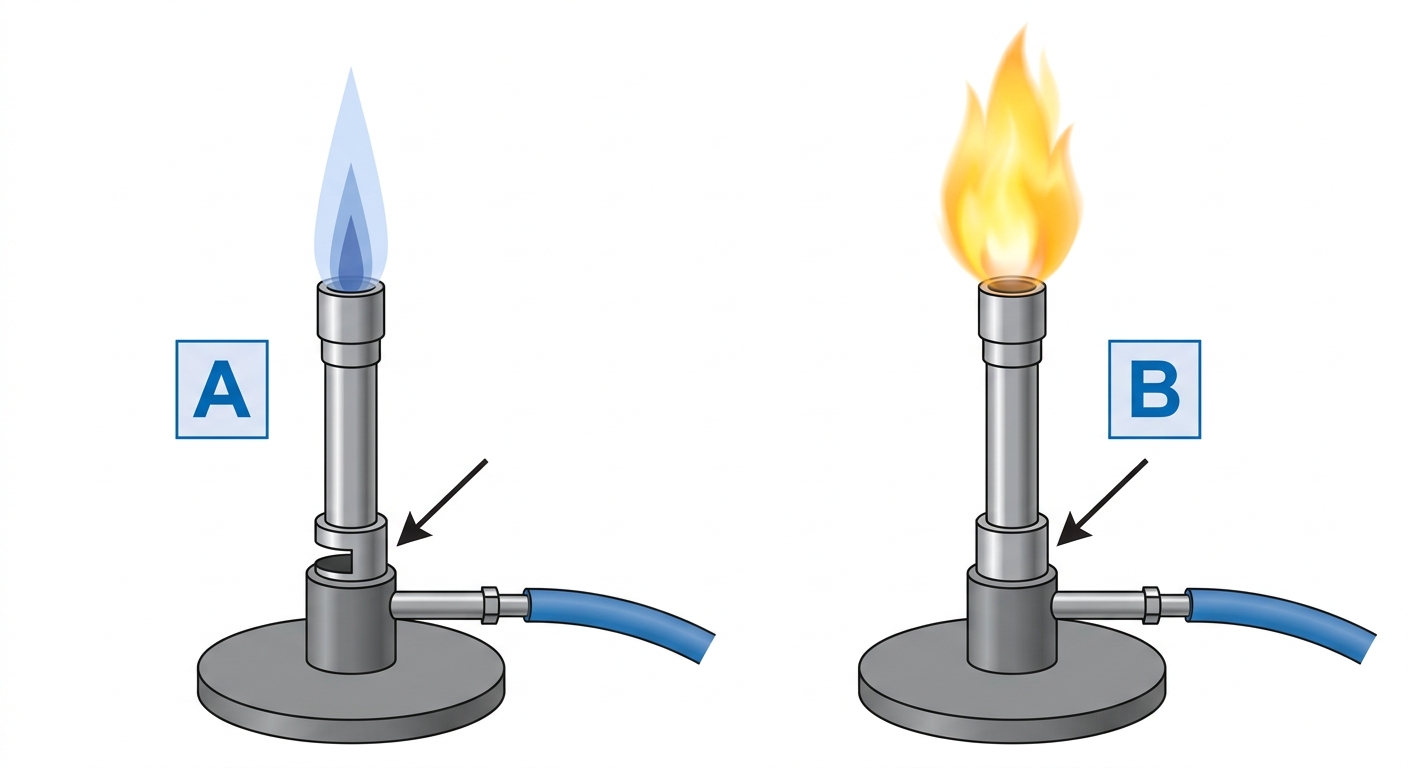
A Bunsen burner can produce two distinct flames depending on the position of the air hole. In Diagram A, the air hole is open and the flame is blue. In Diagram B, the air hole is closed and the flame is yellow.
a
Identify which diagram (A or B) shows complete combustion, and state the colour of the flame produced. [1]
b
Explain why closing the air hole causes the flame to change colour. [1]

Solutions
2QuestionSingle and Double Displacement ReactionsAssessment Practice
5 marks~8 minCriterion C
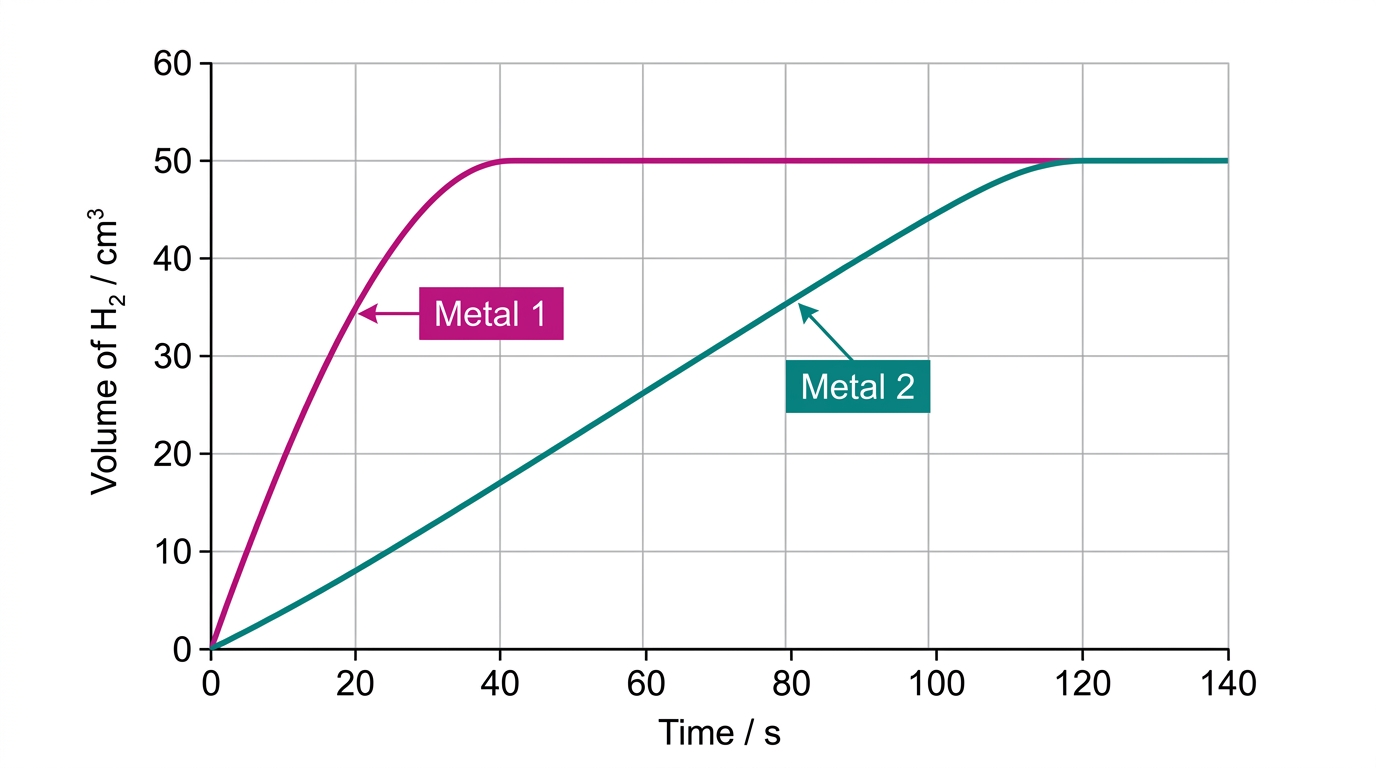
The graph below shows the volume of hydrogen gas produced over time when equal masses of zinc and magnesium are each reacted with excess hydrochloric acid. Magnesium reaches 50 cm³ of hydrogen gas in 40 s; zinc reaches the same volume in 120 s. Both curves level off at 50 cm³.
a
State which metal reacts faster and give one piece of quantitative evidence from the graph to support your answer. [2]
b
Explain how the position of each metal in the reactivity series accounts for the difference in reaction rate observed in the graph. [2]
c
A student claims that because both metals produce the same final volume of hydrogen gas, they must be equally reactive. Evaluate this claim. [1]
Solutions
3QuestionPrecipitation and Gas Formation ReactionsAssessment Practice
6 marks~9 minCriterion B
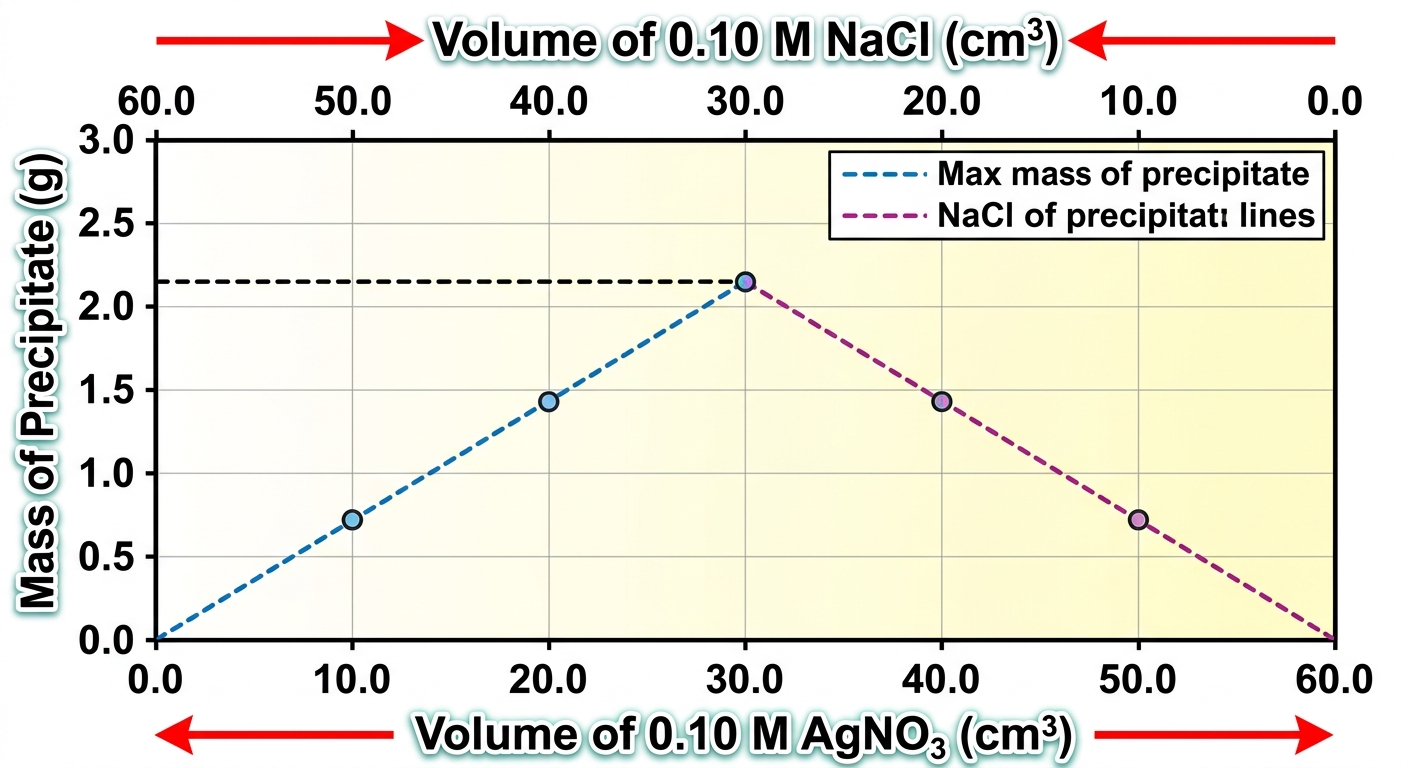
A student mixes various volumes of 0.10 M silver nitrate () solution with 0.10 M sodium chloride () solution. After filtering and drying, the mass of precipitate is recorded.
Volume of (cm³): 10.0, 20.0, 30.0, 40.0, 50.0
Volume of (cm³): 50.0, 40.0, 30.0, 20.0, 10.0
Mass of precipitate (g): 0.72, 1.43, 2.15, 1.43, 0.72
Solubility rules: all nitrates are soluble; chlorides of , , and are insoluble; all sodium salts are soluble.
Volume of (cm³): 10.0, 20.0, 30.0, 40.0, 50.0
Volume of (cm³): 50.0, 40.0, 30.0, 20.0, 10.0
Mass of precipitate (g): 0.72, 1.43, 2.15, 1.43, 0.72
Solubility rules: all nitrates are soluble; chlorides of , , and are insoluble; all sodium salts are soluble.
a
Using the solubility rules, deduce the identity of the precipitate and calculate the moles of and present in each mixture. [2]
b
Explain why the mass of precipitate increases from mixture 1 to mixture 3, then decreases from mixture 3 to mixture 5. [2]
c
Two ionic equations are proposed:
Equation 1:
Equation 2:
Evaluate which equation correctly represents the reaction, using the experimental data to justify your reasoning. [2]
Equation 1:
Equation 2:
Evaluate which equation correctly represents the reaction, using the experimental data to justify your reasoning. [2]
Solutions
4QuestionCombination and Decomposition ReactionsAssessment Practice
8 marks~12 minCriterion D
Data
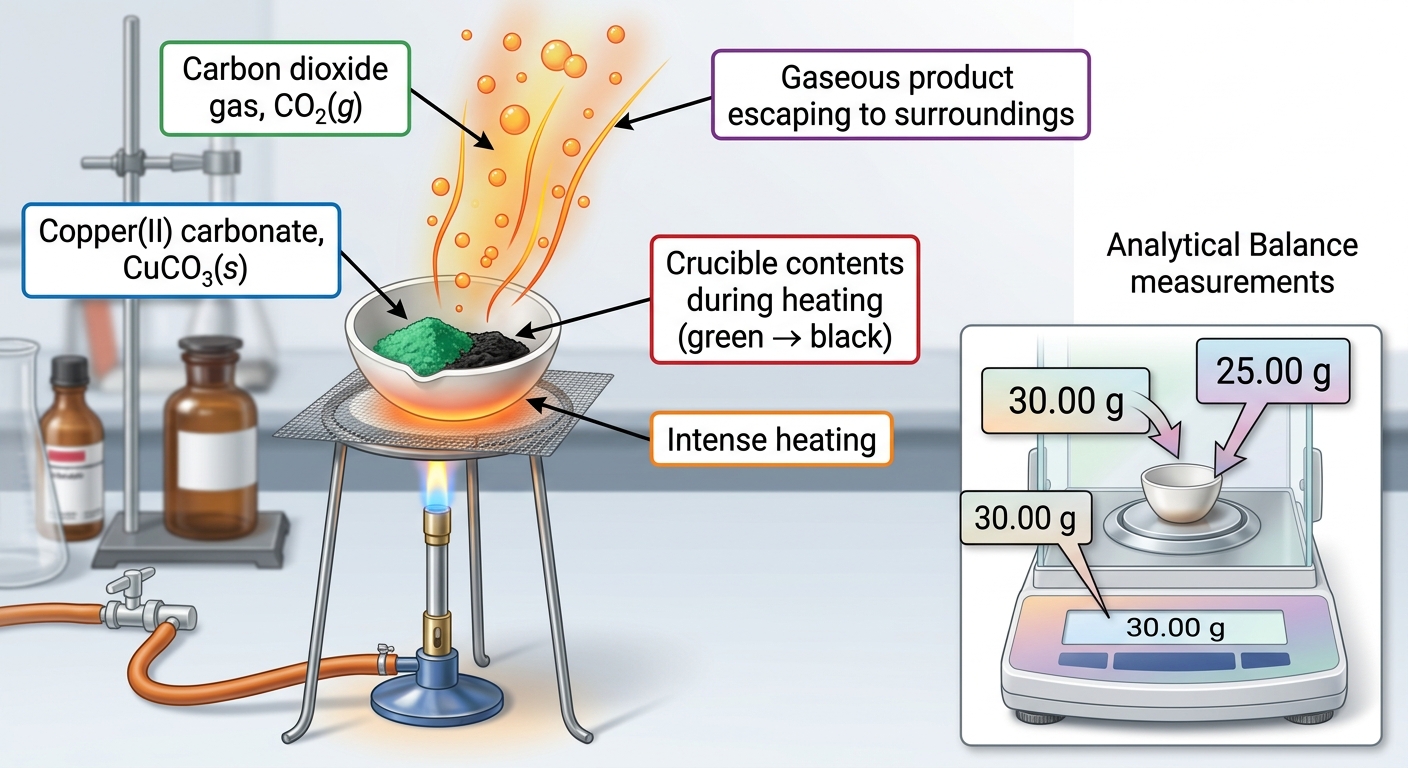
Mass of empty crucible: 25.00 gMass of crucible + before heating: 30.00 g
Mass of crucible + contents after heating: 28.16 g
Molar masses (g/mol): Cu = 63.55, C = 12.01, O = 16.00
A student heats copper(II) carbonate, , strongly in an open crucible. The reaction is:
The student records the following
The student records the following
a
Calculate the expected mass loss when 5.00 g of fully decomposes. [3]
b
Deduce whether the experimental data supports the hypothesis that has undergone a decomposition reaction. [2]
c
Evaluate the suitability of using an open crucible in this experiment, considering both the validity of the mass measurements and one limitation this setup introduces. [3]
Solutions
That's every free question here — 4 of 81.
+77 more questions, plus Mock Papers & Worksheets, are waiting in Premium.