You're viewing free preview questions — 4 questions previewing here — subscribe to unlock 79 more, plus the Full Question Bank, Mock Papers & Worksheets.Upgrade
Ozone Layer and CFCs — Free MYP5 Chemistry Practice Questions

1QuestionStructure and function of the ozone layerConcept Practice
2 marks~3 minCriterion A
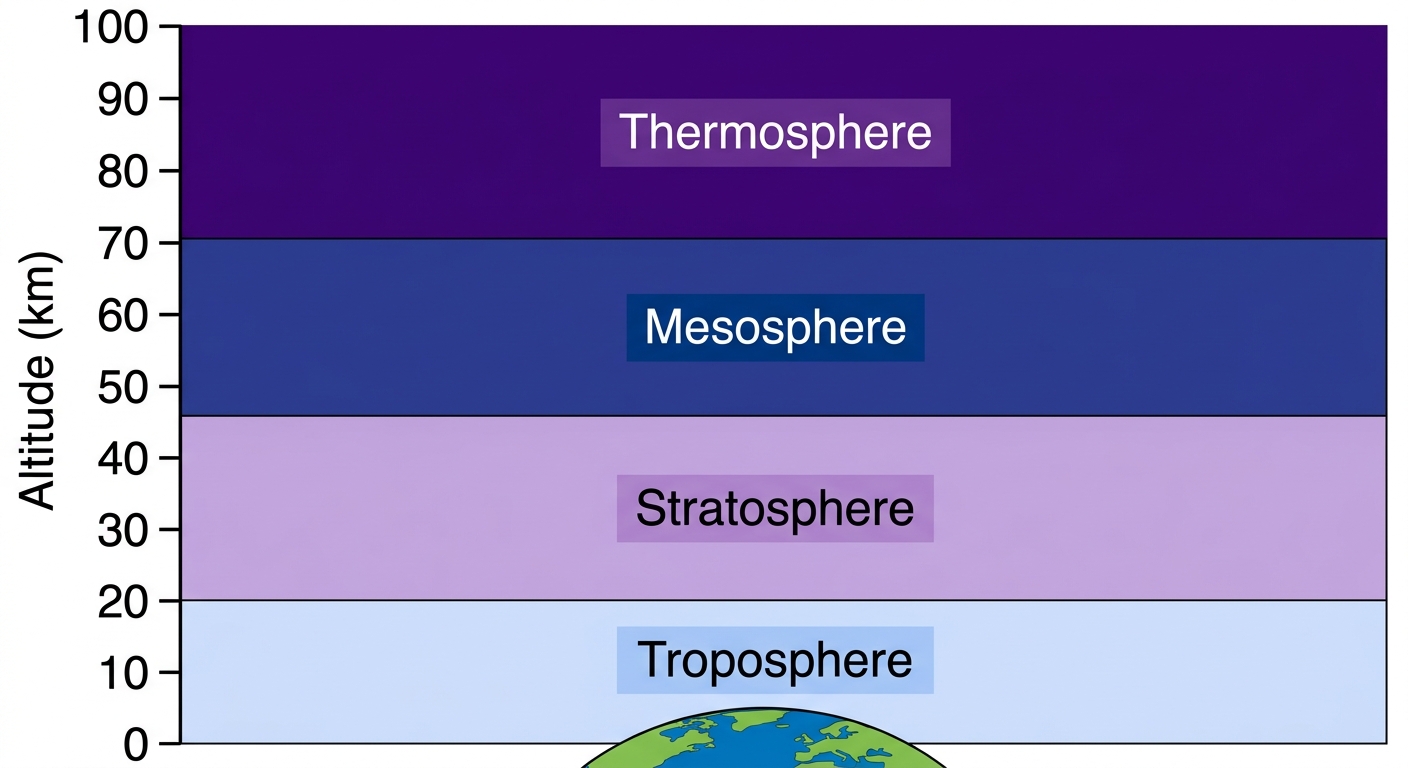
The diagram shows the four main layers of Earth's atmosphere: troposphere, stratosphere, mesosphere, and thermosphere.
a
Identify the atmospheric layer in which the ozone layer is found. [1]
b
Ozone absorbs harmful ultraviolet (UV) radiation from the Sun. Explain why the absence of ozone in this layer would be damaging to life on Earth's surface. [1]

Solutions
2QuestionInternational agreements (e.g., Montreal Protocol)Assessment Practice
5 marks~8 minCriterion D
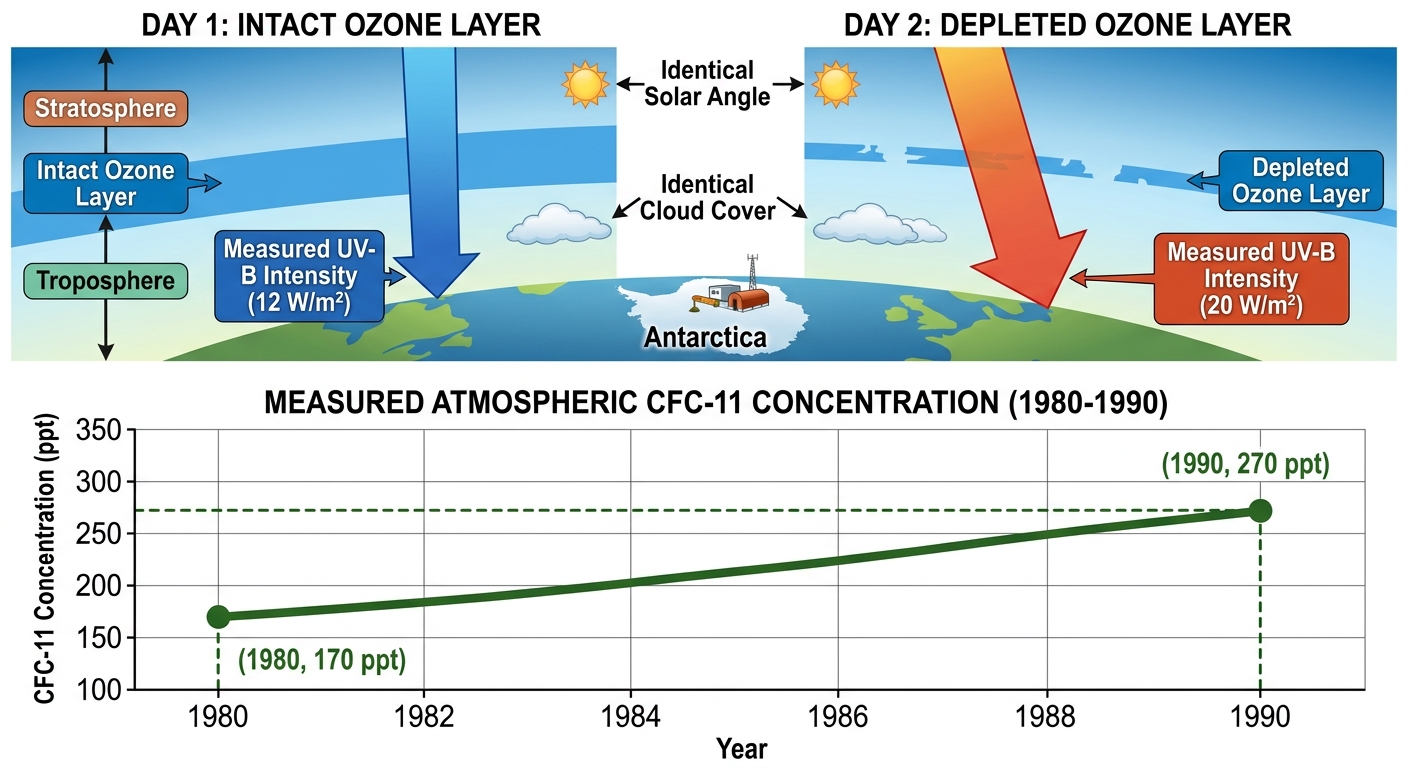
In Antarctica during the 1980s, researchers measured UV-B intensity at ground level under identical solar angles and cloud cover. On Day 1 (intact ozone layer), UV-B intensity was 12 W/m². On Day 2 (depleted ozone layer), UV-B intensity was 20 W/m². Atmospheric CFC-11 concentration rose from 170 ppt in 1980 to 270 ppt in 1990.
A hypothesis states: "CFCs cause ozone depletion, which leads to increased UV-B radiation at ground level."
A hypothesis states: "CFCs cause ozone depletion, which leads to increased UV-B radiation at ground level."
a
Calculate the percentage increase in UV-B intensity from Day 1 to Day 2. [1]
b
Calculate the percentage increase in CFC-11 concentration from 1980 to 1990. [1]
c
Using both calculated values, evaluate whether the data support the hypothesis. In your answer, compare the two percentage changes and discuss one limitation of drawing a conclusion from this evidence. [3]
Solutions
3QuestionStructure and function of the ozone layerAssessment Practice
5 marks~8 minCriterion C
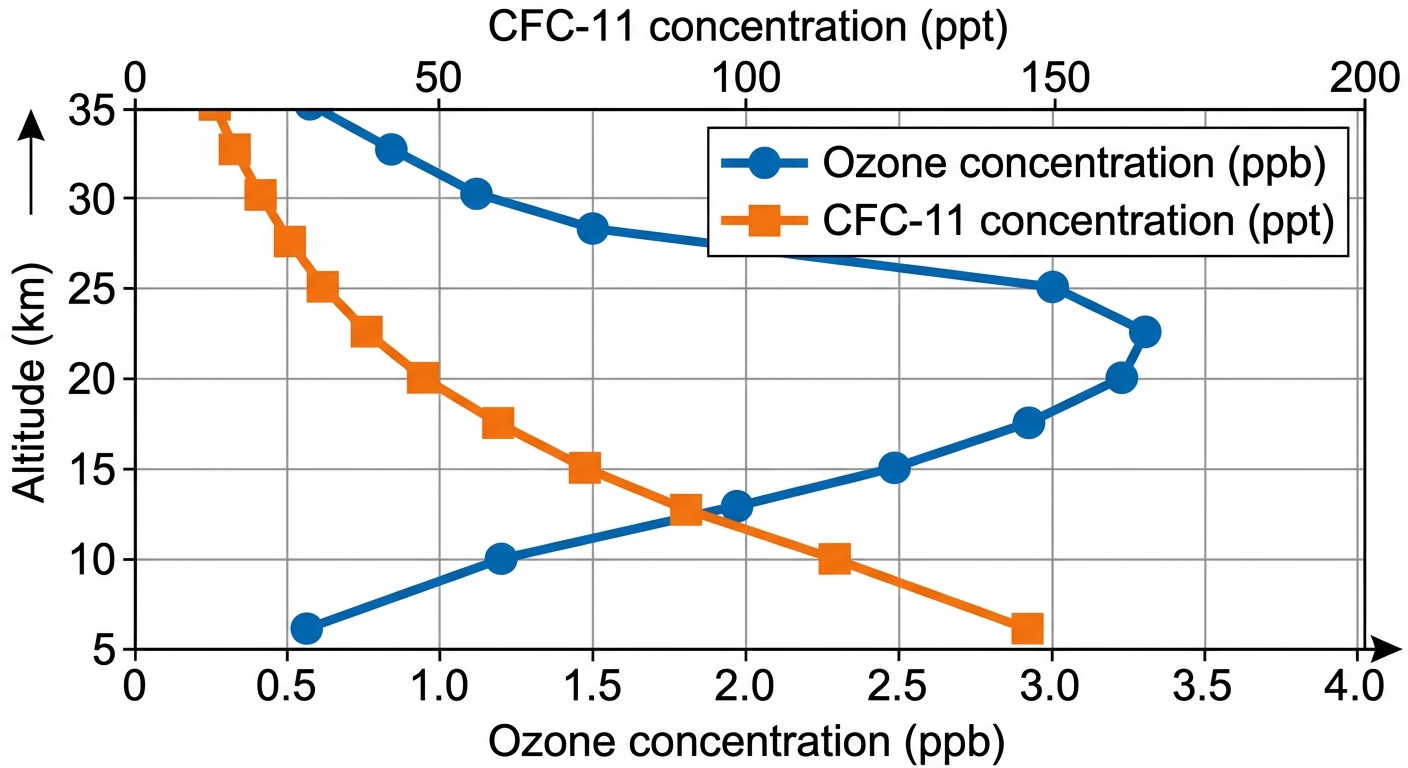
In the 1980s, Antarctic field experiments measured ozone and CFC-11 concentrations at various altitudes. Results are shown below.
The hypothesis is that CFCs catalytically destroy ozone via the chlorine radical cycle:
| Altitude (km) | 10 | 15 | 20 | 25 | 30 |
|---|---|---|---|---|---|
| Ozone concentration (ppb) | 0.2 | 0.5 | 1.5 | 3.0 | 2.5 |
| CFC-11 concentration (ppt) | 150 | 120 | 80 | 40 | 20 |
The hypothesis is that CFCs catalytically destroy ozone via the chlorine radical cycle:
a
Describe the trend in each concentration with increasing altitude. [2]
b
Explain how the chlorine radical cycle predicts a relationship between CFC-11 concentration and ozone concentration. [1]
c
Evaluate whether the data supports the hypothesis, identifying at least one limitation of the evidence. [2]
Solutions
4QuestionInternational agreements (e.g., Montreal Protocol)Assessment Practice
2 marks~3 minCriterion B
The ozone depletion potential (ODP) values for several compounds are given below.
| Compound | CFC-11 | CFC-12 | HCFC-22 | HCFC-123 | HFC-134a |
|---|---|---|---|---|---|
| ODP | 1.0 | 0.82 | 0.05 | 0.02 | 0.0 |
a
Deduce the trend in ODP values as the molecular structure transitions from CFCs to HCFCs to HFCs, and identify the structural feature responsible for this trend. [1]
b
A new refrigerant, HFC-152a, contains no chlorine atoms and has a molecular structure similar to HFC-134a. Deduce its ODP value and justify your answer using the trend identified in part (a). [1]
Solutions
That's every free question here — 4 of 83.
+79 more questions, plus Mock Papers & Worksheets, are waiting in Premium.