You're viewing free preview questions — 4 questions previewing here — subscribe to unlock 81 more, plus the Full Question Bank, Mock Papers & Worksheets.Upgrade
Water Purification and Treatment — Free MYP5 Chemistry Practice Questions

1QuestionDesalination techniques (distillation, reverse osmosis)Concept Practice
2 marks~3 minCriterion A
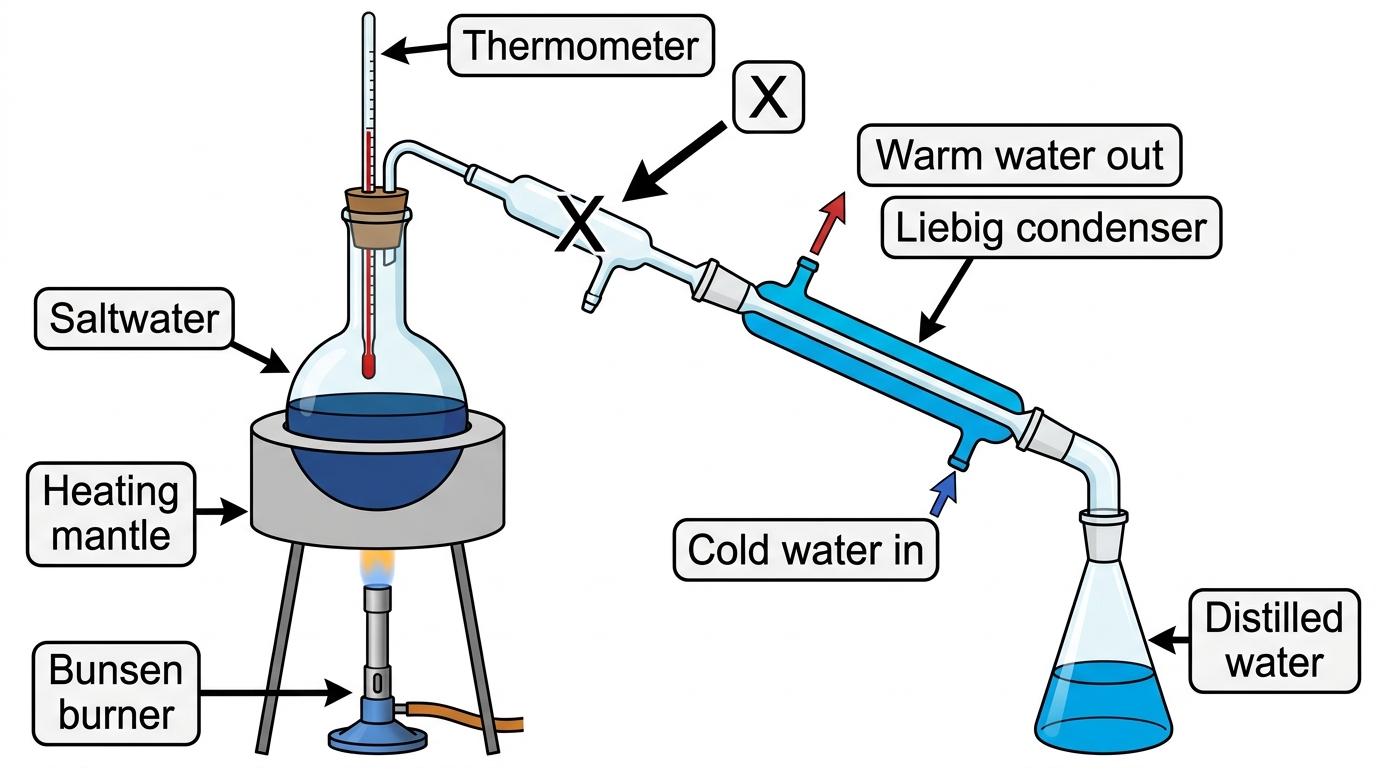
The diagram below shows a laboratory distillation apparatus used to desalinate seawater. Component X is labelled on the diagram.
a
Identify component X. [1]
b
Explain how component X enables pure water to be collected during desalination. [1]

Solutions
2QuestionRole of chlorine and disinfection methodsAssessment Practice
3 marks~5 minCriterion C
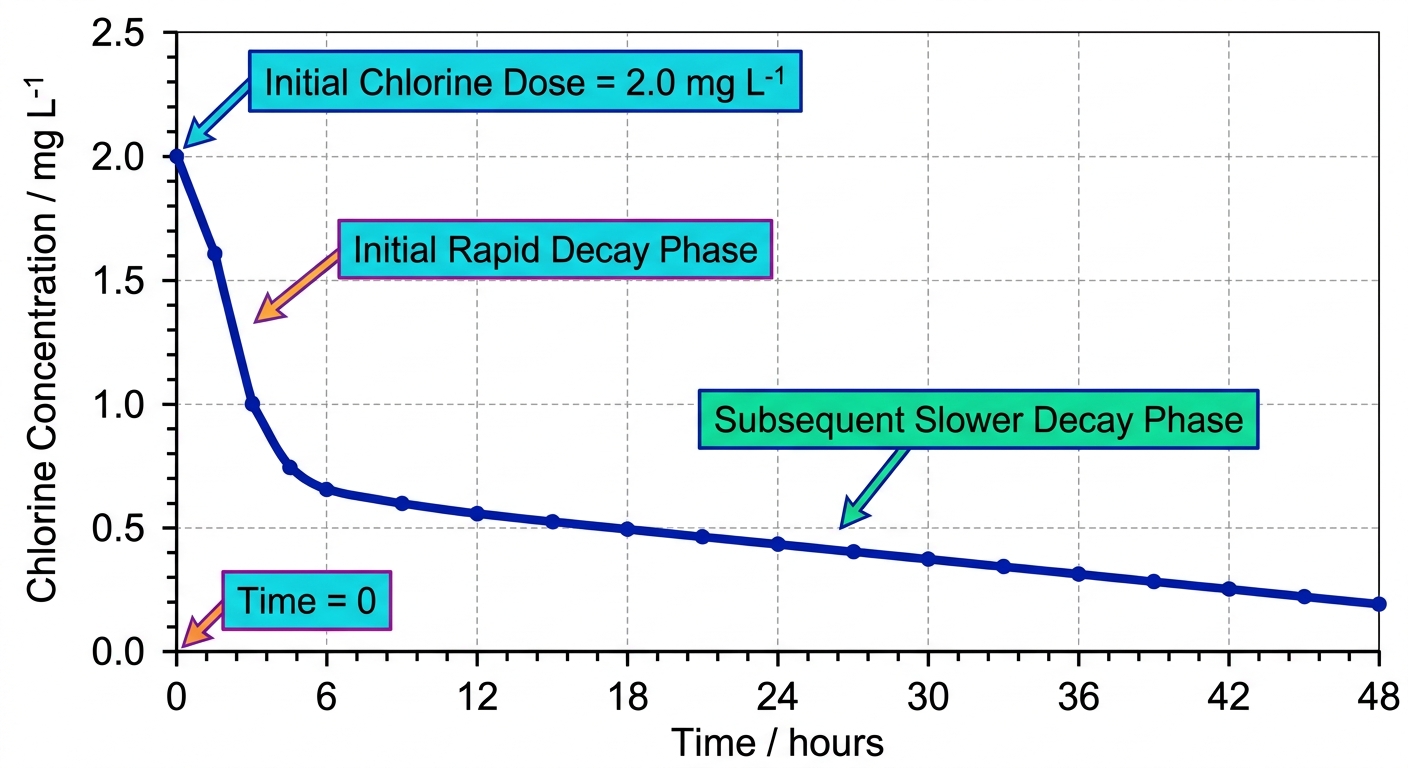
A water treatment plant adds chlorine at an initial dose of 2.0 mg/L to a reservoir sample. The graph below shows how free chlorine concentration changes over 60 minutes.
a
Identify the two distinct phases visible in the chlorine decay curve. [1]
b
Explain the chemical reactions responsible for the initial rapid decrease in chlorine concentration. [1]
c
Explain why the rate of chlorine decay slows during the second phase, and evaluate what this implies about the effectiveness of disinfection over time. [1]
Solutions
3QuestionDesalination techniques (distillation, reverse osmosis)Assessment Practice
6 marks~9 minCriterion D
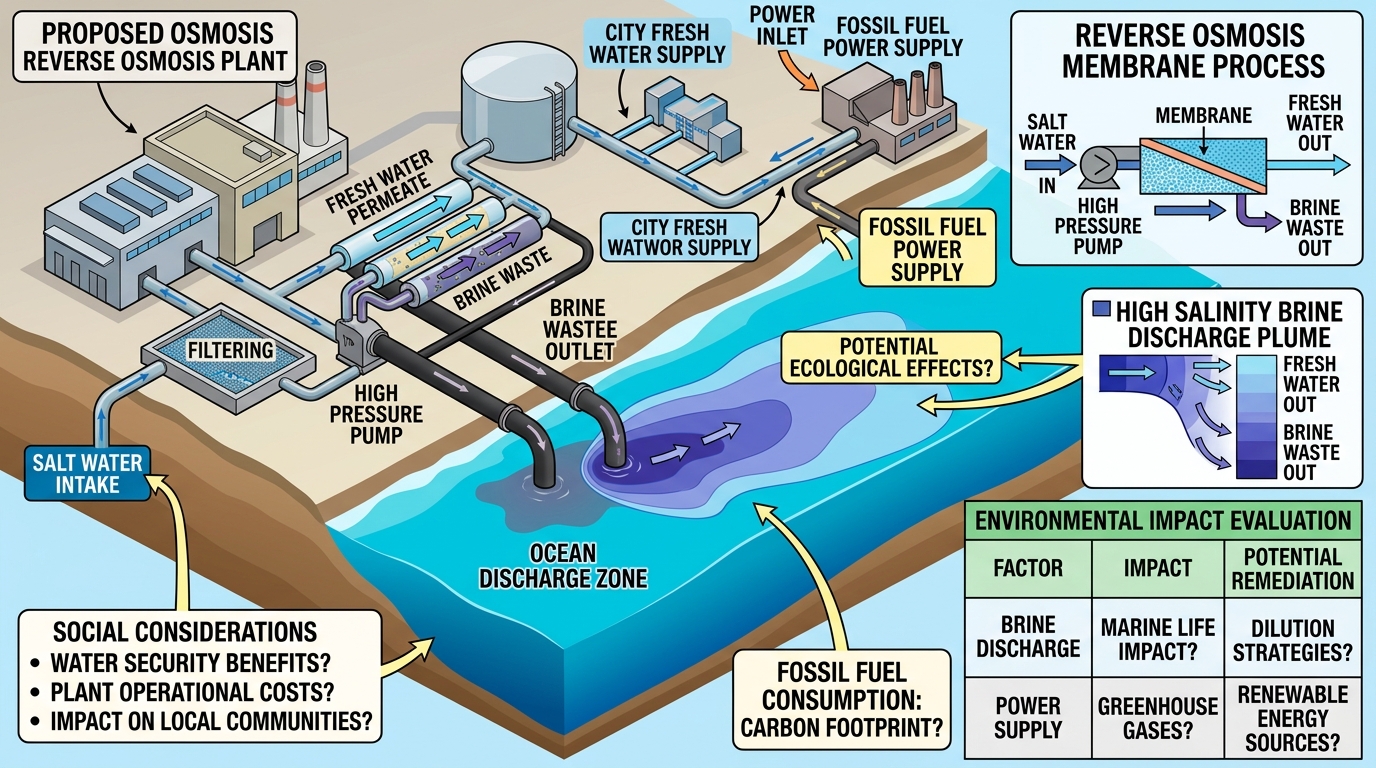
A coastal city facing severe drought is considering a large-scale reverse osmosis (RO) desalination plant powered by a fossil fuel station. Seawater is forced through semi-permeable membranes under high pressure, producing fresh water and a concentrated brine waste discharged directly into the ocean.
a
State one societal benefit of building this plant and explain how it directly addresses the city's water crisis. [2]
b
Identify two distinct environmental costs associated with operating this plant, one linked to brine discharge and one linked to energy source. [2]
c
Evaluate two limitations of using a cost–benefit model to assess this plant's overall impact, referring to assumptions made or gaps in available data. [2]
Solutions
4QuestionRole of chlorine and disinfection methodsAssessment Practice
2 marks~3 minCriterion B
A water treatment plant disinfects drinking water by adding chlorine to eliminate E. coli. The data below show the contact time required to kill 99.9% of E. coli at 20°C.
| Chlorine dose (mg/L) | 0.5 | 1.0 | 1.5 | 2.0 |
|---|---|---|---|---|
| Contact time (min) | 12 | 6 | 4 | 3 |
a
Deduce the mathematical relationship between chlorine dose and contact time, showing clearly how the data support your answer. [1]
b
A treatment plant operates at a chlorine dose of 2.5 mg/L but must achieve 99.9% kill of E. coli within 2 minutes. Evaluate whether this dose is sufficient, using your relationship from (a). [1]
Solutions
That's every free question here — 4 of 85.
+81 more questions, plus Mock Papers & Worksheets, are waiting in Premium.