You're viewing free preview questions — 4 questions previewing here — subscribe to unlock 72 more, plus the Full Question Bank, Mock Papers & Worksheets.Upgrade
Diffusion and Brownian Motion — Free MYP5 Chemistry Practice Questions

1QuestionDefinition of diffusion in gases and liquidsConcept Practice
2 marks~3 minCriterion A
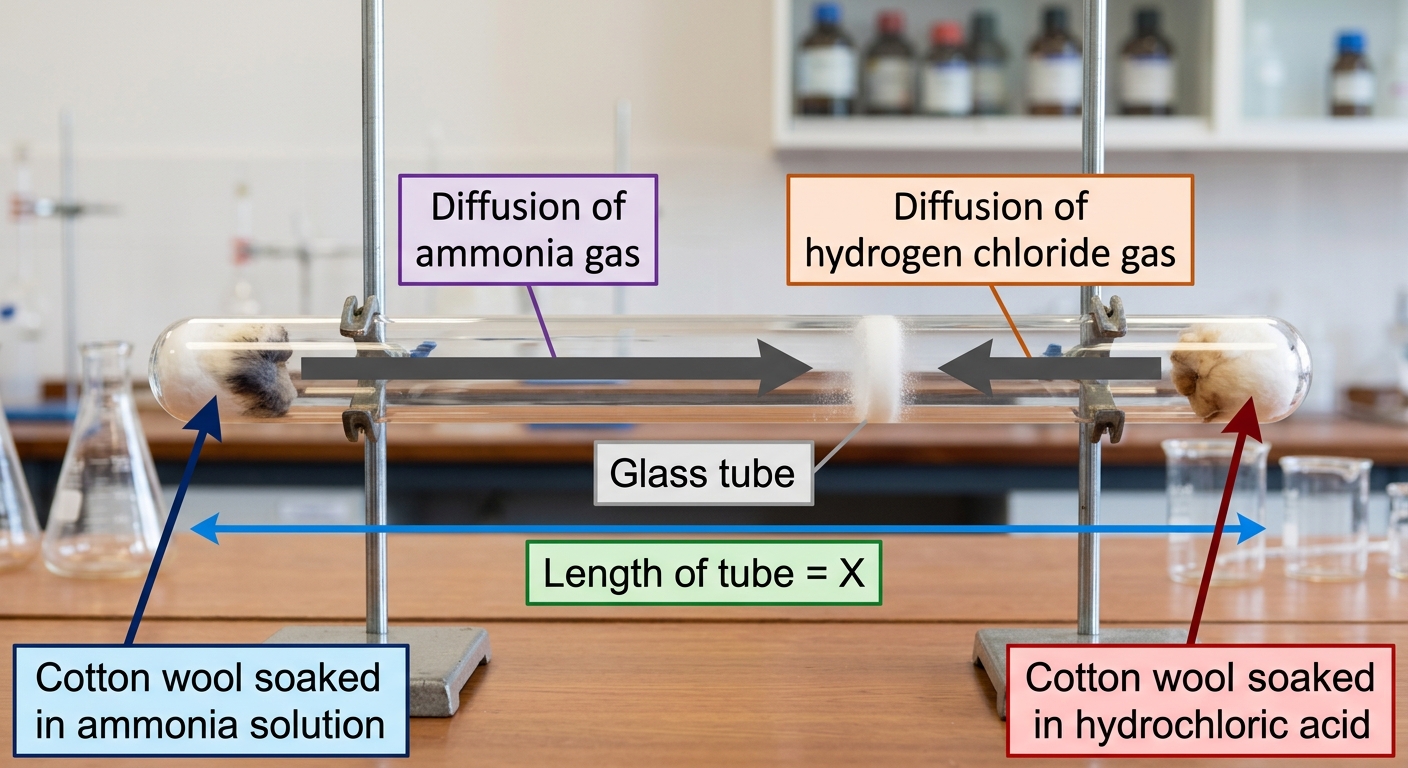
A glass diffusion tube has cotton wool soaked in ammonia () at one end and cotton wool soaked in hydrochloric acid () at the other. After several minutes, a white ring of ammonium chloride () forms inside the tube, closer to the end.
a
Identify the apparatus used in this experiment. [1]
b
Explain what the position of the white ring demonstrates about the rates at which and gases diffuse. [1]

Solutions
2QuestionBrownian motion and evidence for particle movementAssessment Practice
3 marks~5 minCriterion C
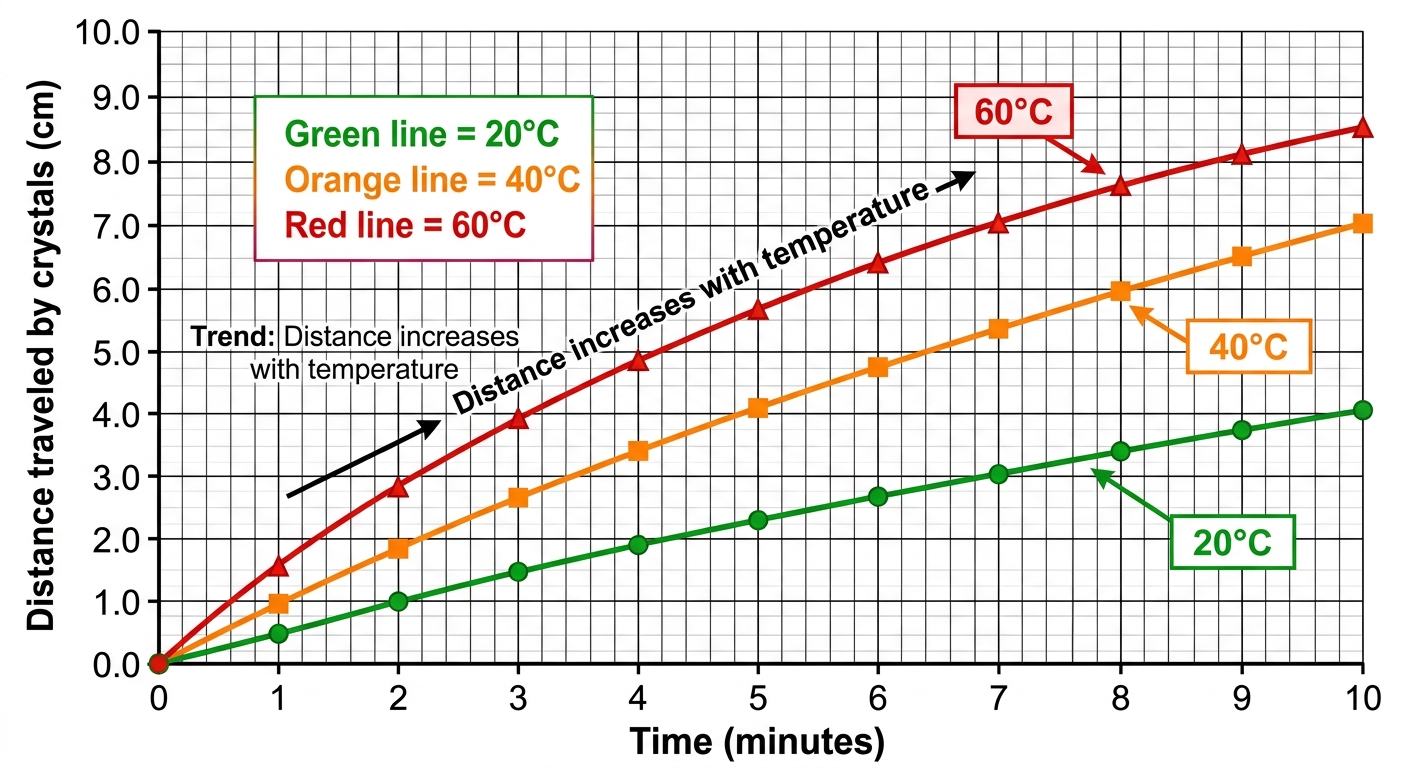
A graph shows the distance travelled by potassium permanganate () crystals dissolving in water at 20 °C, 40 °C, and 60 °C over 10 minutes. The distance increases with temperature.
a
State what happens to the kinetic energy of water particles as temperature increases. [1]
b
Using the particle model, explain how this change in kinetic energy causes to spread further at higher temperatures. [1]
c
The graph shows that the distance travelled at 60 °C is approximately three times that at 20 °C, yet the temperature has not tripled. Explain why a relatively small increase in temperature produces a disproportionately large increase in diffusion distance. [1]
Solutions
3QuestionExamples of diffusion (perfume spreading, gas exchange)Concept Practice
3 marks~5 minCriterion B
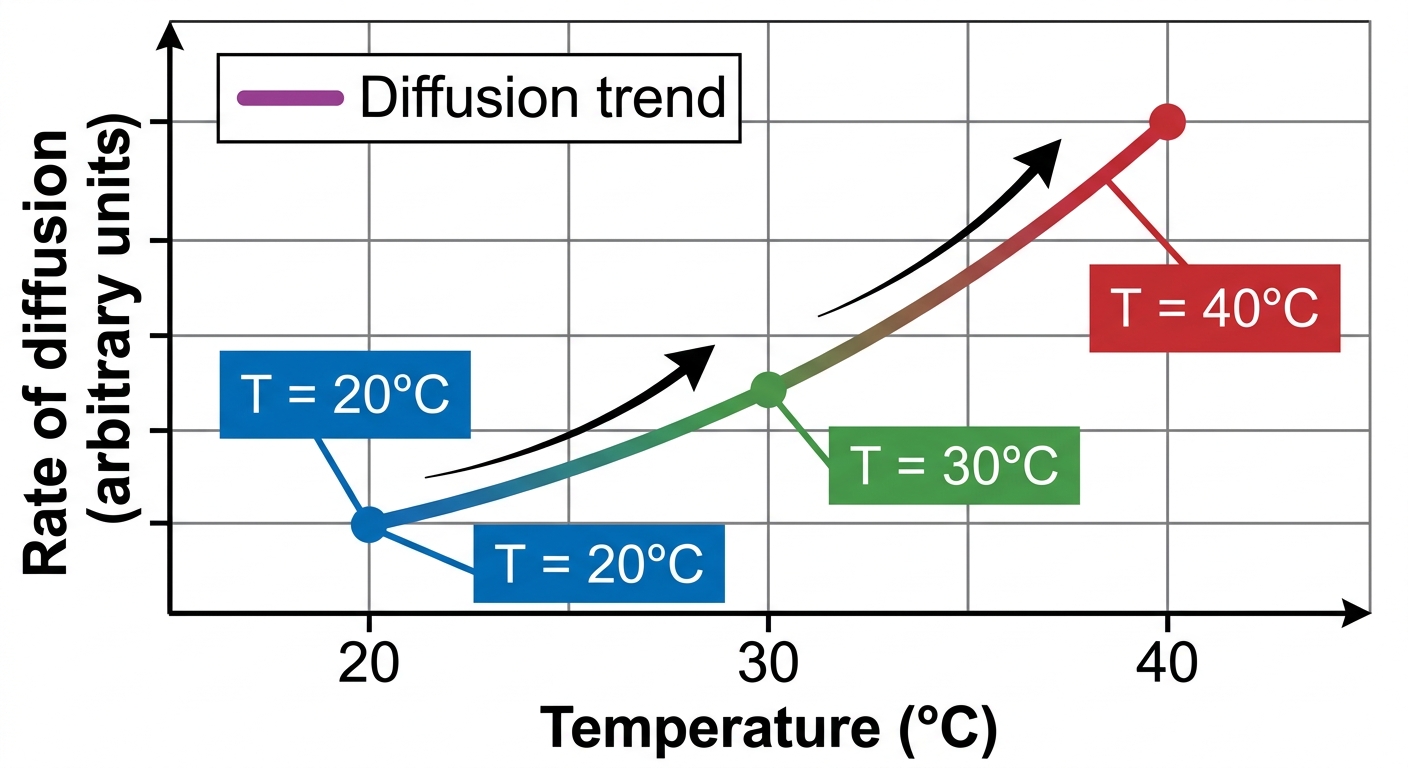
An open perfume bottle is placed in a room. The rate at which the perfume vapour spreads is measured at three temperatures.
| Temperature (°C) | 20 | 30 | 40 |
|---|---|---|---|
| Rate of diffusion (arbitrary units) | 2.0 | 3.5 | 5.5 |
a
Identify the trend shown by the data. [1]
b
Using particle theory, explain why increasing temperature affects the speed of perfume molecules. [1]
c
Analyse why faster-moving perfume molecules produce a higher rate of diffusion through air. [1]
Solutions
4QuestionRelationship between kinetic energy and diffusion speedAssessment Practice
6 marks~9 minCriterion D
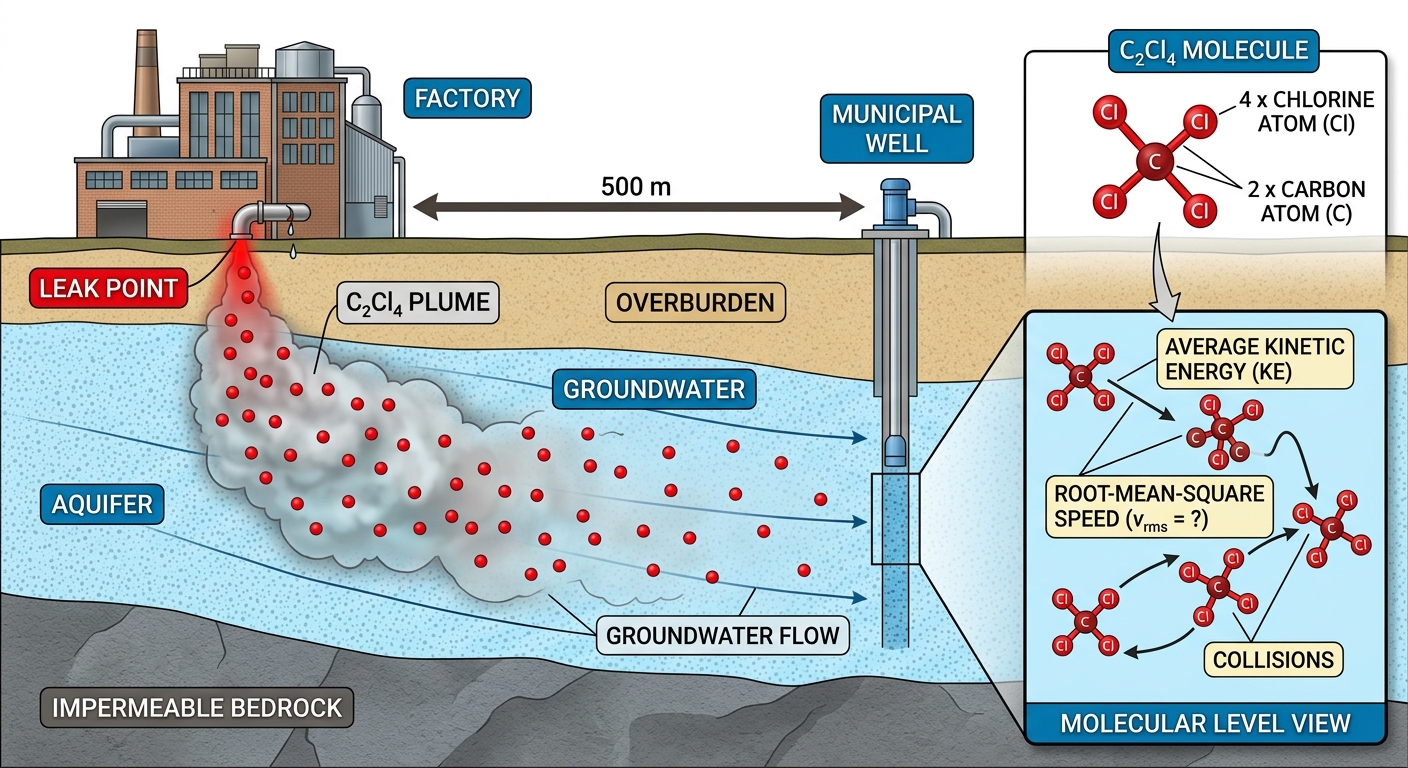
A factory leak releases tetrachloroethylene (C2Cl4, molar mass 166 g/mol) into an aquifer at 285 K. The solvent diffuses through the groundwater toward a municipal well 500 m away. The average kinetic energy of molecules is given by , where J/K.
a
[2 marks] Calculate the root-mean-square speed of tetrachloroethylene molecules at 285 K. Use , where is the mass of one molecule in kg.
b
[1 mark] State one reason why the actual time for the solvent to reach the well is much longer than predicted by the root-mean-square speed alone.
c
[3 marks] Discuss the health implications of tetrachloroethylene reaching the municipal well. Your discussion should include:
Solutions
That's every free question here — 4 of 76.
+72 more questions, plus Mock Papers & Worksheets, are waiting in Premium.