You're viewing free preview questions — 4 questions previewing here — subscribe to unlock 64 more, plus the Full Question Bank, Mock Papers & Worksheets.Upgrade
Particle Model and Kinetic Theory — Free MYP5 Chemistry Practice Questions

1QuestionParticle motion in solids, liquids, and gasesConcept Practice
2 marks~3 minCriterion A
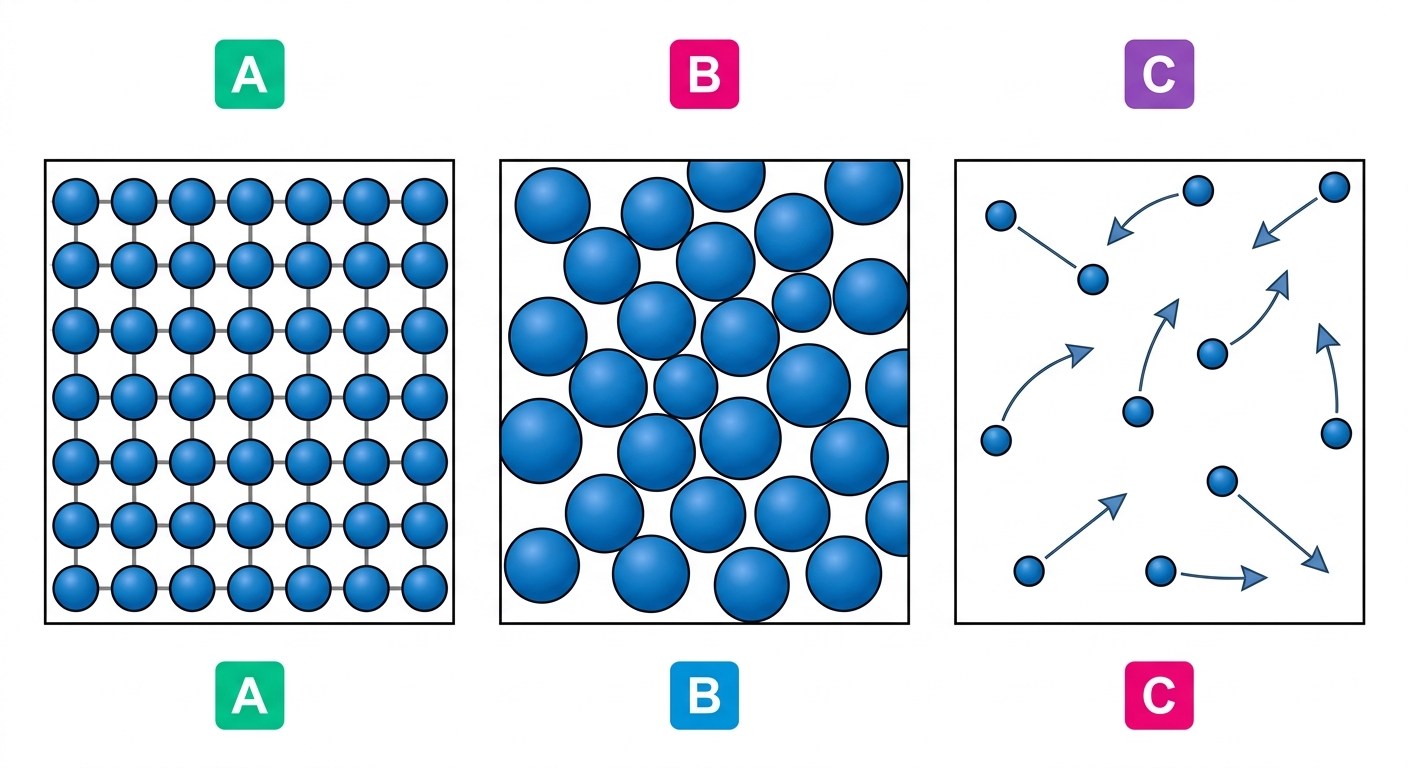
The diagrams below show particle arrangements in three states of matter.
Diagram A: particles arranged in a regular, closely packed lattice.
Diagram B: particles close together but in no regular pattern.
Diagram C: particles far apart, moving randomly.
Diagram A: particles arranged in a regular, closely packed lattice.
Diagram B: particles close together but in no regular pattern.
Diagram C: particles far apart, moving randomly.
a
Identify the state of matter shown in Diagram A. [1]
b
Diagram C shows particles that are far apart and moving randomly. Deduce which property of a gas — compressibility or electrical conductivity — is directly explained by this particle arrangement, and justify your reasoning. [1]

Solutions
2QuestionExplaining macroscopic properties using particle theoryAssessment Practice
3 marks~5 minCriterion C
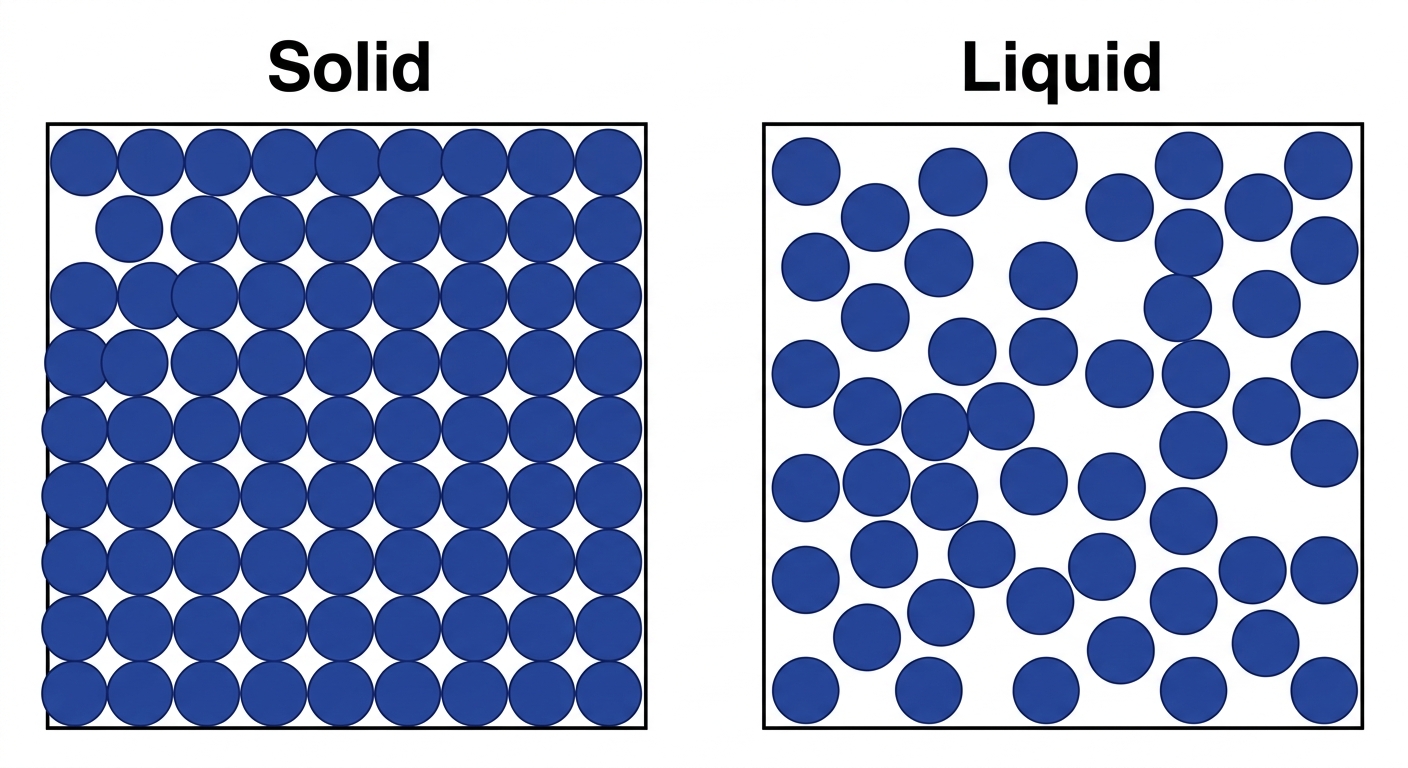
The diagram shows the particle arrangement of the same substance in its solid state (left) and liquid state (right).
a
Describe the spacing and movement of particles in the solid. [1]
b
Explain, using particle theory, why the solid maintains a fixed shape and volume while the liquid conforms to the shape of its container. [1]
c
A student claims: "If you heat the solid just enough to melt it, the particles must be moving faster, so the liquid should take up more volume than the solid." Evaluate this claim. [1]
Solutions
3QuestionExplaining macroscopic properties using particle theoryAssessment Practice
5 marks~8 minCriterion D
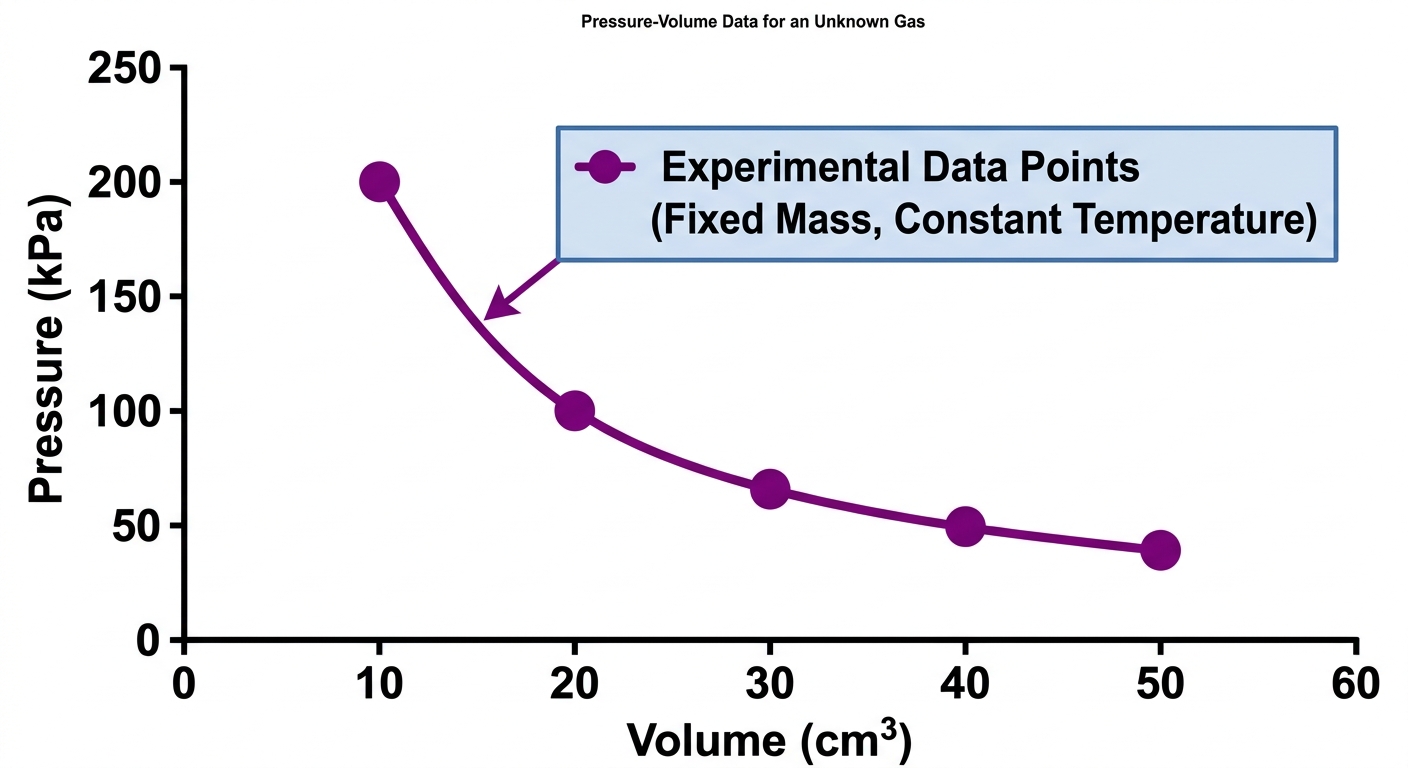
A student hypothesises that gas particles have negligible volume and exert no forces on each other. To test this, she measures the pressure of a fixed mass of gas at constant temperature across five volumes.
| Volume () | 10 | 20 | 30 | 40 | 50 |
|---|---|---|---|---|---|
| Pressure () | 200 | 100 | 66.7 | 50 | 40 |
a
Calculate the product for each data point and deduce the mathematical relationship between pressure and volume. [1]
b
Explain how the particle model accounts for the observed relationship between pressure and volume at constant temperature. [2]
c
Evaluate the extent to which this experimental evidence supports the student's hypothesis, and discuss the limitations that prevent a universal conclusion. [2]
Solutions
4QuestionExplaining macroscopic properties using particle theoryAssessment Practice
7 marks~11 minCriterion B
The table below shows gas volumes for four reactions carried out at the same temperature and pressure.
Reaction 1: — volumes: 4 L, 2 L, 4 L
Reaction 2: — volumes: 2 L, 6 L, 4 L
Reaction 3: — volumes: 1 L, 2 L, 1 L, 2 L
Reaction 4: — volumes: 3 L, 1.5 L, 3 L
Reaction 1: — volumes: 4 L, 2 L, 4 L
Reaction 2: — volumes: 2 L, 6 L, 4 L
Reaction 3: — volumes: 1 L, 2 L, 1 L, 2 L
Reaction 4: — volumes: 3 L, 1.5 L, 3 L
a
Analyse the data and state the pattern relating gas volumes to the coefficients in the balanced equations. Support your answer with one example from the data. [2]
b
Deduce the volume of produced when 6 L of reacts completely with excess :
Show your reasoning. [2]
Show your reasoning. [2]
c
Justify why, at constant temperature and pressure, volume ratios between reacting gases equal their mole ratios. Use the particle model in your answer, and evaluate whether this reasoning would still hold if pressure were doubled mid-reaction. [3]
Solutions
That's every free question here — 4 of 68.
+64 more questions, plus Mock Papers & Worksheets, are waiting in Premium.