You're viewing free preview questions — 4 questions previewing here — subscribe to unlock 82 more, plus the Full Question Bank, Mock Papers & Worksheets.Upgrade
Physical Vs. Chemical Changes — Free MYP5 Chemistry Practice Questions

1QuestionDefinition of chemical change (new substances formed)Concept Practice
3 marks~5 minCriterion A
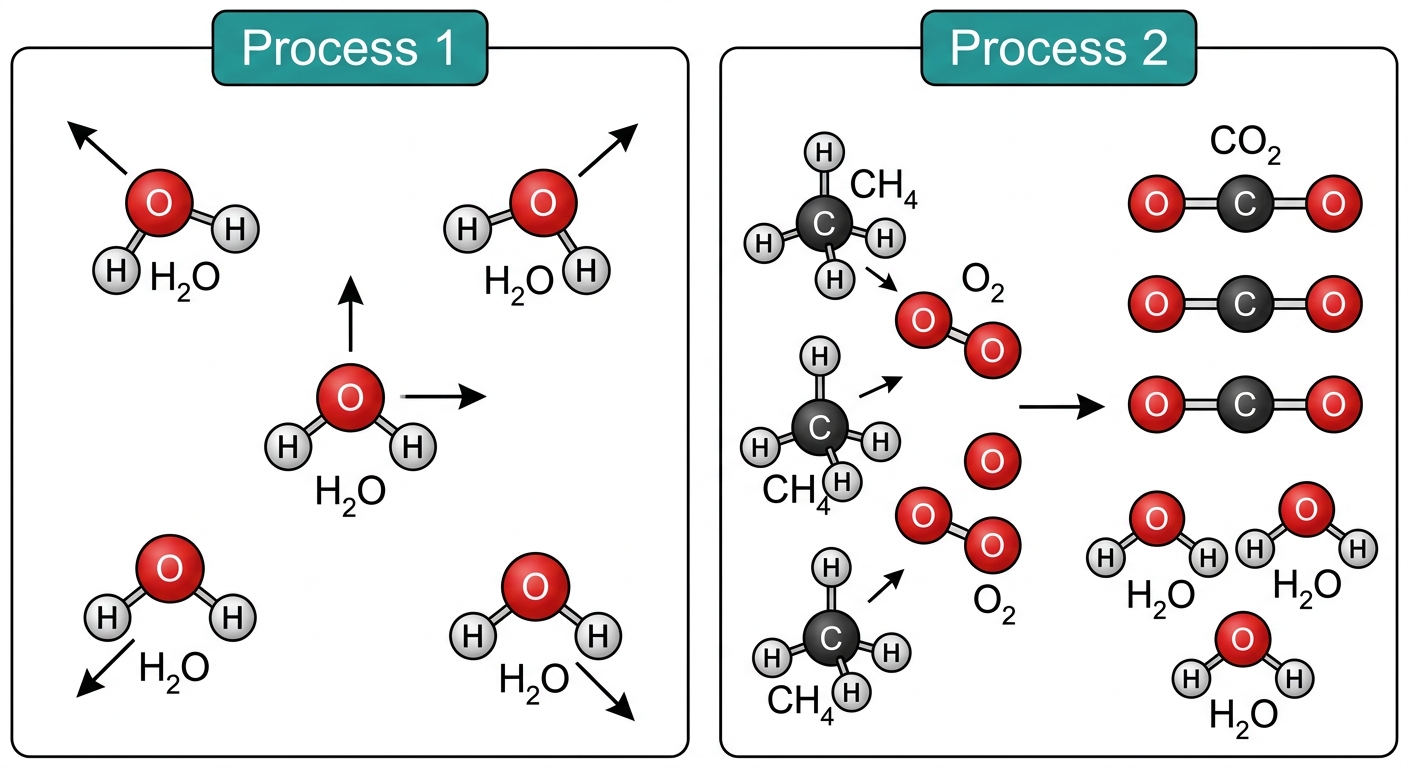
The diagram shows two processes at the particle level.
Process 1: molecules move farther apart while remaining intact.
Process 2: molecules and molecules react to form molecules and molecules.
Process 1: molecules move farther apart while remaining intact.
Process 2: molecules and molecules react to form molecules and molecules.
a
Identify which process represents a chemical change. [1]
b
Explain why Process 1 is classified as a physical change, referring to the definition of a chemical change in your answer. [2]

Solutions
2QuestionDefinition of physical change (no new substance formed)Assessment Practice
4 marks~6 minCriterion C
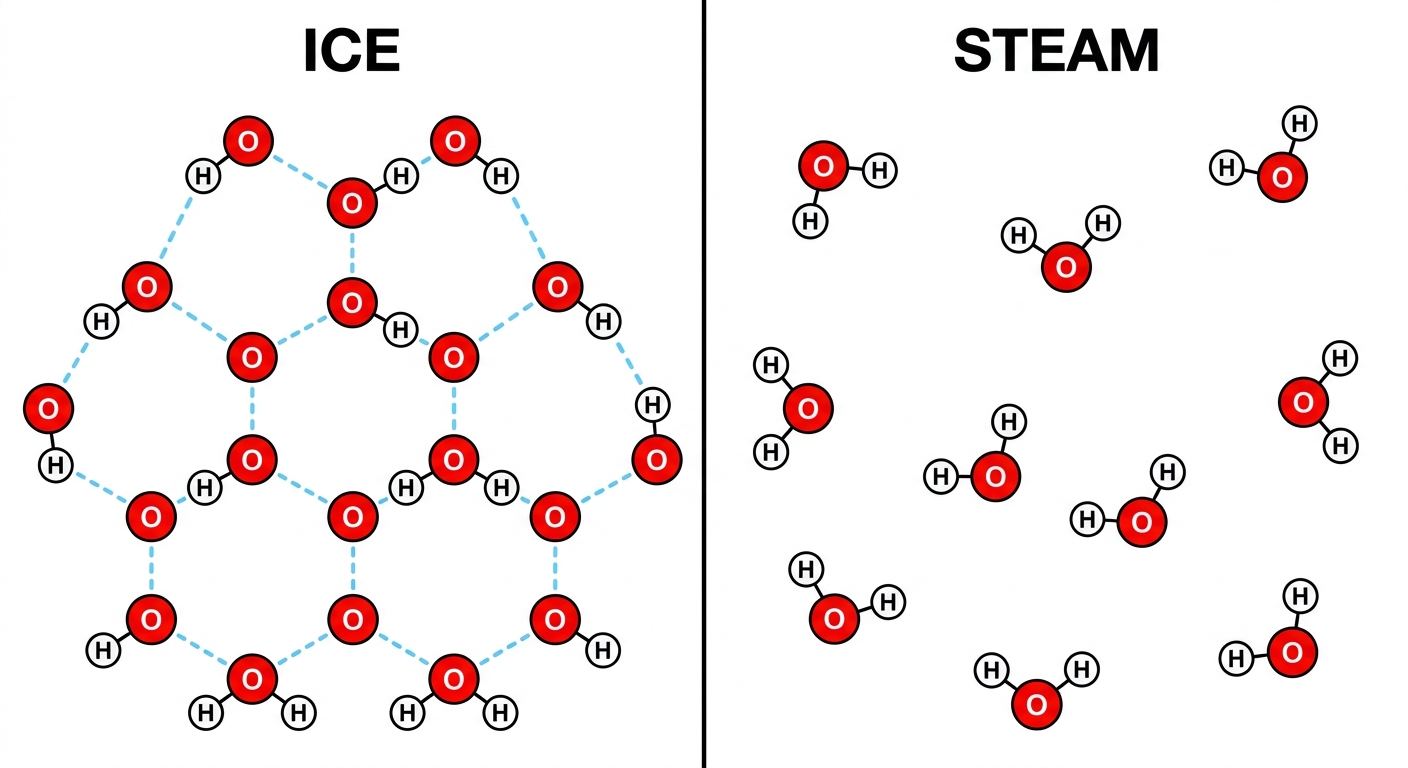
The diagram shows water molecules arranged in ice (fixed lattice, hydrogen bonds shown as dashed lines) and in steam (molecules far apart, moving freely).
a
State what is meant by a physical change. [1]
b
Explain, using the diagram, why melting ice is classified as a physical change rather than a chemical change. Refer to the bonds involved. [2]
c
A student claims that boiling water requires more energy than melting ice, so boiling must involve a chemical change. Evaluate this claim. [1]
Solutions
3QuestionDefinition of chemical change (new substances formed)Assessment Practice
8 marks~12 minCriterion D
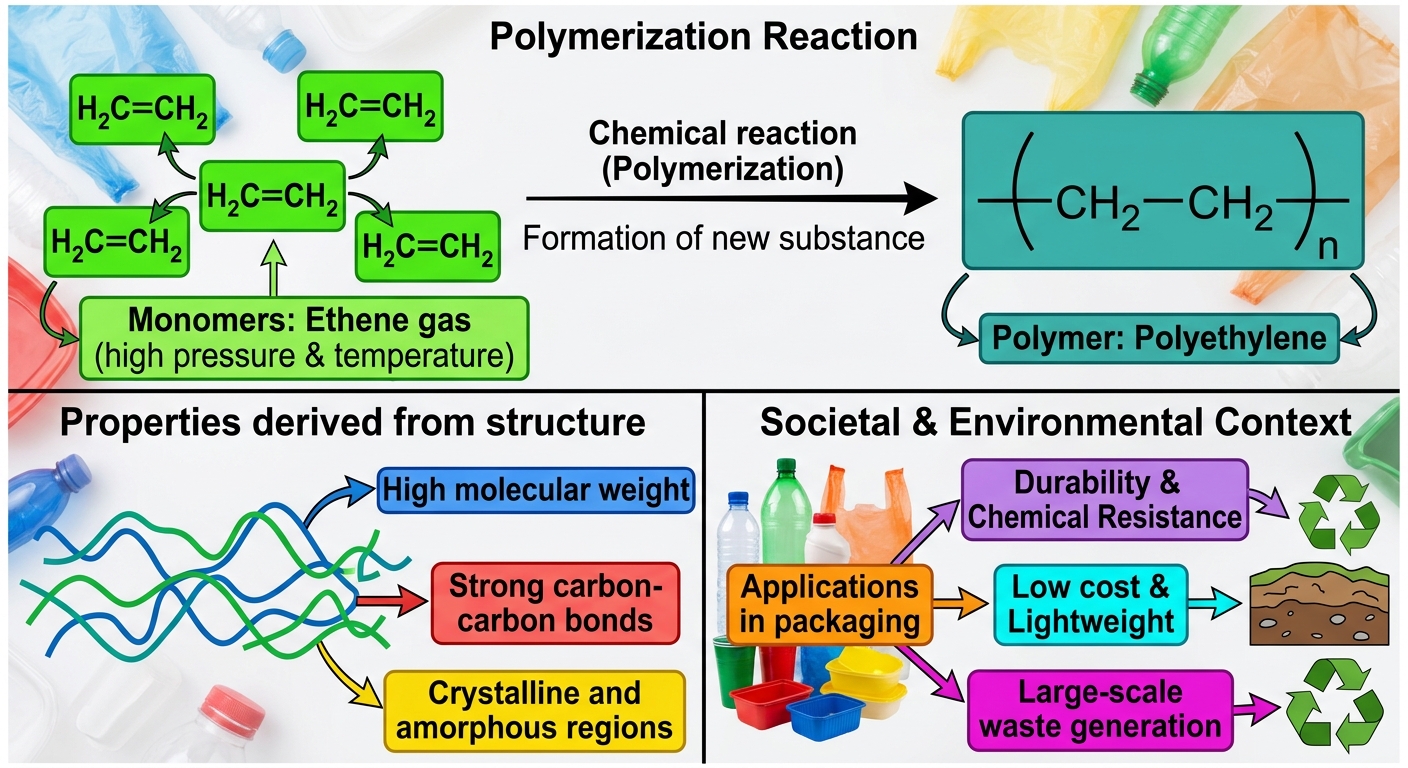
Polyethylene is a synthetic polymer produced by polymerising ethene gas under high pressure and temperature. This chemical change forms long-chain molecules with strong covalent C–C bonds throughout the backbone. Polyethylene is widely used in food packaging because of the properties that emerge from this new molecular structure. However, global plastic recycling rates remain below 10%, and polyethylene persists in the environment for hundreds of years.
a
Identify and explain two societal benefits of polyethylene packaging that arise directly from the properties of the polymer formed. [2]
b
Describe two environmental problems caused by polyethylene waste, linking each problem to the chemical nature of the polymer. [2]
c
Evaluate the sustainability of producing and using polyethylene packaging, considering the chemical stability of the polymer, current waste management limitations, and the balance between societal benefits and environmental costs. [4]
Solutions
4QuestionDefinition of chemical change (new substances formed)Assessment Practice
4 marks~6 minCriterion B
A student investigated whether new substances were formed in five experiments. The results are shown below.
Experiment 1: 10 g iron + 6 g sulfur → 16 g black solid. New substance formed: Yes. Reversible: No.
Experiment 2: 5 g salt + 50 g water → 55 g salt solution. New substance formed: No. Reversible: Yes.
Experiment 3: 10 g green powder → 6 g black powder + gas released. New substance formed: Yes. Reversible: No.
Experiment 4: 20 g solid wax → 20 g liquid wax. New substance formed: No. Reversible: Yes.
Experiment 5: 2 g magnesium → 3.3 g white ash. New substance formed: Yes. Reversible: No.
Experiment 1: 10 g iron + 6 g sulfur → 16 g black solid. New substance formed: Yes. Reversible: No.
Experiment 2: 5 g salt + 50 g water → 55 g salt solution. New substance formed: No. Reversible: Yes.
Experiment 3: 10 g green powder → 6 g black powder + gas released. New substance formed: Yes. Reversible: No.
Experiment 4: 20 g solid wax → 20 g liquid wax. New substance formed: No. Reversible: Yes.
Experiment 5: 2 g magnesium → 3.3 g white ash. New substance formed: Yes. Reversible: No.
a
Deduce a general rule linking new substance formation, reversibility, and mass change, using evidence from at least two experiments. [2]
b
A sixth experiment heats a mixture of sand and sugar. The sugar chars to a black solid and a gas is released; the sand is unchanged. Justify whether a new substance is formed and whether the change is reversible, applying your rule from part (a). [2]
Solutions
That's every free question here — 4 of 86.
+82 more questions, plus Mock Papers & Worksheets, are waiting in Premium.