You're viewing free preview questions — 6 questions previewing here — subscribe to unlock 64 more, plus the Full Question Bank, Mock Papers & Worksheets.Upgrade
Back

Reversible Reactions and Equilibrium (qualitative) — Free MYP5 Chemistry Practice Questions

Free questions

Open in full, with answers, mark scheme and examiner insights.

Question 1Criterion A · Band 3-4 · Easy · 6 marksrevisionprep.com

Closed system requirement for equilibrium
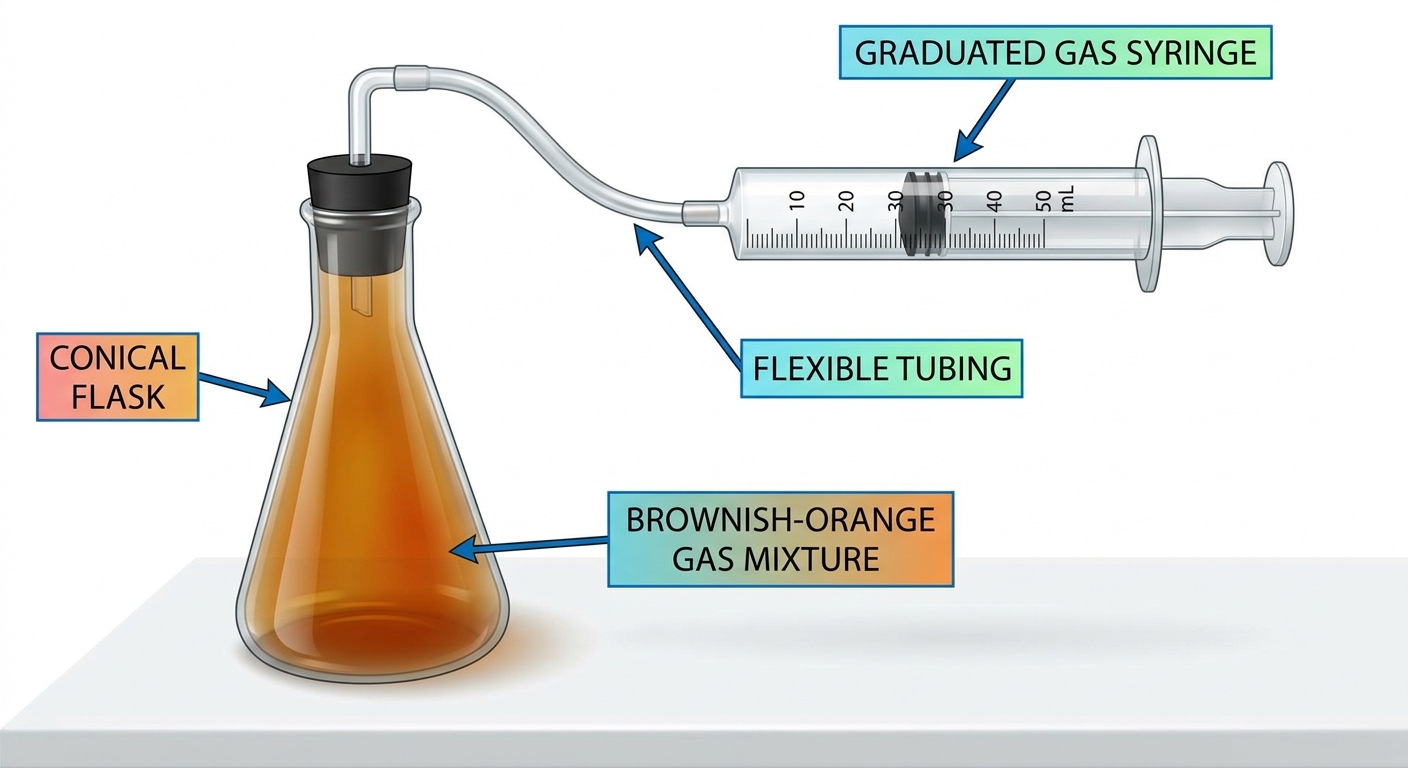
A conical flask containing a mixture of brown nitrogen dioxide and colourless dinitrogen tetroxide is connected by tubing to a gas syringe, as shown. The plunger can move, but no gas can escape.

2NO2(g)⇌N2O4(g)\mathrm{2NO_2(g) \rightleftharpoons N_2O_4(g)}
Question diagram
(a)
Explain why the apparatus is a closed system even though the plunger can move. [2]Criterion A (ii) · Level 3-4
(b)
The apparatus is left at constant temperature and the colour stops changing. Explain why the colour stays constant even though reactions are still taking place. [2]Criterion A (ii) · Level 3-4
(c)
The stopper is removed for a few minutes and then replaced. Predict and explain how the brown colour in the flask changes. [2]Criterion A (iii) · Level 3-4

revisionprep.com

Summary Answer

Not available for this question.

Model Answer

Not available for this question.

Marking Scheme

Not available for this question.

Examiner Insights

Not available for this question.

Question 2Criterion A + D · Band 1-4 · Easy · 4 marksrevisionprep.com

Real-life examples (industrial processes, biological systems)

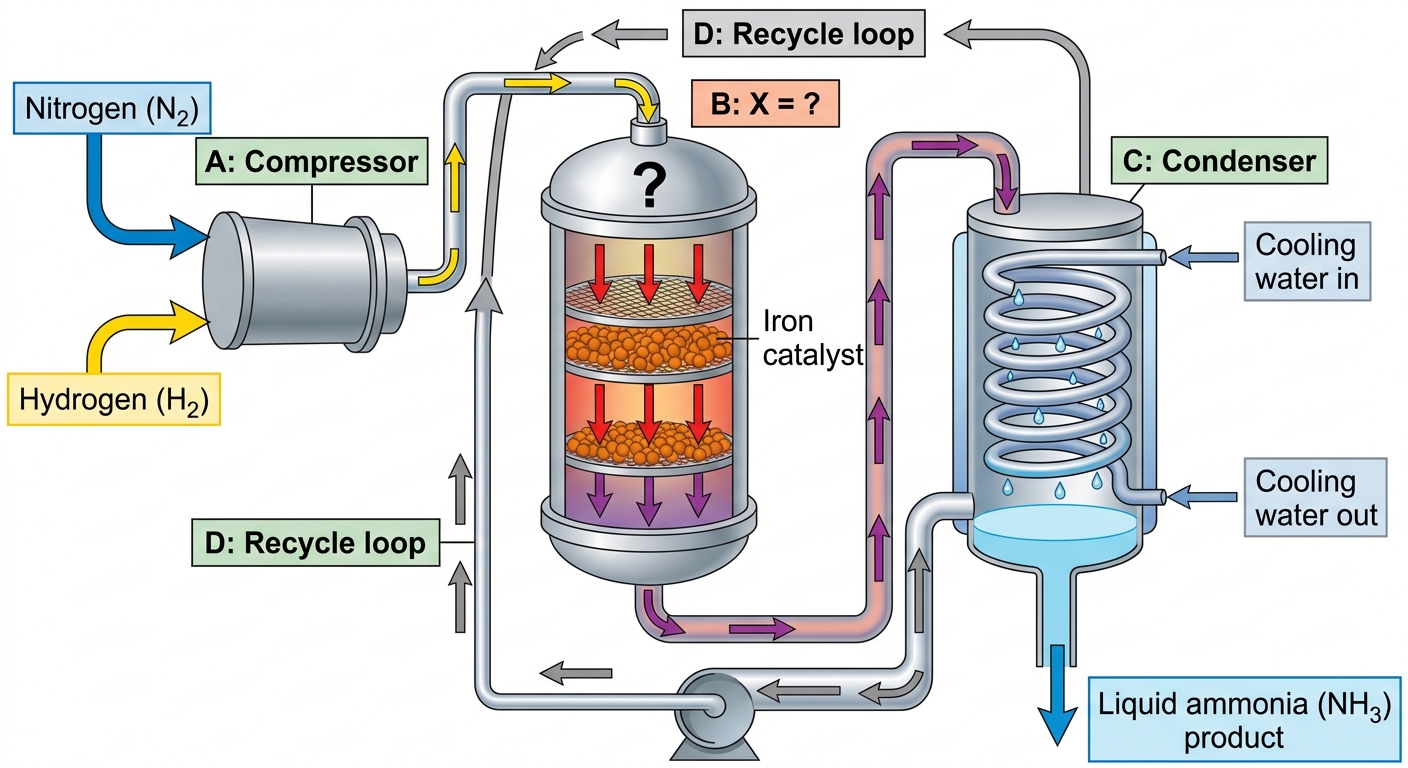
The diagram shows an ammonia plant. Component X contains beds of iron.

N2(g)+3H2(g)⇌2NH3(g)\mathrm{N_2(g) + 3H_2(g) \rightleftharpoons 2NH_3(g)}

Boiling points: ammonia −33 °C, nitrogen −196 °C, hydrogen −253 °C.
Question diagram
(a)
Identify component X. [1]Criterion A (i) · Level 1-2
(b)
Explain why an iron catalyst is used even though it does not change the percentage of ammonia at equilibrium. [2]Criterion D (i) · Level 3-4
(c)
Explain why ammonia leaves the condenser (C) as a liquid while nitrogen and hydrogen do not. [1]Criterion A (ii) · Level 3-4

revisionprep.com

Summary Answer

Not available for this question.

Model Answer

Not available for this question.

Marking Scheme

Not available for this question.

Examiner Insights

Not available for this question.

Question 3Criterion A + C · Band 1-6 · Medium · 6 marksrevisionprep.com

Dynamic equilibrium (forward rate = backward rate)

Hydrogen and iodine react in a sealed container at constant temperature:

H₂(g) + I₂(g) ⇌ 2HI(g)

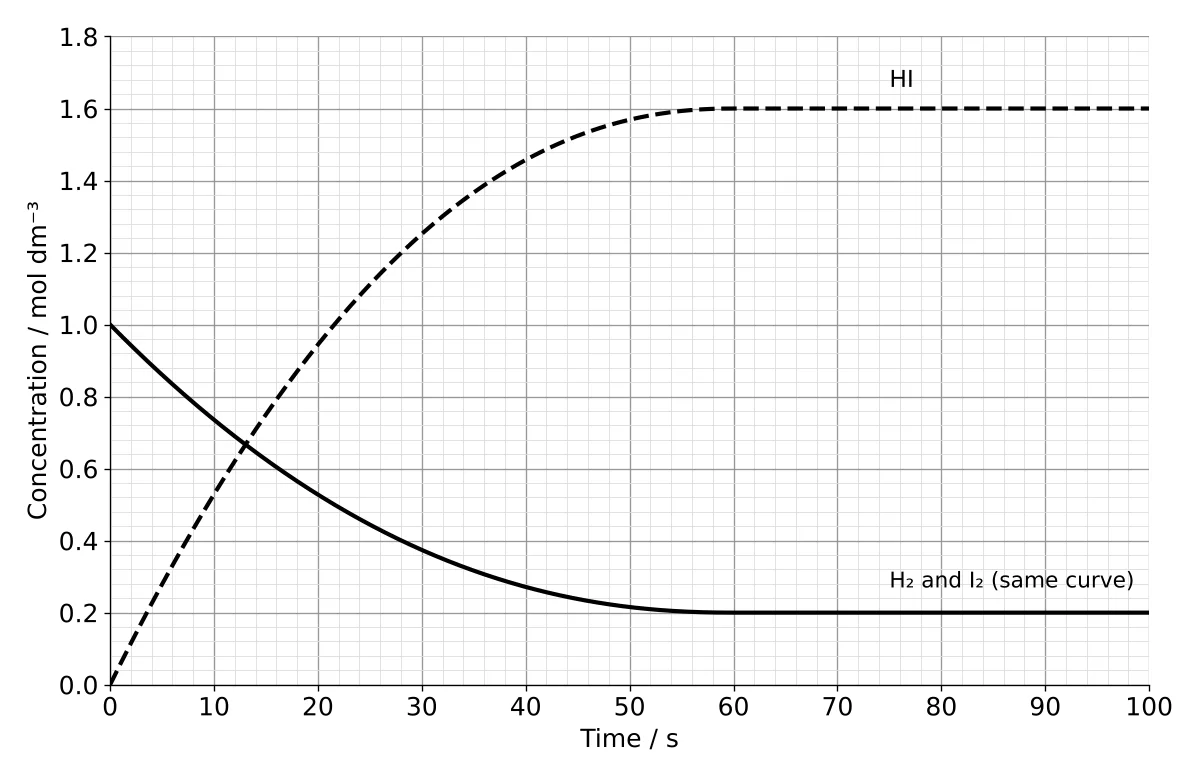
The graph shows the concentrations, starting with 1.00 mol dm⁻³ each of hydrogen and iodine.
Question diagram
(a)
Use the graph to state the time at which equilibrium is reached. [1]Criterion C (ii) · Level 1-2
(b)
Explain why the HI curve rises by twice as much as the H₂ curve falls. [1]Criterion A (ii) · Level 3-4
(c)
Explain what the horizontal sections of the curves show about the forward and backward reactions. [2]Criterion A (i) · Level 3-4
(d)
A student says: 'At equilibrium the concentrations of reactants and products are equal.' Use the graph to evaluate this statement. [2]Criterion C (iii) · Level 5-6

revisionprep.com

Summary Answer

Not available for this question.

Model Answer

Not available for this question.

Marking Scheme

Not available for this question.

Examiner Insights

Not available for this question.

Question 4Criterion B · Band 3-6 · Medium · 9 marksrevisionprep.com

Effect of changes in conditions (temperature, concentration – basic idea)

Cobalt(II) ions form a pink and a blue species in chloride solution:

[Co(H2O)6]2+(aq)+4Cl−(aq)⇌[CoCl4]2−(aq)+6H2O(l)\mathrm{[Co(H_2O)_6]^{2+}(aq) + 4Cl^-(aq) \rightleftharpoons [CoCl_4]^{2-}(aq) + 6H_2O(l)}

The forward reaction is endothermic. Jae wants to investigate how temperature affects the position of this equilibrium. He has a stock solution of the purple equilibrium mixture, water baths, a thermometer and a colorimeter that measures the absorbance of the blue species (higher absorbance means more of the blue species).
(a)
Formulate a hypothesis and explain it using scientific reasoning. [2]Criterion B (ii) · Level 5-6
(b)
Explain how Jae should change the independent variable and measure the dependent variable, including how he will know that each sample has reached equilibrium. [3]Criterion B (iii) · Level 5-6
(c)
Identify two control variables and explain how each would be controlled. [2]Criterion B (iii) · Level 5-6
(d)
Explain how he will collect sufficient data. [1]

(e) Describe one safety precaution for this investigation. [1]
Criterion B (iii) · Level 3-4

revisionprep.com

Summary Answer

Not available for this question.

Model Answer

Not available for this question.

Marking Scheme

Not available for this question.

Examiner Insights

Not available for this question.

Question 5Criterion C · Band 3-8 · Challenge · 8 marksrevisionprep.com

Definition of reversible reactions

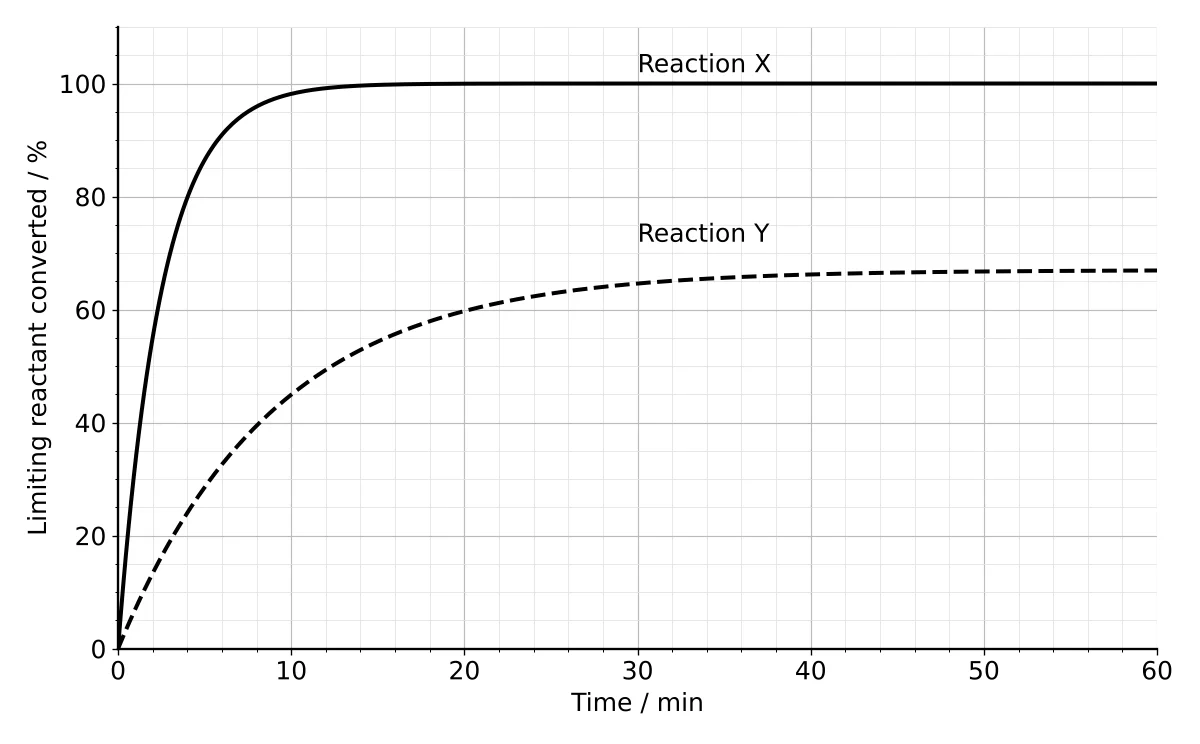
Two reactions, X and Y, were each carried out at constant temperature in a sealed flask. In both reactions the second reactant was present in excess. The percentage of the limiting reactant converted was measured over 60 minutes. The graph shows the results.
Question diagram
(a)
Identify which reaction is reversible. Justify your answer using the graph. [2]Criterion C (ii) · Level 3-4
(b)
Use the graph to estimate the time at which reaction Y reaches equilibrium. [1]Criterion C (ii) · Level 3-4
(c)
Explain, in terms of the forward and backward reactions, why the curve for reaction Y levels off at about 67%. [2]Criterion C (ii) · Level 5-6
(d)
A student suggests that reaction Y stops at 67% because one of the reactants has run out. Evaluate this suggestion. [3]Criterion C (iii) · Level 7-8

revisionprep.com

Summary Answer

Not available for this question.

Model Answer

Not available for this question.

Marking Scheme

Not available for this question.

Examiner Insights

Not available for this question.

Question 6Criterion D + A · Band 3-8 · Challenge · 8 marksrevisionprep.com

Haber process: conditions and compromise (qualitative)

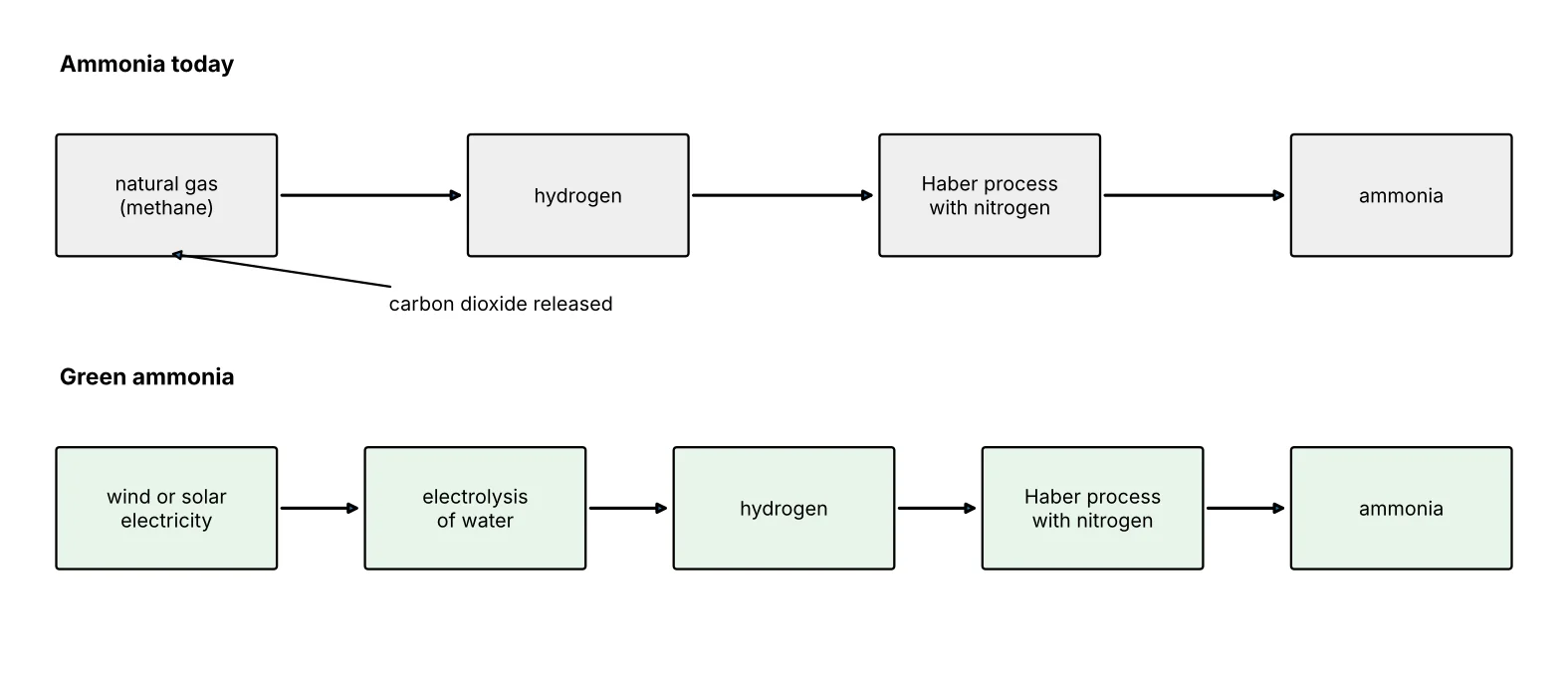
About 180 million tonnes of ammonia are made each year by the Haber process, mostly for fertilisers. Hydrogen for the process comes mainly from natural gas, and making 1 tonne of ammonia releases about 2 tonnes of carbon dioxide. Fertiliser washed from fields can cause algal blooms in rivers and lakes.

N2(g)+3H2(g)⇌2NH3(g)\mathrm{N_2(g) + 3H_2(g) \rightleftharpoons 2NH_3(g)}

The diagram compares the two ways of making ammonia.
Question diagram
(a)
Calculate the approximate mass of carbon dioxide released each year by ammonia production. [1]Criterion A (ii) · Level 3-4
(b)
Explain how the Haber process helps to feed the world's growing population. [2]Criterion D (i) · Level 5-6
(c)
'Green ammonia' is made using hydrogen from the electrolysis of water, powered by wind or solar energy. Discuss the implications of switching to green ammonia, considering environmental, economic and social perspectives, and give a reasoned conclusion. [5]Criterion D (ii) · Level 7-8

revisionprep.com

Summary Answer

Not available for this question.

Model Answer

Not available for this question.

Marking Scheme

Not available for this question.

Examiner Insights

Not available for this question.

That's every free question here — 6 of 70.

+64 more questions, plus Mock Papers & Worksheets, are waiting in Premium.

Upgrade