You're viewing free preview questions — 4 questions previewing here — subscribe to unlock 76 more, plus the Full Question Bank, Mock Papers & Worksheets.Upgrade
Collision Theory and activation energy — Free MYP5 Chemistry Practice Questions

1QuestionConditions for successful collisions (energy + orientation)Concept Practice
3 marks~5 minCriterion A
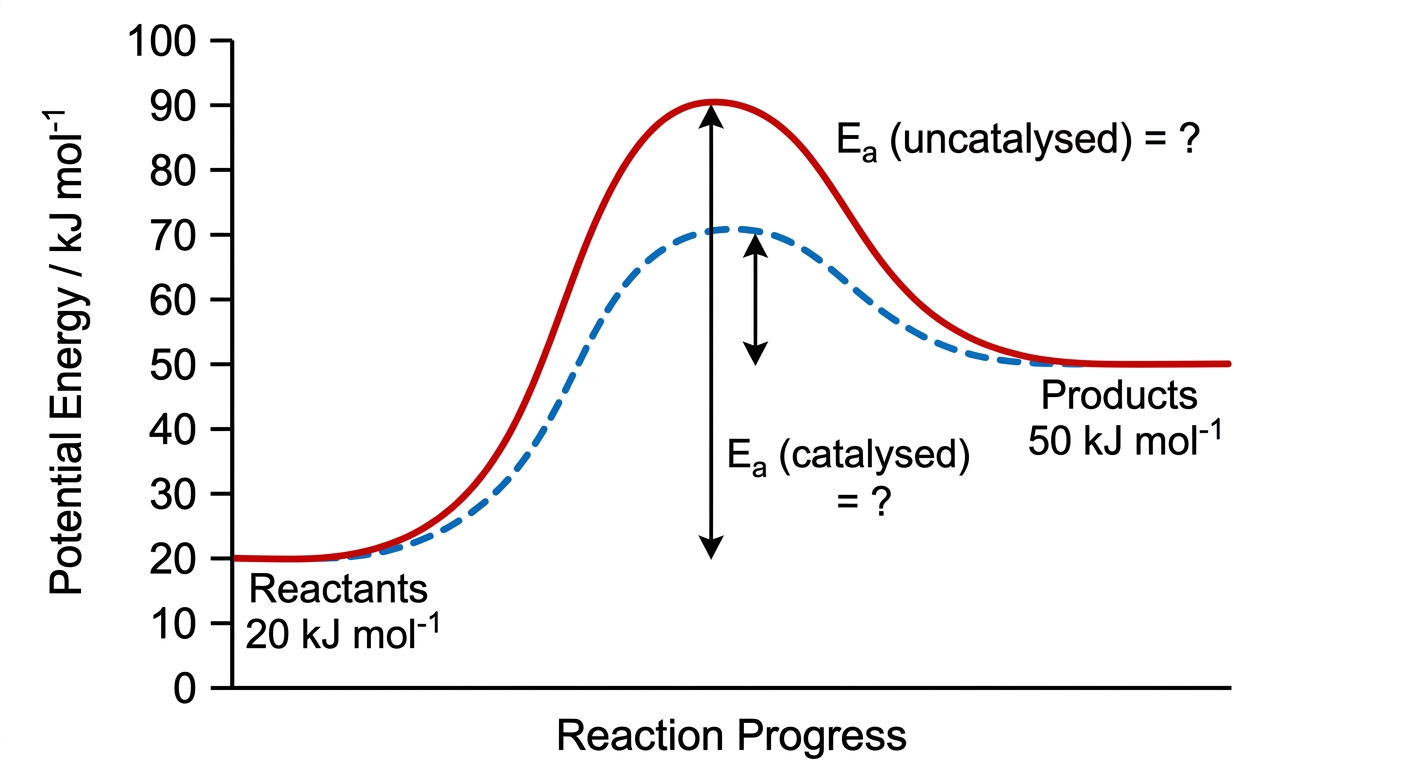
The reaction profile below shows energy changes for a reaction proceeding with and without a catalyst.
a
Explain what a catalyst does to the reaction pathway that results in a lower activation energy. [1]
b
Explain, using collision theory, what condition must be met for a collision between reactant particles to be successful. [1]
c
Analyse how the lower activation energy of the catalysed pathway affects the proportion of successful collisions among reactant particles. [1]

Solutions
2QuestionBasics of Collision TheoryAssessment Practice
3 marks~5 minCriterion C
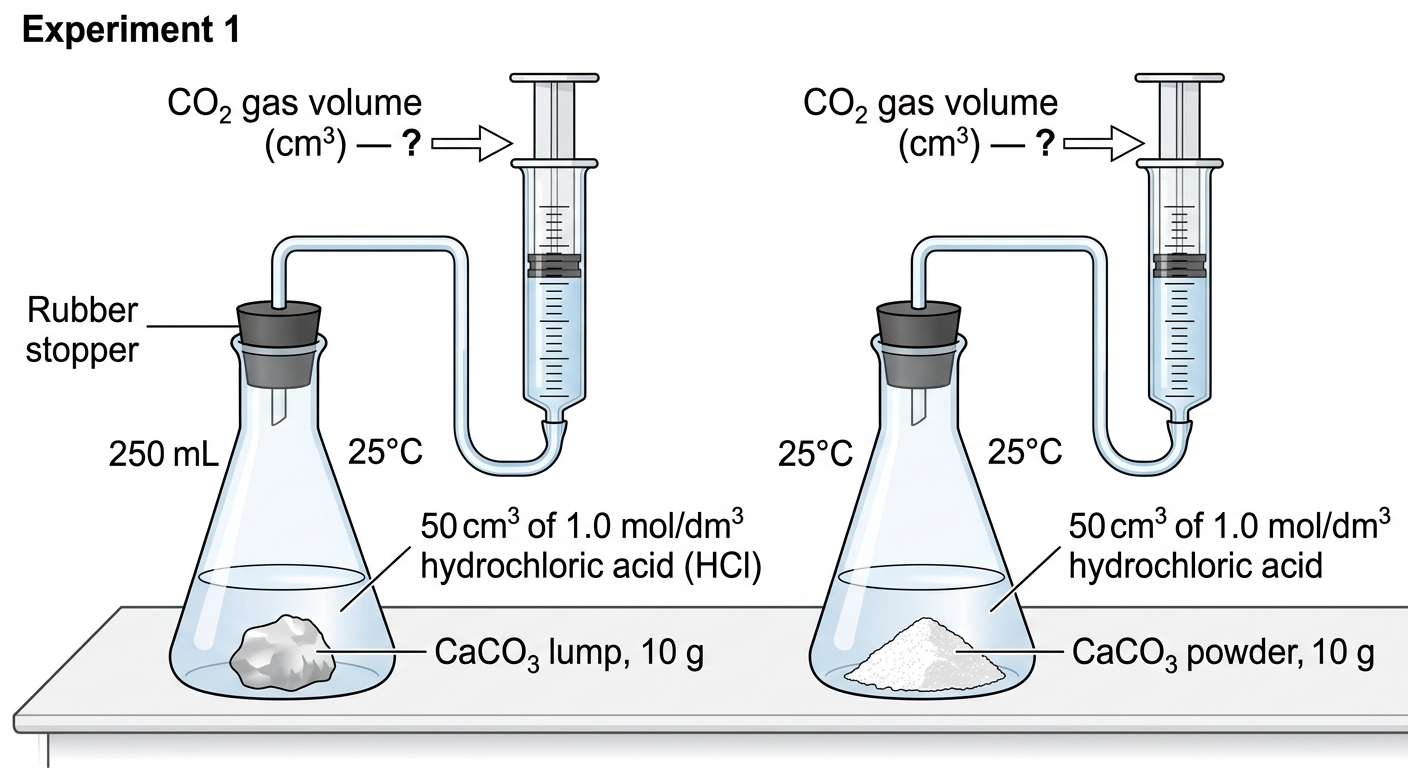
Two experiments investigate the effect of particle size on the rate of reaction between calcium carbonate and dilute hydrochloric acid.
Experiment 1: A 10 g lump of calcium carbonate is added to 50 cm³ of 1.0 mol dm⁻³ hydrochloric acid at 25°C.
Experiment 2: 10 g of powdered calcium carbonate is added to 50 cm³ of 1.0 mol dm⁻³ hydrochloric acid at 25°C.
The volume of carbon dioxide produced is recorded over time.
Experiment 1: A 10 g lump of calcium carbonate is added to 50 cm³ of 1.0 mol dm⁻³ hydrochloric acid at 25°C.
Experiment 2: 10 g of powdered calcium carbonate is added to 50 cm³ of 1.0 mol dm⁻³ hydrochloric acid at 25°C.
The volume of carbon dioxide produced is recorded over time.
a
Explain, using collision theory, why powdered calcium carbonate reacts faster than the lump. [2]
b
A student claims that increasing the concentration of hydrochloric acid would increase the rate more than raising the temperature by 10°C. Evaluate this claim. [1]
Solutions
3QuestionEffect of activation energy on reaction rateAssessment Practice
5 marks~8 minCriterion B
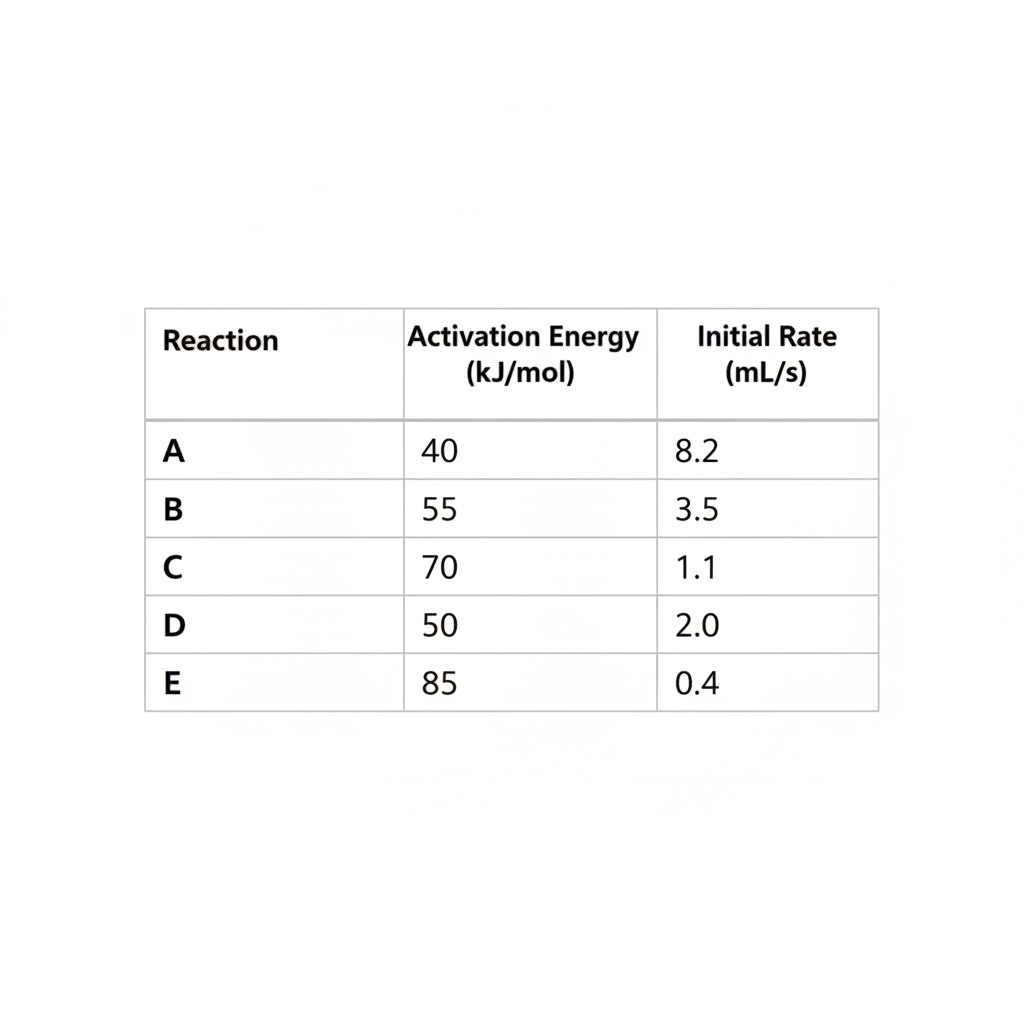
A student investigates how activation energy affects the rate of decomposition of , using five different catalysts. Oxygen gas production is measured at constant temperature.
| Reaction | A | B | C | D | E |
|---|---|---|---|---|---|
| Activation energy (kJ/mol) | 40 | 55 | 70 | 50 | 85 |
| Initial rate (mL/s) | 8.2 | 3.5 | 1.1 | 2.0 | 0.4 |
a
Deduce the relationship between activation energy and initial rate of reaction. [1]
b
Explain this relationship using collision theory. [2]
c
Identify the anomalous data point and justify why it does not fit the expected trend, using collision theory in your answer. [2]
Solutions
4QuestionBasics of Collision TheoryAssessment Practice
5 marks~8 minCriterion D
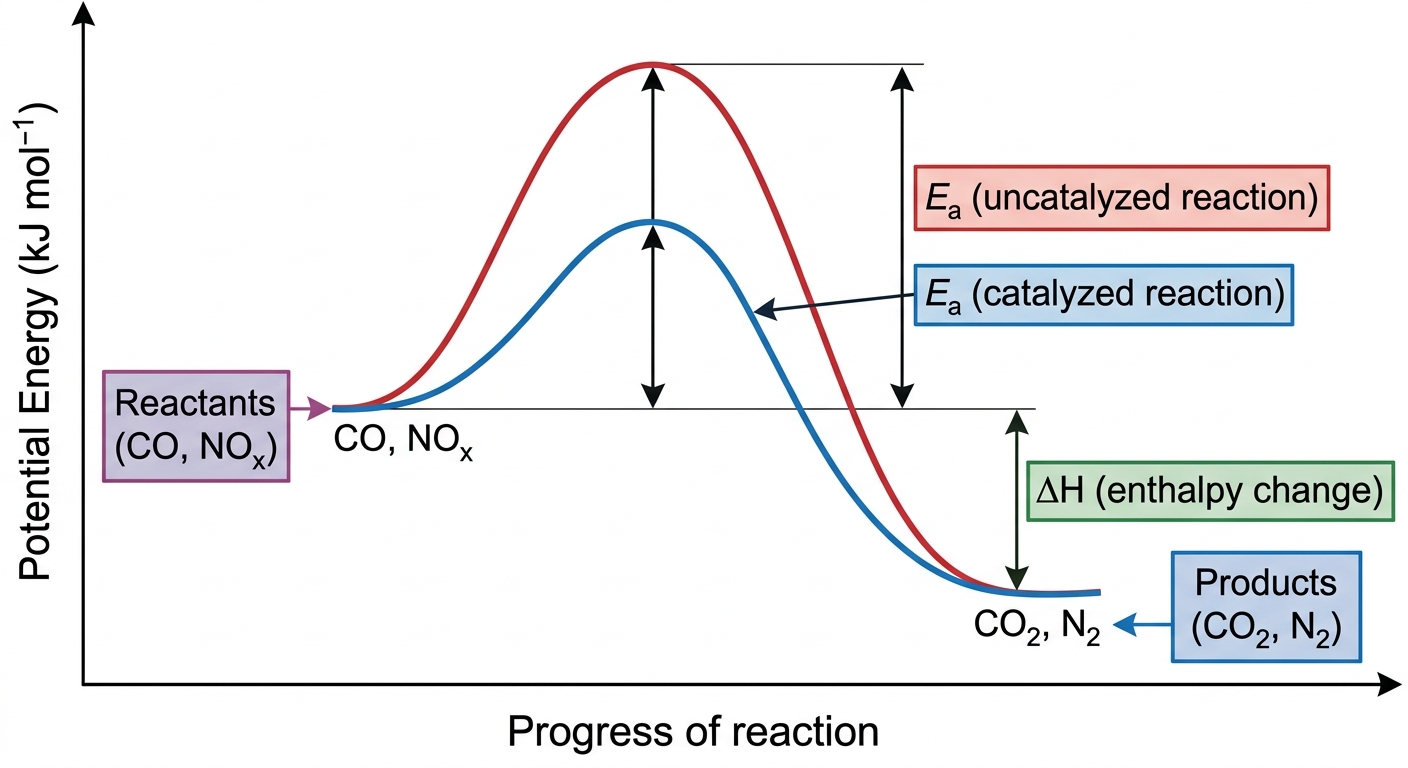
Catalytic converters use platinum and palladium to reduce the activation energy of reactions that convert toxic exhaust gases into less harmful substances. Without a catalyst, these reactions proceed too slowly at typical exhaust temperatures (approximately 300–600 °C).
a
Explain how reducing activation energy allows the conversion of and into and to proceed efficiently at exhaust temperatures. [2]
b
Explain how the catalyst provides an alternative reaction pathway to achieve this lower activation energy. [1]
c
Analyse one environmental advantage and one environmental disadvantage of catalytic converters, considering both the reduction of exhaust emissions and the extraction of platinum-group metals. [2]
Solutions
That's every free question here — 4 of 80.
+76 more questions, plus Mock Papers & Worksheets, are waiting in Premium.