You're viewing free preview questions — 4 questions previewing here — subscribe to unlock 52 more, plus the Full Question Bank, Mock Papers & Worksheets.Upgrade
Reversible Reactions and Equilibrium (qualitative) — Free MYP5 Chemistry Practice Questions

1QuestionClosed system requirement for equilibriumConcept Practice
3 marks~5 minCriterion A
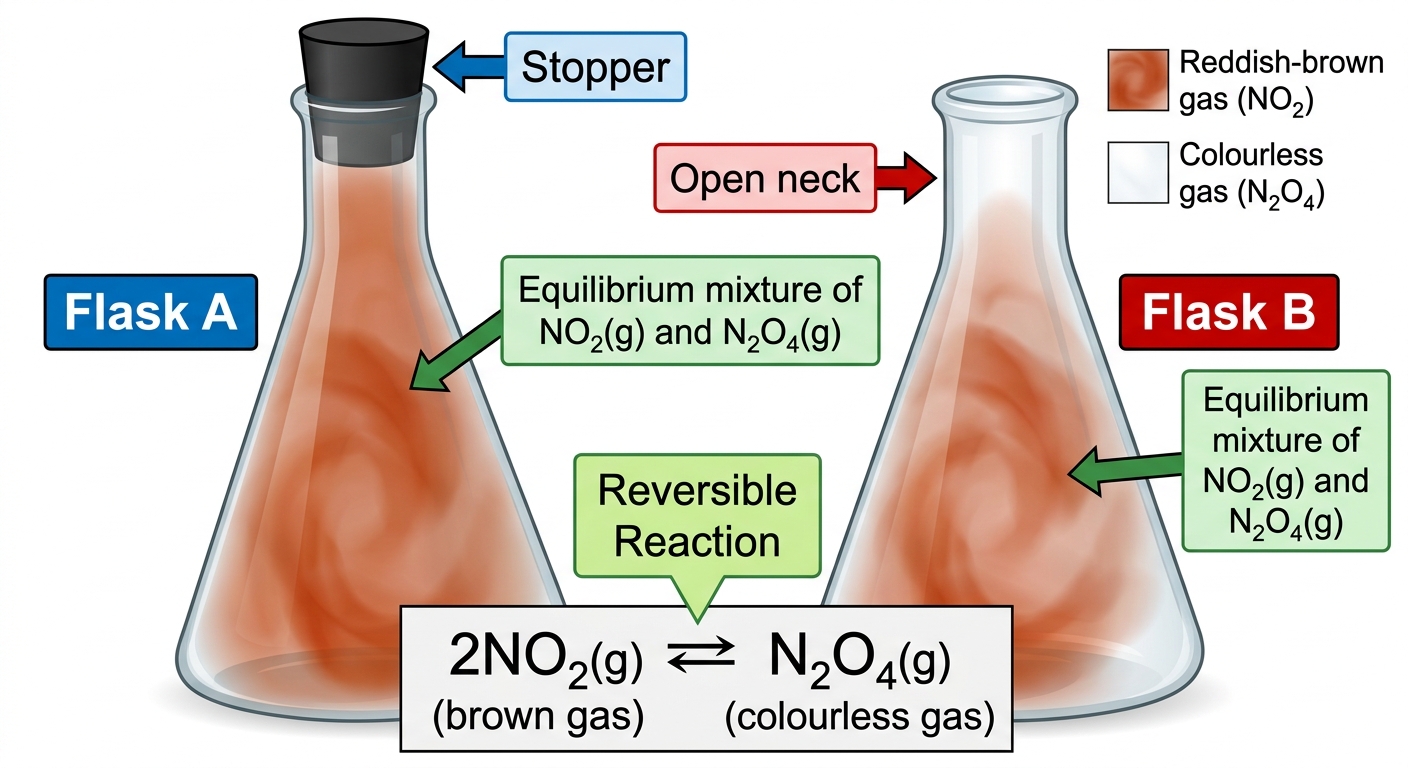
The diagram shows two sealed flasks and one open flask containing the reversible reaction:
(brown) (colourless)
Flask A is sealed with a stopper. Flask B is open to the atmosphere.
(brown) (colourless)
Flask A is sealed with a stopper. Flask B is open to the atmosphere.
a
Identify which flask can achieve dynamic equilibrium. [1]
b
Explain why Flask B cannot achieve dynamic equilibrium, using the concept of a closed system. [2]

Solutions
2QuestionDefinition of reversible reactionsAssessment Practice
3 marks~5 minCriterion C
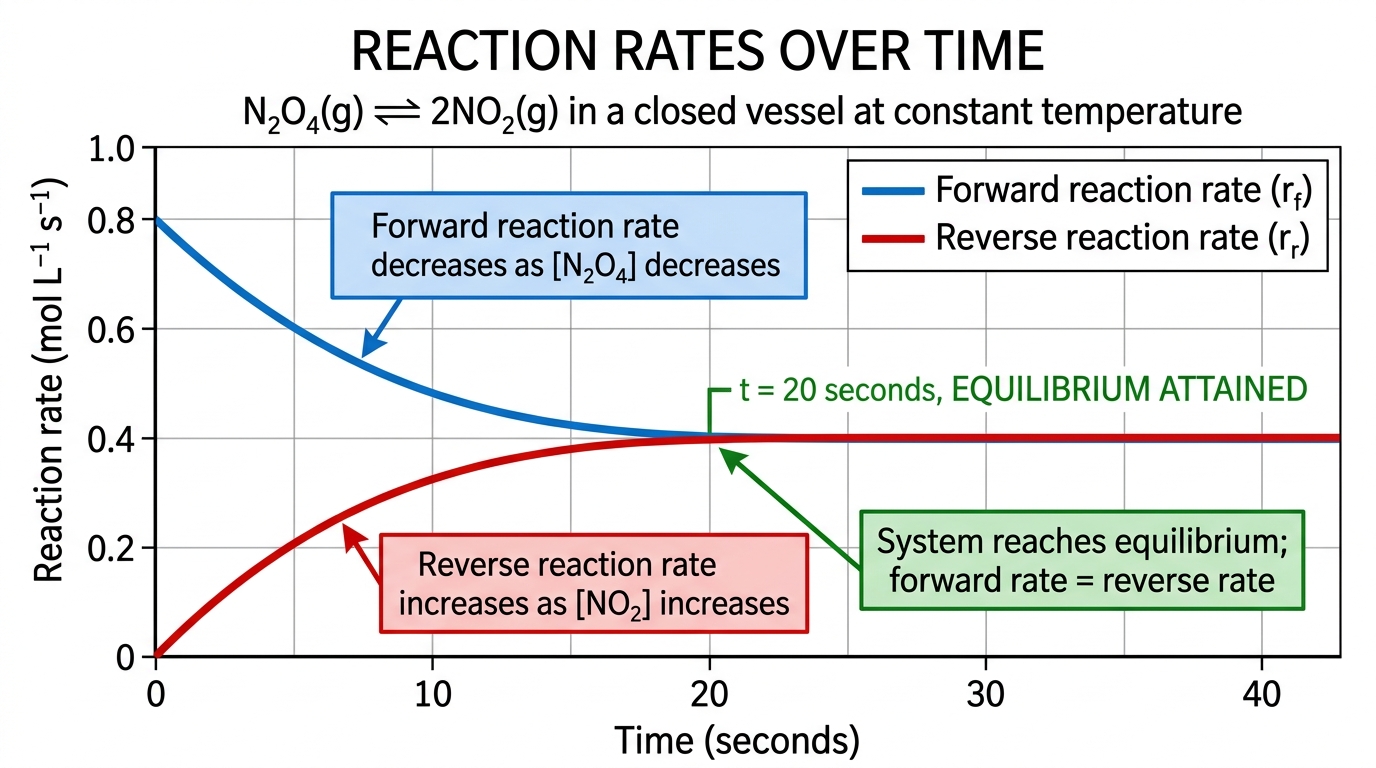
The graph below shows how the forward and reverse reaction rates change over time for a closed system at constant temperature, based on the equation:
At s, the forward rate is and the reverse rate is zero. Both rates converge over approximately 20 s until they are equal and constant at , where they remain.
At s, the forward rate is and the reverse rate is zero. Both rates converge over approximately 20 s until they are equal and constant at , where they remain.
a
Justify the time at which the system first reaches equilibrium. [1]
b
Explain what the equal, constant rates after 20 s indicate about the concentrations of and in the system. [1]
c
Discuss why the forward reaction rate does not drop to zero when the system reaches equilibrium, even though there is no net change in concentration. [1]
Solutions
3QuestionEffect of changes in conditions (temperature, concentration – basic idea)Assessment Practice
5 marks~8 minCriterion D
The reversible reaction between dinitrogen tetroxide and nitrogen dioxide is:
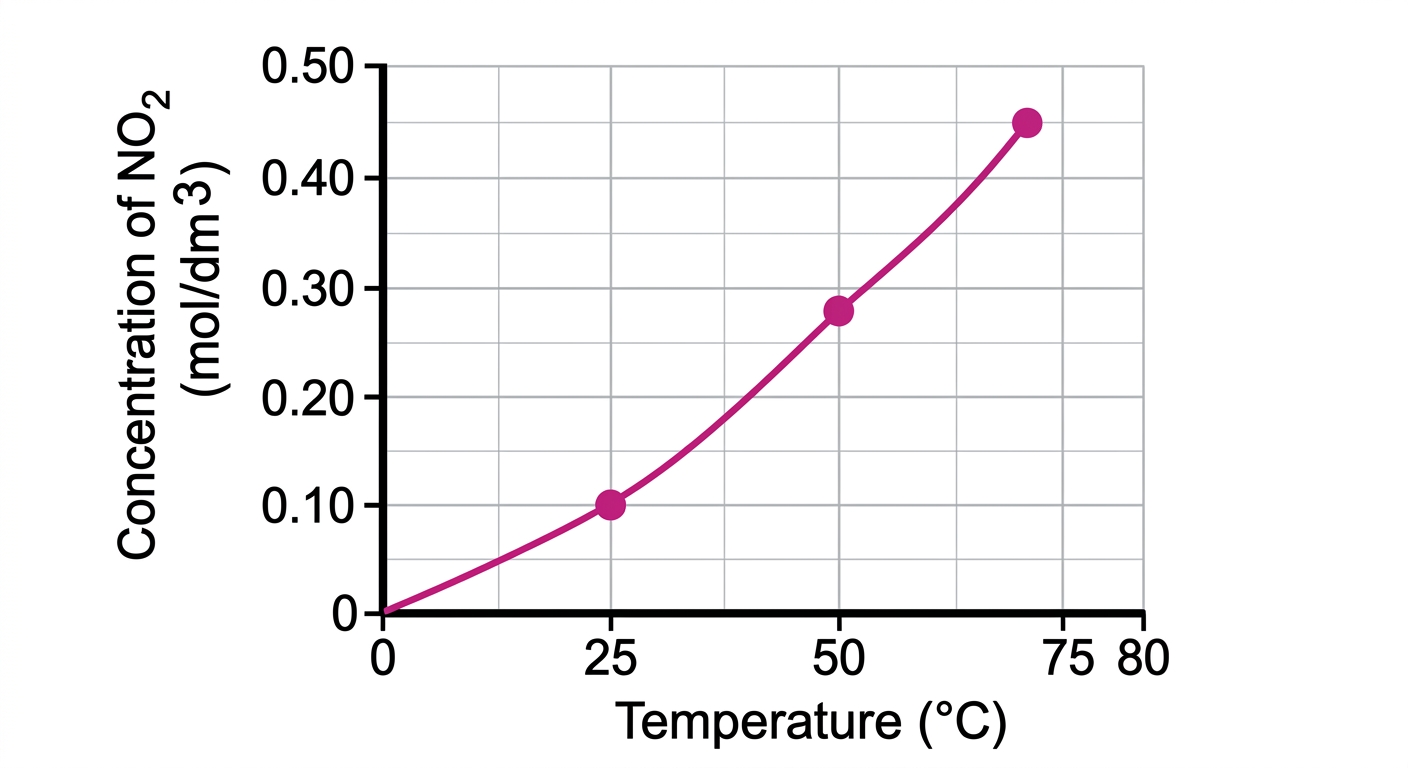
The forward reaction produces , a brown gas. A student investigates the effect of temperature on equilibrium by heating sealed tubes of the gas mixture and measuring the concentration of once equilibrium is reached. Results are shown in the graph below.
The student hypothesises that the forward reaction is exothermic.
The forward reaction produces , a brown gas. A student investigates the effect of temperature on equilibrium by heating sealed tubes of the gas mixture and measuring the concentration of once equilibrium is reached. Results are shown in the graph below.
The student hypothesises that the forward reaction is exothermic.
a
State Le Chatelier's principle as it applies to a change in temperature. [1]
b
Interpret the graph to describe how the equilibrium position changes as temperature increases. [2]
c
Evaluate the student's hypothesis using your answers to (a) and (b). [2]
Solutions
4QuestionClosed system requirement for equilibriumAssessment Practice
7 marks~11 minCriterion B
A student investigates the equilibrium between nitrogen dioxide and dinitrogen tetroxide in a sealed syringe:
Different amounts of NO are injected and, after equilibrium is reached at constant temperature, concentrations are recorded:
Different amounts of NO are injected and, after equilibrium is reached at constant temperature, concentrations are recorded:
| Injection | 1 | 2 | 3 | 4 | 5 |
|---|---|---|---|---|---|
| (M) | 0.10 | 0.20 | 0.35 | 0.55 | 0.80 |
| (M) | 0.05 | 0.10 | 0.18 | 0.28 | 0.41 |
a
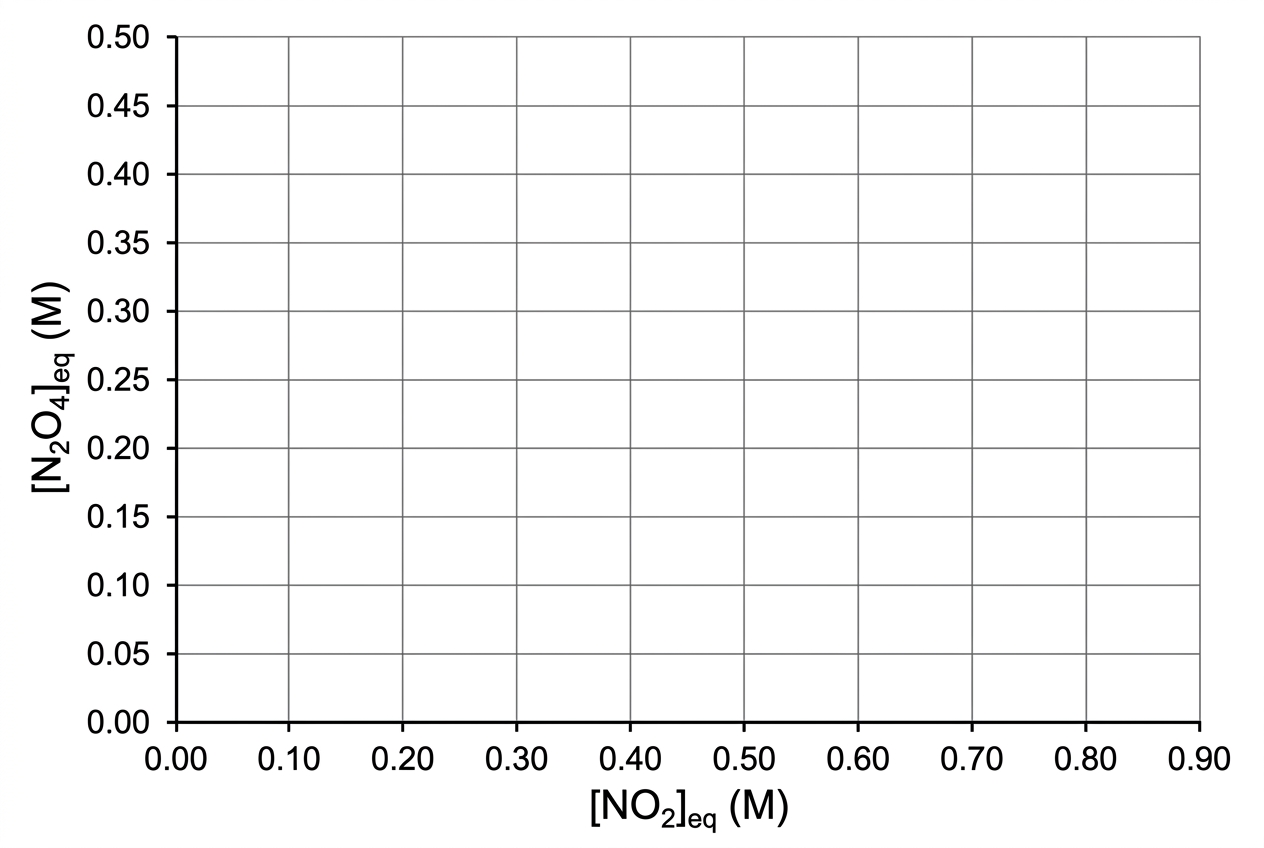
Construct a graph of (y-axis) against (x-axis) and interpret the relationship shown. [2]
b
Deduce the equilibrium concentration of NO when M. Show your method clearly. [2]
c
Analyse why does not increase in direct proportion to , using both the equilibrium expression for this reaction and collision theory. [3]
Solutions
That's every free question here — 4 of 56.
+52 more questions, plus Mock Papers & Worksheets, are waiting in Premium.