You're viewing free preview questions — 6 questions previewing here — subscribe to unlock 129 more, plus the Full Question Bank, Mock Papers & Worksheets.Upgrade
Back

Quadratic equations — Free MYP5 Mathematics (Extended) Practice Questions

Free questions

Open in full, with answers, mark scheme and examiner insights.

Easy1 question
Question 1Criterion A · Band 1-4 · Easy · 7 marksrevisionprep.com

Solving by Factorisation

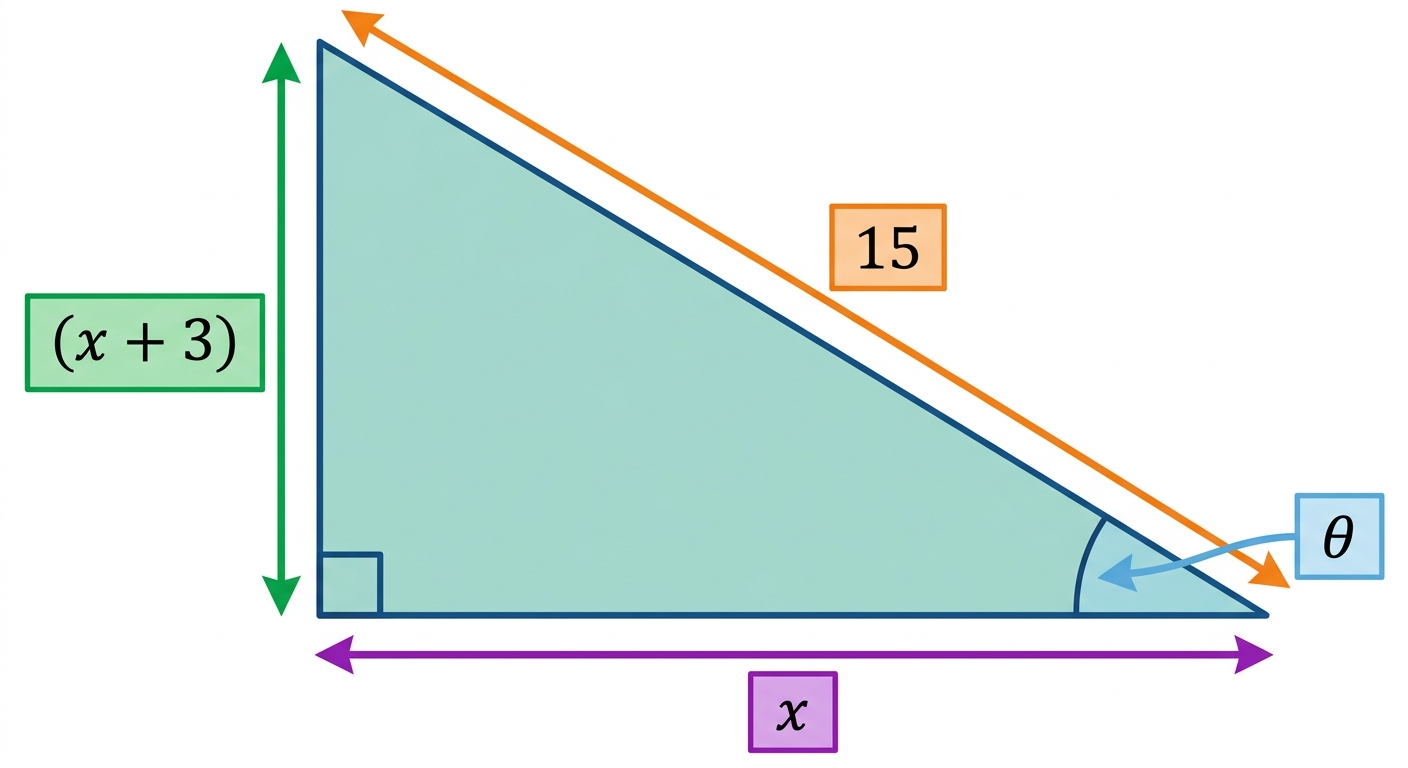
A carpenter cuts a right-angled triangular brace. The two shorter sides are xx cm and (x+3)(x + 3) cm long and the longest side is 15 cm, as shown in the diagram.
Question diagram
(a)
Write down an equation connecting the three sides. [1]Criterion A (i) · Level 1-2
(b)
Show that the equation simplifies to x2+3x−108=0x^2 + 3x - 108 = 0. [2]Criterion A (ii) · Level 3-4
(c)
Solve the equation, and find the lengths of the two shorter sides. [3]Criterion A (ii) · Level 3-4
(d)
Find the perimeter of the brace. [1]Criterion A (iii) · Level 1-2

revisionprep.com

Summary Answer

Not available for this question.

Model Answer

Not available for this question.

Marking Scheme

Not available for this question.

Examiner Insights

Not available for this question.

Medium7 questions
Question 2Criterion C · Band 1-6 · Medium · 8 marksrevisionprep.com

Solving by Factorisation

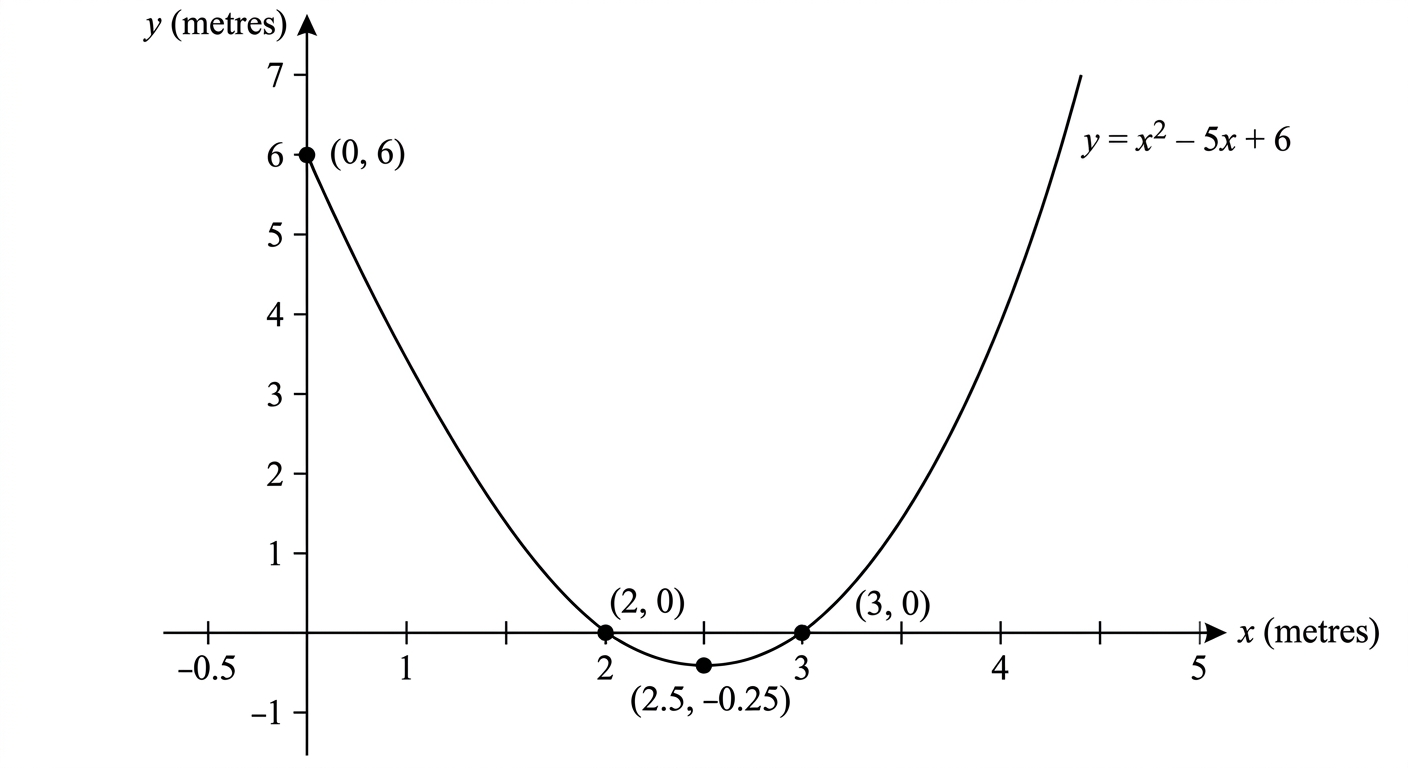
The graph of y=x2−5x+6y = x^2 - 5x + 6 is shown.
Question diagram
(a)
Use the graph to write down the solutions of x2−5x+6=0x^2 - 5x + 6 = 0. [1]Criterion C (ii) · Level 1-2
(b)
Verify your answers to (a) by factorising. [2]Criterion C (iii) · Level 3-4
(c)
Use the point (0,6)(0, 6) on the graph to explain why x=0x = 0 is one solution of x2−5x+6=6x^2 - 5x + 6 = 6. Then find the other solution algebraically. [3]Criterion C (iii), C (iv) · Level 5-6
(d)
State the number of solutions of x2−5x+6=−0.25x^2 - 5x + 6 = -0.25, and explain your answer using the graph. [2]Criterion C (iv) · Level 5-6

revisionprep.com

Summary Answer

Not available for this question.

Model Answer

Not available for this question.

Marking Scheme

Not available for this question.

Examiner Insights

Not available for this question.

Question 3Criterion A + D · Band 1-6 · Medium · 8 marksrevisionprep.com

Solving by Factorisation

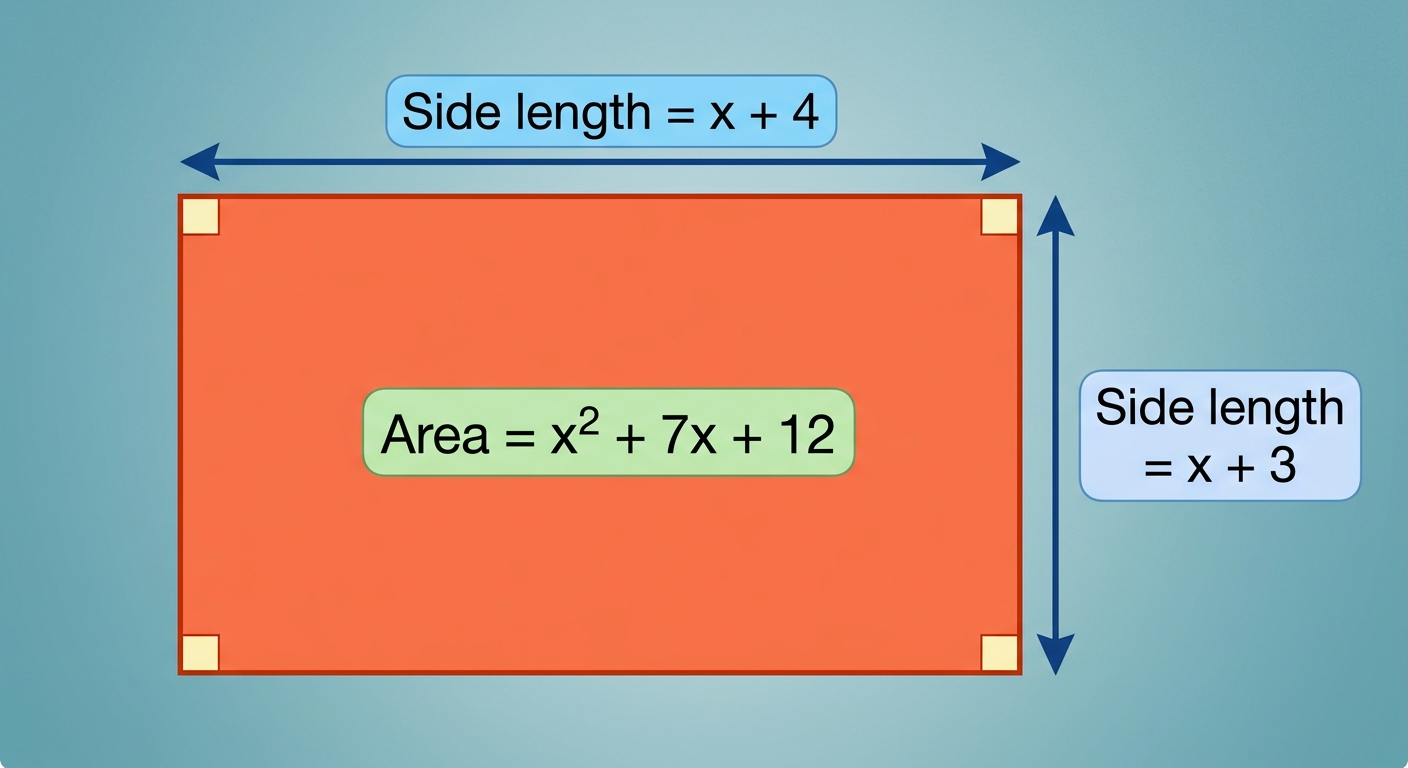
The diagram shows a rectangular patio with sides (x+4)(x + 4) m and (x+3)(x + 3) m. Its area is (x2+7x+12) m2(x^2 + 7x + 12)\text{ m}^2.
Question diagram
(a)
Show that (x+4)(x+3)=x2+7x+12(x + 4)(x + 3) = x^2 + 7x + 12. [1]Criterion A (i) · Level 1-2
(b)
The area of the patio is 42 m242\text{ m}^2. Find the value of xx. [3]Criterion A (ii) · Level 3-4
(c)
Find the perimeter of the patio. [2]Criterion A (iii) · Level 3-4
(d)
Explain why the equation x2+7x+12=0x^2 + 7x + 12 = 0 cannot describe any real patio. [2]Criterion D (v) · Level 5-6

revisionprep.com

Summary Answer

Not available for this question.

Model Answer

Not available for this question.

Marking Scheme

Not available for this question.

Examiner Insights

Not available for this question.

Question 4Criterion A · Band 1-6 · Medium · 7 marksrevisionprep.com

Solving quadratic equations: mixed practice
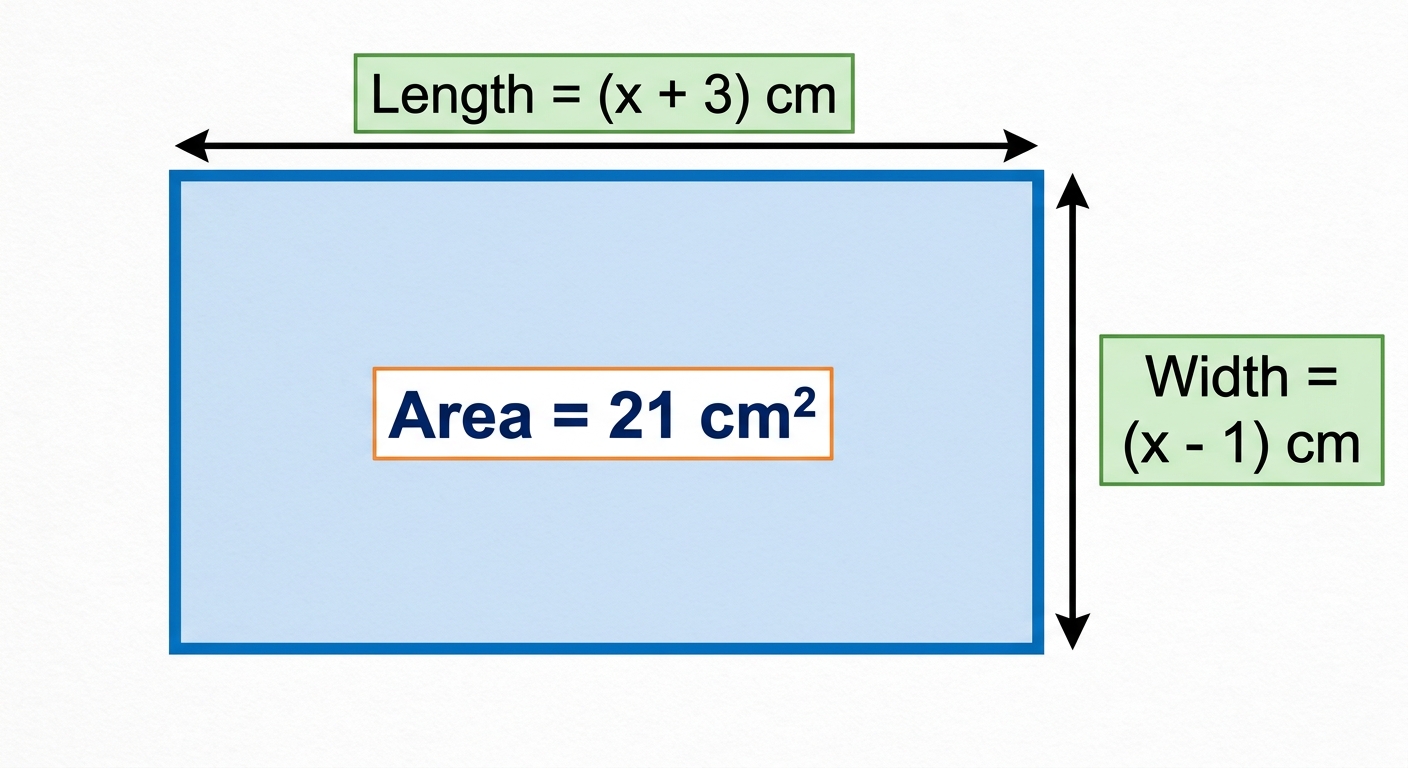
A rectangular tile has length (x+3)(x + 3) cm and width (x−1)(x - 1) cm, as shown in the diagram. Its area is 21 cm221\text{ cm}^2.
Question diagram
(a)
Show that x2+2x−24=0x^2 + 2x - 24 = 0. [1]Criterion A (i) · Level 1-2
(b)
Solve the equation, and find the length and width of the tile. [3]Criterion A (ii) · Level 3-4
(c)
A larger tile has the same form, (x+3)(x + 3) cm by (x−1)(x - 1) cm, but an area of 30 cm230\text{ cm}^2. Find its width, correct to 3 significant figures. [3]Criterion A (iii) · Level 5-6

revisionprep.com

Summary Answer

Not available for this question.

Model Answer

Not available for this question.

Marking Scheme

Not available for this question.

Examiner Insights

Not available for this question.

Question 5Criterion A · Band 3-6 · Medium · 8 marksrevisionprep.com

Solving Using the Quadratic Formula

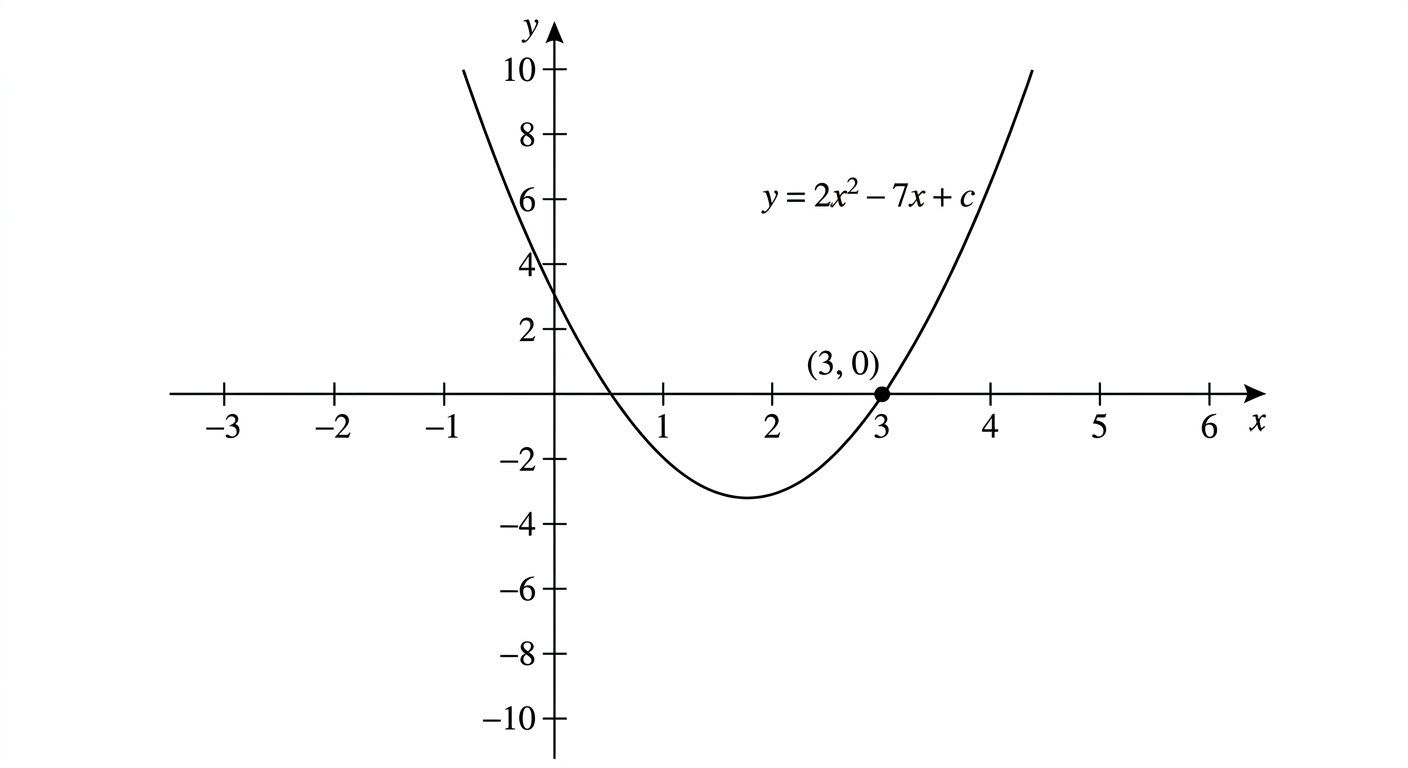
A quadratic function is defined by f(x)=2x2−7x+cf(x) = 2x^2 - 7x + c, where cc is a constant.

It is known that one root of f(x)=0f(x) = 0 is x=3x = 3.
Question diagram
(a)
Show that c=3c = 3. [2]Criterion A (ii) · Level 3-4
(b)
Hence find the second root of f(x)=0f(x) = 0, giving your answer as an exact fraction. [2]Criterion A (ii) · Level 3-4
(c)
The line y=mx+1y = mx + 1 is tangent to the parabola y=f(x)y = f(x). Find the two possible values of mm in exact form, and justify why exactly two such tangent lines exist. [4]Criterion A (iii) · Level 5-6

revisionprep.com

Summary Answer

Not available for this question.

Model Answer

Not available for this question.

Marking Scheme

Not available for this question.

Examiner Insights

Not available for this question.

Question 6Criterion D · Band 3-6 · Medium · 9 marksrevisionprep.com

Solving Using the Quadratic Formula

Data

tt (s): 0.4, 0.8, 1.2

Observed hh (m): 2.5, 3.6, 1.4
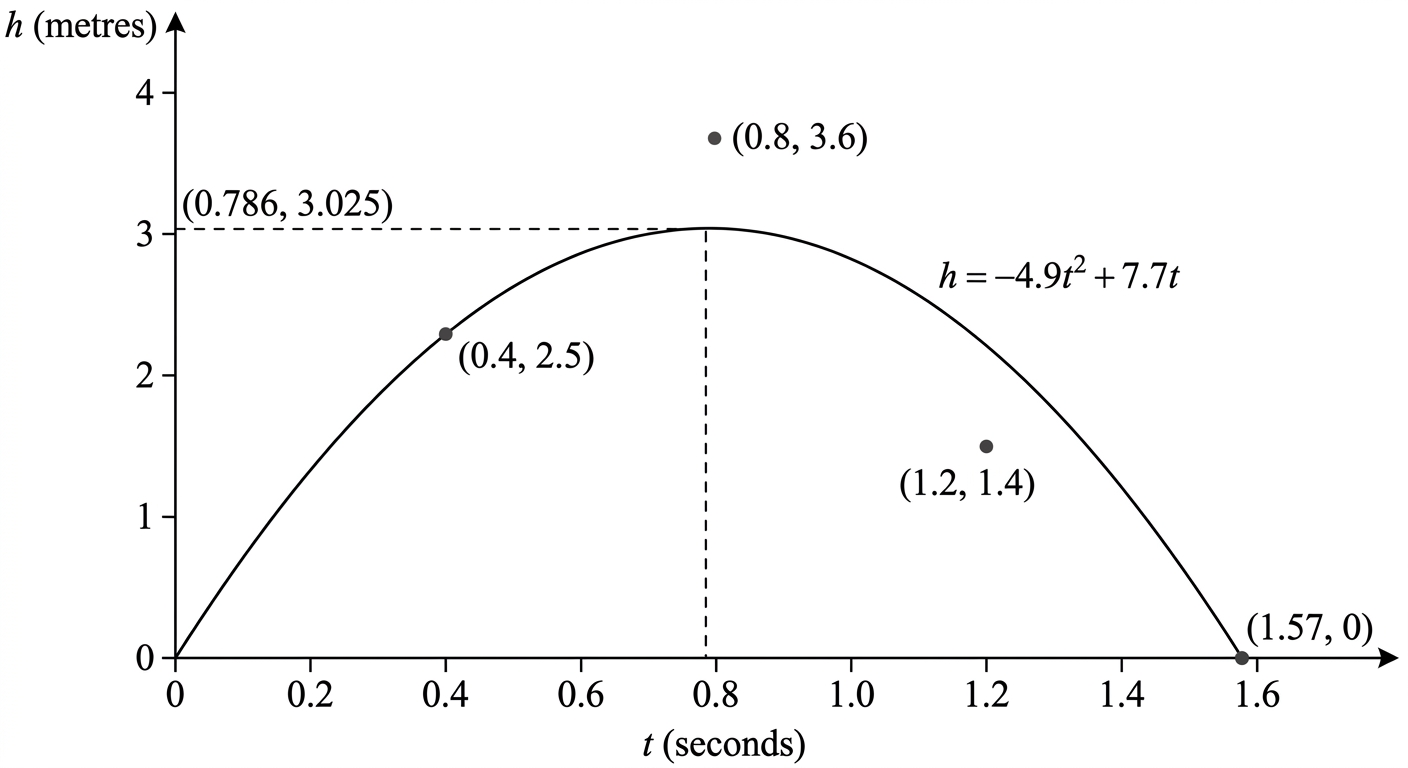
A sports analyst models the height hh (in metres) of a football above the ground at time tt (in seconds) after it is kicked, using the equation h(t)=−4.9t2+7.7t,0≤t≤1.57.h(t) = -4.9t^2 + 7.7t, \quad 0 \le t \le 1.57. The diagram shows the graph of this model together with three observed height measurements taken during the kick.

Observed
Question diagram
(a)
Calculate the predicted height from the model at t=0.4t = 0.4, t=0.8t = 0.8, and t=1.2t = 1.2. Give each value to 2 decimal places. [2]Criterion D (ii) · Level 3-4
(b)
Using the quadratic formula, find the two times at which the model predicts the ball is at a height of 2 m. Give your answers to 2 decimal places. t=−b±b2−4ac2at = \frac{-b \pm \sqrt{b^2 - 4ac}}{2a} [3]Criterion A (ii) · Level 3-4
(c)
Calculate the percentage error between the model's prediction and the observed height at each of the three times, using percentage error=∣predicted−observed∣observed×100%.\text{percentage error} = \frac{|\text{predicted} - \text{observed}|}{\text{observed}} \times 100\%. Give each percentage error to 1 decimal place. [2]Criterion D (iii) · Level 3-4
(d)
The analyst claims the quadratic model is reliable for predicting the height of the ball throughout its entire flight. Assess this claim using your percentage errors from part (c), and state one limitation of using a quadratic model in this context. [2]Criterion D (v) · Level 5-6

revisionprep.com

Summary Answer

Not available for this question.

Model Answer

Not available for this question.

Marking Scheme

Not available for this question.

Examiner Insights

Not available for this question.

Question 7Criterion B + C · Band 3-6 · Medium · 5 marksrevisionprep.com

Nature of Roots Using Discriminant

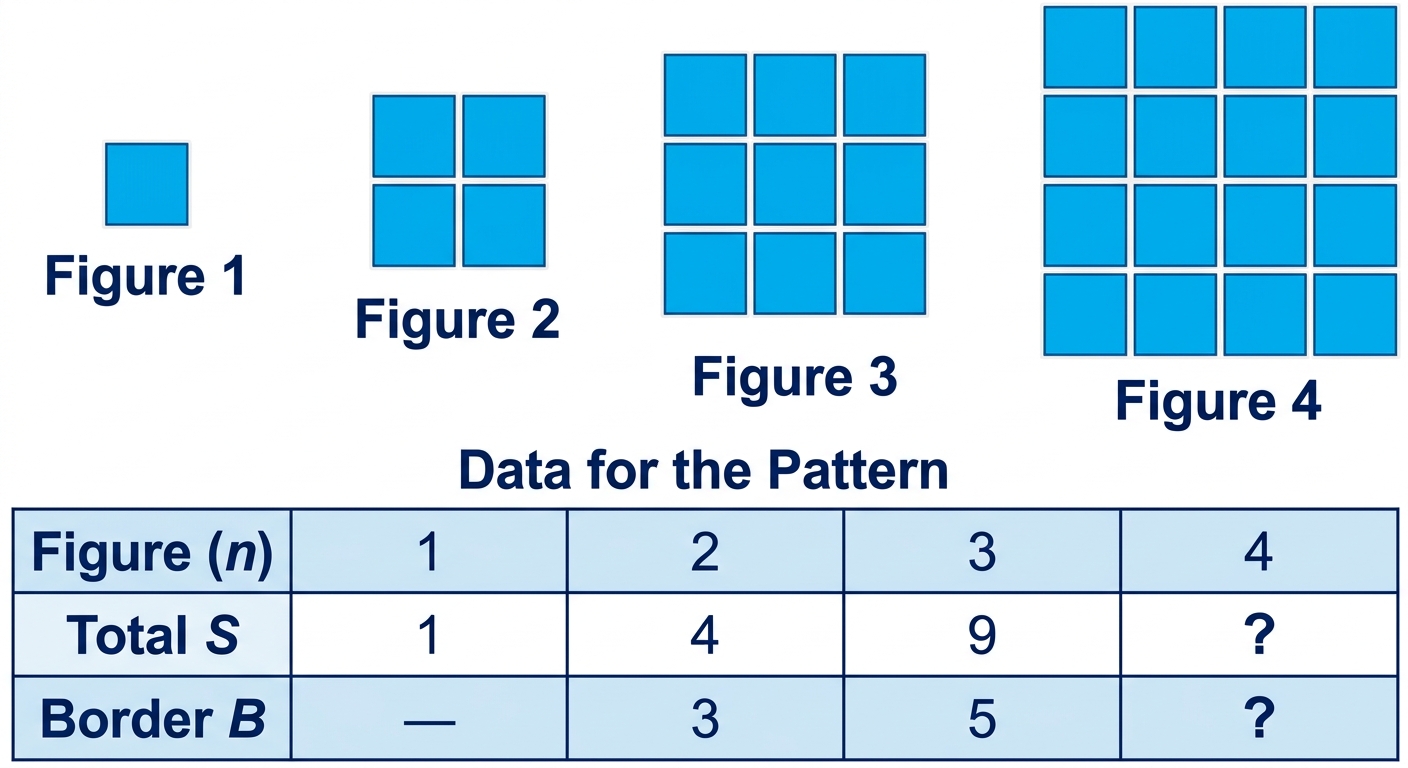
The diagram shows Figures 1 to 4 of a pattern made from unit squares arranged in growing square grids.

Figure (nn)1234
Total SS149?
Border BB—35?
Question diagram
(a)
Write down the values of SS and BB for Figure 4. [1]Criterion B (i) · Level 3-4
(b)
Find a general rule for SS in terms of nn. Hence show that B(n)=S(n)−S(n−1)=2n−1B(n) = S(n) - S(n-1) = 2n - 1 for n≥2n \geq 2. [3]Criterion B (ii) · Level 5-6
(c)
A student claims: "Because BB is always odd, the total SS can never be even." Justify whether each part of this claim is correct, referring to your rules from part (b). [1]Criterion C (iv) · Level 5-6

revisionprep.com

Summary Answer

Not available for this question.

Model Answer

Not available for this question.

Marking Scheme

Not available for this question.

Examiner Insights

Not available for this question.

Question 8Criterion A + C · Band 3-6 · Medium · 8 marksrevisionprep.com

Nature of Roots Using Discriminant

A quadratic function is given by f(x)=x2+bx+cf(x) = x^2 + bx + c, where bb and cc are integers. The graph of f(x)f(x) passes through the point (1,0)(1, 0) and has its axis of symmetry at x=3x = 3.
(a)
Write down the two roots of f(x)=0f(x) = 0. [1]Criterion A (ii) · Level 3-4
(b)
Find the values of bb and cc. [2]Criterion A (ii) · Level 3-4
(c)
The equation f(x)=kf(x) = k has no real solutions. Justify whether a value of k=−5k = -5 would satisfy this condition, using the vertex of the parabola. [2]Criterion C (iv) · Level 5-6
(d)
The line y=x−5y = x - 5 meets the graph of y=f(x)y = f(x) at two points. Find the coordinates of both points. [3]Criterion A (iii) · Level 5-6

revisionprep.com

Summary Answer

Not available for this question.

Model Answer

Not available for this question.

Marking Scheme

Not available for this question.

Examiner Insights

Not available for this question.

Challenge4 questions
Question 9Criterion B · Band 3-8 · Challenge · 8 marksrevisionprep.com

Solving by Factorisation

This question is about the expression x2+bx+12x^2 + bx + 12, where bb is an integer.
(a)
Factorise x2+7x+12x^2 + 7x + 12, x2+8x+12x^2 + 8x + 12 and x2+13x+12x^2 + 13x + 12. [2]Criterion B (i) · Level 3-4
(b)
Find all the integer values of bb, positive and negative, for which x2+bx+12x^2 + bx + 12 can be written as (x+p)(x+q)(x + p)(x + q) with pp and qq integers. Organise your results in a table. [2]Criterion B (i) · Level 5-6
(c)
Describe a general rule for finding every integer bb for which x2+bx+cx^2 + bx + c factorises, where cc is a positive integer. [2]Criterion B (ii) · Level 5-6
(d)
Use your rule to find how many integer values of bb make x2+bx+18x^2 + bx + 18 factorise. Verify your answer for the largest value of bb. [2]Criterion B (iii) · Level 7-8

revisionprep.com

Summary Answer

Not available for this question.

Model Answer

Not available for this question.

Marking Scheme

Not available for this question.

Examiner Insights

Not available for this question.

Question 10Criterion D + A · Band 1-8 · Challenge · 14 marksrevisionprep.com

Solving quadratic equations: mixed practice
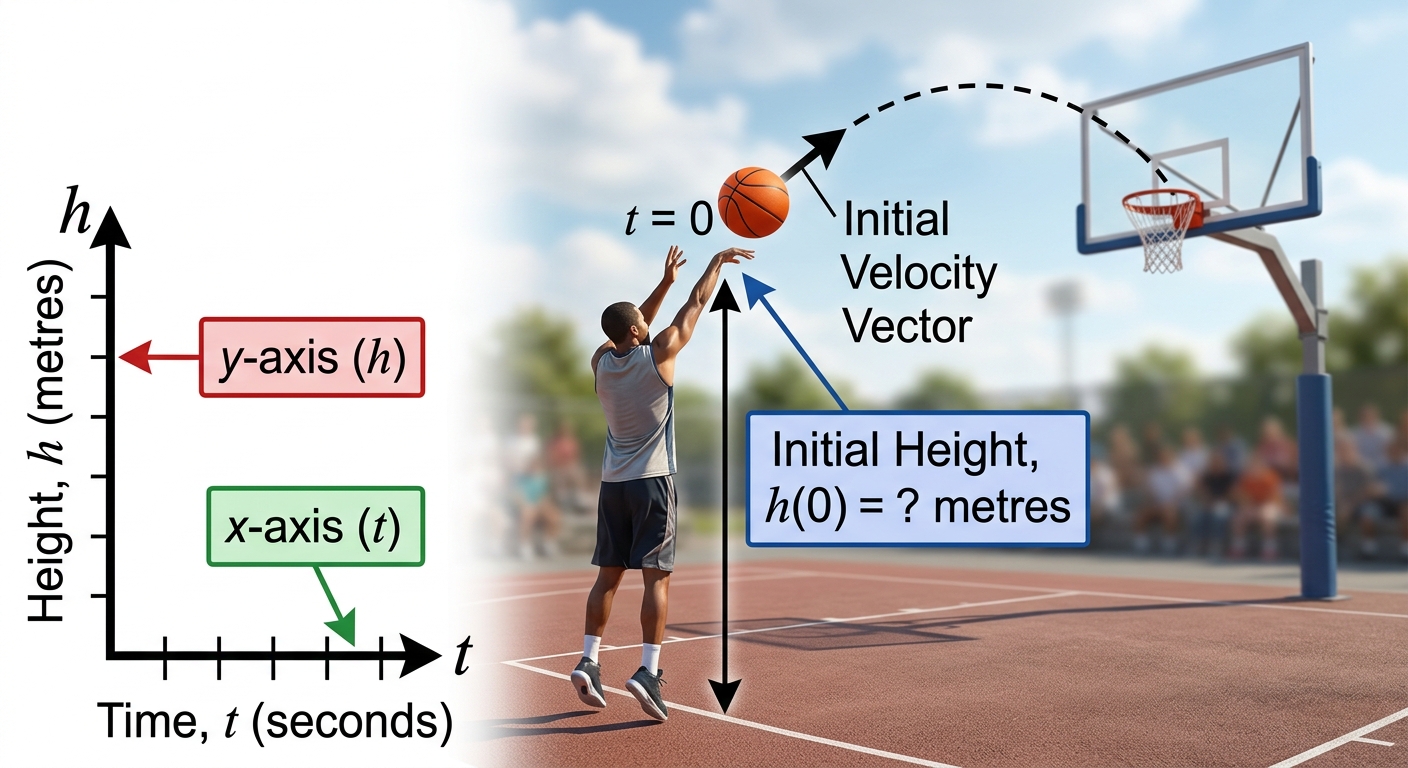
A basketball player takes a shot. The height of the ball, hh metres, tt seconds after it is released is modelled by h=−4.9t2+8t+2.1h = -4.9t^2 + 8t + 2.1.
Question diagram
(a)
Write down the height at which the ball is released. [1]Criterion D (i) · Level 1-2
(b)
Use the discriminant to determine whether the ball reaches a height of 5.5 m. [3]Criterion A (iii) · Level 5-6
(c)
The shot misses and the ball falls to the floor. Find the time at which it hits the floor, correct to 2 decimal places. [3]Criterion A (ii) · Level 3-4
(d)
State one assumption of the model that may make your answer to (c) inaccurate. [1]

(e) The ball reaches a height of HH metres when −4.9t2+8t+2.1=H-4.9t^{2} + 8t + 2.1 = H. Use the discriminant of this equation to find the greatest height reached by the ball, correct to 3 significant figures. [3]

(f) A replay camera records the ball only while it is more than 4 m above the floor. Find the times between which the camera records the ball, correct to 3 significant figures. [3]
Criterion D (v) · Level 3-4

revisionprep.com

Summary Answer

Not available for this question.

Model Answer

Not available for this question.

Marking Scheme

Not available for this question.

Examiner Insights

Not available for this question.

Question 11Criterion A + C · Band 3-8 · Challenge · 8 marksrevisionprep.com

Solving Using the Quadratic Formula

A quadratic function is given by f(x)=2x2+5x+cf(x) = 2x^2 + 5x + c, where cc is a constant.
(a)
Given that f ⁣(12)=0f\!\left(\dfrac{1}{2}\right) = 0, show that c=−3c = -3. [1]Criterion A (ii) · Level 3-4
(b)
Find the other solution of f(x)=0f(x) = 0. Give your answer as an exact value. [2]Criterion A (ii) · Level 3-4
(c)
An engineer states that the equation f(x)=kf(x) = k has no real solutions for k<−6k < -6. Justify whether the engineer's claim is correct. [3]Criterion C (iv) · Level 5-6
(d)
Show that, for every value of kk for which f(x)=kf(x) = k has two real solutions, the sum of the solutions is −52-\dfrac{5}{2}. [2]Criterion B (iii) · Level 7-8

revisionprep.com

Summary Answer

Not available for this question.

Model Answer

Not available for this question.

Marking Scheme

Not available for this question.

Examiner Insights

Not available for this question.

Question 12Criterion C · Band 3-8 · Challenge · 10 marksrevisionprep.com

Nature of Roots Using Discriminant

Consider the family of quadratic equations x2+bx+5=0x^2 + bx + 5 = 0, where bb is a positive integer.

The table below shows the number of real roots for b=1,2,3,4,5,6b = 1, 2, 3, 4, 5, 6.

bb123456
Number of real roots000022


The discriminant of x2+bx+5=0x^2 + bx + 5 = 0 is Δ=b2−20\Delta = b^2 - 20.
(a)
Calculate Δ\Delta for each value of bb in the table and verify that every entry in the "Number of real roots" row is correct. [3]Criterion A (ii) · Level 3-4
(b)
Show that the smallest positive integer value of bb for which x2+bx+5=0x^2 + bx + 5 = 0 has two distinct real roots is b=5b = 5, using the condition Δ>0\Delta > 0. [3]Criterion A (iii) · Level 5-6
(c)
A student claims: "For every positive integer b≥5b \geq 5, the equation x2+bx+5=0x^2 + bx + 5 = 0 has two distinct real roots and both roots are always negative." Justify whether the student's claim is fully correct. In your justification you must: — prove that Δ>0\Delta > 0 for all positive integers b≥5b \geq 5, and — determine the sign of both roots for all such bb, using Vieta's formulas x1+x2=−bandx1x2=5.x_1 + x_2 = -b \qquad \text{and} \qquad x_1 x_2 = 5. [4]Criterion B (iii) · Level 7-8

revisionprep.com

Summary Answer

Not available for this question.

Model Answer

Not available for this question.

Marking Scheme

Not available for this question.

Examiner Insights

Not available for this question.

That's every free question here — 6 of 135.

+129 more questions, plus Mock Papers & Worksheets, are waiting in Premium.

Upgrade