You're viewing free preview questions — 4 questions previewing here — subscribe to unlock 41 more, plus the Full Question Bank, Mock Papers & Worksheets.Upgrade
Solving Quadratic Equations — Free MYP5 Mathematics (Extended) Practice Questions

1QuestionNature of Roots Using DiscriminantAssessment Practice
5 marks~8 minCriterion A
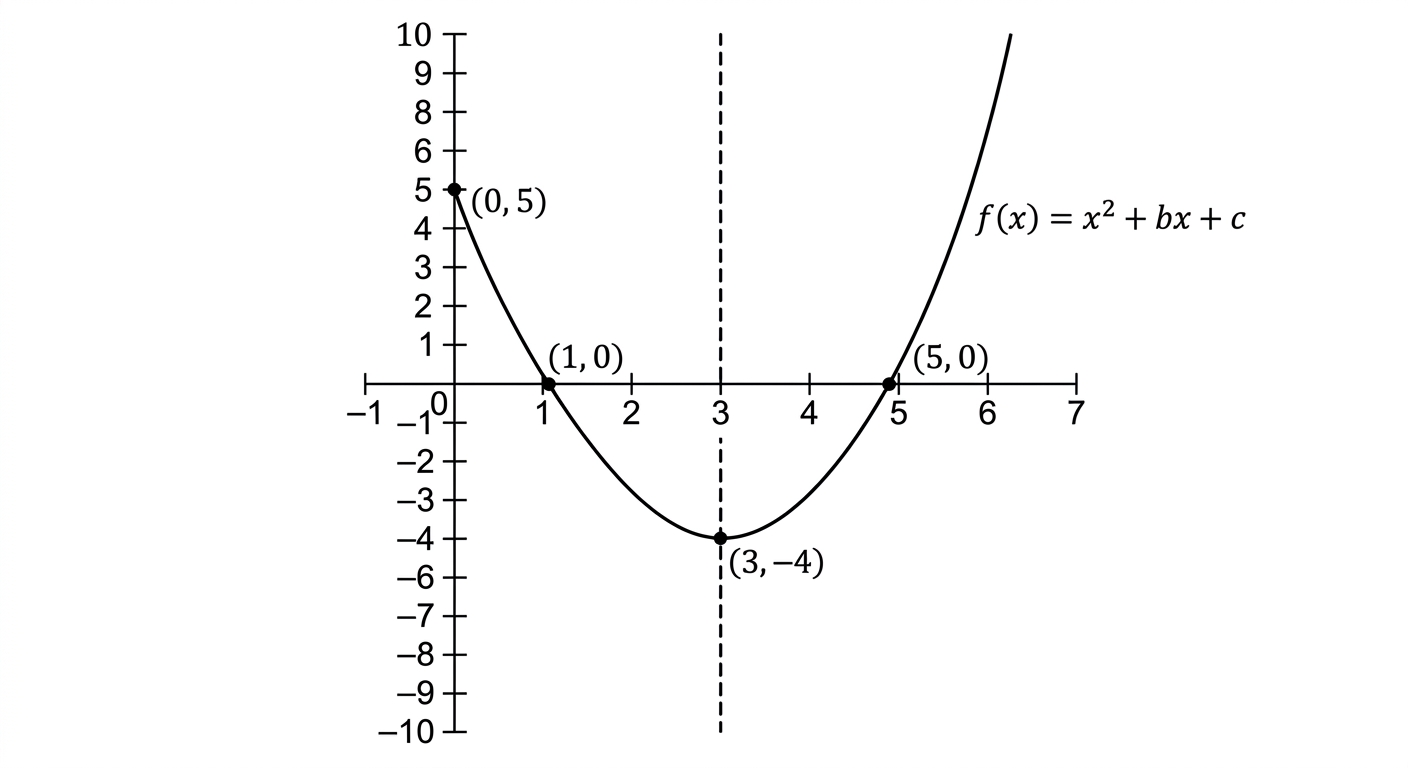
A quadratic function is given by , where and are integers.
The graph of passes through the point and has its axis of symmetry at .
The graph of passes through the point and has its axis of symmetry at .
a
Write down the two roots of . [1]
b
Find the values of and . [2]
c
The equation has no real solutions. Justify whether a value of would satisfy this condition, using the vertex of the parabola. [2]

Solutions
2QuestionSolving Using the Quadratic FormulaAssessment Practice
6 marks~9 minCriterion B
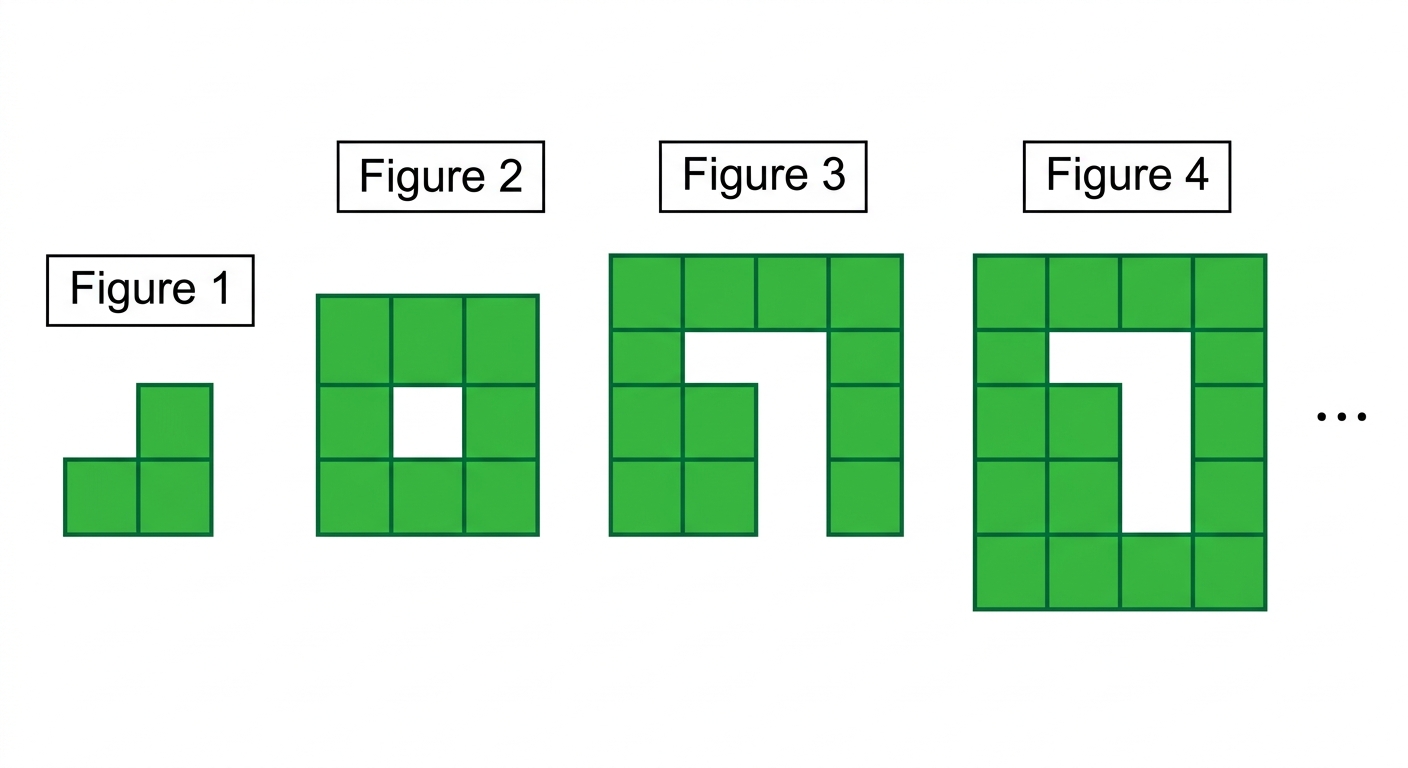
The diagram shows Figures 1 to 4 of a pattern made from small squares arranged in an L-shape.
Figure 1: 3 squares, Figure 2: 7 squares, Figure 3: 13 squares, Figure 4: 21 squares.
Figure 1: 3 squares, Figure 2: 7 squares, Figure 3: 13 squares, Figure 4: 21 squares.
a
Write down the number of small squares in Figure 5. [1]
b
Find a rule for the number of small squares in Figure , giving your answer in the form , where and are integers to be found. [3]
c
A student claims that no figure in this pattern can contain exactly 100 small squares. Justify whether the student is correct. [2]
Solutions
3QuestionSolving Using the Quadratic FormulaAssessment Practice
6 marks~9 minCriterion D
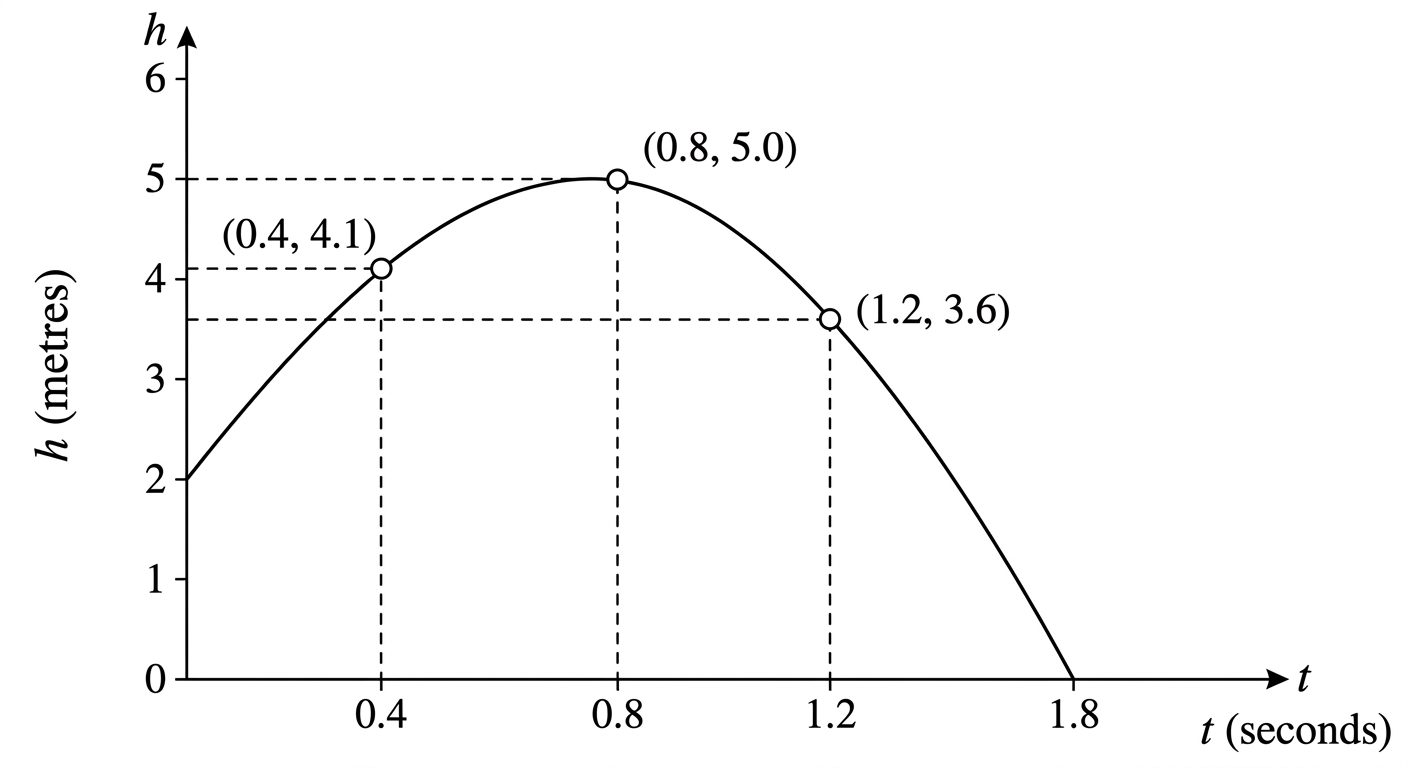
A basketball player shoots a free throw. The height metres of the ball above the ground, seconds after release, is modelled by
A motion sensor records the following observed heights.
(seconds):
Observed (m):
A motion sensor records the following observed heights.
(seconds):
Observed (m):
a
Calculate the predicted heights given by the model at , , and . Give each value to 2 decimal places. [1]
b
The axis of symmetry of the parabola is . Calculate the maximum height of the ball. Give your answer in metres to 3 significant figures. [2]
c
The player claims the ball reaches a maximum height of more than 5 metres. Assess whether the model supports this claim, and justify your reasoning using your answers to parts (a) and (b). [3]
Solutions
4QuestionNature of Roots Using DiscriminantAssessment Practice
10 marks~15 minCriterion C
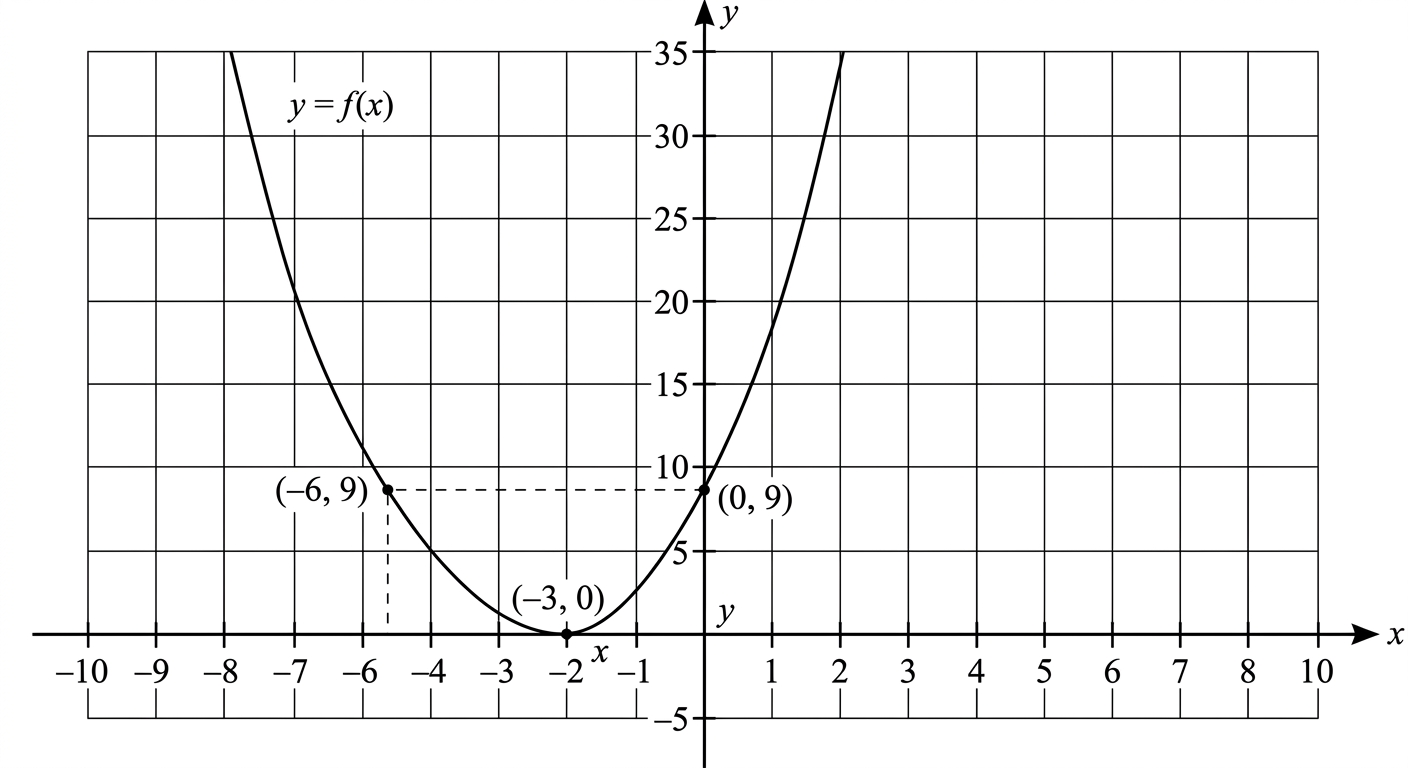
Consider the quadratic function , where is a real constant.
a
Find the set of values of for which has two distinct real roots, giving your answer in set notation. [3]
b
For the specific case , show that the vertex of the graph of lies below the -axis, and hence state the number of -intercepts of the graph. [3]
c
A student claims: "Because the coefficient of is positive and , the graph of can never cross the -axis for any real value of ."
Critique this claim. Use the discriminant to identify a specific value of for which the graph crosses the -axis at two distinct points, and explain why the student's reasoning is flawed. [4]
Critique this claim. Use the discriminant to identify a specific value of for which the graph crosses the -axis at two distinct points, and explain why the student's reasoning is flawed. [4]
Solutions
That's every free question here — 4 of 45.
+41 more questions, plus Mock Papers & Worksheets, are waiting in Premium.