You're viewing free preview questions — 4 questions previewing here — subscribe to unlock 199 more, plus the Full Question Bank, Mock Papers & Worksheets.Upgrade
Coordinate Geometry and Transformations — Free MYP5 Mathematics (Extended) Practice Questions

1QuestionClassifying shapes and anglesAssessment Practice
6 marks~9 minCriterion C
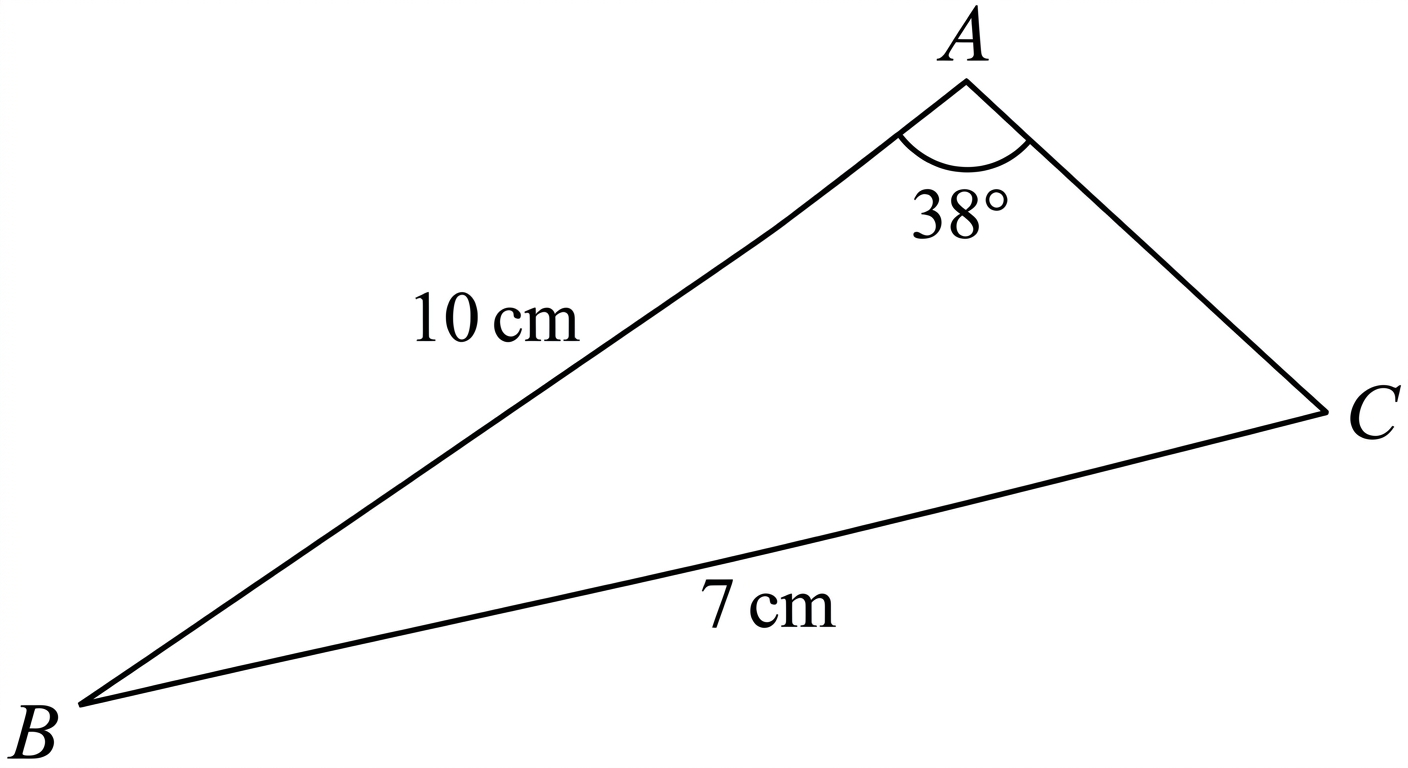
The diagram shows triangle with cm, cm, and .
a
State why the given information produces an ambiguous case when applying the sine rule. [1]
b
Find the two possible values of , giving your answers to one decimal place. [2]
c
For each value of found in part (b), find the corresponding length in centimetres to three significant figures. Justify which value of is consistent with a surveyor's requirement that the triangle must have an obtuse angle at . [3]

Solutions
2QuestionAngles in intersecting and parallel linesAssessment Practice
6 marks~9 minCriterion A
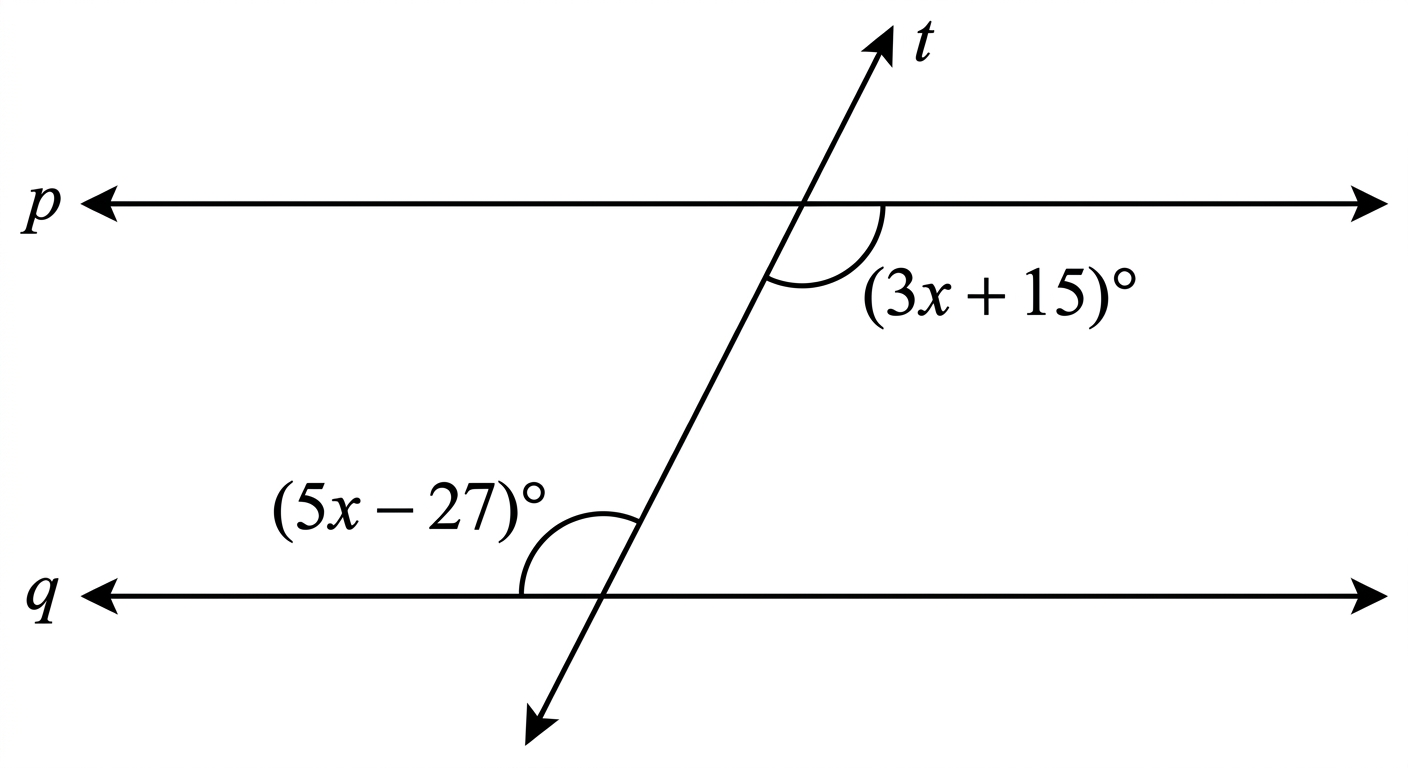
The diagram shows two parallel lines and cut by a transversal . Angle , formed between and line on the right-hand side below , measures . Angle , in the alternate interior position between and line , measures . A third line passes through the point where meets . The angle between and , measured on the same side as , equals of angle .
a
State the geometric relationship between angles and , and hence form an equation in . [2]
b
Find the value of and calculate the size of angle . [2]
c
Justify whether line is perpendicular to line . [2]
Solutions
3QuestionRotation around a given pointAssessment Practice
7 marks~11 minCriterion B
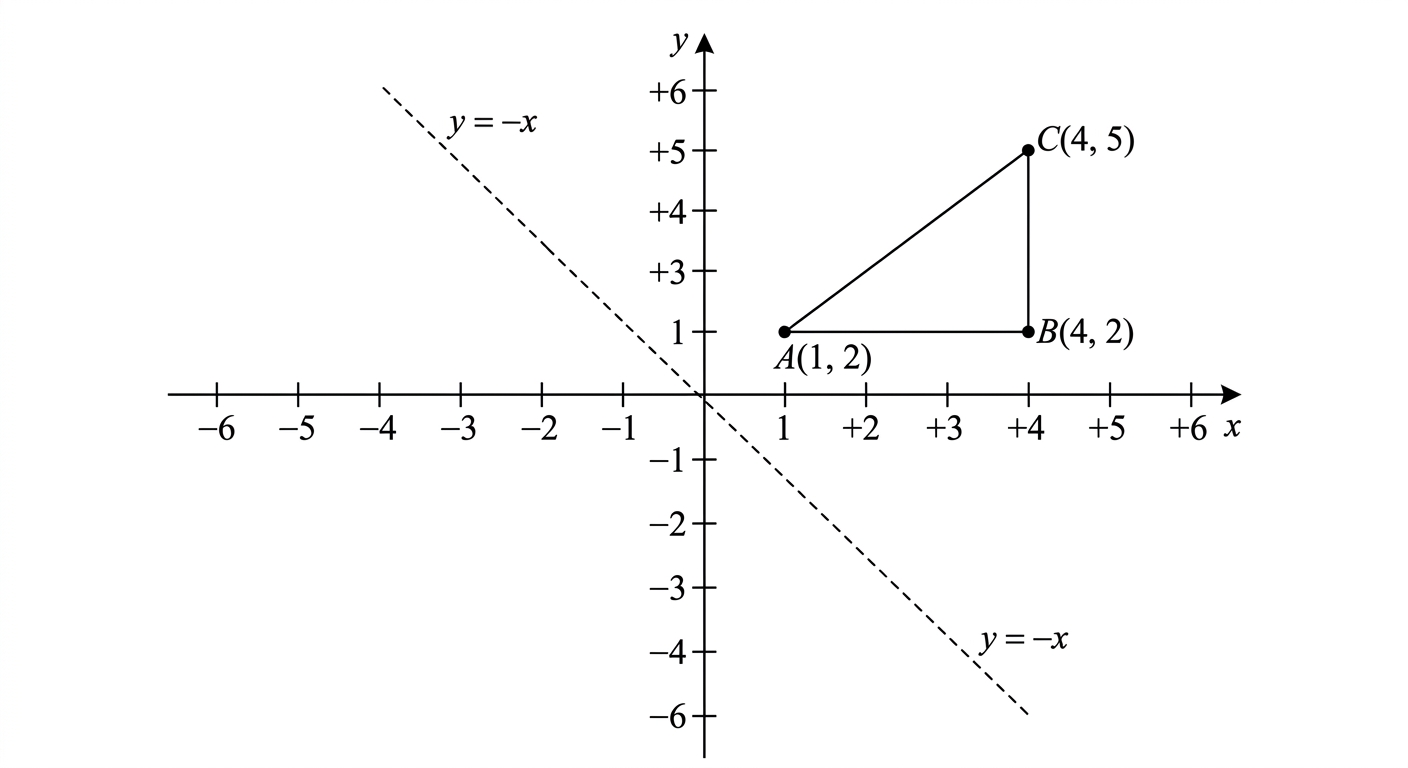
The diagram shows triangle with vertices , , and .
Triangle is first rotated clockwise about the origin to give triangle , then reflected in the line to give triangle .
Triangle is first rotated clockwise about the origin to give triangle , then reflected in the line to give triangle .
a
Find the coordinates of , , and after the clockwise rotation about the origin. [2]
b
Find the coordinates of , , and after the reflection in the line . [2]
c
Justify that a single transformation maps triangle directly onto triangle , stating the mirror line and verifying your answer using the coordinates of at least two vertex pairs. [3]
Solutions
4QuestionCoordinate geometry (distance, midpoint, gradient formulas)Assessment Practice
8 marks~12 minCriterion D
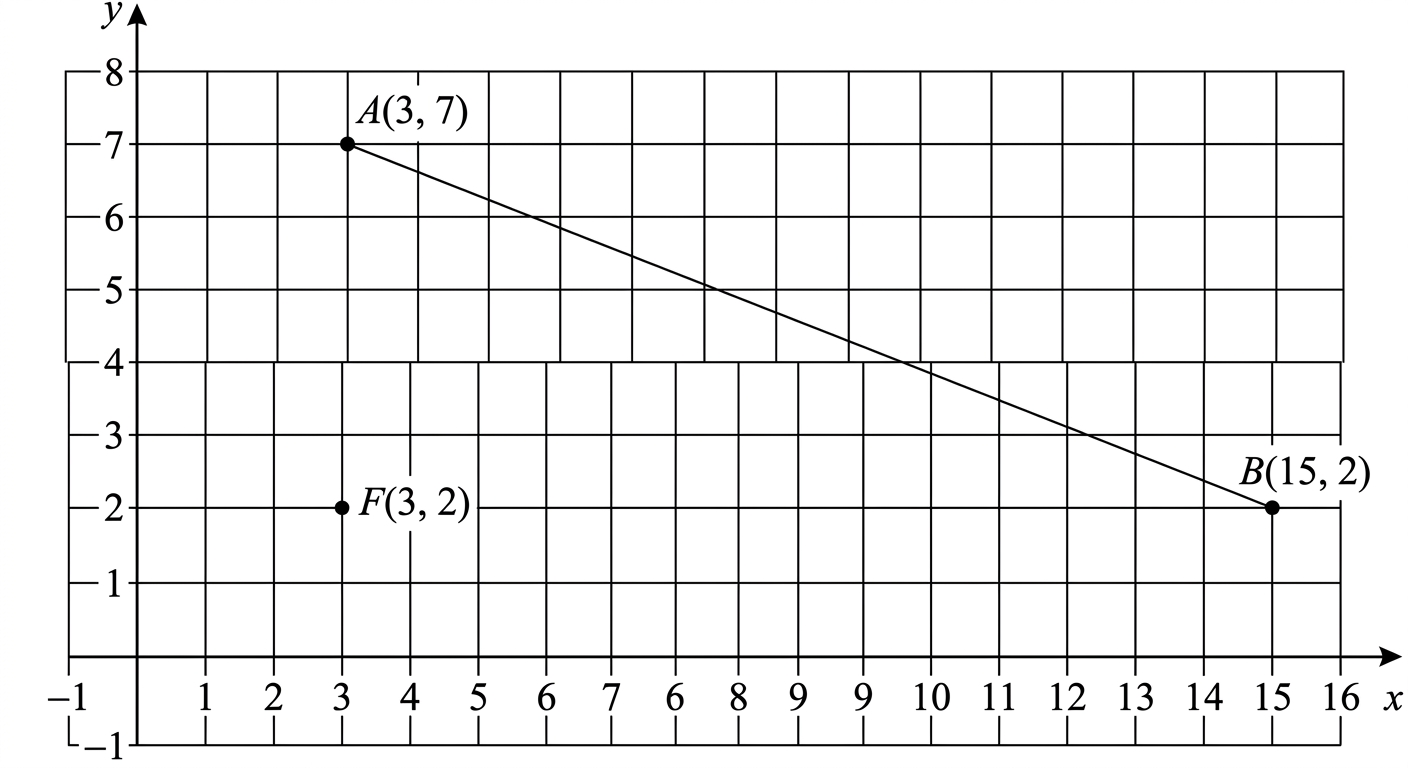
A city planner is designing a park on a coordinate grid where 1 unit represents 100 m. Entrance A is at and Entrance B is at . A straight footpath is planned directly between A and B.
The diagram shows the positions of A, B, and the fountain F at .
The diagram shows the positions of A, B, and the fountain F at .
a
Show that the straight-line distance between A and B on the grid is exactly 13 units. [2]
b
A second route connects A to the fountain F at , then continues from F to B. The planner claims this two-segment route is longer than the direct path AB. Determine whether the planner's claim is correct, giving all distances in metres. [2]
c
The straight footpath AB is built. A surveyor measures the actual walking distance as 1 430 m. The percentage error between the planned length and the surveyed distance is given by
Calculate the percentage error to 1 decimal place. Advise the city planner whether the planned length is suitable to use for construction budgeting, justifying your answer with reference to the percentage error. [4]
Calculate the percentage error to 1 decimal place. Advise the city planner whether the planned length is suitable to use for construction budgeting, justifying your answer with reference to the percentage error. [4]
Solutions
That's every free question here — 4 of 203.
+199 more questions, plus Mock Papers & Worksheets, are waiting in Premium.