You're viewing free preview questions — 4 questions previewing here — subscribe to unlock 64 more, plus the Full Question Bank, Mock Papers & Worksheets.Upgrade
Units, Conversions and Compound Measures — Free MYP5 Mathematics (Extended) Practice Questions

1QuestionDensity Mass and VolumeConcept Practice
2 marks~3 minCriterion A
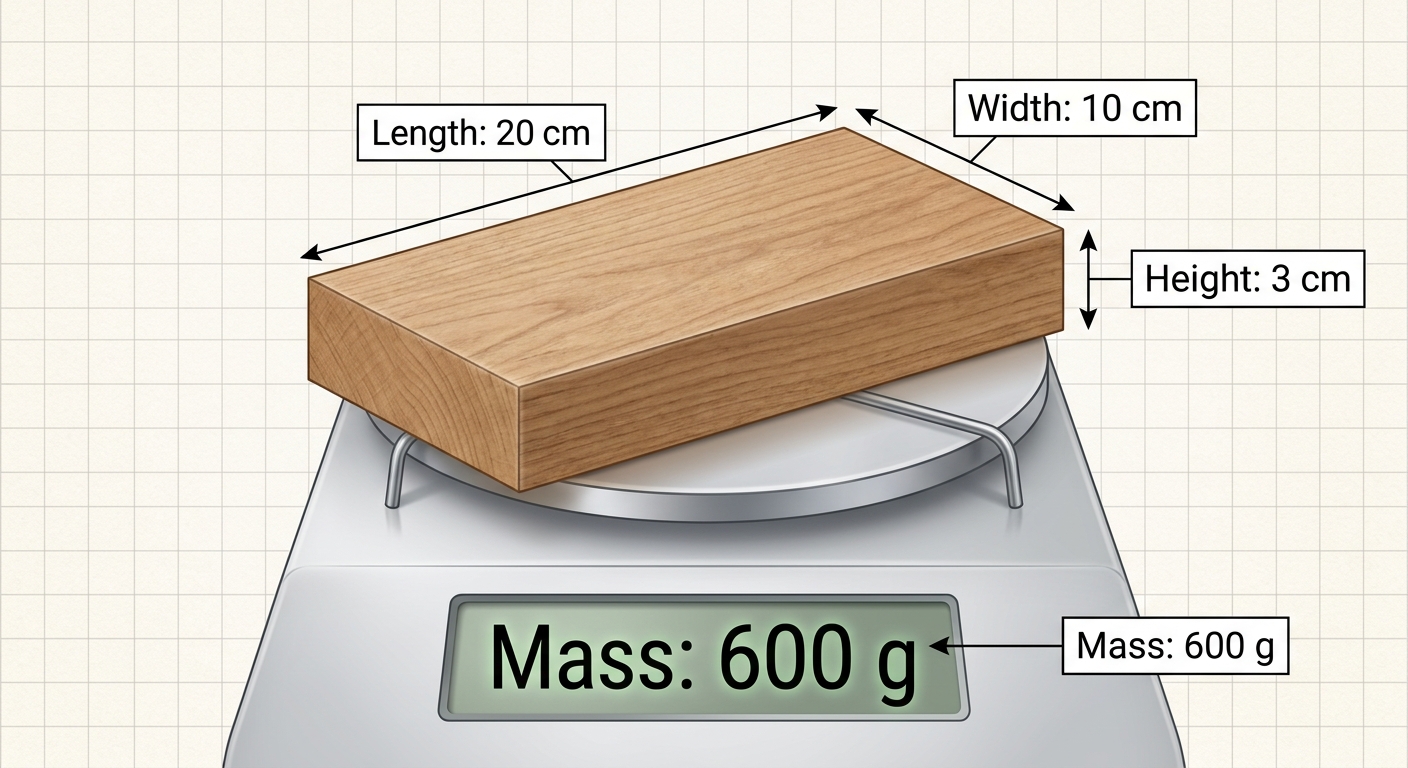
A furniture maker tests a rectangular block of oak before use in a project. The block has the following dimensions:
Length: 20 cm
Width: 10 cm
Height: 3 cm
The mass of the block is 480 g. Oak suitable for the project must have a density strictly greater than 0.75 g/cm³.
Calculate the density of the block, then advise the furniture maker whether this block of oak should be used in the project. Justify your answer. [2]
Length: 20 cm
Width: 10 cm
Height: 3 cm
The mass of the block is 480 g. Oak suitable for the project must have a density strictly greater than 0.75 g/cm³.
Calculate the density of the block, then advise the furniture maker whether this block of oak should be used in the project. Justify your answer. [2]

Solutions
2QuestionConverting Between Metric UnitsAssessment Practice
6 marks~9 minCriterion D
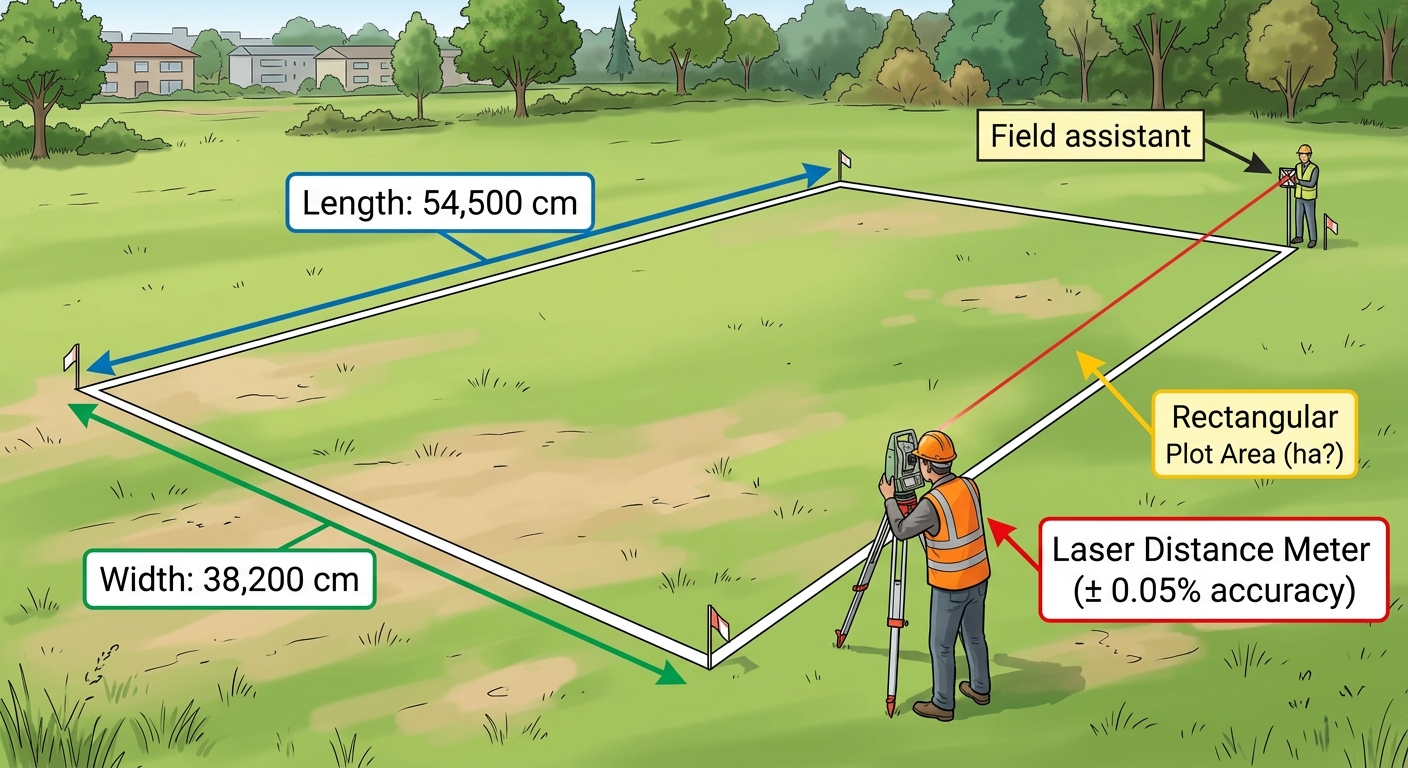
A land surveyor uses a high-precision laser distance meter to measure a rectangular plot intended for a community garden.
Length:
Width:
The manufacturer specifies an accuracy of for each measurement. Recall that .
Length:
Width:
The manufacturer specifies an accuracy of for each measurement. Recall that .
a
Show that the area of the plot is approximately . Show all working, including unit conversions. [2]
b
Deduce the possible range of the area, in hectares, accounting for the measurement error. [2]
c
Advise the surveyor whether hectares, square metres, or square centimetres is the most appropriate unit for reporting the area of this community garden, justifying your recommendation with reference to both the scale of the area and the precision of the measurements. [2]
Solutions
3QuestionMulti-Step Problems with Compound MeasuresAssessment Practice
6 marks~9 minCriterion B
A manufacturer produces solid metal cubes of increasing side lengths, all from the same material. The side lengths and measured masses are recorded below.
Side length (cm): 1, 2, 3, 4, 5
Mass (g): 2, 8, 18, 32, 50
Side length (cm): 1, 2, 3, 4, 5
Mass (g): 2, 8, 18, 32, 50
a
Analyse the mass values to identify the relationship between and . Show the first and second differences between consecutive mass values and justify why the relationship is quadratic. [2]
b
Deduce a formula for the density (g/cm³) of a cube in terms of its side length , using . Show all working. [2]
c
The manufacturer requires a cube of side length 6 cm to have a density no greater than 0.30 g/cm³ to meet a safety specification. Using your formula from part (b), advise the manufacturer whether this cube meets the specification and recommend one practical course of action if it does not. [2]
Solutions
4QuestionConverting Between Metric UnitsAssessment Practice
6 marks~9 minCriterion C
A satellite image analyst measures features at three scales. Each measurement is the side length of a square region.
Square A: side
Square B: side
Square C: side
Square A: side
Square B: side
Square C: side
a
Calculate the area of each square in , , and . [3]
b
A colleague claims: "To convert an area measurement, you use the same conversion factor as for length." Using your results from part (a), deduce the correct general rule for converting between area units, and identify the error in the colleague's claim. [2]
c
Justify why area unit conversions require the linear conversion factor to be squared, relating your reasoning to the definition of area as a two-dimensional measure. [1]
Solutions
That's every free question here — 4 of 68.
+64 more questions, plus Mock Papers & Worksheets, are waiting in Premium.