You're viewing free preview questions — 4 questions previewing here — subscribe to unlock 109 more, plus the Full Question Bank, Mock Papers & Worksheets.Upgrade
Solving Exponential Equations using Logarithms — Free MYP5 Mathematics (Extended) Practice Questions

1QuestionApplying logarithms to both sidesAssessment Practice
5 marks~8 minCriterion A
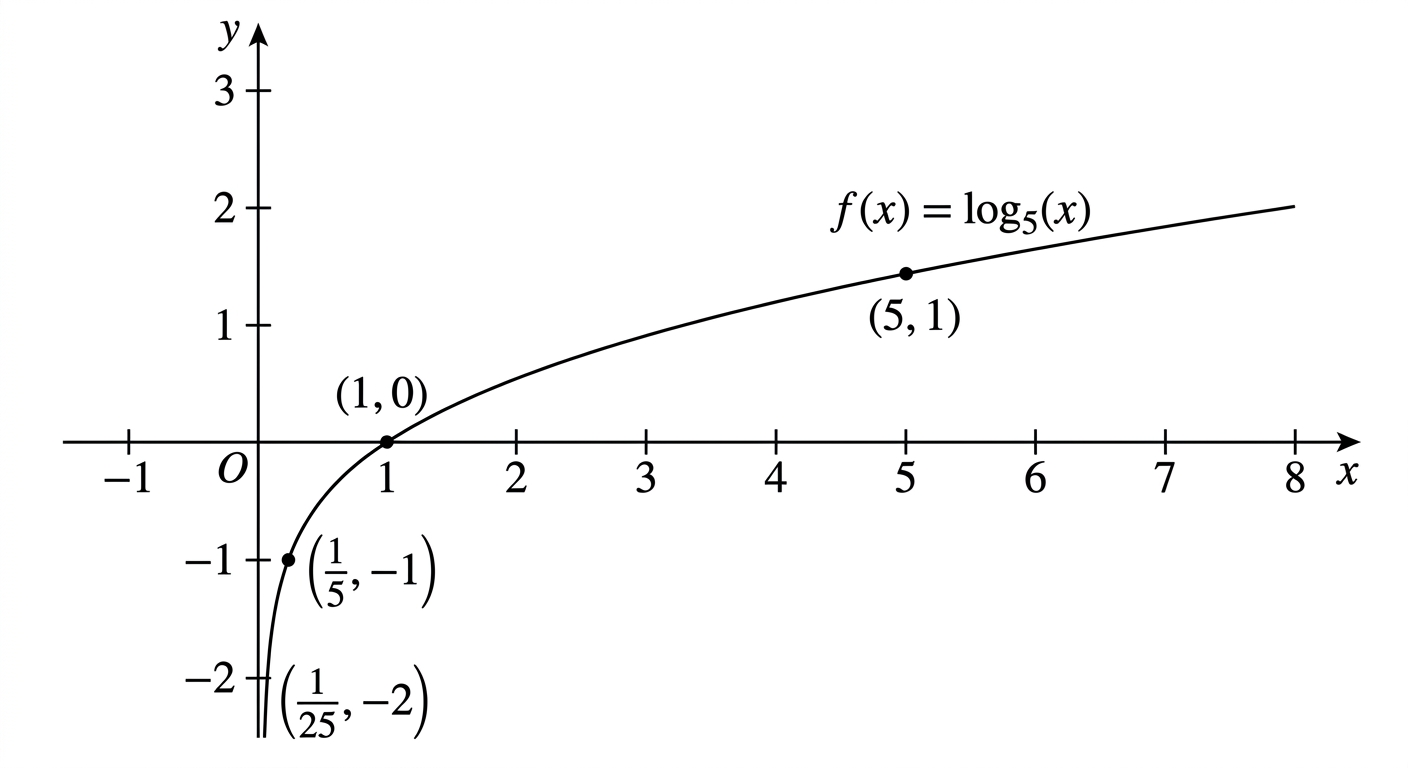
The diagram shows part of the graph of for .
a
Write down the value of . [1]
b
The graph of is obtained by reflecting in the -axis and then translating it by . Find an expression for . [2]
c
Deduce the equation of the vertical asymptote of and hence state the domain of . [2]

Solutions
2QuestionApplying logarithms to both sidesAssessment Practice
6 marks~9 minCriterion C
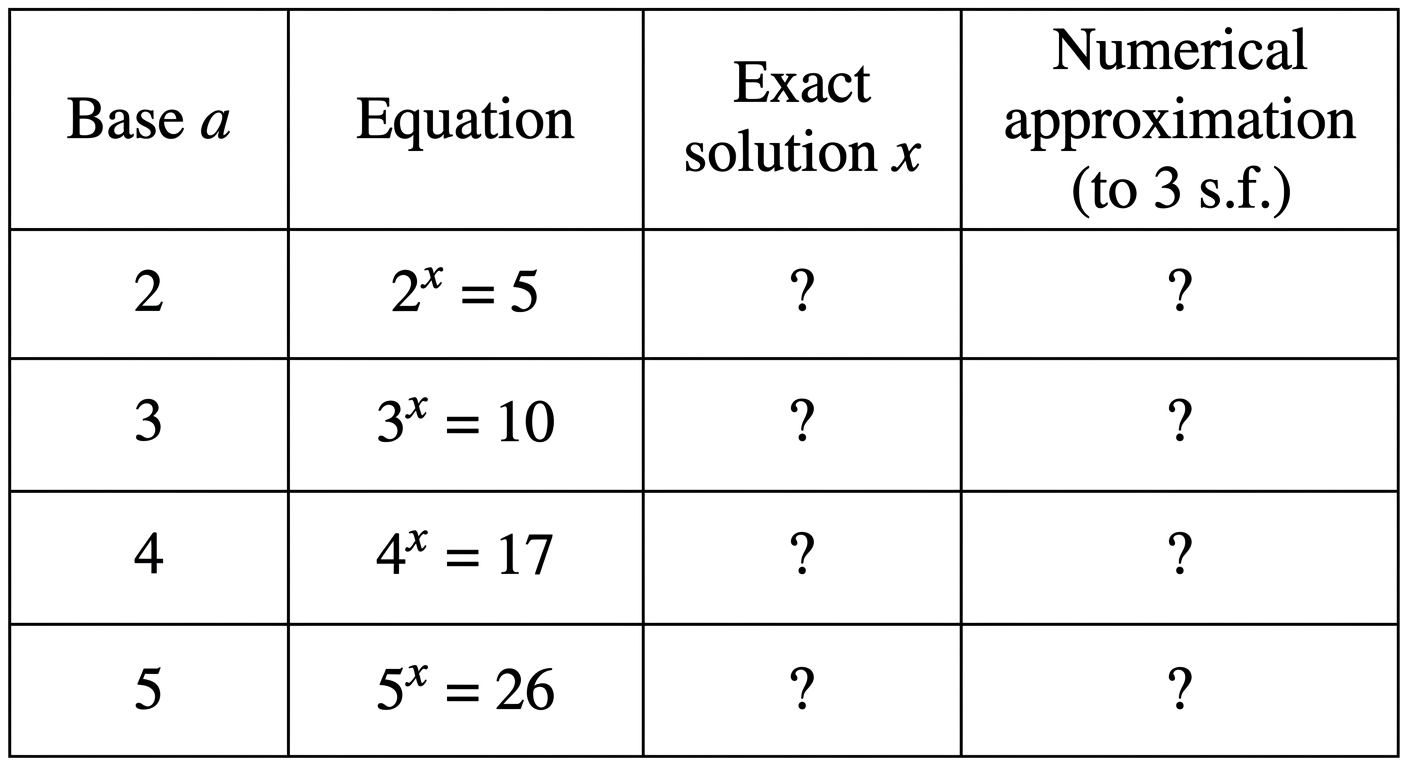
The table below shows four exponential equations of the form .
Base : 2, 3, 4, 5
Equation: , , ,
Approximate solution : , , ,
Base : 2, 3, 4, 5
Equation: , , ,
Approximate solution : , , ,
a
Write down the exact solution of in the form , where and are integers. [1]
b
Find the exact solution of in terms of , and hence show that for all valid bases , and that as . [3]
c
A student claims: "For a very large base , the equation is approximately the same as , so ."
Justify whether the student's reasoning is correct, and state one limitation of using as an approximation for small values of . [2]
Justify whether the student's reasoning is correct, and state one limitation of using as an approximation for small values of . [2]
Solutions
3QuestionIsolating exponential expressionsAssessment Practice
9 marks~14 minCriterion B
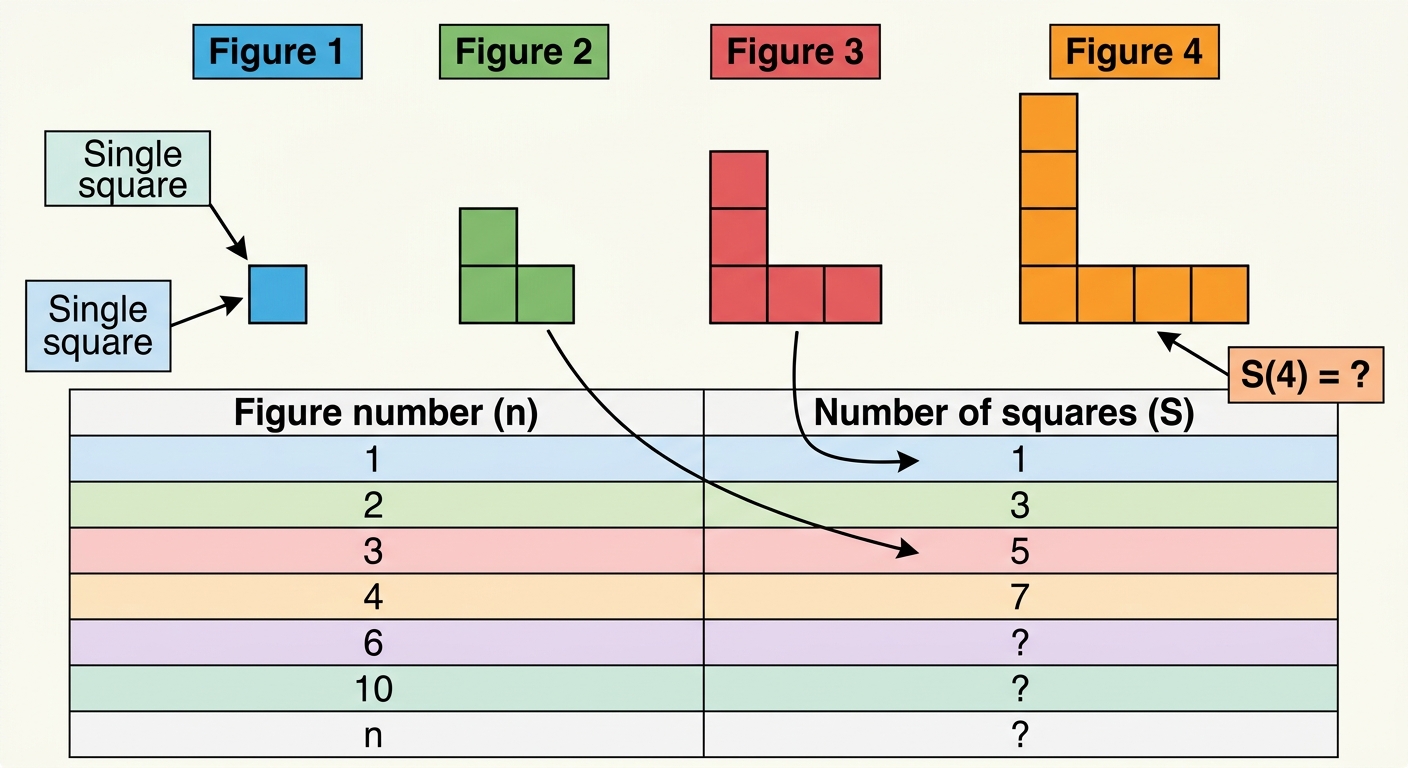
The diagram shows the first four figures of a pattern. Each figure is made from small squares arranged in an L-shape: Figure consists of a column of squares on the left and a row of squares along the bottom, sharing one corner square.
| Figure () | 1 | 2 | 3 | 4 |
|---|---|---|---|---|
| Squares () | 1 | 3 | 5 | 7 |
a
Find the number of squares in Figure 6 and Figure 10. [2]
b
Show that the number of squares in Figure is given by . Verify your rule for Figure 4. [3]
c
A second pattern is created where each Figure is formed by placing two copies of the original L-shape together, sharing their corner squares. The number of squares in Figure of the second pattern is .
Show that , and hence justify whether is the only positive integer solution to . [4]
Show that , and hence justify whether is the only positive integer solution to . [4]
Solutions
4QuestionApplying logarithms to both sidesAssessment Practice
11 marks~17 minCriterion D
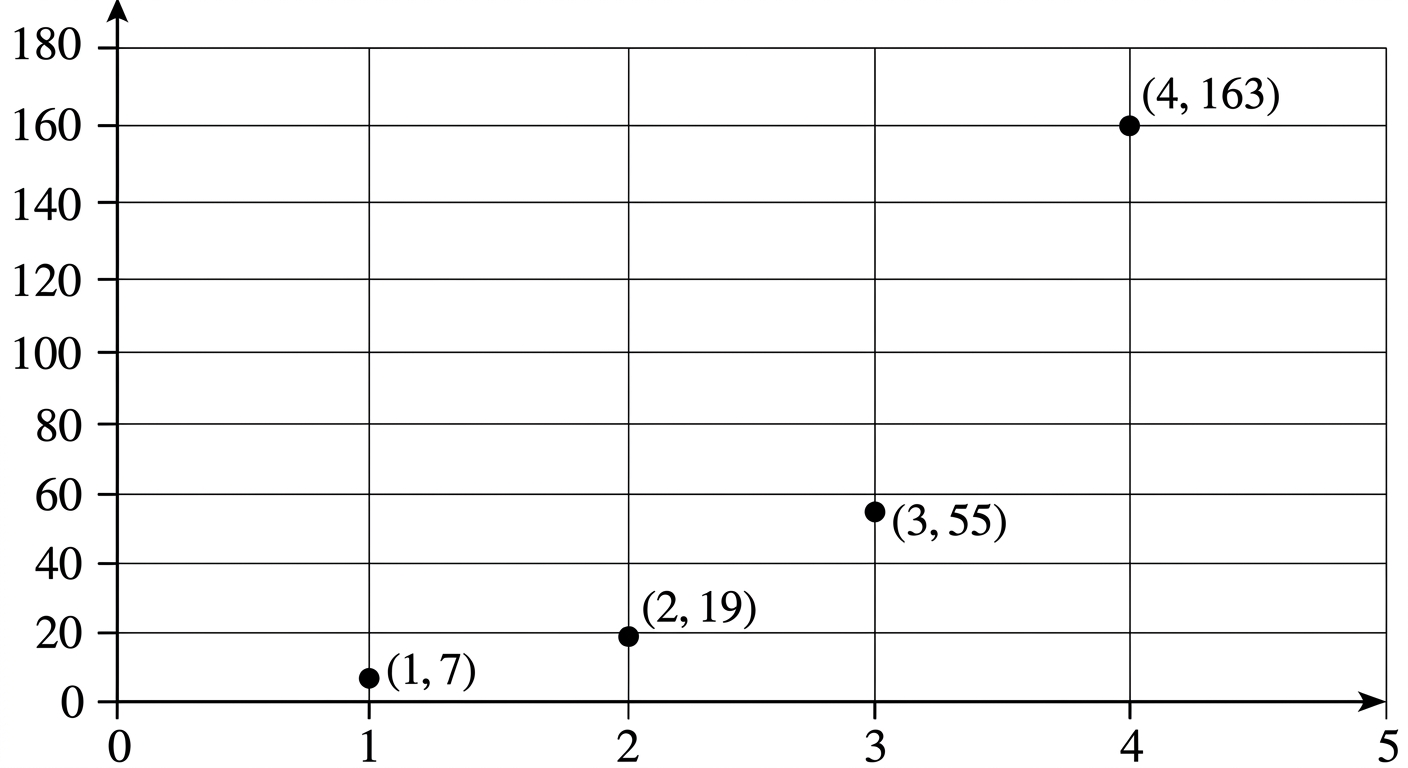
The table below shows four data points believed to follow a relationship of the form .
| 1 | 2 | 3 | 4 | |
| 7 | 19 | 55 | 163 |
a
Show that the first differences of have a common ratio of 3, and hence find the values of and by solving a pair of simultaneous equations. [4]
b
Show that plotting against produces a linear relationship with gradient , and verify this using at least two data points from the table. [3]
c
Justify why cannot be applied directly to both sides of to linearise the model, and assess whether the model provides a reliable basis for predicting values beyond . [4]
Solutions
That's every free question here — 4 of 113.
+109 more questions, plus Mock Papers & Worksheets, are waiting in Premium.