You're viewing free preview questions — 6 questions previewing here — subscribe to unlock 62 more, plus the Full Question Bank, Mock Papers & Worksheets.Upgrade
Back

Perimeter and Area of 2D Shapes — Free MYP5 Mathematics (Extended) Practice Questions

Free questions

Open in full, with answers, mark scheme and examiner insights.

Question 1Criterion D + C · Band 3-6 · Medium · 8 marksrevisionprep.com

Perimeter of Triangles Quadrilaterals and Circles
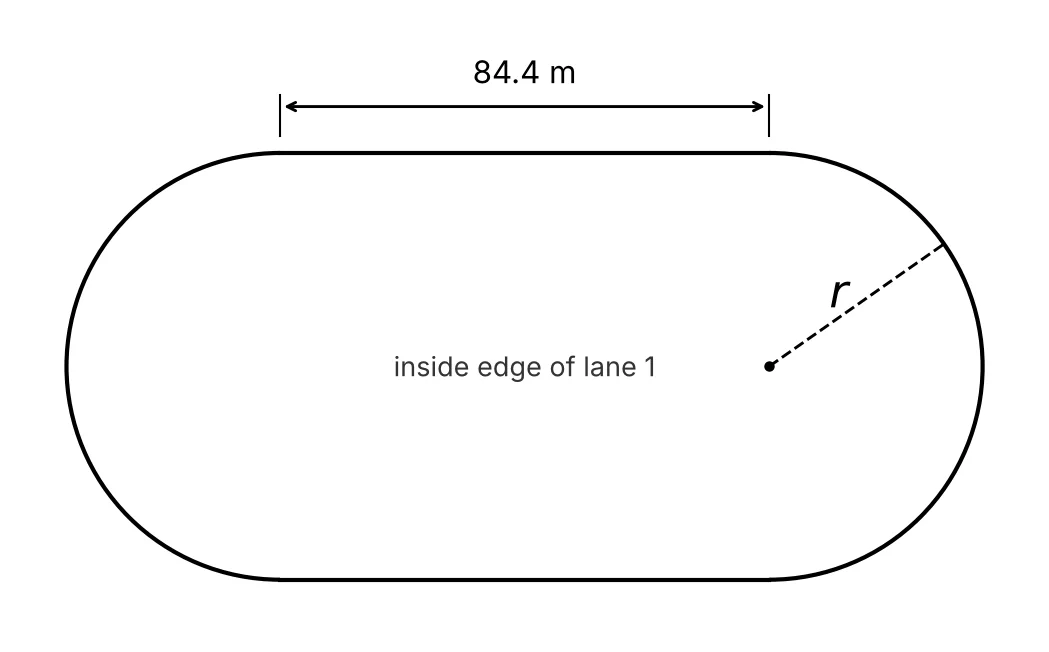
The diagram shows the inside edge of lane 1 of a running track. It is made from two straight sections, each 84.4 m long, and two semicircular ends of radius rr m. One lap of this edge is 400 m.
Question diagram
(a)
Find rr, correct to 3 significant figures. [3]Criterion D (i), D (ii) · Level 3-4
(b)
The inside edge of lane 2 is 1.22 m further out on both bends, with the same straight sections. Find how much further a runner travels on one lap of lane 2 than on one lap of lane 1. [2]Criterion D (iii) · Level 5-6
(c)
In a one-lap race, the lane 2 runner starts ahead of the lane 1 runner so that both run the same distance. State how far ahead, and justify the degree of accuracy the track marker should use. [2]Criterion D (iii), D (iv) · Level 5-6
(d)
Justify why your answer to (b) does not depend on the value of rr. [1]Criterion C (iv) · Level 5-6

revisionprep.com

Summary Answer

Not available for this question.

Model Answer

Not available for this question.

Marking Scheme

Not available for this question.

Examiner Insights

Not available for this question.

Question 2Criterion A + C · Band 1-6 · Medium · 8 marksrevisionprep.com

Area of Rectangles Triangles and Parallelograms
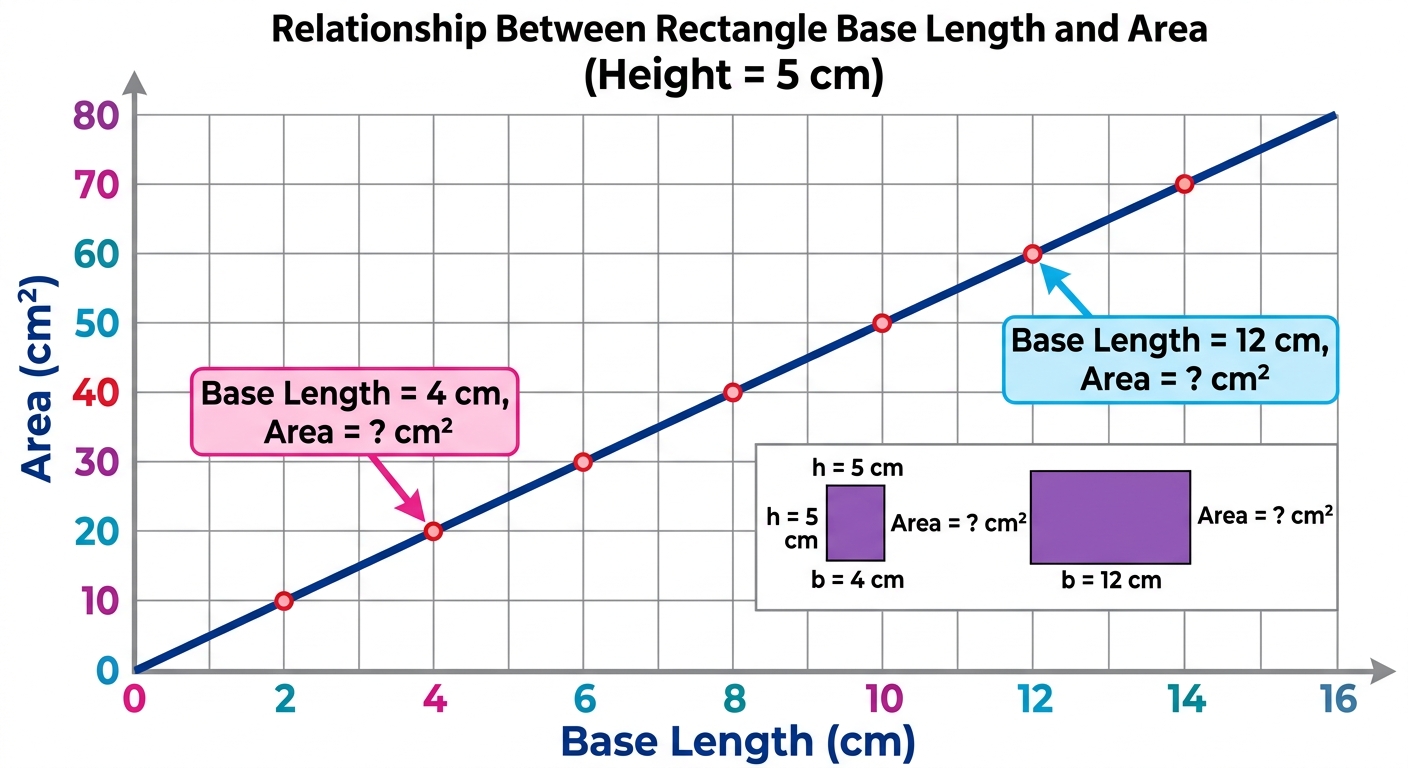
The graph shows how the area AA cm² of a rectangle changes with its base length bb cm, when the height is fixed at 5 cm.
Question diagram
(a)
Use the graph to write down the area when b=12b = 12. [1]Criterion A (i) · Level 1-2
(b)
Find the gradient of the line and state what it represents. [2]Criterion C (i), C (iii) · Level 3-4
(c)
Write down an equation for AA in terms of bb. [1]Criterion C (iii) · Level 3-4
(d)
Find the base length that gives an area of 47.5 cm². [2]

(e) A second set of rectangles has height 2.5 cm. Describe two ways in which its graph would compare with this one. [2]
Criterion A (ii) · Level 3-4

revisionprep.com

Summary Answer

Not available for this question.

Model Answer

Not available for this question.

Marking Scheme

Not available for this question.

Examiner Insights

Not available for this question.

Question 3Criterion A + C · Band 1-6 · Medium · 14 marksrevisionprep.com

Area of Trapeziums and Rhombuses

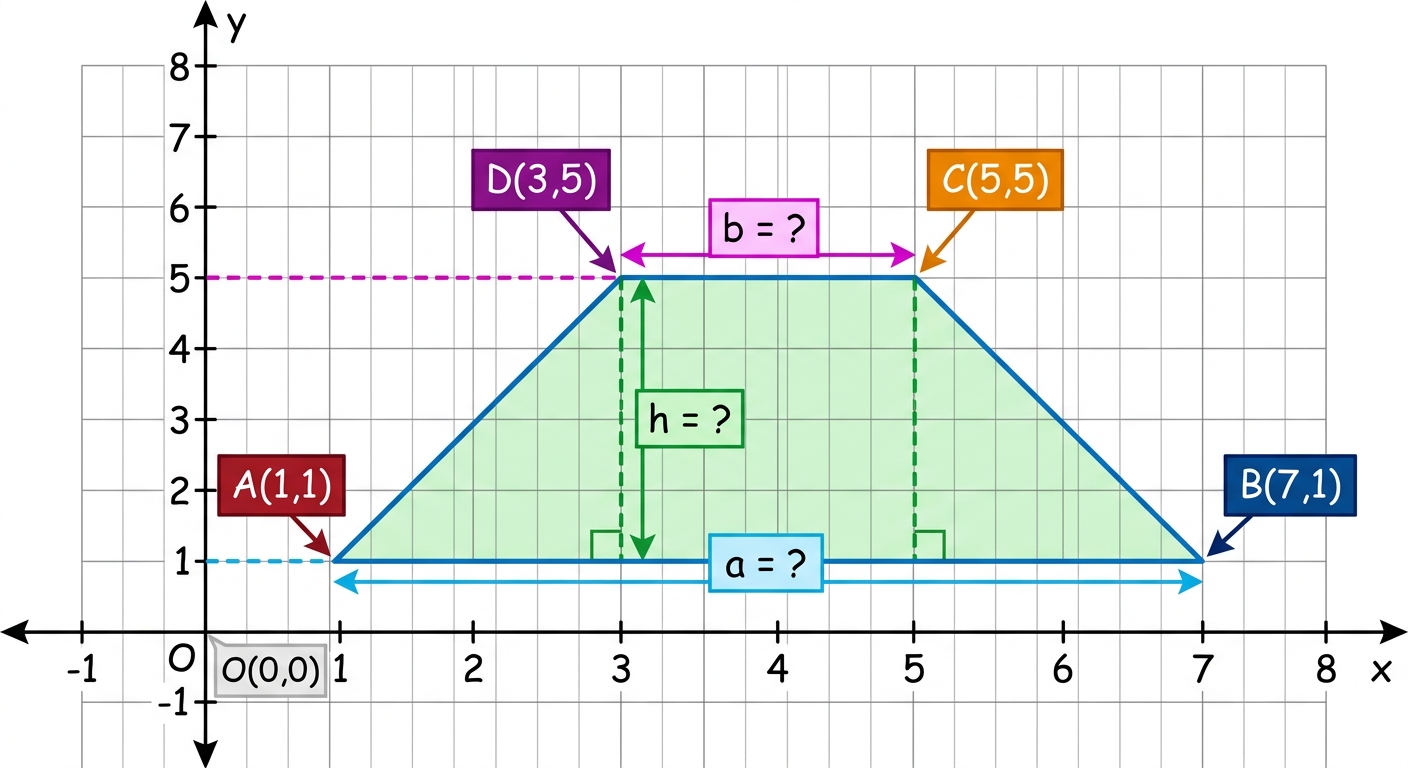
On a coordinate grid where 1 unit represents 1 m, a garden bed is modelled by trapezium ABCDABCD with vertices A(1,1)A(1, 1), B(7,1)B(7, 1), C(5,5)C(5, 5) and D(3,5)D(3, 5), as shown.
Question diagram
(a)
Write down the lengths of ABAB and CDCD and the perpendicular height of the trapezium. [2]Criterion A (i) · Level 1-2
(b)
Find the area of the garden bed. [2]Criterion A (ii) · Level 1-2
(c)
Find the length of ADAD, and hence find the perimeter of the bed, correct to 3 significant figures. [3]Criterion A (ii), A (iii) · Level 3-4
(d)
Using the coordinates, explain why the trapezium is symmetrical about the line x=4x = 4. [2]

(e) Find AC→\overrightarrow{AC} and BD→\overrightarrow{BD} as column vectors. Determine whether the diagonals have equal length and whether they are perpendicular. [3]

(f) Hence show that the area of ABCDABCD equals 12×AC×BD\dfrac{1}{2} \times AC \times BD, and verify that this agrees with your answer to (b). [2]
Criterion C (iv), C (v) · Level 5-6

revisionprep.com

Summary Answer

Not available for this question.

Model Answer

Not available for this question.

Marking Scheme

Not available for this question.

Examiner Insights

Not available for this question.

Question 4Criterion A + C · Band 1-6 · Medium · 10 marksrevisionprep.com

Using Compound Shapes in Area Calculations
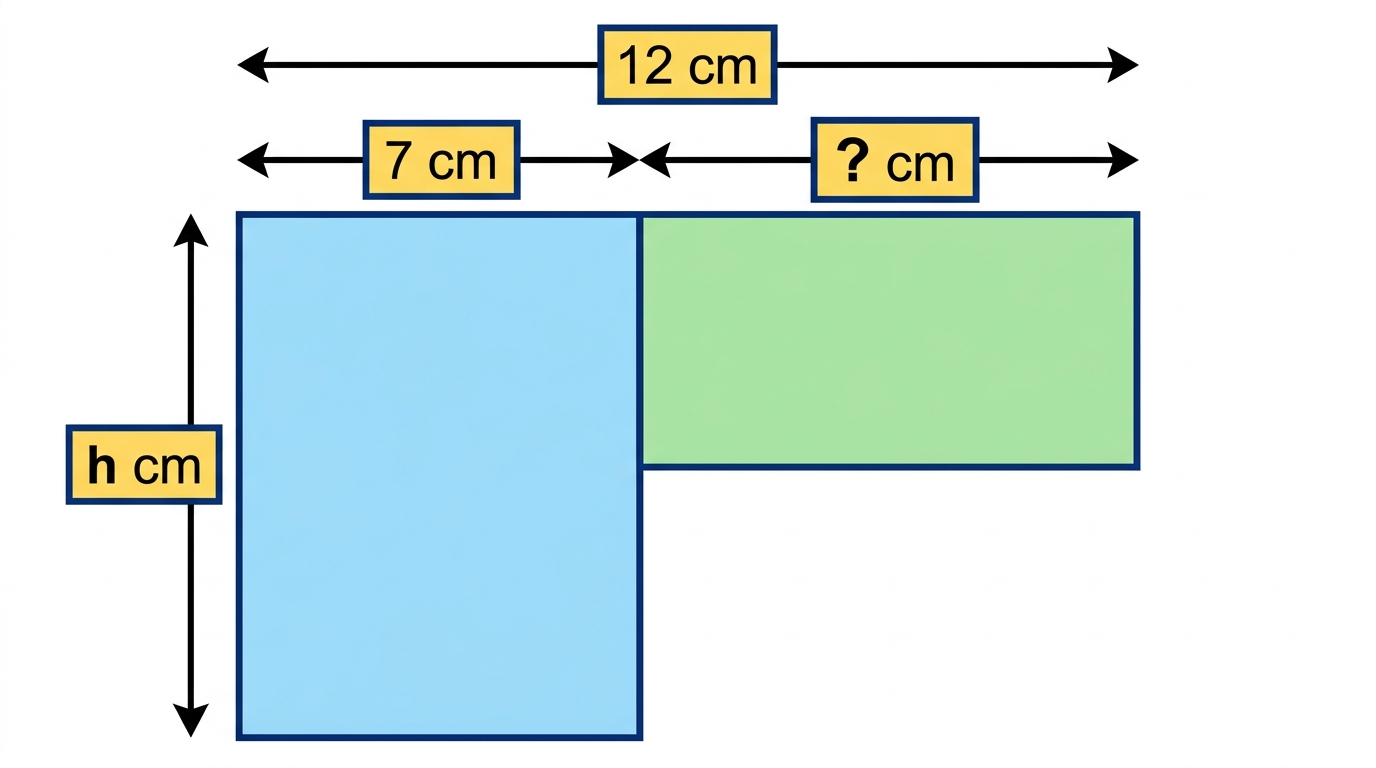
The diagram shows an L-shaped terrace made from two rectangles, drawn on a scale model. The total width is 12 cm. The left rectangle is 7 cm wide and h=9h = 9 cm tall. The right rectangle is 5 cm tall and sits along the top edge.
Question diagram
(a)
Write down the length marked ? on the diagram. [1]Criterion A (i) · Level 1-2
(b)
Find the area of the terrace. [2]Criterion A (ii) · Level 1-2
(c)
Find the perimeter of the terrace. [2]Criterion A (ii), A (iii) · Level 3-4
(d)
The model is built to a scale of 1:251 : 25. Find the area of the real terrace in m2^2. [3]

(e) Mina finds the real area by multiplying 8888 by 2525. Explain her mistake, and state the area, in cm2^2, that she should have found. [2]
Criterion A (ii), A (iii) · Level 5-6

revisionprep.com

Summary Answer

Not available for this question.

Model Answer

Not available for this question.

Marking Scheme

Not available for this question.

Examiner Insights

Not available for this question.

Question 5Criterion B + A · Band 1-8 · Challenge · 14 marksrevisionprep.com

Perimeter of Triangles Quadrilaterals and Circles
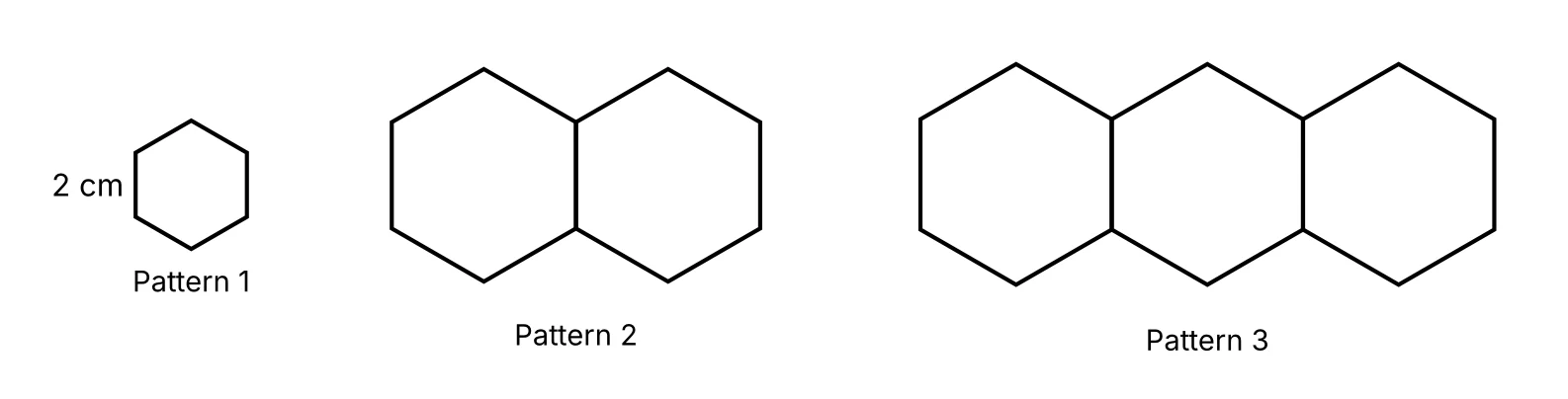
Regular hexagonal tiles with sides of 2 cm are laid in a row. Each new tile shares one side with the tile before it, as shown. The perimeter of a pattern is the length of its outer boundary.
Question diagram
(a)
Find the perimeter of Pattern 1, Pattern 2, Pattern 3 and Pattern 4. [2]Criterion B (i) · Level 1-2
(b)
Describe the pattern in your results and write down a general rule for the perimeter PP cm of Pattern nn. [2]Criterion B (ii) · Level 3-4
(c)
Verify your rule for Pattern 6 by counting the sides on its outer boundary. [1]Criterion B (iii) · Level 5-6
(d)
Justify why each extra tile adds exactly 8 cm to the perimeter. [2]

(e) Determine whether a pattern in this row can have a perimeter of exactly 100 cm. [2]

(f) Show that the area of one hexagonal tile is 636\sqrt{3} cm2^2, and hence write down the area of Pattern nn in exact form. [2]

(g) Show that the ratio of the perimeter to the area of Pattern nn can be written as (4n+2)39n\dfrac{(4n + 2)\sqrt{3}}{9n}, and find the exact value that the ratio approaches as nn becomes very large. [3]
Criterion B (iii) · Level 7-8

revisionprep.com

Summary Answer

Not available for this question.

Model Answer

Not available for this question.

Marking Scheme

Not available for this question.

Examiner Insights

Not available for this question.

Question 6Criterion C + A · Band 3-8 · Challenge · 13 marksrevisionprep.com

Solving Real-World Problems Involving Area and Perimeter
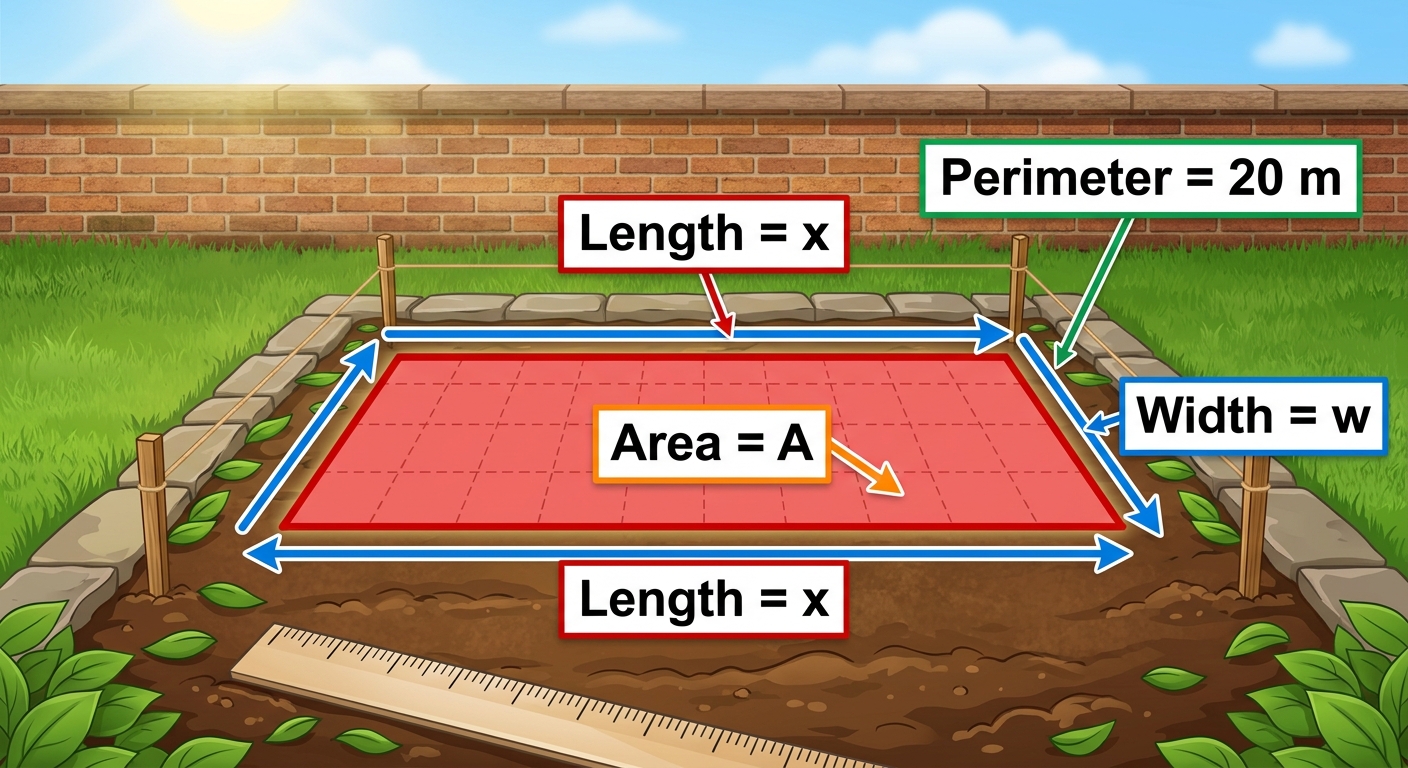
The picture shows a rectangular garden with a perimeter of 20 m. Its length is xx m.
Question diagram
(a)
Show that the area of the garden is x(10−x)x(10 - x) m². [2]Criterion C (iv) · Level 3-4
(b)
The garden must have an area of 21 m². Find its length and width. [3]Criterion A (i), A (ii) · Level 5-6
(c)
Explain why a garden with this perimeter cannot have an area of 30 m². [2]Criterion C (iv) · Level 5-6
(d)
Find the set of values of xx for which the area of the garden is greater than 1616 m2^2. Give your answer in interval notation. [3]

(e) Write x(10−x)x(10 - x) in the form q−(x−p)2q - (x - p)^2. Hence determine the greatest possible area and the dimensions of the garden that gives it. [3]
Criterion A (ii), A (iii) · Level 5-6

revisionprep.com

Summary Answer

Not available for this question.

Model Answer

Not available for this question.

Marking Scheme

Not available for this question.

Examiner Insights

Not available for this question.

That's every free question here — 6 of 68.

+62 more questions, plus Mock Papers & Worksheets, are waiting in Premium.

Upgrade