RevisionPrep
Log inGo Premium

Mathematics Extended

Free Version

Number and Operations

8 subtopics · 591 exam-style questions

“Pick a subtopic to start practising.”
Real Number System and ClassificationsRatio Proportion and PercentagesOperations with Fractions and DecimalsEstimation Rounding and Significant FiguresExponents Powers and RootsScientific Notation and Standard FormError Bounds and ApproximationsFinancial Mathematics

Sample questions from Number and Operations

  1. Error Bounds and Approximations[8 marks]
    Sofia rounds numbers to 1 decimal place in two ways.

    Method 1: round the number to 2 decimal places, then round that answer to 1 decimal place.

    Method 2: round the number straight to 1 decimal place.

    She tests the numbers 4.3414.341, 4.3464.346, 4.3494.349, 4.3554.355 and 4.3844.384.

    (a) Show Sofia's five numbers in a table, giving the result of each step of Method 1 and the result of Method 2. [3]

    (b) Describe which numbers give different answers with the two methods, and state a general rule for numbers with 3 decimal places. [2]

    (c) Test your rule on 7.2457.245 and on 7.2557.255. [1]

    (d) Justify why your rule works. [2]
    Practise this subtopic
  2. Real Number System and Classifications[4 marks]
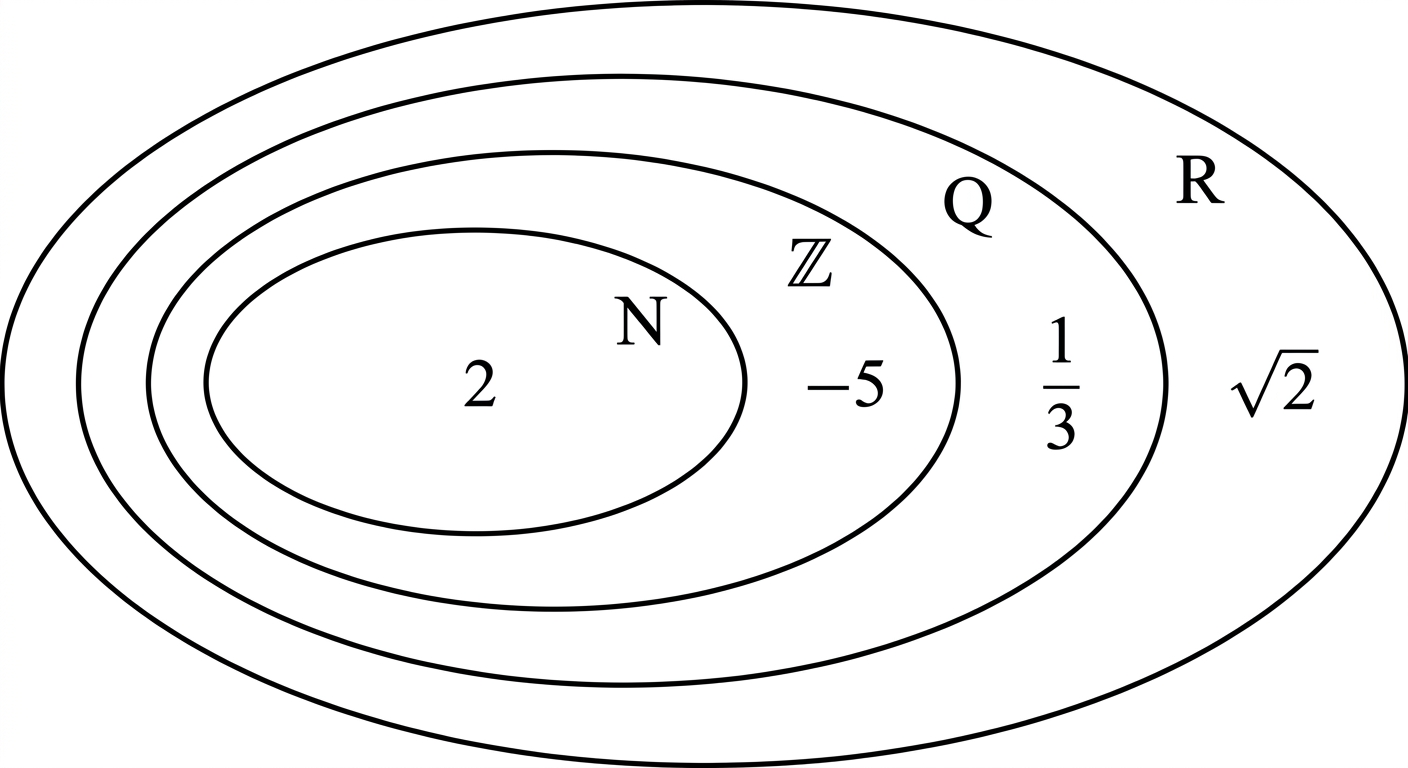
    The diagram shows the sets N⊂Z⊂Q⊂R\mathbb{N} \subset \mathbb{Z} \subset \mathbb{Q} \subset \mathbb{R}, with the numbers 22, −5-5, 13\dfrac{1}{3} and 2\sqrt{2} placed in their regions.

    (a) Write down, in set notation, the elements shown that belong to Z\mathbb{Z} but not to N\mathbb{N}. [1]

    (b) Write down the elements shown that belong to R∖Q\mathbb{R} \setminus \mathbb{Q}. [1]

    (c) State the region of the diagram in which each of −0.25-0.25 and 9\sqrt{9} should be placed. Give a reason for each. [2]
    Diagram for a Real Number System and Classifications practice questionPractise this subtopic
  3. Financial Mathematics[6 marks]
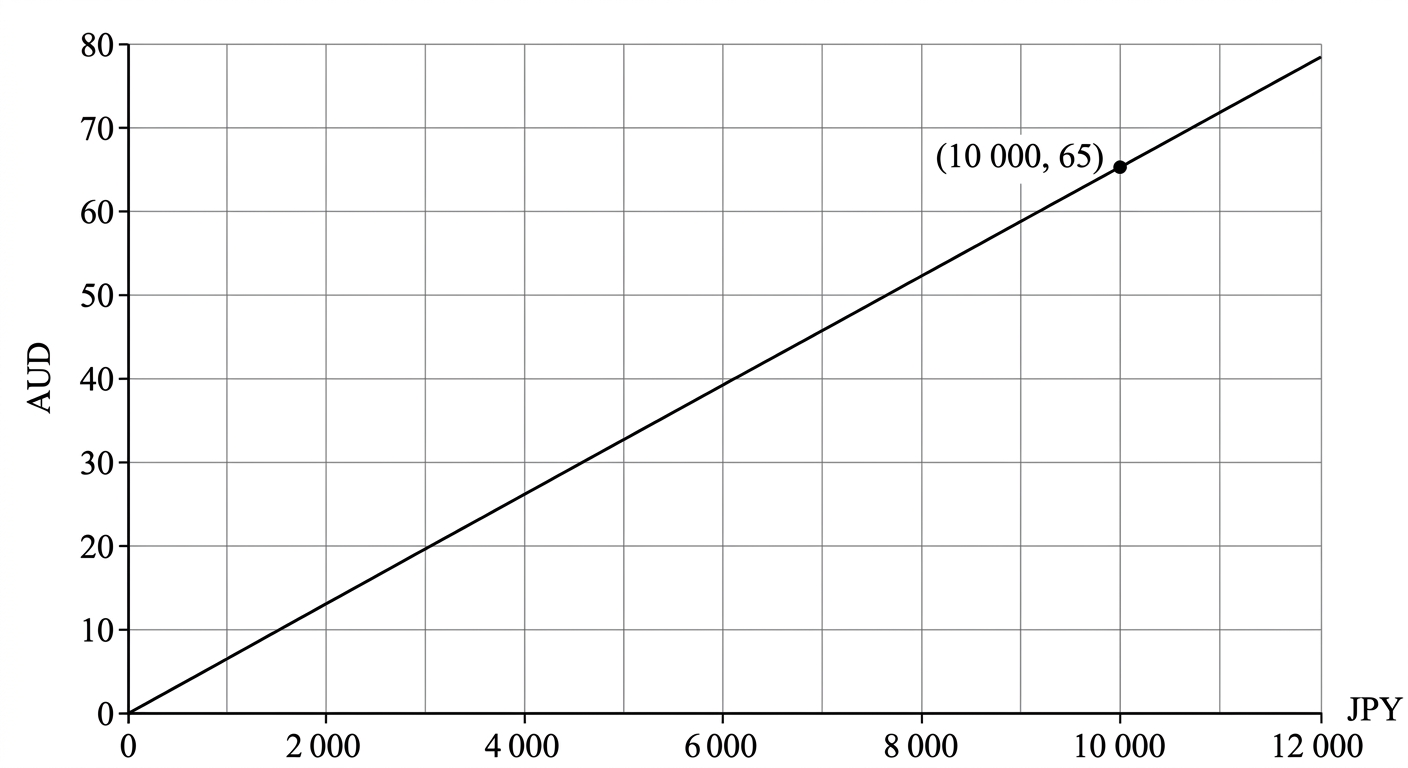
    Mia travels from Japan to Australia. The conversion graph shows Japanese yen (JPY) against Australian dollars (AUD). The line passes through the origin and the point (10 000, 65).

    (a) Write down the exchange rate as AUD per 1000 JPY. [1]

    (b) Explain why the conversion graph is a straight line through the origin. [1]

    (c) Calculate how many yen Mia needs for 120 AUD. [2]

    (d) Mia has 20 000 JPY. A travel pass costs 125 AUD. Determine whether she can afford it, and how many AUD she would have left or be short. [2]
    Diagram for a Financial Mathematics practice questionPractise this subtopic
  4. Operations with Fractions and Decimals[4 marks]
    A community garden has 24 plots of equal size. Vegetables are planted in 38\dfrac{3}{8} of the plots, flowers in 16\dfrac{1}{6} and herbs in 14\dfrac{1}{4}. The rest are unused. The garden committee will pay for an irrigation system only if more than 23\dfrac{2}{3} of the plots are in use.

    (a) Find the fraction of the plots that are in use. [2]

    (b) Determine the number of unused plots. [1]

    (c) Determine whether the committee will pay for the irrigation system. [1]
    Practise this subtopic
  5. Estimation Rounding and Significant Figures[5 marks]
    A government gives extra funding to any city whose population, rounded to the nearest 100 000100\,000, is at least 2 800 0002\,800\,000. The population of Meridian City is 2 783 4562\,783\,456.

    (a) Round the population of Meridian City to the nearest 100 000100\,000. [1]

    (b) State whether Meridian City receives the extra funding. [1]

    (c) Round the population of Meridian City to the nearest 10 00010\,000. [1]

    (d) A city has a population of PP, where PP is a whole number that rounds to 2 800 0002\,800\,000 to the nearest 100 000100\,000. Write down the error interval for PP and the smallest population that would receive the funding. [2]
    Practise this subtopic
  6. Exponents Powers and Roots[8 marks]
    A designer makes a set of square panels. Panel 1 has an area of 2 m22\ \text{m}^{2}, panel 2 has an area of 4 m24\ \text{m}^{2}, panel 3 has an area of 6 m26\ \text{m}^{2}, and so on, with the area increasing by 2 m22\ \text{m}^{2} each time.

    (a) Write the side lengths of the first eight panels in exact form, and identify which of them are whole numbers. [2]

    (b) Describe a rule for the panel numbers nn that have a whole-number side length. [2]

    (c) Predict the next two panel numbers after panel 8 that have a whole-number side length, and verify your prediction. [2]

    (d) Justify why a panel with an odd panel number can never have a whole-number side length. [2]
    Practise this subtopic

Every question, revision note and worksheet for Number and Operations — with Premium.

Unlock Full Access