You're viewing free preview questions — 6 questions previewing here — subscribe to unlock 49 more, plus the Full Question Bank, Mock Papers & Worksheets.Upgrade
Back

Error Bounds and Approximations — Free MYP5 Mathematics (Extended) Practice Questions

Free questions

Open in full, with answers, mark scheme and examiner insights.

Question 1Criterion D + A · Band 1-6 · Medium · 7 marksrevisionprep.com

Rounding to Decimal Places and Significant Figures

A school club is making 2323 banners. Each banner needs 1.371.37 m of fabric. Fabric is sold only in whole metres and costs $8.45\text{\textdollar}8.45 per metre.
(a)
Calculate the total length of fabric needed for the 2323 banners. [1]Criterion A (ii) · Level 1-2
(b)
Determine the length of fabric the club must buy. Justify your answer. [2]Criterion D (ii), D (v) · Level 3-4
(c)
Calculate the cost of the fabric, giving your answer to an appropriate degree of accuracy. [2]Criterion D (iii), D (iv) · Level 3-4
(d)
Last year the club bought a 3030 m roll of the same fabric. Determine the greatest number of complete banners that could be cut from it, and explain why the rounding here differs from part (b). [2]Criterion D (iii), D (v) · Level 5-6

revisionprep.com

Summary Answer

Not available for this question.

Model Answer

Not available for this question.

Marking Scheme

Not available for this question.

Examiner Insights

Not available for this question.

Question 2Criterion A + D · Band 1-6 · Medium · 7 marksrevisionprep.com

Calculations Using Rounded Values

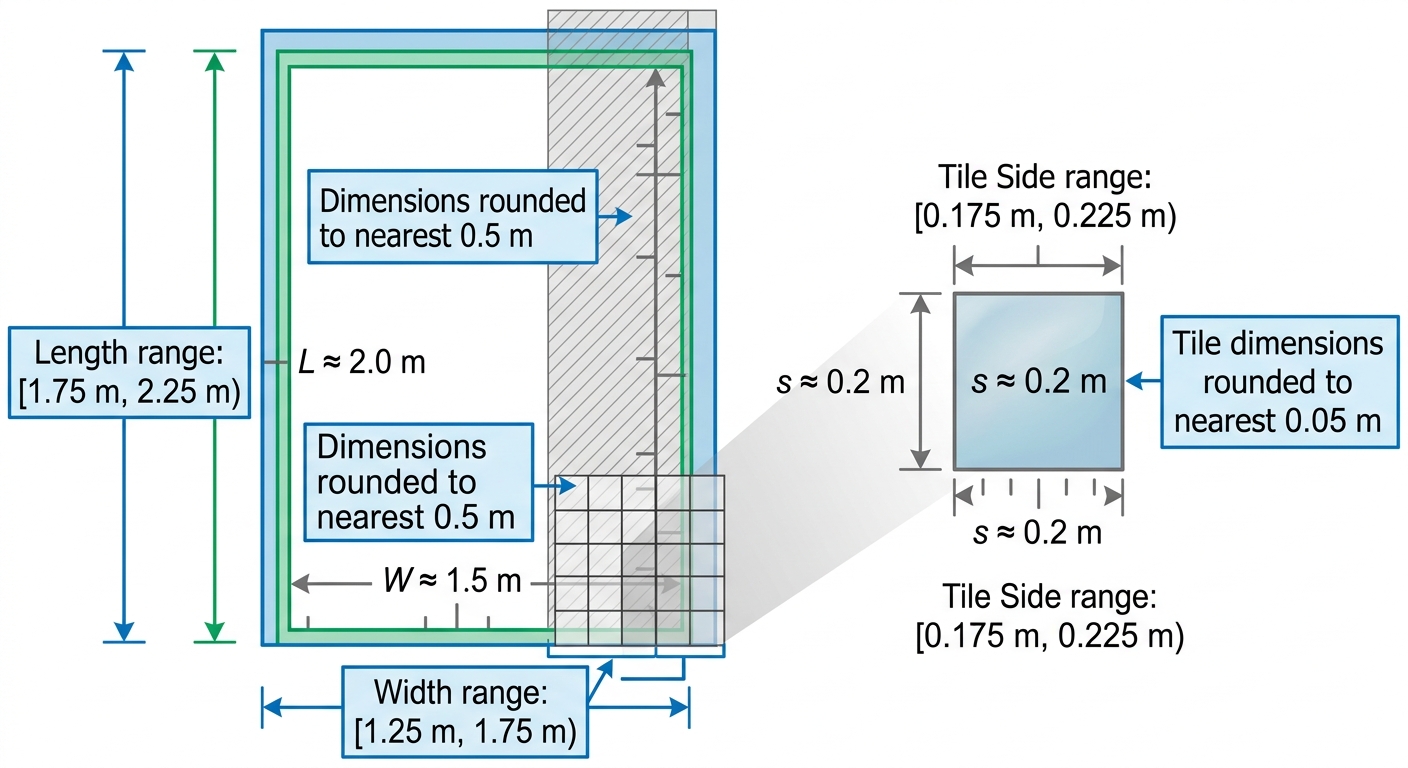
The diagram shows a bathroom floor measured as 2.02.0 m by 1.51.5 m, each rounded to the nearest 0.50.5 m. Square tiles have side 0.20.2 m, rounded to the nearest 0.050.05 m. The ranges on the diagram give the bounds of each measurement.
Question diagram
(a)
Calculate the largest possible area of the floor. [1]Criterion A (ii) · Level 1-2
(b)
Calculate the smallest possible area of one tile. [1]Criterion A (ii) · Level 1-2
(c)
Hence find the greatest number of tiles that might be needed to cover the floor. [2]Criterion A (i), A (iii) · Level 5-6
(d)
Find the least number of tiles that might be needed to cover the floor. [1]

(e) The homeowner works out 3÷0.04=753 \div 0.04 = 75 and buys 7575 tiles. Comment on whether this is a sensible purchase. [2]
Criterion A (iii) · Level 5-6

revisionprep.com

Summary Answer

Not available for this question.

Model Answer

Not available for this question.

Marking Scheme

Not available for this question.

Examiner Insights

Not available for this question.

Question 3Criterion C + A · Band 3-6 · Medium · 5 marksrevisionprep.com

Understanding Absolute and Percentage Error

An optical bench has a certified length of 1.521.52 m. A technician measures it as 1.551.55 m. Kofi works out the percentage error as 0.031.55×100%=1.94%\dfrac{0.03}{1.55} \times 100\% = 1.94\%.
(a)
Calculate the correct percentage error of the measurement. [2]Criterion A (ii) · Level 3-4
(b)
Identify Kofi's mistake. [1]Criterion C (i) · Level 3-4
(c)
Show that, whenever a measurement MM is larger than the exact value EE, Kofi's method gives a smaller percentage than the correct method. [2]Criterion C (iv), C (v) · Level 5-6

revisionprep.com

Summary Answer

Not available for this question.

Model Answer

Not available for this question.

Marking Scheme

Not available for this question.

Examiner Insights

Not available for this question.

Question 4Criterion A + D · Band 3-6 · Medium · 7 marksrevisionprep.com

Estimation in Problem Solving

A swimming pool is 24.624.6 m long and 12.412.4 m wide, with an average depth of 1.851.85 m. A school poster claims that the pool holds more water than one million 330330 mL bottles. (11 m3=1000^3 = 1000 litres.)
(a)
Estimate the volume of the pool by rounding each measurement to 1 significant figure. [2]Criterion A (ii) · Level 3-4
(b)
Use your estimate to find the number of bottles of water the pool holds, correct to 1 significant figure. [2]Criterion A (i), A (ii) · Level 5-6
(c)
Calculate the volume of the pool, and the number of bottles it holds, using the measurements given. Give the number of bottles correct to 3 significant figures. [1]Criterion A (iii) · Level 3-4
(d)
Comment on whether rounding to 1 significant figure was a sensible way to check the poster's claim, and suggest a better estimate. [2]Criterion D (iv), D (v) · Level 5-6

revisionprep.com

Summary Answer

Not available for this question.

Model Answer

Not available for this question.

Marking Scheme

Not available for this question.

Examiner Insights

Not available for this question.

Question 5Criterion B · Band 3-8 · Challenge · 8 marksrevisionprep.com

Rounding to Decimal Places and Significant Figures

Sofia rounds numbers to 1 decimal place in two ways.

Method 1: round the number to 2 decimal places, then round that answer to 1 decimal place.

Method 2: round the number straight to 1 decimal place.

She tests the numbers 4.3414.341, 4.3464.346, 4.3494.349, 4.3554.355 and 4.3844.384.
(a)
Show Sofia's five numbers in a table, giving the result of each step of Method 1 and the result of Method 2. [3]Criterion B (i) · Level 3-4
(b)
Describe which numbers give different answers with the two methods, and state a general rule for numbers with 3 decimal places. [2]Criterion B (ii) · Level 5-6
(c)
Test your rule on 7.2457.245 and on 7.2557.255. [1]Criterion B (iii) · Level 5-6
(d)
Justify why your rule works. [2]Criterion B (iii) · Level 7-8

revisionprep.com

Summary Answer

Not available for this question.

Model Answer

Not available for this question.

Marking Scheme

Not available for this question.

Examiner Insights

Not available for this question.

Question 6Criterion A + C · Band 1-8 · Challenge · 9 marksrevisionprep.com

Calculations Using Rounded Values

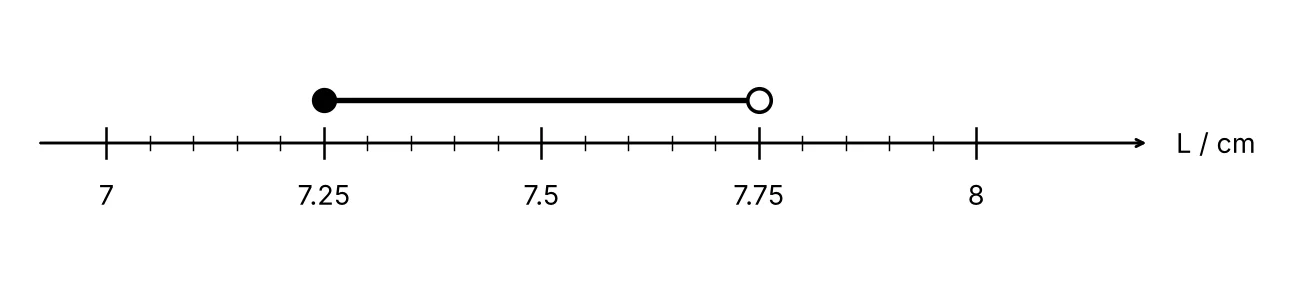
The number line shows the error interval for a length LL cm.
Question diagram
(a)
Write down the error interval shown, using inequality notation. [1]Criterion A (ii) · Level 1-2
(b)
State the value to which LL was recorded and the degree of accuracy used. [2]Criterion A (i), A (iii) · Level 3-4
(c)
A different length MM is recorded as 7.57.5 cm, correct to 1 decimal place. Write down the error interval for MM and describe how its number line would differ from the one shown. [2]Criterion C (iii), C (ii) · Level 5-6
(d)
The length MM from part (c) is joined end to end with LL. Find the error interval for L+ML + M. [2]

(e) Show that every possible value of L+ML + M satisfies ∣(L+M)−15∣≤0.3\left\lvert (L + M) - 15 \right\rvert \le 0.3, and explain where 0.30.3 comes from. [2]
Criterion A (iii) · Level 5-6

revisionprep.com

Summary Answer

Not available for this question.

Model Answer

Not available for this question.

Marking Scheme

Not available for this question.

Examiner Insights

Not available for this question.

That's every free question here — 6 of 55.

+49 more questions, plus Mock Papers & Worksheets, are waiting in Premium.

Upgrade