You're viewing free preview questions — 6 questions previewing here — subscribe to unlock 83 more, plus the Full Question Bank, Mock Papers & Worksheets.Upgrade
Back

Geometric Sequences and Series — Free MYP5 Mathematics (Extended) Practice Questions

Free questions

Open in full, with answers, mark scheme and examiner insights.

Question 1Criterion A · Band 3-4 · Medium · 2 marksrevisionprep.com

Recognising Geometric Sequences

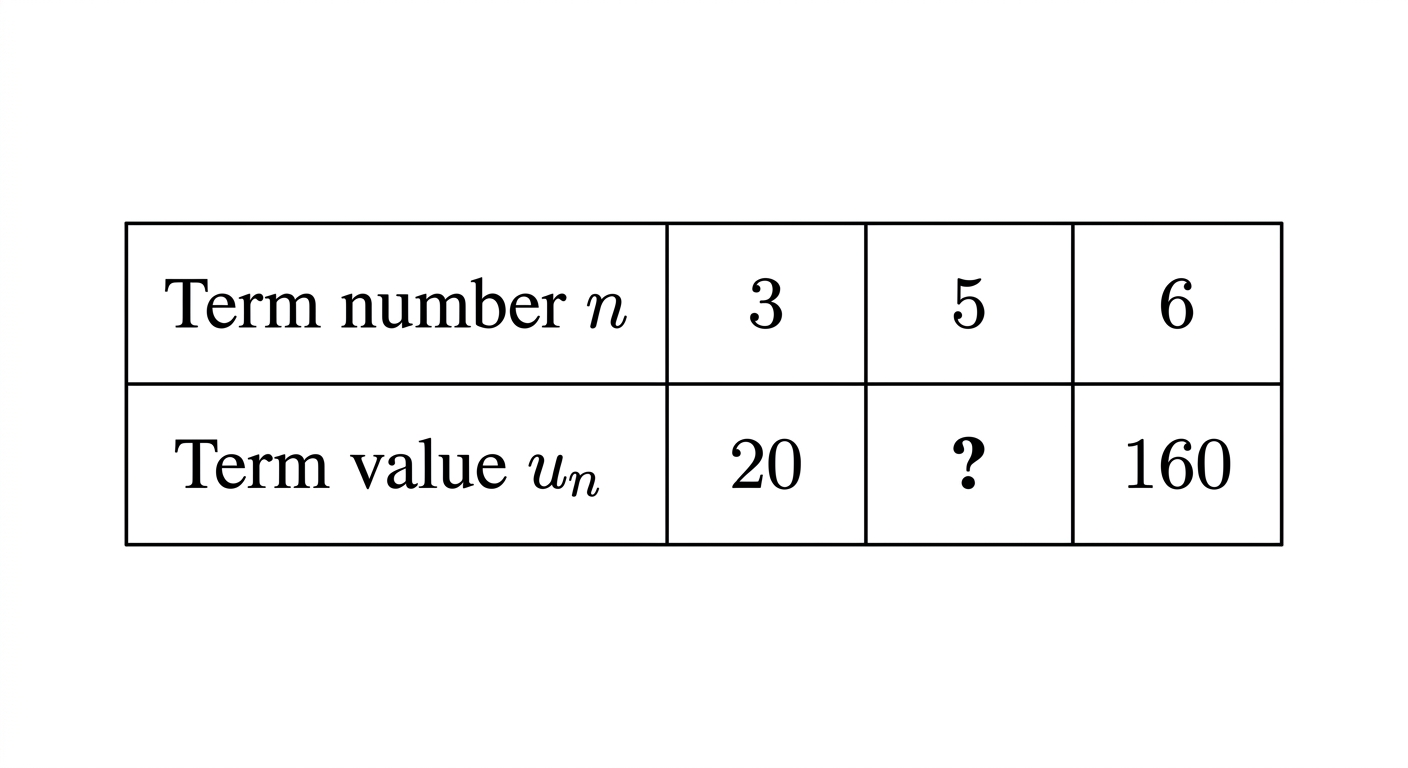
The table below shows three terms of a geometric sequence.

Term number nn356
Term value unu_n20?160
Question diagram
(a)
Show that the common ratio of the sequence is r=2r = 2. [1]Criterion A (ii) · Level 3-4
(b)
Hence find the value of u5u_5. [1]Criterion A (ii) · Level 3-4

revisionprep.com

Summary Answer

Not available for this question.

Model Answer

Not available for this question.

Marking Scheme

Not available for this question.

Examiner Insights

Not available for this question.

Question 2Criterion A + C · Band 3-6 · Medium · 9 marksrevisionprep.com

Finding the Common Ratio

A geometric sequence has first term u1=2u_{1} = 2 and third term u3=18u_{3} = 18.
(a)
Find both possible values of the common ratio rr. [2]Criterion A (ii) · Level 3-4
(b)
For the positive value of rr, find the value of nn for which un=1458u_{n} = 1458. [2]Criterion A (ii) · Level 3-4
(c)
A second geometric sequence has first term 44 and the same common ratio rr as the first sequence. Given that the sum of its first kk terms is 14561456, justify, for each value of rr in (a), whether kk is a valid term number. [3]Criterion A (iii) · Level 5-6
(d)
Explain why neither of the second sequences has a sum to infinity. [2]Criterion C (iv) · Level 5-6

revisionprep.com

Summary Answer

Not available for this question.

Model Answer

Not available for this question.

Marking Scheme

Not available for this question.

Examiner Insights

Not available for this question.

Question 3Criterion D · Band 3-6 · Medium · 8 marksrevisionprep.com

General Term of a Geometric Sequence

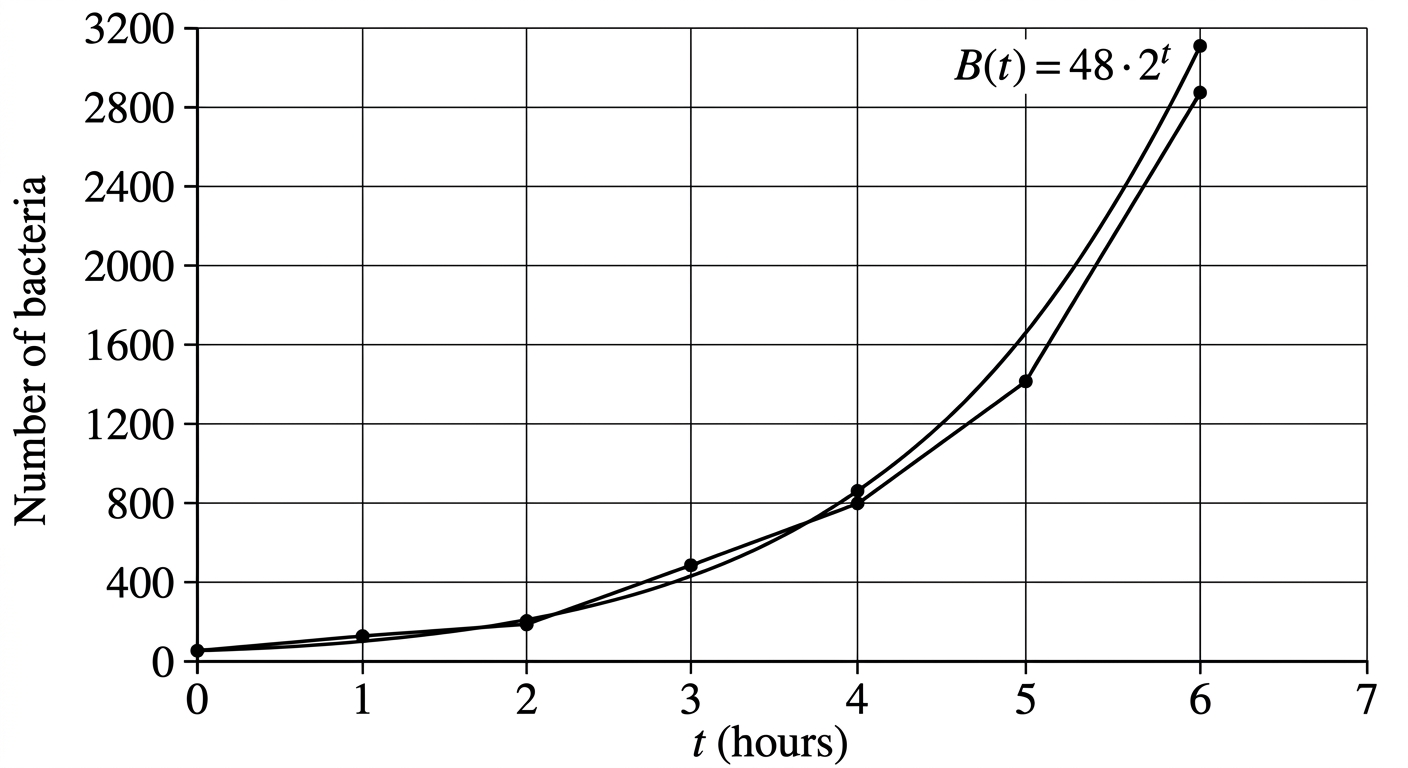
A colony of bacteria doubles in number every hour. At time t=0t = 0 hours, the colony contains 4848 bacteria. The number of bacteria at time tt hours is modelled by
B(t)=48⋅2t.B(t) = 48 \cdot 2^{t}.
The table below shows the predicted and actual bacteria counts.

tt (hours): 00 \ \ 22 \ \ 44 \ \ 66
Predicted B(t)B(t): 4848 \ \ 192192 \ \ 768768 \ \ 30723072
Actual count: 4848 \ \ 180180 \ \ 810810 \ \ 29002900
Question diagram
(a)
Calculate the percentage error between the predicted and actual counts at t=2t = 2 and at t=6t = 6, using percentage error=∣predicted−actual∣actual×100%.\text{percentage error} = \frac{|\text{predicted} - \text{actual}|}{\text{actual}} \times 100\%. Give each answer correct to 2 significant figures. [2]Criterion D (iii) · Level 3-4
(b)
The percentage error at t=4t = 4 is 5.2%5.2\%. Using all four percentage errors from the table, including your answers from part (a) and the value at t=0t = 0, justify whether the scientist's claim that the model is reliable only for 0≤t≤40 \leq t \leq 4 is reasonable. Suggest one limitation of using an exponential model to predict the long-term bacteria count. [3]Criterion D (v) · Level 5-6
(c)
Using the model B(t)=48⋅2tB(t) = 48 \cdot 2^{t}, find the number of complete hours it takes for the colony to first exceed 10 00010\,000 bacteria. Show your method clearly, using logarithms. Advise a laboratory technician whether the model can be used to schedule this event reliably, referring to the percentage errors from parts (a) and (b). [3]Criterion D (iii), D (v) · Level 5-6

revisionprep.com

Summary Answer

Not available for this question.

Model Answer

Not available for this question.

Marking Scheme

Not available for this question.

Examiner Insights

Not available for this question.

Question 4Criterion A + B · Band 5-6 · Medium · 10 marksrevisionprep.com

Solving Word Problems with Geometric Sequences

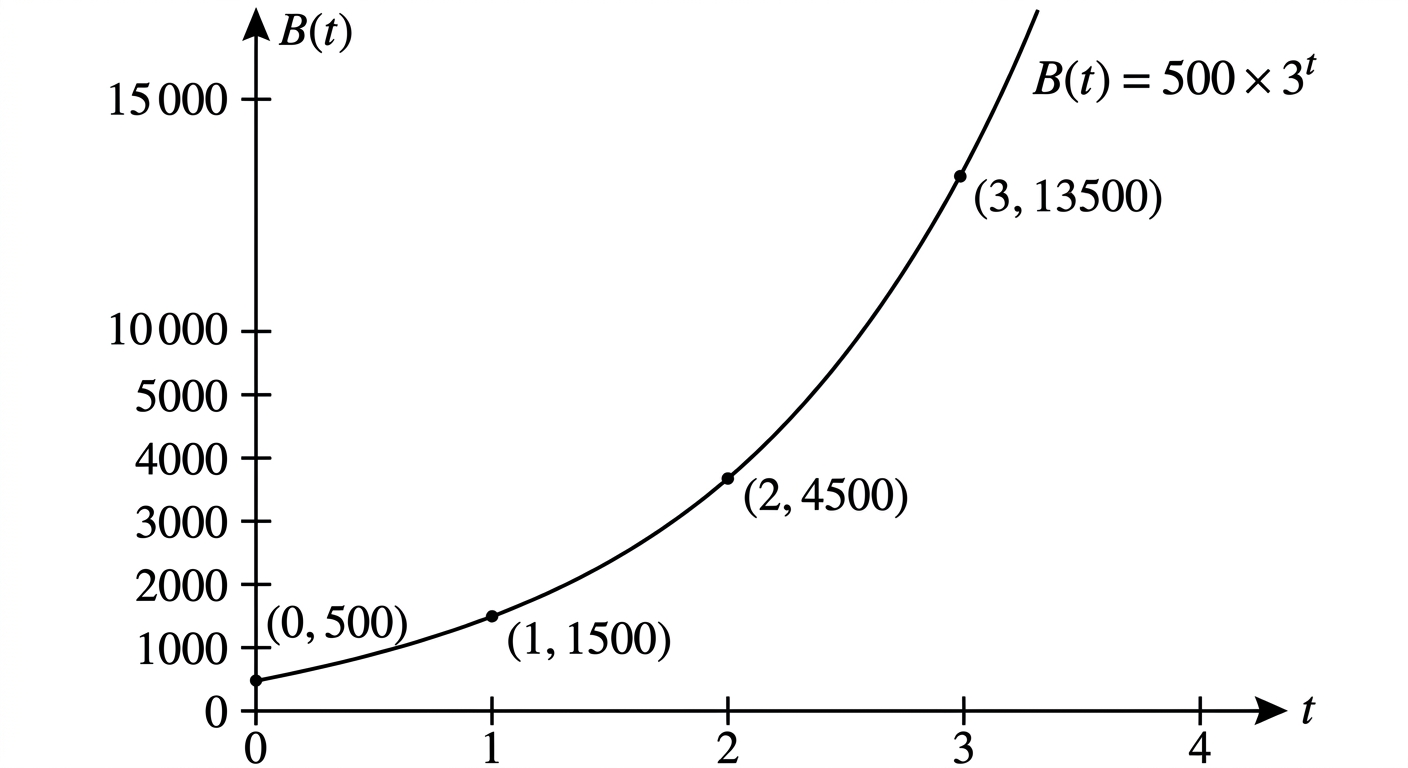
A bacterial colony is modelled by the exponential function
B(t)=500×3tB(t) = 500 \times 3^{t}
where B(t)B(t) is the number of bacteria and tt is the time in complete hours after the colony is first observed.
Question diagram
(a)
Find the number of complete hours required for the population of colony BB to first exceed 1 000 0001\,000\,000. [3]Criterion A (iii) · Level 5-6
(b)
A second colony is modelled by C(t)=4000×ktC(t) = 4000 \times k^{t}, where k>1k > 1. Given that the two colonies have the same population at t=4t = 4, find the exact value of kk. [3]Criterion A (iii) · Level 5-6
(c)
A scientist claims that colony CC will eventually overtake colony BB for t>4t > 4. Using your value of kk from part (b), justify whether this claim is correct. [4]Criterion B (iii) · Level 5-6

revisionprep.com

Summary Answer

Not available for this question.

Model Answer

Not available for this question.

Marking Scheme

Not available for this question.

Examiner Insights

Not available for this question.

Question 5Criterion B + A · Band 3-8 · Challenge · 10 marksrevisionprep.com

Recognising Geometric Sequences

An arithmetic sequence has first term a=3a = 3 and common difference dd, with d≠0d \neq 0.
(a)
Show that the 1st, 2nd and 5th terms of an arithmetic sequence with first term aa and common difference dd form a geometric sequence only when d=2ad = 2a. [3]Criterion B (iii) · Level 5-6
(b)
For a=3a = 3, write down the geometric sequence formed by the 1st, 2nd and 5th terms, and state its common ratio. [2]Criterion A (ii) · Level 3-4
(c)
The 5th term of the geometric sequence in (b) is also a term of the arithmetic sequence. Find which term of the arithmetic sequence it is. [2]Criterion A (iii) · Level 5-6
(d)
Prove that every term of the geometric sequence 3,9,27,…3, 9, 27, \ldots is also a term of the arithmetic sequence 3,9,15,…3, 9, 15, \ldots [3]Criterion B (iii) · Level 7-8

revisionprep.com

Summary Answer

Not available for this question.

Model Answer

Not available for this question.

Marking Scheme

Not available for this question.

Examiner Insights

Not available for this question.

Question 6Criterion C + B · Band 3-8 · Challenge · 9 marksrevisionprep.com

Finding the Common Ratio

The numbers of small triangles in Figures 1, 2, 3 and 4 of a pattern are 1,4,91, 4, 9 and 1616. The pattern continues so that Figure nn contains Tn=n2T_{n} = n^{2} small triangles.
(a)
Explain why the sequence 1,4,9,16,…1, 4, 9, 16, \ldots is neither arithmetic nor geometric. [2]Criterion C (iv) · Level 3-4
(b)
Show that the number of triangles added when going from Figure n−1n - 1 to Figure nn is 2n−12n - 1. [2]Criterion B (iii) · Level 5-6
(c)
Using sigma notation and the sum of an arithmetic series, prove that ∑k=1n(2k−1)=n2\sum_{k=1}^{n} (2k - 1) = n^{2} for every positive integer nn. [3]Criterion B (iii) · Level 7-8
(d)
Find the value of ∑k=1130(2k−1)\sum_{k=11}^{30} (2k - 1). [2]Criterion A (iii) · Level 5-6

revisionprep.com

Summary Answer

Not available for this question.

Model Answer

Not available for this question.

Marking Scheme

Not available for this question.

Examiner Insights

Not available for this question.

That's every free question here — 6 of 89.

+83 more questions, plus Mock Papers & Worksheets, are waiting in Premium.

Upgrade