You're viewing free preview questions — 6 questions previewing here — subscribe to unlock 73 more, plus the Full Question Bank, Mock Papers & Worksheets.Upgrade
Back

Independent and Dependent Events — Free MYP5 Mathematics (Extended) Practice Questions

Free questions

Open in full, with answers, mark scheme and examiner insights.

Question 1Criterion A · Band 3-4 · Easy · 5 marksrevisionprep.com

Conditional Probability Introductory

A school recorded the favourite sport of 100 students in Grades 10 and 11.

Grade 10soccer 30basketball 20tennis 10
Grade 11soccer 18basketball 12tennis 10


A student is chosen at random.
(a)
Given that the student is in Grade 10, find the probability that their favourite sport is soccer. [2]Criterion A (i), A (ii) · Level 3-4
(b)
Given that the student's favourite sport is tennis, find the probability that the student is in Grade 11. [2]Criterion A (i), A (ii) · Level 3-4
(c)
The sports coordinator claims that a Grade 10 student is more likely to choose soccer than to choose basketball or tennis. Justify whether the claim is correct. [1]Criterion A (iii) · Level 3-4

revisionprep.com

Summary Answer

Not available for this question.

Model Answer

Not available for this question.

Marking Scheme

Not available for this question.

Examiner Insights

Not available for this question.

Question 2Criterion A · Band 1-4 · Easy · 7 marksrevisionprep.com

Using Probability Trees for Multi-Stage Events
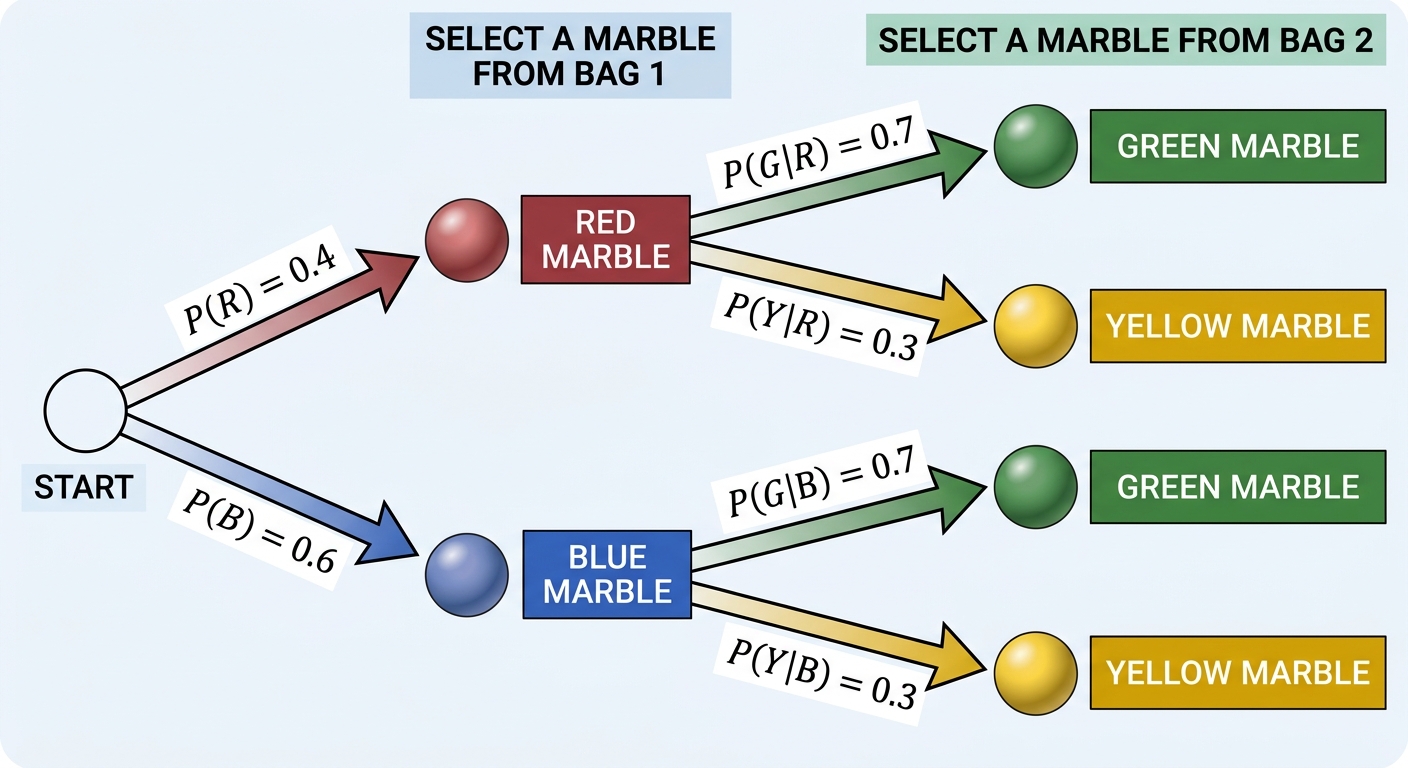
A marble is taken at random from Bag 1, and then a marble is taken at random from Bag 2. The tree diagram shows the probabilities.
Question diagram
(a)
Explain how the tree diagram shows that the colour taken from Bag 2 does not depend on the colour taken from Bag 1. [1]Criterion A (i) · Level 1-2
(b)
Find the probability of taking a red marble and then a green marble. [2]Criterion A (ii) · Level 1-2
(c)
Find the probability that one of the two marbles is yellow. [2]Criterion A (i), A (ii) · Level 3-4
(d)
Find the probability of not taking a blue marble followed by a green marble. [2]Criterion A (i), A (iii) · Level 3-4

revisionprep.com

Summary Answer

Not available for this question.

Model Answer

Not available for this question.

Marking Scheme

Not available for this question.

Examiner Insights

Not available for this question.

Question 3Criterion D + A · Band 1-6 · Medium · 8 marksrevisionprep.com

Defining Independence in Probability

A school canteen sells ice cream in two flavours with one topping each. The orders from one week are shown.

Chocolate with sprinkles: 40
Chocolate with nuts: 60
Vanilla with sprinkles: 30
Vanilla with nuts: 70
(a)
Find the probability that a randomly chosen order is chocolate, and the probability that it has sprinkles. [2]Criterion A (ii) · Level 1-2
(b)
If flavour and topping were independent, find the number of chocolate-with-sprinkles orders the canteen would expect out of 200. [2]Criterion D (ii), D (iii) · Level 3-4
(c)
Compare your answer to (b) with the data, and state whether flavour and topping appear to be independent. [2]Criterion D (iii), D (v) · Level 5-6
(d)
Next term the canteen expects 360 orders and assumes the same proportion will have sprinkles. Find the number of sprinkle portions it should prepare, and justify the degree of accuracy of your answer. [2]Criterion D (iii), D (iv) · Level 5-6

revisionprep.com

Summary Answer

Not available for this question.

Model Answer

Not available for this question.

Marking Scheme

Not available for this question.

Examiner Insights

Not available for this question.

Question 4Criterion A + D · Band 3-6 · Medium · 10 marksrevisionprep.com

Recognising and Modelling Dependent Events
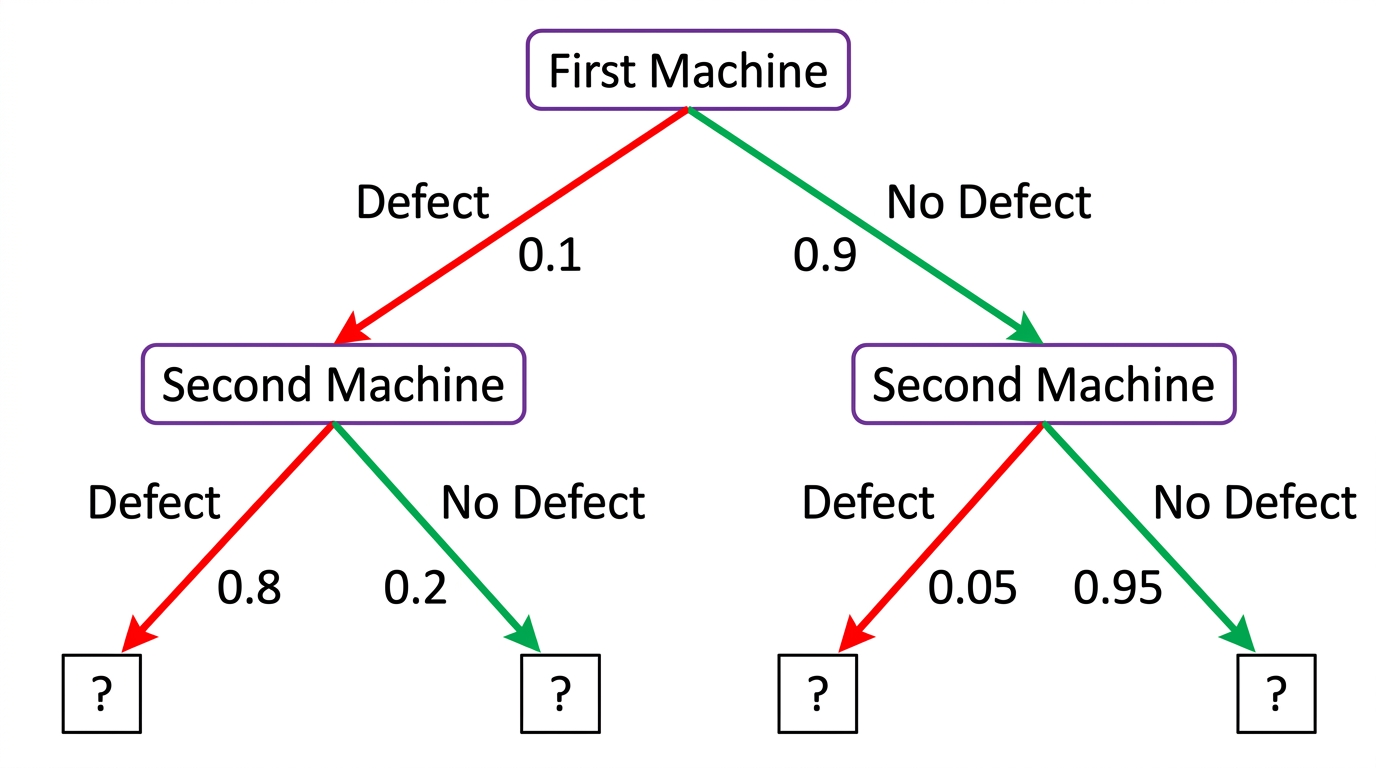
Every component made in a factory passes through two machines. The tree diagram shows the probability that each machine produces a defect. The probability for the second machine depends on what happened at the first machine.
Question diagram
(a)
Find the probability of each of the four outcomes marked ? on the tree diagram. [3]Criterion A (ii) · Level 3-4
(b)
A component is defective if at least one machine produces a defect. Find the probability that a component is defective. [2]Criterion A (i), A (iii) · Level 3-4
(c)
In one shift, 2000 components are made. Estimate the number of defective components. [2]Criterion D (iii) · Level 3-4
(d)
The manager says: "If we repair the first machine so that it never produces a defect, the proportion of defective components will fall below 6%." Justify whether she is right. [2]

(e) Explain what in the tree diagram shows that the defects at the two machines are dependent. [1]
Criterion D (ii), D (v) · Level 5-6

revisionprep.com

Summary Answer

Not available for this question.

Model Answer

Not available for this question.

Marking Scheme

Not available for this question.

Examiner Insights

Not available for this question.

Question 5Criterion B · Band 3-8 · Challenge · 10 marksrevisionprep.com

Defining Independence in Probability

A fair six-sided die is rolled nn times. Let pnp_n be the probability that at least one six is obtained.
(a)
Show that p2=1136p_2 = \dfrac{11}{36}. [2]Criterion B (i) · Level 3-4
(b)
Find p3p_3 and p4p_4, giving each as a fraction and as a decimal correct to 3 decimal places. [2]Criterion B (i) · Level 3-4
(c)
Write down a general rule for pnp_n in terms of nn. [2]Criterion B (ii) · Level 5-6
(d)
Use your rule to find the smallest number of rolls for which pn>0.9p_n > 0.9. [2]

(e) Justify why your rule holds, referring to independence. [2]
Criterion B (iii) · Level 5-6

revisionprep.com

Summary Answer

Not available for this question.

Model Answer

Not available for this question.

Marking Scheme

Not available for this question.

Examiner Insights

Not available for this question.

Question 6Criterion C + A · Band 1-8 · Challenge · 7 marksrevisionprep.com

Real-Life Applications Games Genetics and Decision-Making
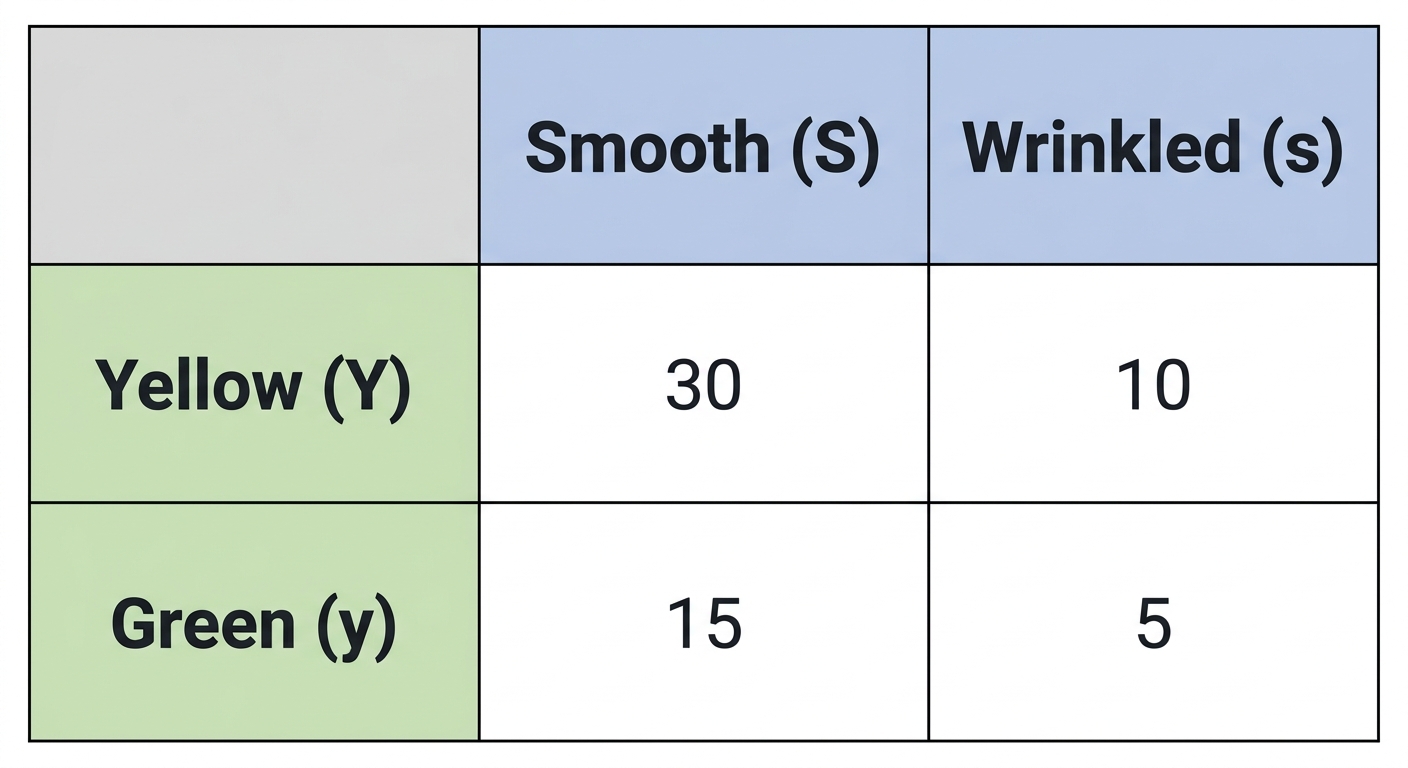
A botanist crossed pea plants and recorded the seed colour and seed texture of 60 offspring. The results are shown in the table.
Question diagram
(a)
Given that a plant has smooth seeds, find the probability that it has yellow seeds. [2]Criterion A (i), A (ii) · Level 3-4
(b)
Find the probability that a plant chosen at random has yellow seeds. [1]Criterion A (ii) · Level 1-2
(c)
Show that P(yellow and smooth)=P(yellow)×P(smooth)P(\text{yellow and smooth}) = P(\text{yellow}) \times P(\text{smooth}). [2]Criterion C (iv) · Level 5-6
(d)
The botanist says: "Knowing that a plant has smooth seeds helps me predict its seed colour." Evaluate this statement. [2]Criterion C (iv), C (v) · Level 7-8

revisionprep.com

Summary Answer

Not available for this question.

Model Answer

Not available for this question.

Marking Scheme

Not available for this question.

Examiner Insights

Not available for this question.

That's every free question here — 6 of 79.

+73 more questions, plus Mock Papers & Worksheets, are waiting in Premium.

Upgrade