You're viewing free preview questions — 4 questions previewing here — subscribe to unlock 113 more, plus the Full Question Bank, Mock Papers & Worksheets.Upgrade
Using Trigonometry in 3D Problems — Free MYP5 Mathematics (Extended) Practice Questions

1QuestionApplications in Architecture and PhysicsAssessment Practice
6 marks~9 minCriterion A
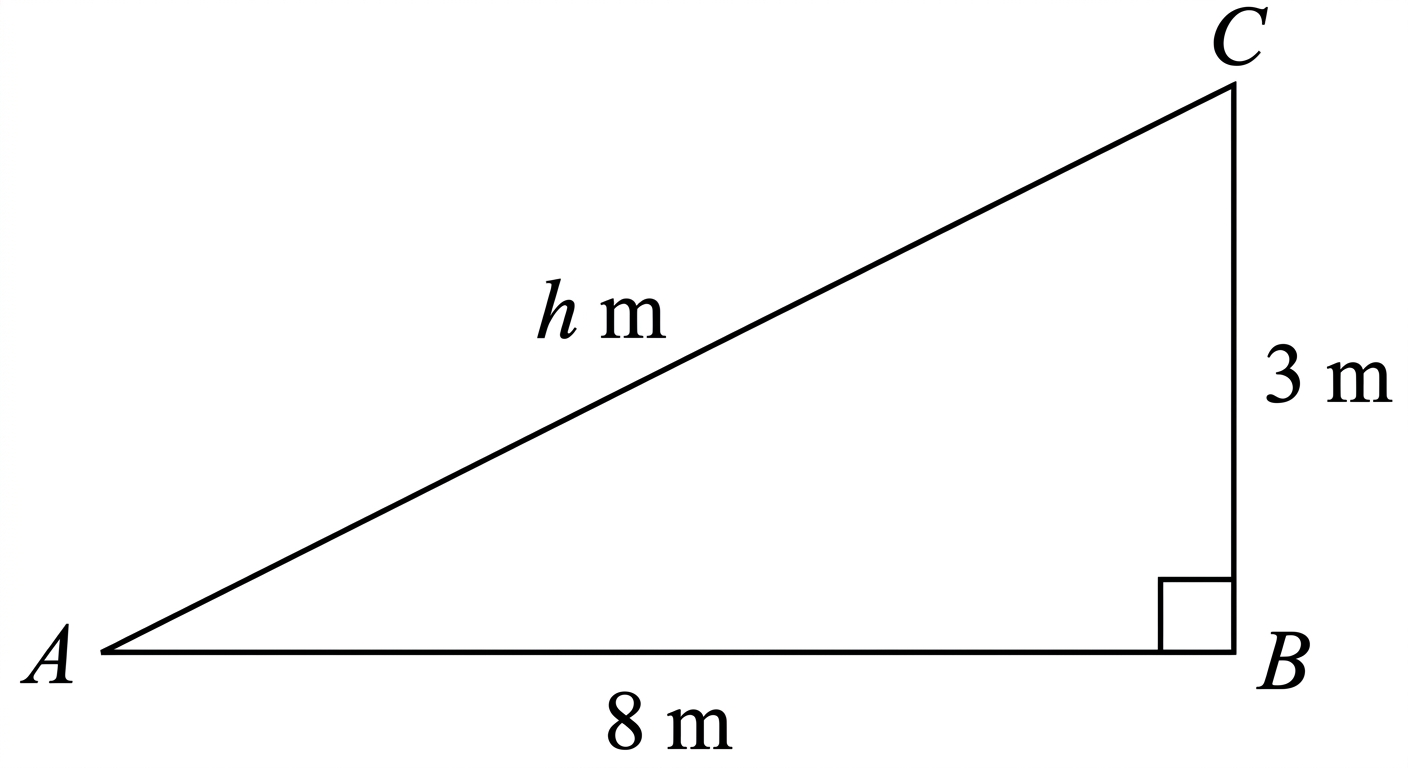
The diagram shows a right-angled triangle representing a roof truss, where . The horizontal span m, the vertical rise m, and the hypotenuse m.
a
Show that . [1]
b
A second roof truss is geometrically similar to the first. Its hypotenuse is m. Find the horizontal span of the second truss, in metres. [2]
c
A third roof truss has the same horizontal span of m but a vertical rise m, where , and a hypotenuse of m. Find the value of and hence justify whether this third truss meets a building regulation requiring a vertical rise of at least m. [3]

Solutions
2QuestionApplications in Architecture and PhysicsAssessment Practice
6 marks~9 minCriterion C
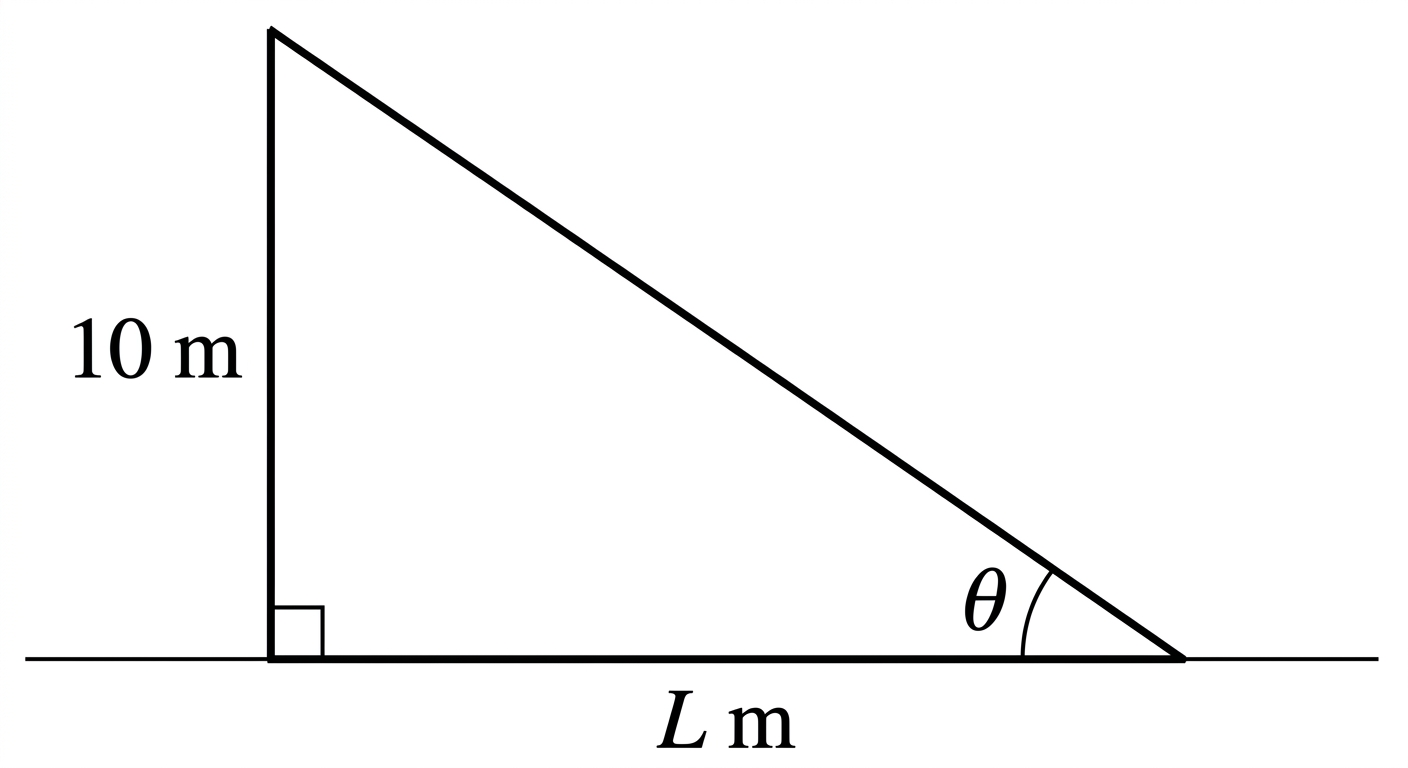
A vertical pole of height 10 m stands on horizontal ground. A sun ray makes an elevation angle with the horizontal, casting a shadow of length metres along the ground.
The ratio is defined as
The ratio is defined as
a
Write down the value of when . [1]
b
Calculate to 3 significant figures for each elevation angle in the table below.
Elevation angle (degrees): 30, 40, 50, 60
Shadow length (m): 17.32, 11.92, 8.39, 5.77
: ?, ?, ?, ? [2]
Elevation angle (degrees): 30, 40, 50, 60
Shadow length (m): 17.32, 11.92, 8.39, 5.77
: ?, ?, ?, ? [2]
c
A student claims that for any elevation angle . Justify this claim using your completed table, and hence deduce whether the model is reliable enough to predict shadow behaviour at for a solar panel alignment system that requires predictions accurate to 3 significant figures. [3]
Solutions
3QuestionApplications in Architecture and PhysicsAssessment Practice
9 marks~14 minCriterion B
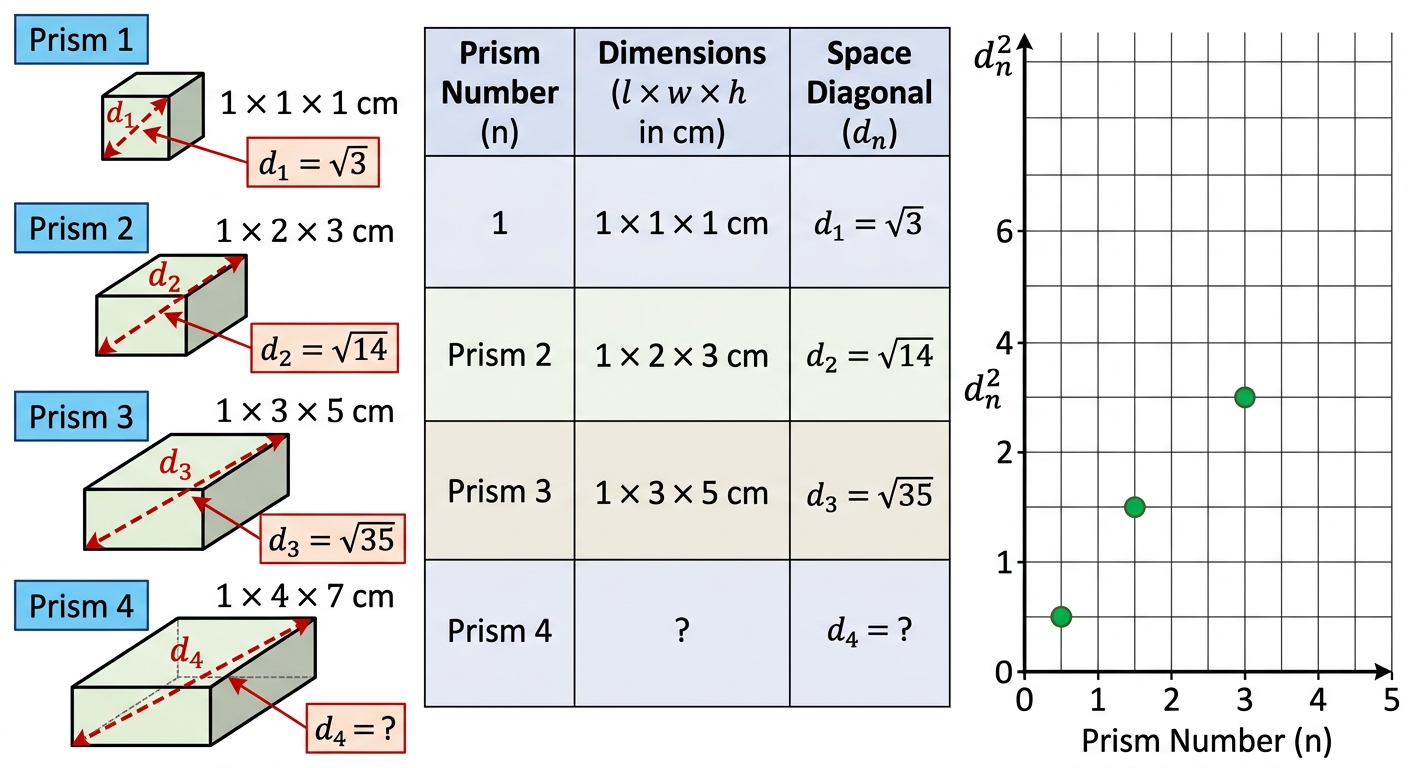
The table shows the dimensions and space diagonal lengths for a sequence of rectangular prisms.
The space diagonal of a rectangular prism with dimensions , , is given by
| Prism number | 1 | 2 | 3 | 4 |
|---|---|---|---|---|
| Dimensions (cm) | ||||
| Space diagonal (cm) |
The space diagonal of a rectangular prism with dimensions , , is given by
a
Calculate the exact value of , the space diagonal of Prism 4. Give your answer in the form , where is an integer. [2]
b
Deduce a rule for , the space diagonal of Prism , in the form
where , , and are integers. State the values of , , and . [3]
where , , and are integers. State the values of , , and . [3]
c
Verify your rule for Prism 3. Hence justify why the expression under the square root must be a quadratic function of for every prism in this sequence, referring to the structure of the dimensions. [4]
Solutions
4QuestionApplications in Architecture and PhysicsAssessment Practice
9 marks~14 minCriterion D
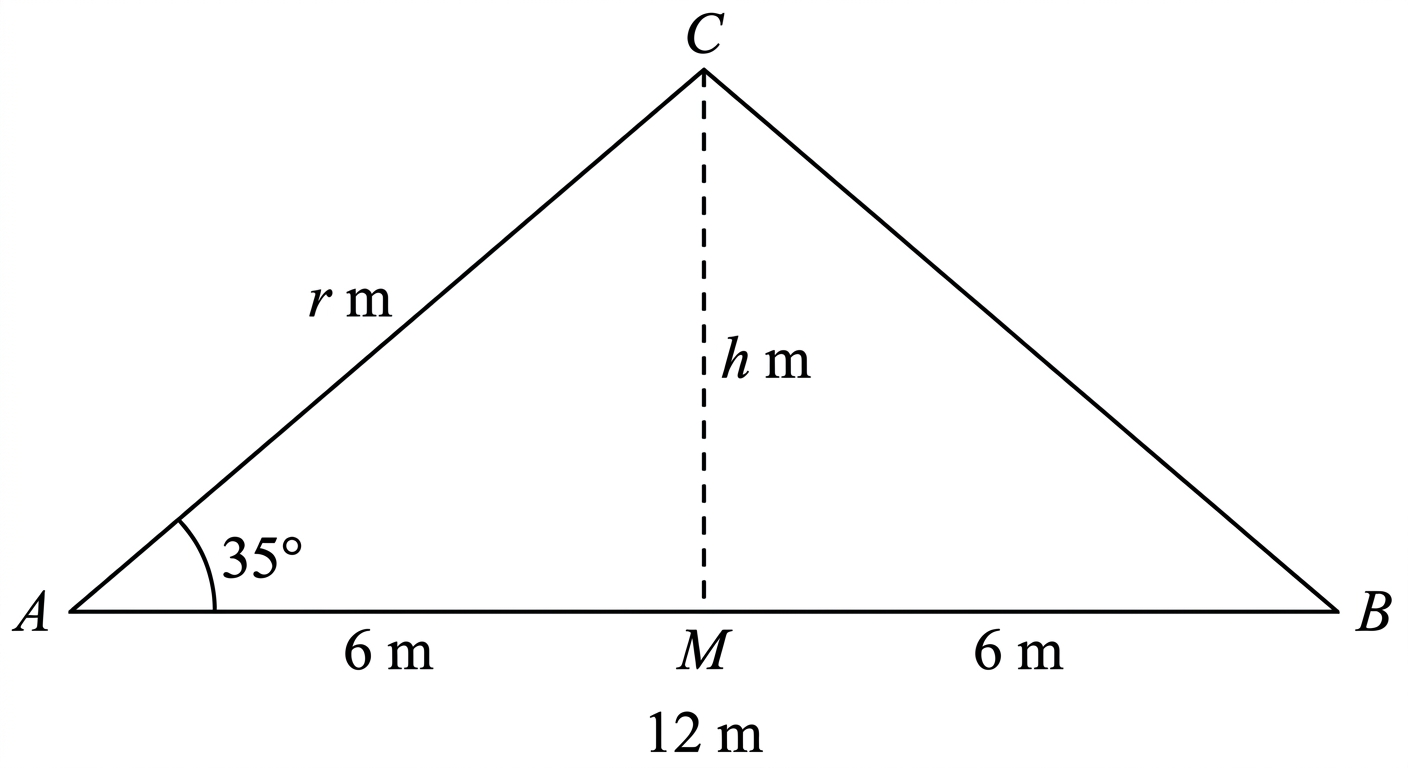
An architect is designing a roof truss for a community centre. The truss forms an isosceles triangle in a vertical plane with a horizontal base of 12 m. The pitch angle (the angle between the base and each sloping rafter) is . The ridge height above the base is m and each rafter has length m.
a
Show that , and hence calculate to 3 significant figures. Give your answer in metres. [2]
b
Find the rafter length to 3 significant figures. Give your answer in metres. [2]
The architect uses the linear model to predict the height (in metres) at horizontal distance metres from the left support. After construction, three on-site measurements are taken.
(m): 3, 6, 9
Predicted (m): 2.10, 4.20, 6.30
Measured height (m): 2.61, 4.88, 7.43
The architect uses the linear model to predict the height (in metres) at horizontal distance metres from the left support. After construction, three on-site measurements are taken.
(m): 3, 6, 9
Predicted (m): 2.10, 4.20, 6.30
Measured height (m): 2.61, 4.88, 7.43
c
Calculate the percentage error at m, using
Give your answer to 1 decimal place. [2]
Give your answer to 1 decimal place. [2]
d
Assess whether the linear model is suitable for use in the final construction drawings, referring to the percentage errors at all three values of and giving one reason why the measured heights may differ from the model predictions. [3]
Solutions
That's every free question here — 4 of 117.
+113 more questions, plus Mock Papers & Worksheets, are waiting in Premium.