You're viewing free preview questions — 4 questions previewing here — subscribe to unlock 77 more, plus the Full Question Bank, Mock Papers & Worksheets.Upgrade
Combined Transformations 2 — Free MYP5 Mathematics (Extended) Practice Questions

1QuestionDescribing Combined Transformations in Real-Life ContextsConcept Practice
2 marks~3 minCriterion A
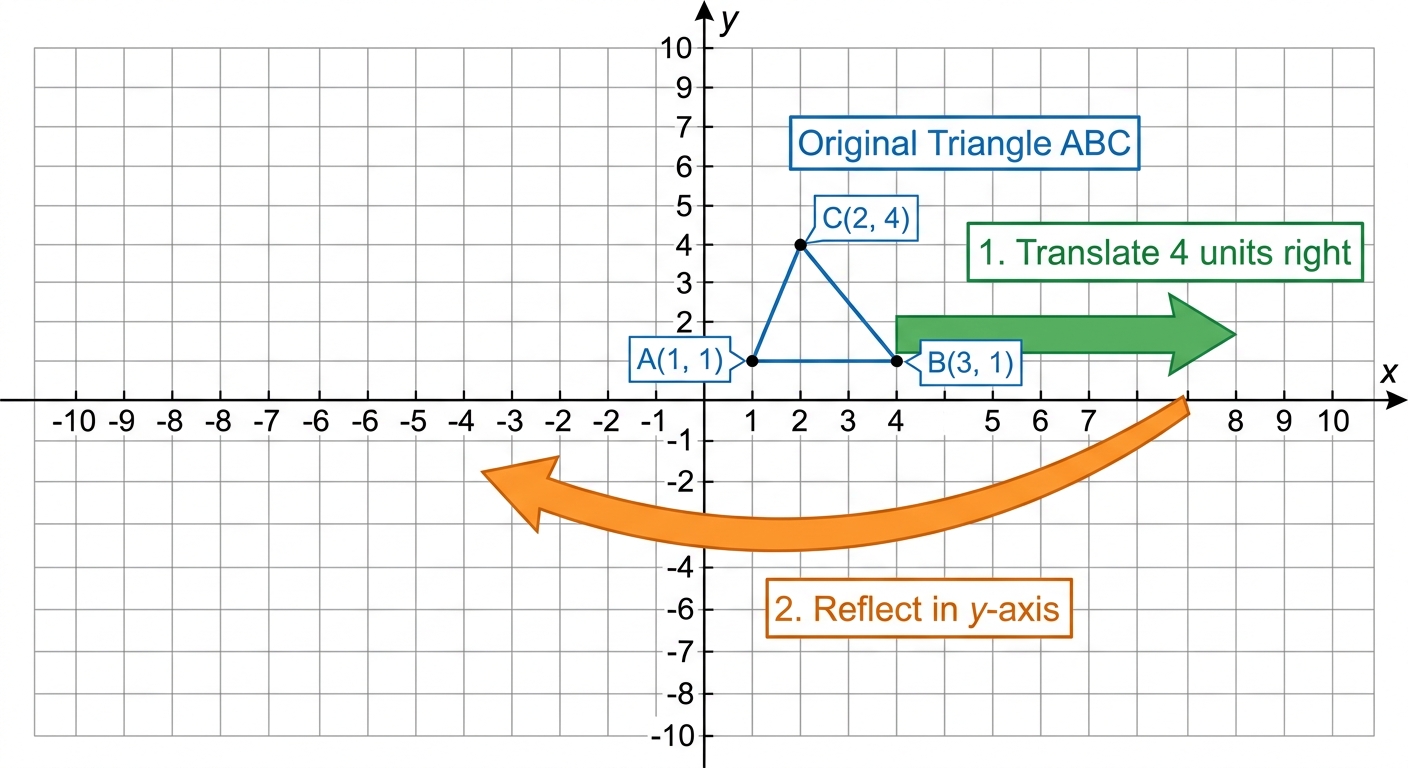
A graphic designer is positioning a logo on a digital canvas. The logo is modelled by triangle with vertices , , and .
The designer applies two transformations in sequence:
The designer applies two transformations in sequence:
1
Translate the triangle 4 units to the right.
2
Reflect the translated triangle in the -axis.
The canvas has a vertical centre line along the -axis.
Determine the final coordinates of vertex after both transformations, and justify whether the designer's requirement that lands in the negative -region is met. [2]
The canvas has a vertical centre line along the -axis.
Determine the final coordinates of vertex after both transformations, and justify whether the designer's requirement that lands in the negative -region is met. [2]

Solutions
2QuestionDescribing Combined Transformations in Real-Life ContextsAssessment Practice
2 marks~3 minCriterion C
A graphic designer maps a logo element using triangle with vertices , , and . The triangle is reflected in the -axis and then translated by the vector to produce triangle .
Identify one geometric property that is preserved under this combined transformation, and justify why both rigid transformations guarantee this property is unchanged. [2]
Identify one geometric property that is preserved under this combined transformation, and justify why both rigid transformations guarantee this property is unchanged. [2]
Solutions
3QuestionDescribing Combined Transformations in Real-Life ContextsAssessment Practice
2 marks~3 minCriterion D
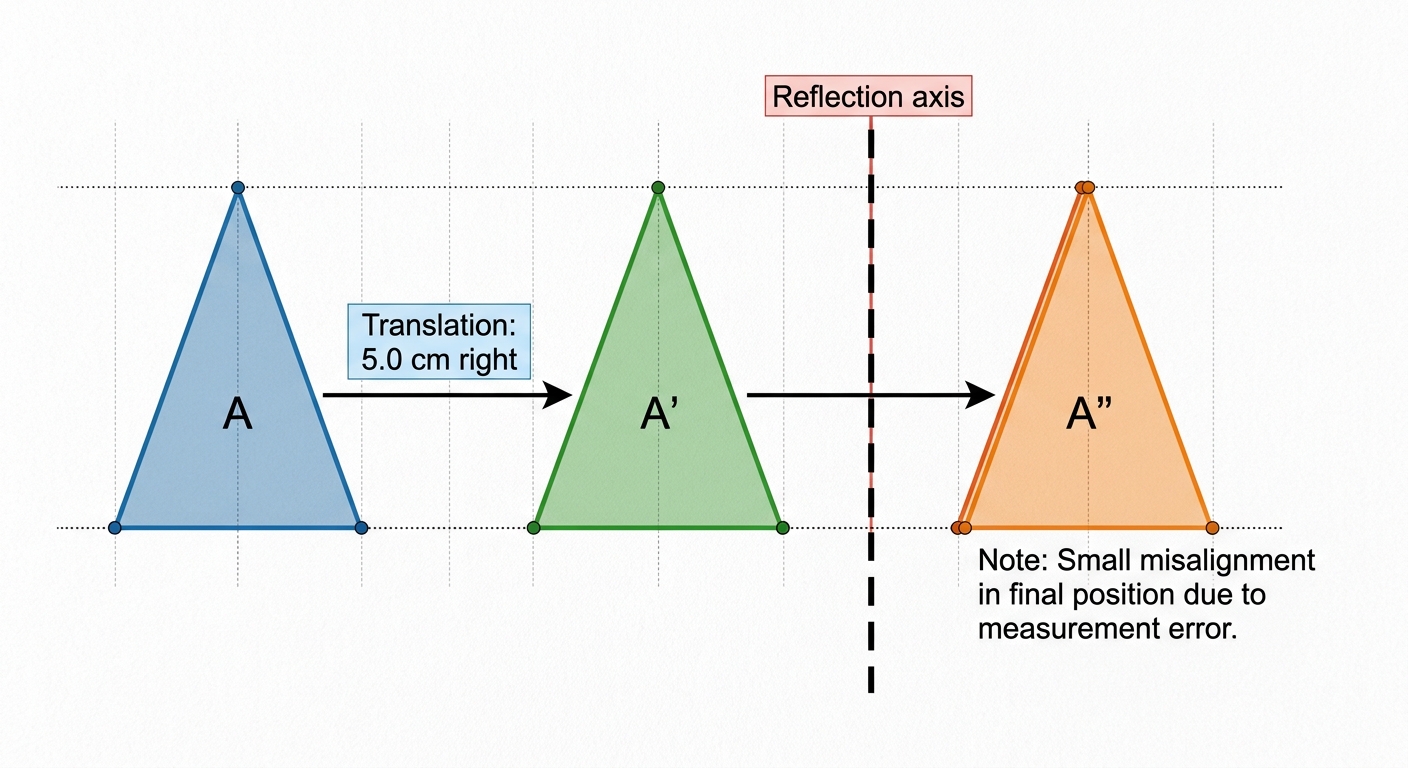
A graphic designer applies a translation of to the right to a triangular logo element, then reflects it across a vertical line of symmetry to produce a mirrored pattern.
a
Describe one real-world context, other than logo design, in which a translation followed by a reflection is used to create a symmetrical pattern. [1]
b
The designer measures the translation distance imprecisely. Explain how this error affects the symmetry of the final pattern. [1]
Solutions
4QuestionDescribing Combined Transformations in Real-Life ContextsAssessment Practice
6 marks~9 minCriterion B
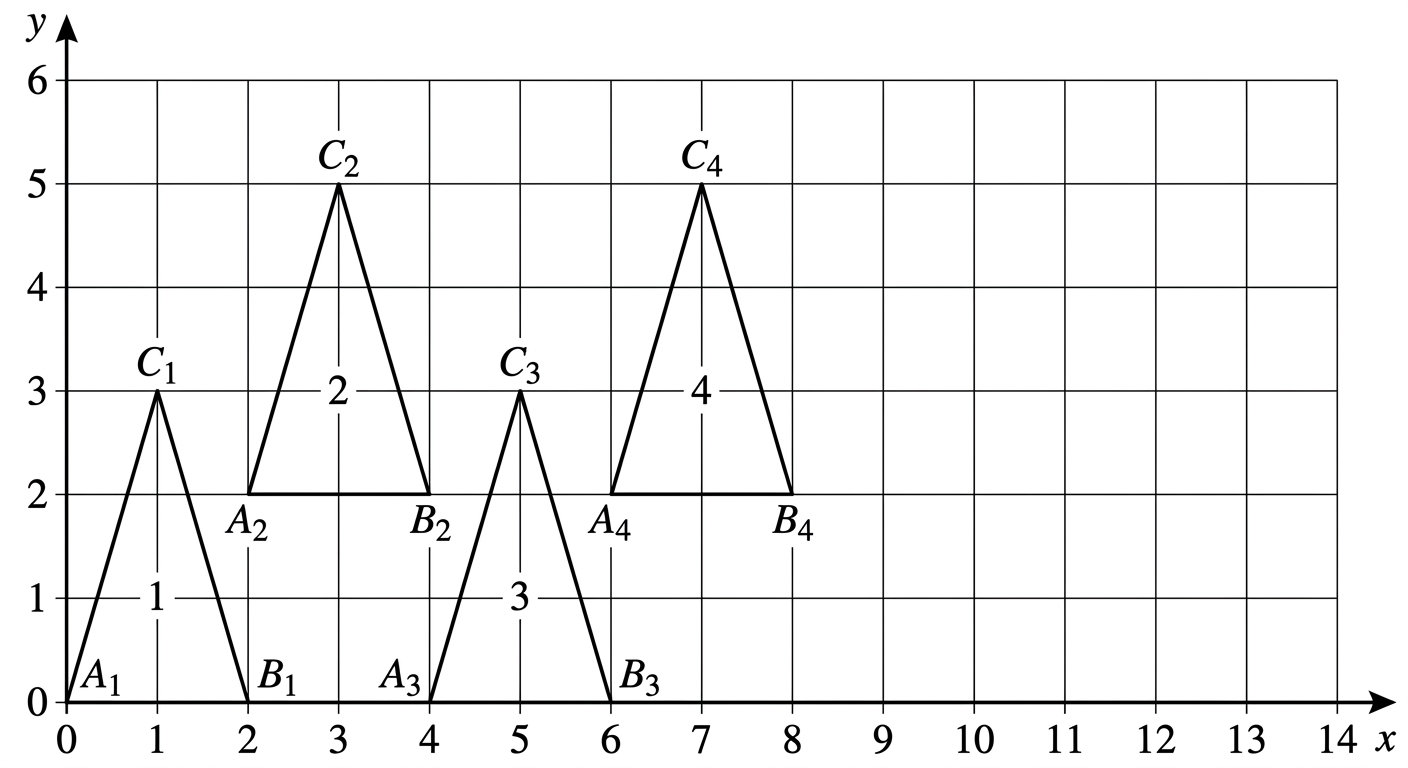
A graphic designer uses a repeating tile pattern. A triangle with vertices , , is transformed repeatedly to produce a sequence of images.
| Image 1 | |||
|---|---|---|---|
| Image 2 | |||
| Image 3 | |||
| Image 4 |
a
Construct Image 5 and Image 6 on the coordinate grid provided. Describe the pattern you observe in the sequence. [2]
b
Deduce the general rule for the transformation that maps each image to the next, expressing it as a combination of translations. [2]
c
The designer considers extending the tile pattern using a new triangle with vertices , , . Apply your rule to find the vertices after one transformation, then justify whether this new triangle would produce a valid repeating tile pattern consistent with the original sequence. [2]
Solutions
That's every free question here — 4 of 81.
+77 more questions, plus Mock Papers & Worksheets, are waiting in Premium.