You're viewing free preview questions — 6 questions previewing here — subscribe to unlock 147 more, plus the Full Question Bank, Mock Papers & Worksheets.Upgrade
Back

Combined transformations: successive and single equivalent — Free MYP5 Mathematics (Extended) Practice Questions

Free questions

Open in full, with answers, mark scheme and examiner insights.

Question 1Criterion A · Band 1-4 · Easy · 6 marksrevisionprep.com

Matrix Representation of Translations

Triangle ABCABC has A(1,1)A(1, 1), B(4,1)B(4, 1) and C(4,3)C(4, 3). A point (x,y)(x, y) can be written as (xy1)\begin{pmatrix} x \\ y \\ 1 \end{pmatrix}, so that a translation by (ab)\begin{pmatrix} a \\ b \end{pmatrix} has the 3×33 \times 3 matrix T(a,b)=(10a01b001)T(a, b) = \begin{pmatrix} 1 & 0 & a \\ 0 & 1 & b \\ 0 & 0 & 1 \end{pmatrix}.
(a)
Write down T(2,3)T(2, 3) and T(−5,1)T(-5, 1). [1]Criterion A (i) · Level 1-2
(b)
Find T(−5,1)T(2,3)T(-5, 1)T(2, 3) and describe the transformation it represents. [3]Criterion A (ii) · Level 3-4
(c)
Write down the images of AA, BB and CC under the product. [1]Criterion A (ii) · Level 1-2
(d)
Write down the 3×33 \times 3 matrix that maps the image back to ABCABC. [1]Criterion A (iii) · Level 3-4

revisionprep.com

Summary Answer

Not available for this question.

Model Answer

Not available for this question.

Marking Scheme

Not available for this question.

Examiner Insights

Not available for this question.

Question 2Criterion A · Band 1-6 · Medium · 7 marksrevisionprep.com

Using Matrices for Simple Transformations Introductory
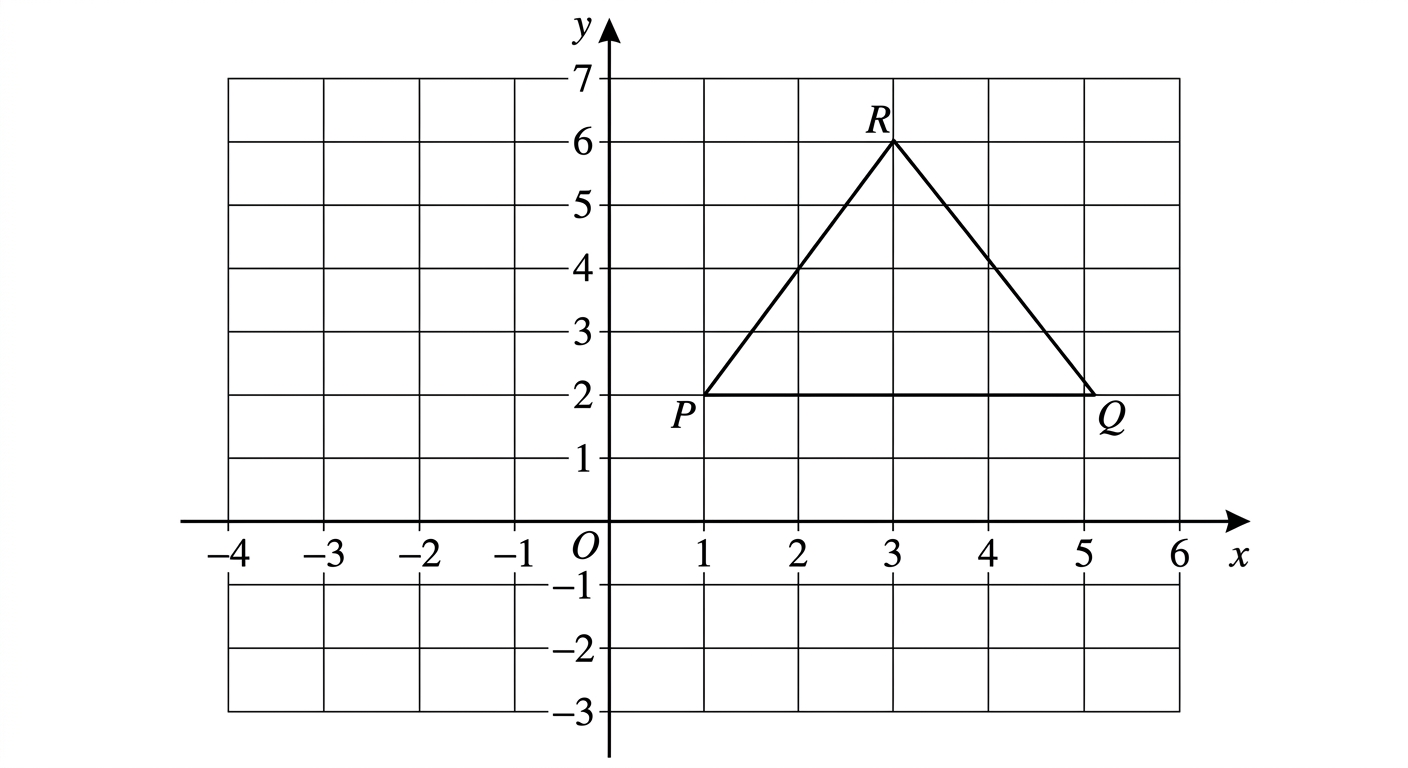
The diagram shows triangle PQRPQR with P(1,2)P(1, 2), Q(5,2)Q(5, 2) and R(3,6)R(3, 6). It is enlarged with centre the origin and scale factor −12-\tfrac{1}{2}.
Question diagram
(a)
Write down the matrix of this enlargement. [1]Criterion A (i) · Level 1-2
(b)
Find the coordinates of P′P', Q′Q' and R′R'. [2]Criterion A (ii) · Level 3-4
(c)
Find the area of triangle P′Q′R′P'Q'R'. [2]Criterion A (ii), A (iii) · Level 3-4
(d)
Triangle P′Q′R′P'Q'R' is then mapped by (−200−2)\begin{pmatrix} -2 & 0 \\ 0 & -2 \end{pmatrix}. Find the single matrix for the two steps and describe its effect. [2]Criterion A (iii) · Level 5-6

revisionprep.com

Summary Answer

Not available for this question.

Model Answer

Not available for this question.

Marking Scheme

Not available for this question.

Examiner Insights

Not available for this question.

Question 3Criterion A · Band 1-6 · Medium · 8 marksrevisionprep.com

Using Matrices for Simple Transformations Introductory
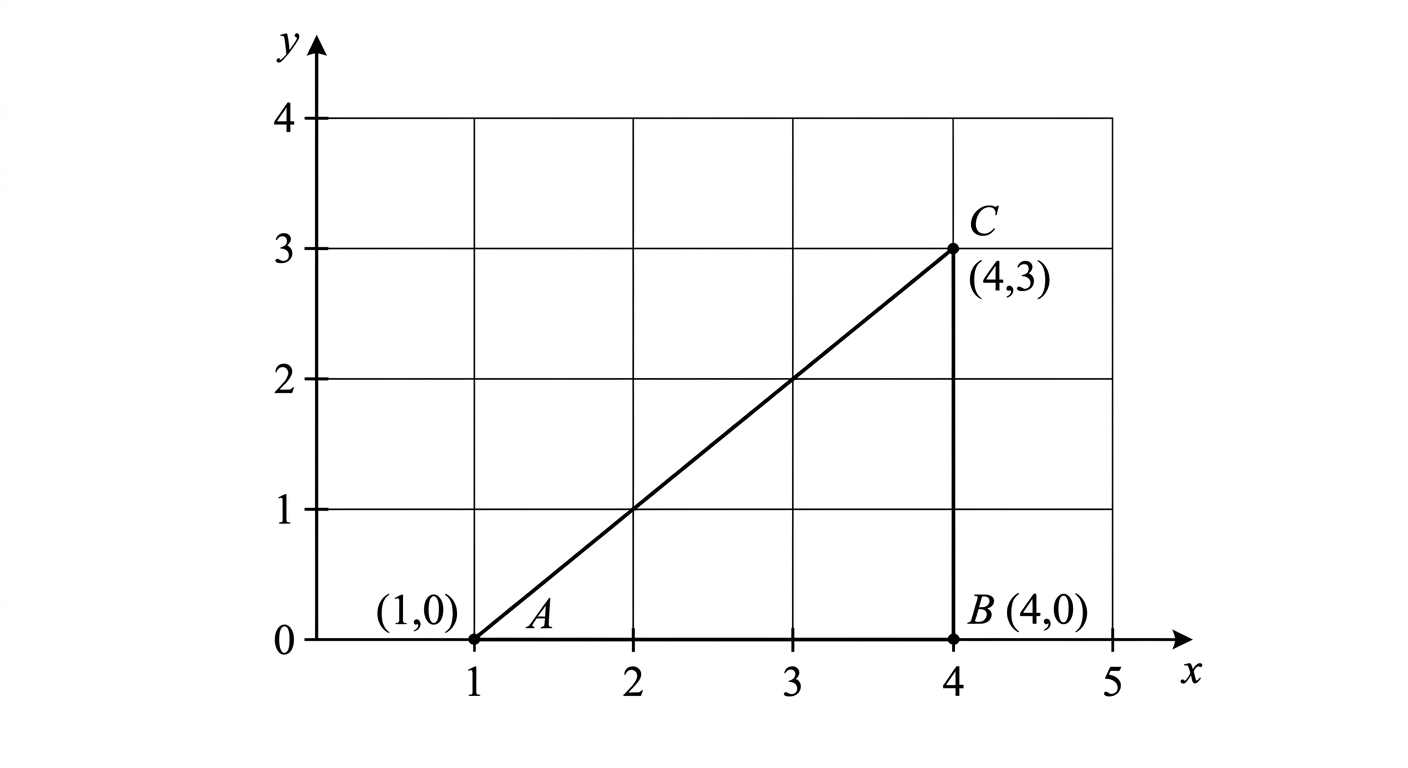
The diagram shows triangle ABCABC with A(1,0)A(1, 0), B(4,0)B(4, 0) and C(4,3)C(4, 3).
Question diagram
(a)
Write down the matrix RR that represents a rotation of 90∘90^\circ anticlockwise about the origin. [1]Criterion A (i) · Level 1-2
(b)
Use RR to find the coordinates of A′A', B′B' and C′C', the images of AA, BB and CC. [2]Criterion A (ii) · Level 3-4
(c)
Triangle A′B′C′A'B'C' is then reflected in the line y=xy = x. Find the single matrix that represents the rotation followed by the reflection. [3]Criterion A (i), A (ii) · Level 5-6
(d)
Identify the single transformation represented by your matrix in (c), and verify it using the point CC. [2]Criterion A (iii) · Level 5-6

revisionprep.com

Summary Answer

Not available for this question.

Model Answer

Not available for this question.

Marking Scheme

Not available for this question.

Examiner Insights

Not available for this question.

Question 4Criterion C · Band 3-6 · Medium · 6 marksrevisionprep.com

Applying Successive Transformations

Triangle ABCABC has A(1,2)A(1, 2), B(4,2)B(4, 2) and C(3,5)C(3, 5). It is rotated 90∘90^\circ clockwise about the origin and the image is then reflected in the yy-axis.
(a)
Find the images of AA, BB and CC after each step. [2]Criterion C (ii) · Level 3-4
(b)
Find the single matrix for the two steps. [2]Criterion C (i) · Level 3-4
(c)
Malik says the final triangle is the reflection of ABCABC in the line y=xy = x. Use your results to show that he is wrong, and state the correct mirror line. [2]Criterion C (iv), C (v) · Level 5-6

revisionprep.com

Summary Answer

Not available for this question.

Model Answer

Not available for this question.

Marking Scheme

Not available for this question.

Examiner Insights

Not available for this question.

Question 5Criterion A + C · Band 3-6 · Medium · 11 marksrevisionprep.com

Applying Successive Transformations

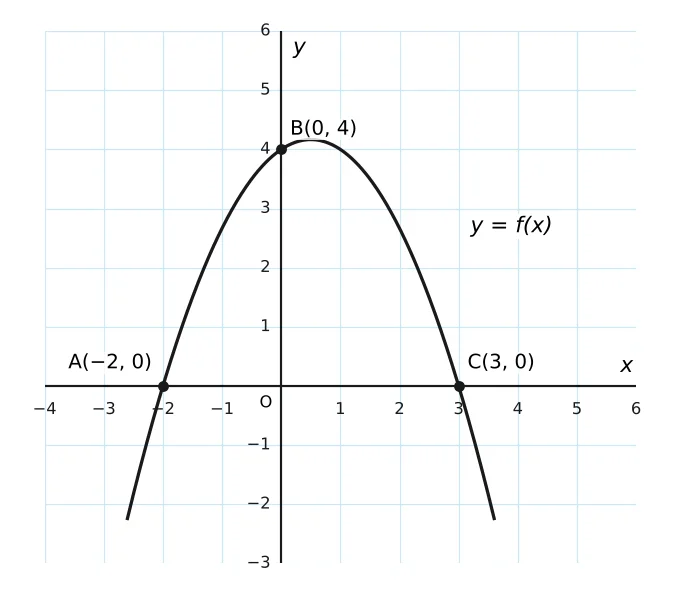
The diagram shows the graph of y=f(x)y = f(x), which passes through A(−2,0)A(-2, 0), B(0,4)B(0, 4) and C(3,0)C(3, 0). The graph is reflected in the yy-axis and the image is then translated by the vector (3−2)\begin{pmatrix} 3 \\ -2 \end{pmatrix}.
Question diagram
(a)
Find the images of AA, BB and CC. [3]Criterion A (ii) · Level 3-4
(b)
Show that the final image has equation y=f(3−x)−2y = f(3 - x) - 2. [2]Criterion A (ii), A (iii) · Level 5-6
(c)
Write down the coordinates of the points where the final image meets the line y=−2y = -2, and state how they are related to AA and CC. [2]Criterion A (iii) · Level 5-6
(d)
The two transformations are now applied in the other order. Find the image of BB, and hence explain why the final graph is different. [2]

(e) Show that the original combination is the same as a reflection in the line x=1.5x = 1.5 followed by a translation by (0−2)\begin{pmatrix} 0 \\ -2 \end{pmatrix}. [2]
Criterion C (iv) · Level 5-6

revisionprep.com

Summary Answer

Not available for this question.

Model Answer

Not available for this question.

Marking Scheme

Not available for this question.

Examiner Insights

Not available for this question.

Question 6Criterion A + C · Band 3-6 · Medium · 10 marksrevisionprep.com

Identifying Single Equivalent Transformation

R1R_{1} is a rotation of 90∘90^\circ clockwise about the origin OO. R2R_{2} is a rotation of 90∘90^\circ clockwise about the point (2,0)(2, 0). The notation R2∘R1R_{2} \circ R_{1} means R1R_{1} is applied first and then R2R_{2}.
(a)
Write down R1(x,y)R_{1}(x, y), and show that R2(x,y)=(y+2,2−x)R_{2}(x, y) = (y + 2, 2 - x). [3]Criterion A (i), A (ii) · Level 3-4
(b)
Find (R2∘R1)(x,y)(R_{2} \circ R_{1})(x, y) and hence describe fully the single transformation equivalent to R2∘R1R_{2} \circ R_{1}. [3]Criterion A (iii) · Level 5-6
(c)
Find (R1∘R2)(x,y)(R_{1} \circ R_{2})(x, y) and describe fully the single transformation it represents. [2]Criterion A (iii) · Level 5-6
(d)
Explain why both combinations turn shapes through the same angle, yet are not the same transformation. [2]Criterion C (iv) · Level 5-6

revisionprep.com

Summary Answer

Not available for this question.

Model Answer

Not available for this question.

Marking Scheme

Not available for this question.

Examiner Insights

Not available for this question.

Question 7Criterion D · Band 3-8 · Challenge · 9 marksrevisionprep.com

Using Matrices for Simple Transformations Introductory
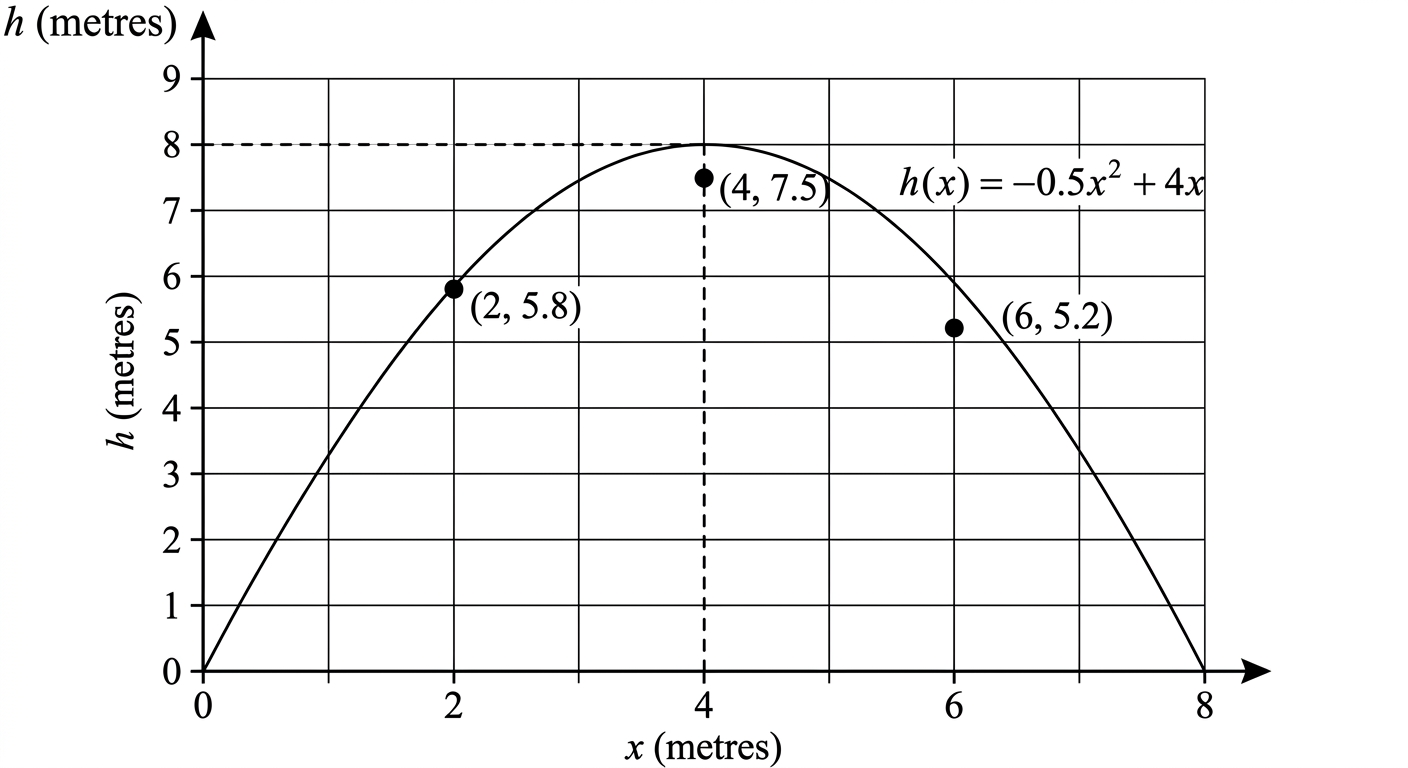
A mobile game models the first bounce of a ball by h(x)=−0.5x2+4xh(x) = -0.5x^{2} + 4x for 0≤x≤80 \le x \le 8, where hh is the height in metres and xx the horizontal distance in metres. The diagram shows the model with three heights measured in testing. Each later bounce is the image of the previous one under the transformation TT: an enlargement with centre the origin and scale factor 0.50.5, followed by a translation by (80)\begin{pmatrix} 8 \\ 0 \end{pmatrix}.
Question diagram
(a)
Show that the second bounce has equation h2(x)=−(x−8)(x−12)h_{2}(x) = -(x - 8)(x - 12) for 8≤x≤128 \le x \le 12. [3]Criterion D (ii) · Level 5-6
(b)
Find the maximum height of the second bounce and where it lands. [2]Criterion D (iii) · Level 3-4
(c)
Testing measured heights of 5.85.8 m, 7.57.5 m and 5.25.2 m at x=2x = 2, 44 and 66. Find the largest difference between the model and the measurements, and justify the degree of accuracy to which the model's heights should be quoted. [2]Criterion D (iv) · Level 5-6
(d)
Under TT, the bounces land at x=8,12,14,…x = 8, 12, 14, \ldots Determine whether the ball ever passes x=16x = 16 m in this model, and comment on whether this makes sense for a real ball. [2]Criterion D (v) · Level 7-8

revisionprep.com

Summary Answer

Not available for this question.

Model Answer

Not available for this question.

Marking Scheme

Not available for this question.

Examiner Insights

Not available for this question.

Question 8Criterion B · Band 3-8 · Challenge · 8 marksrevisionprep.com

Identifying Single Equivalent Transformation

A horizontal stretch with scale factor 1k\tfrac{1}{k} maps the curve y=f(x)y = f(x) to y=f(kx)y = f(kx); a vertical stretch with scale factor aa maps it to y=af(x)y = af(x).
(a)
For f(x)=x2f(x) = x^{2}, x3x^{3} and x4x^{4}, write f(2x)f(2x) as a multiple of f(x)f(x). [2]Criterion B (i) · Level 3-4
(b)
State a rule for the single vertical stretch equivalent to the horizontal stretch with scale factor 1k\tfrac{1}{k} applied to y=xny = x^{n}. [2]Criterion B (ii) · Level 5-6
(c)
Prove your rule. [2]Criterion B (iii) · Level 7-8
(d)
Show that for y=x2+1y = x^{2} + 1 no vertical stretch is equivalent to the horizontal stretch with scale factor 12\tfrac{1}{2}. [2]Criterion B (iii) · Level 7-8

revisionprep.com

Summary Answer

Not available for this question.

Model Answer

Not available for this question.

Marking Scheme

Not available for this question.

Examiner Insights

Not available for this question.

Question 9Criterion B · Band 3-8 · Challenge · 10 marksrevisionprep.com

Identifying Single Equivalent Transformation

A point is reflected in one mirror line through the origin and the image is then reflected in a second mirror line through the origin. The point (2,1)(2, 1) is used to test three pairs of mirrors:

Pair 1the xx-axisthen y=xy = x
Pair 2the yy-axisthen y=xy = x
Pair 3the xx-axisthen the yy-axis


For reflections M1M_{1} and M2M_{2}, the notation M2∘M1M_{2} \circ M_{1} means M1M_{1} is applied first and then M2M_{2}.
(a)
For each pair, find the final image of (2,1)(2, 1) and describe the single rotation about the origin that maps (2,1)(2, 1) to that image. [3]Criterion B (i) · Level 3-4
(b)
For each pair, write down the angle between the two mirror lines. Describe the pattern linking this angle to the angle of rotation, and state it as a general rule. [2]Criterion B (ii) · Level 5-6
(c)
Use your rule to predict the single transformation for a reflection in y=xy = x followed by a reflection in y=−xy = -x. Verify your prediction with the point (2,1)(2, 1). [2]Criterion B (iii) · Level 5-6
(d)
Let R=M2∘M1R = M_{2} \circ M_{1} be the single rotation for any two of these mirrors. Using the fact that every reflection is self-inverse, prove that M1∘M2=R−1M_{1} \circ M_{2} = R^{-1}. Hence state the single transformation for a reflection in y=xy = x followed by a reflection in the xx-axis. [3]Criterion B (iii) · Level 7-8

revisionprep.com

Summary Answer

Not available for this question.

Model Answer

Not available for this question.

Marking Scheme

Not available for this question.

Examiner Insights

Not available for this question.

That's every free question here — 6 of 153.

+147 more questions, plus Mock Papers & Worksheets, are waiting in Premium.

Upgrade