You're viewing free preview questions — 6 questions previewing here — subscribe to unlock 145 more, plus the Full Question Bank, Mock Papers & Worksheets.Upgrade
Back

Vector Representation and Notation — Free MYP5 Mathematics (Extended) Practice Questions

Free questions

Open in full, with answers, mark scheme and examiner insights.

Question 1Criterion D · Band 1-6 · Medium · 8 marksrevisionprep.com

Understanding Vectors as Arrows with Direction and Magnitude
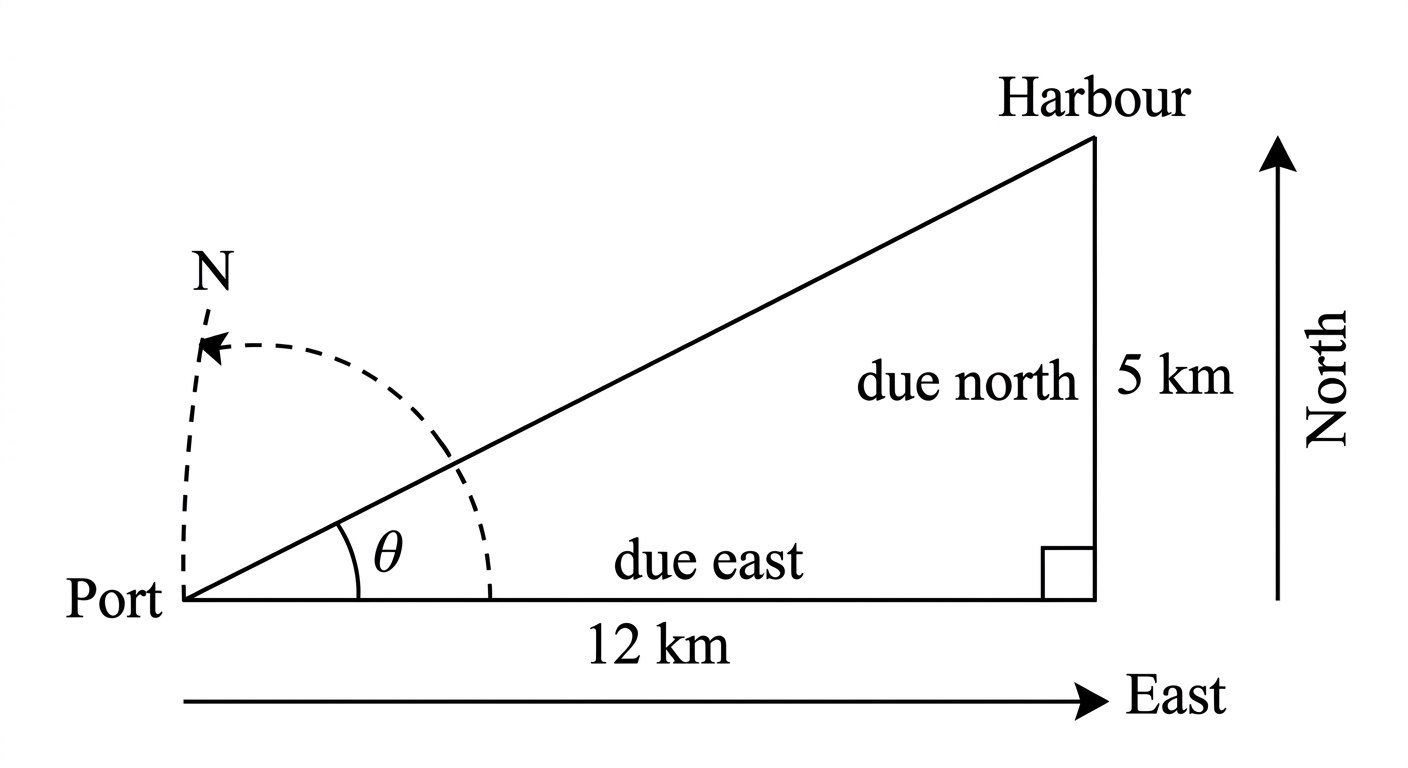
A ship's GPS records its displacement from port to harbour as 1212 km due east and 55 km due north, as shown in the diagram. Each component has an uncertainty of ±0.5\pm 0.5 km.
Question diagram
(a)
Write down the displacement vector d\mathbf{d} and find ∣d∣\lvert \mathbf{d} \rvert. [2]Criterion D (i), D (iii) · Level 1-2
(b)
Find the angle θ\theta and the bearing of the harbour from the port, to the nearest degree. [2]Criterion D (ii), D (iii) · Level 3-4
(c)
Find the least and greatest possible distances from port to harbour, to 3 significant figures. [2]Criterion D (ii), D (iii) · Level 5-6
(d)
The captain reports the distance as 13.013.0 km. Justify whether this degree of accuracy is appropriate. [2]Criterion D (iv) · Level 5-6

revisionprep.com

Summary Answer

Not available for this question.

Model Answer

Not available for this question.

Marking Scheme

Not available for this question.

Examiner Insights

Not available for this question.

Question 2Criterion A · Band 1-6 · Medium · 8 marksrevisionprep.com

Column Vector Notation

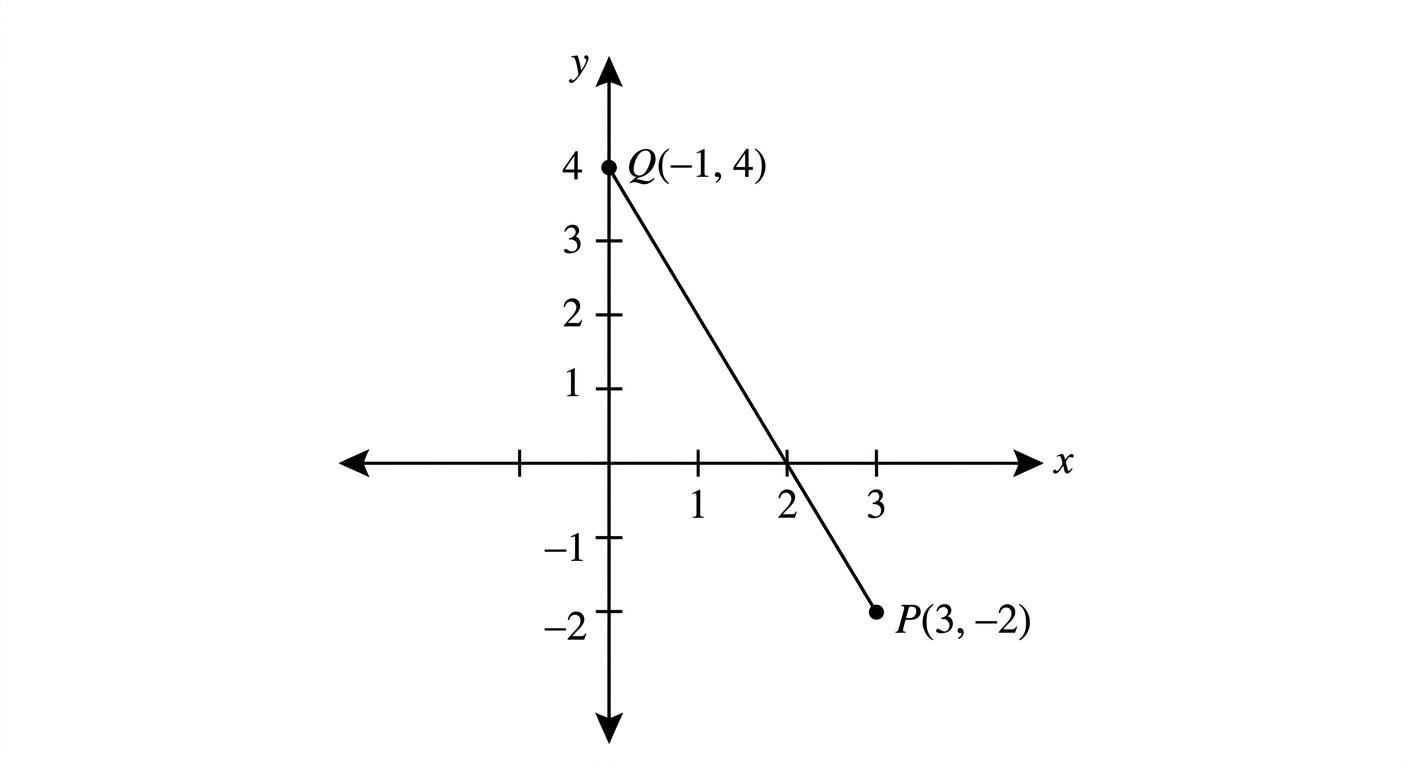
The diagram shows points P(3,−2)P(3, -2) and Q(−1,4)Q(-1, 4) joined by a line segment.
Question diagram
(a)
Write down PQ→\overrightarrow{PQ} as a column vector. [1]Criterion A (i) · Level 1-2
(b)
Show that PQ→\overrightarrow{PQ} is parallel to (2−3)\begin{pmatrix} 2 \\ -3 \end{pmatrix}, and state whether they point in the same direction. [2]Criterion A (ii) · Level 3-4
(c)
Find the coordinates of the midpoint MM of PQPQ, using PM→=12PQ→\overrightarrow{PM} = \tfrac{1}{2}\overrightarrow{PQ}. [2]Criterion A (ii) · Level 3-4
(d)
The point RR is such that QR→=(62)\overrightarrow{QR} = \begin{pmatrix} 6 \\ 2 \end{pmatrix}. Determine whether ∣PR→∣=∣PQ→∣\lvert \overrightarrow{PR} \rvert = \lvert \overrightarrow{PQ} \rvert, and describe triangle PQRPQR. [3]Criterion A (iii) · Level 5-6

revisionprep.com

Summary Answer

Not available for this question.

Model Answer

Not available for this question.

Marking Scheme

Not available for this question.

Examiner Insights

Not available for this question.

Question 3Criterion A + C · Band 1-6 · Medium · 8 marksrevisionprep.com

Representing Vectors in Diagrams and Coordinates
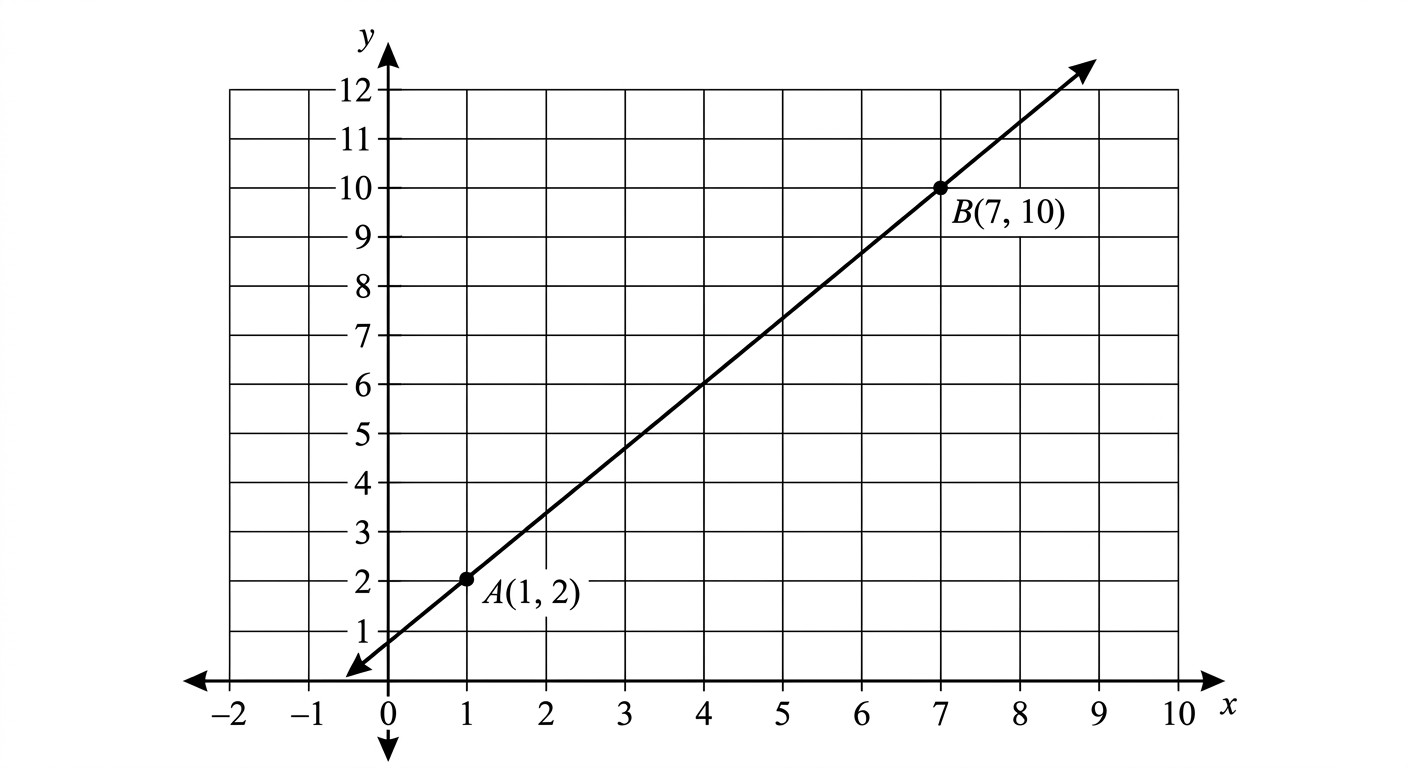
The diagram shows the straight line through A(1,2)A(1, 2) and B(7,10)B(7, 10). Every point PP on the line has position vector OP→=OA→+tAB→\overrightarrow{OP} = \overrightarrow{OA} + t\overrightarrow{AB} for some number tt.
Question diagram
(a)
Write down AB→\overrightarrow{AB}, and the points given by t=0t = 0, t=1t = 1 and t=12t = \tfrac{1}{2}. [2]Criterion A (i), A (ii) · Level 1-2
(b)
Find the value of tt for the point (4,6)(4, 6), and for the point (−2,−2)(-2, -2). [2]Criterion A (ii) · Level 3-4
(c)
State the values of tt that give the points between AA and BB, and describe where the points with t<0t < 0 lie. [2]Criterion C (i), C (iv) · Level 5-6
(d)
Determine whether the point (19,27)(19, 27) lies on the line. [2]Criterion A (iii) · Level 5-6

revisionprep.com

Summary Answer

Not available for this question.

Model Answer

Not available for this question.

Marking Scheme

Not available for this question.

Examiner Insights

Not available for this question.

Question 4Criterion C · Band 3-6 · Medium · 7 marksrevisionprep.com

Notation and Labelling for Displacement Vectors

Points PP, QQ and RR are such that PQ→=(25)\overrightarrow{PQ} = \begin{pmatrix} 2 \\ 5 \end{pmatrix} and QR→=(−41)\overrightarrow{QR} = \begin{pmatrix} -4 \\ 1 \end{pmatrix}.
(a)
Write in correct notation: (i) the vector from QQ to PP; (ii) the length of the segment PRPR. Explain the difference between PR→\overrightarrow{PR} and PRPR. [3]Criterion C (i), C (iv) · Level 3-4
(b)
Find PR→\overrightarrow{PR}, RP→\overrightarrow{RP} and QP→\overrightarrow{QP}. [2]Criterion C (i) · Level 3-4
(c)
When writing by hand, a vector v\mathbf{v} printed in bold is written as v‾\underline{v}. Explain why some mark must be added in handwriting, and find ∣PR→∣\lvert \overrightarrow{PR} \rvert in exact form using correct notation. [2]Criterion C (i), C (iv) · Level 5-6

revisionprep.com

Summary Answer

Not available for this question.

Model Answer

Not available for this question.

Marking Scheme

Not available for this question.

Examiner Insights

Not available for this question.

Question 5Criterion B · Band 1-8 · Challenge · 8 marksrevisionprep.com

Unit Vectors and Position Vectors (Introductory)
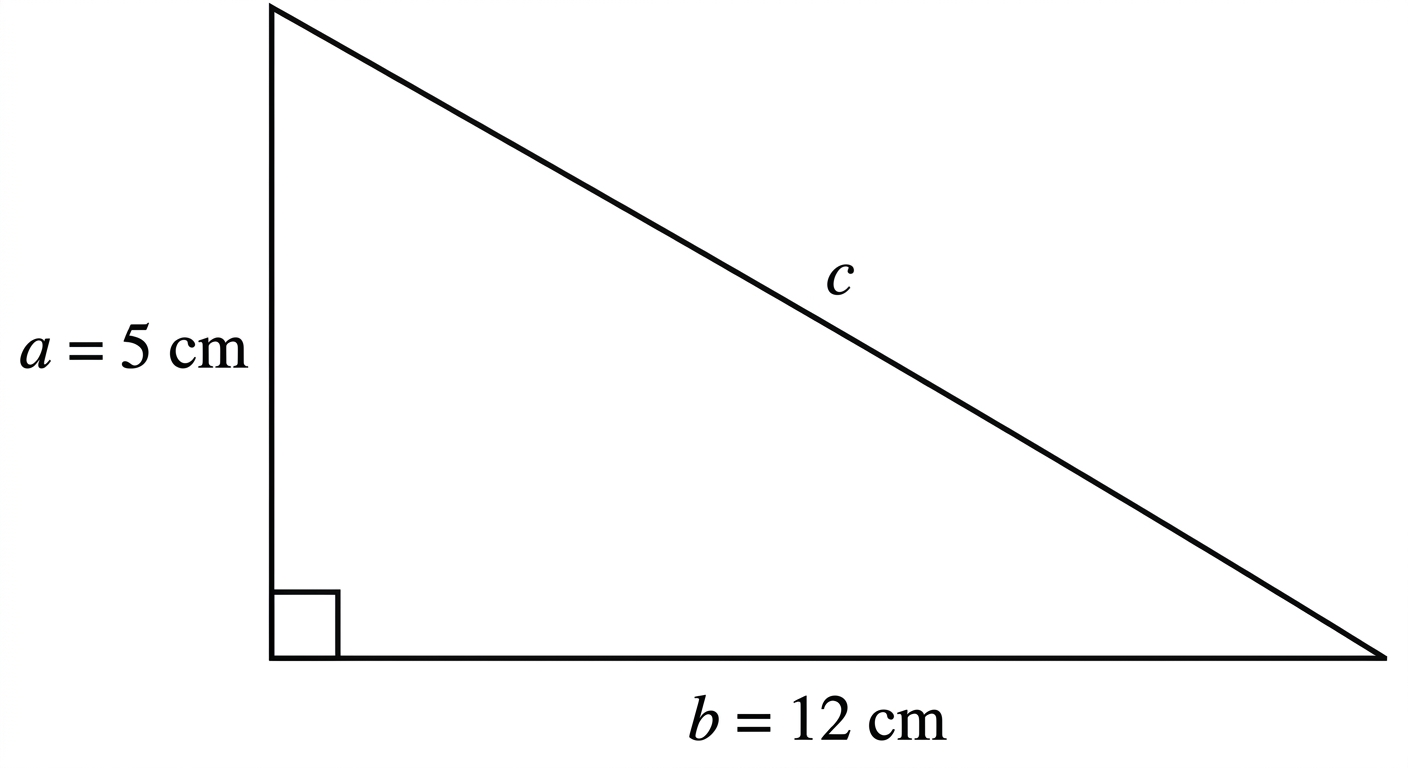
The diagram shows a right-angled triangle with legs a=5a = 5 cm and b=12b = 12 cm. Placing it on axes gives the vector (512)\begin{pmatrix} 5 \\ 12 \end{pmatrix} along the hypotenuse. Vectors with whole-number components and whole-number magnitude give unit vectors with rational components.
Question diagram
(a)
Find cc, and the unit vector in the direction of (512)\begin{pmatrix} 5 \\ 12 \end{pmatrix}. [2]Criterion B (i) · Level 1-2
(b)
For whole numbers m>n>0m > n > 0, let v=(m2−n22mn)\mathbf{v} = \begin{pmatrix} m^{2} - n^{2} \\ 2mn \end{pmatrix}. Find v\mathbf{v} and ∣v∣\lvert \mathbf{v} \rvert for (m,n)=(2,1)(m, n) = (2, 1), (3,2)(3, 2) and (4,1)(4, 1). [2]Criterion B (i) · Level 3-4
(c)
Describe the pattern in ∣v∣\lvert \mathbf{v} \rvert, and prove that it holds for all mm and nn. [3]Criterion B (ii), B (iii) · Level 7-8
(d)
Hence write down a unit vector with rational components whose first component is 725\tfrac{7}{25}. [1]Criterion B (ii) · Level 5-6

revisionprep.com

Summary Answer

Not available for this question.

Model Answer

Not available for this question.

Marking Scheme

Not available for this question.

Examiner Insights

Not available for this question.

Question 6Criterion A + C · Band 1-8 · Challenge · 9 marksrevisionprep.com

Unit Vectors and Position Vectors (Introductory)
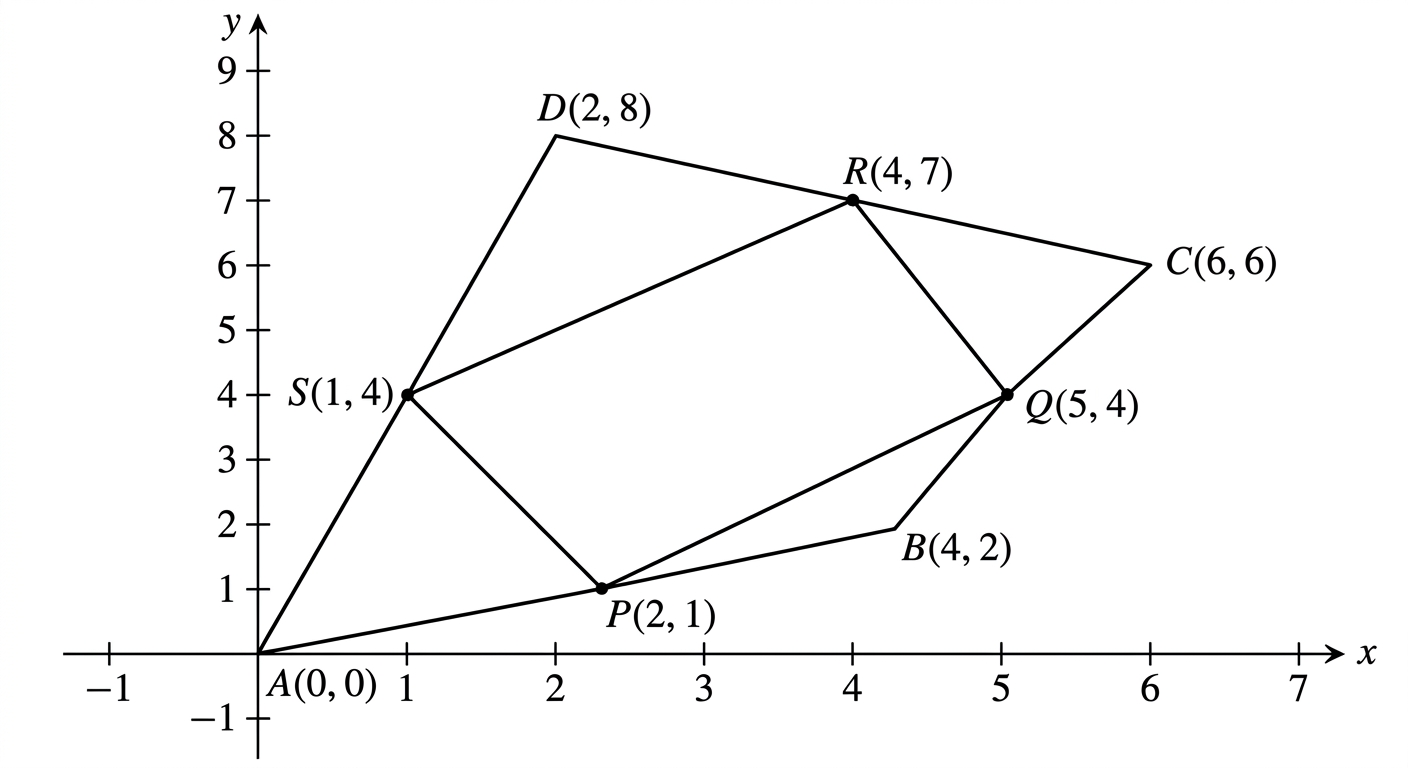
The diagram shows quadrilateral ABCDABCD with A(0,0)A(0, 0), B(4,2)B(4, 2), C(6,6)C(6, 6) and D(2,8)D(2, 8). PP, QQ, RR and SS are the midpoints of ABAB, BCBC, CDCD and DADA.
Question diagram
(a)
Use position vectors to find the position vectors of PP, QQ, RR and SS. [2]Criterion A (ii) · Level 1-2
(b)
Find PQ→\overrightarrow{PQ} and SR→\overrightarrow{SR}, and hence state what type of quadrilateral PQRSPQRS is. [3]Criterion A (ii), A (iii) · Level 3-4
(c)
For a general quadrilateral with vertices of position vectors a\mathbf{a}, b\mathbf{b}, c\mathbf{c}, d\mathbf{d}, prove that PQ→=SR→=12(c−a)\overrightarrow{PQ} = \overrightarrow{SR} = \tfrac{1}{2}(\mathbf{c} - \mathbf{a}), and hence that PQRSPQRS is always a parallelogram. [4]Criterion C (iv), C (v) · Level 7-8

revisionprep.com

Summary Answer

Not available for this question.

Model Answer

Not available for this question.

Marking Scheme

Not available for this question.

Examiner Insights

Not available for this question.

That's every free question here — 6 of 151.

+145 more questions, plus Mock Papers & Worksheets, are waiting in Premium.

Upgrade