You're viewing free preview questions — 6 questions previewing here — subscribe to unlock 37 more, plus the Full Question Bank, Mock Papers & Worksheets.Upgrade
Back

Special Identities and Common Patterns — Free MYP5 Mathematics (Standard) Practice Questions

Free questions

Open in full, with answers, mark scheme and examiner insights.

Question 1Criterion A + C · Band 1-4 · Easy · 4 marksrevisionprep.com

Perfect Square Identities

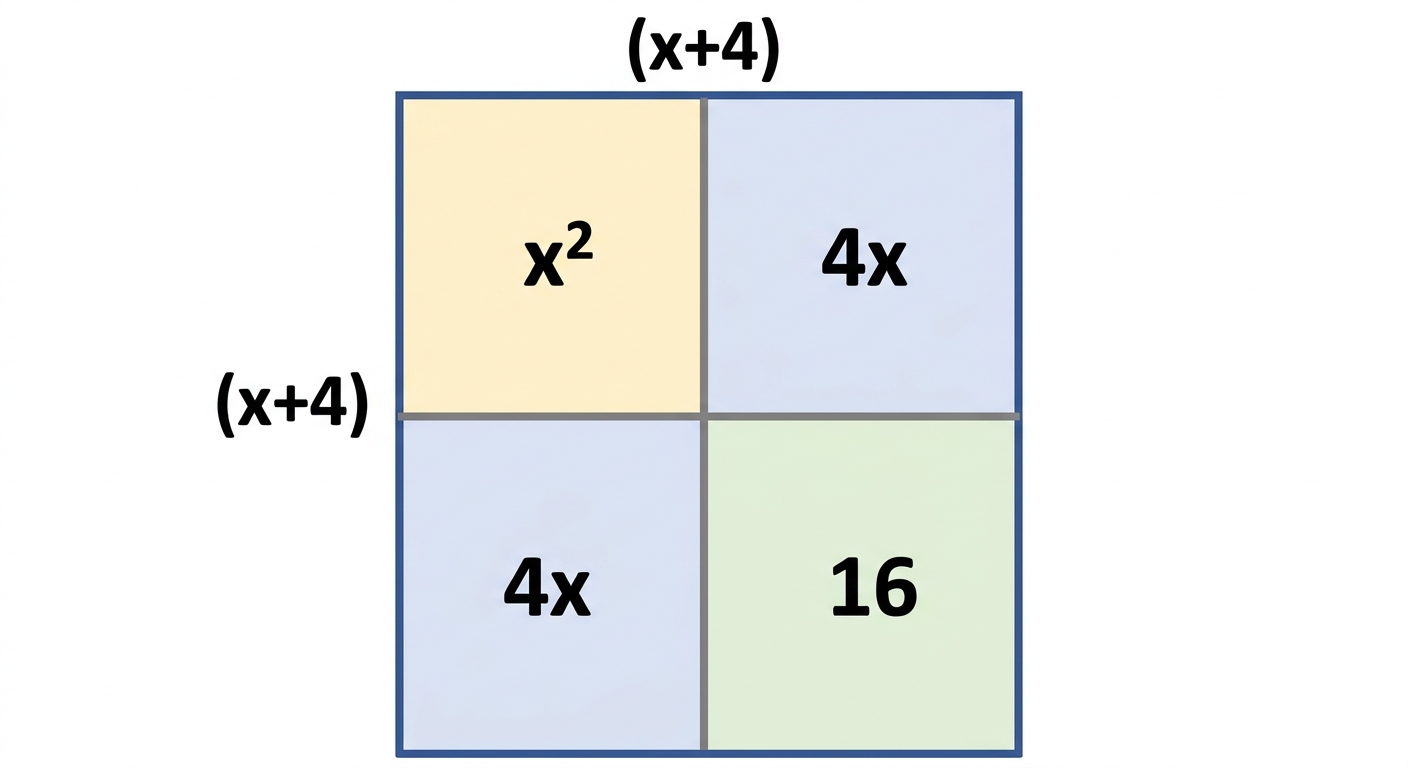
The diagram shows a square tile of side (x+4)(x+4) cm divided into four rectangles. The area of each rectangle, in cm², is written on it.
Question diagram
(a)
Write down an expression for the area of the whole tile as the square of a binomial. [1]Criterion A (i) · Level 1-2
(b)
Write down the sum of the four areas, simplified. [1]Criterion A (ii) · Level 1-2
(c)
Leo writes (x+4)2=x2+16(x+4)^2 = x^2 + 16. Use the diagram to explain the error in Leo's statement. [2]Criterion C (iii), C (iv) · Level 3-4

revisionprep.com

Summary Answer

Not available for this question.

Model Answer

Not available for this question.

Marking Scheme

Not available for this question.

Examiner Insights

Not available for this question.

Question 2Criterion A · Band 3-4 · Easy · 6 marksrevisionprep.com

Recognising and Using Identities in Problems

Do not use a calculator in this question. For each part, state which special identity you use, then evaluate.
(a)
61261^2 [2]Criterion A (i), A (ii) · Level 3-4
(b)
61×5961 \times 59 [2]Criterion A (i), A (ii) · Level 3-4
(c)
612−59261^2 - 59^2 [2]Criterion A (i), A (ii) · Level 3-4

revisionprep.com

Summary Answer

Not available for this question.

Model Answer

Not available for this question.

Marking Scheme

Not available for this question.

Examiner Insights

Not available for this question.

Question 3Criterion C + A · Band 3-6 · Medium · 6 marksrevisionprep.com

Perfect Square Identities

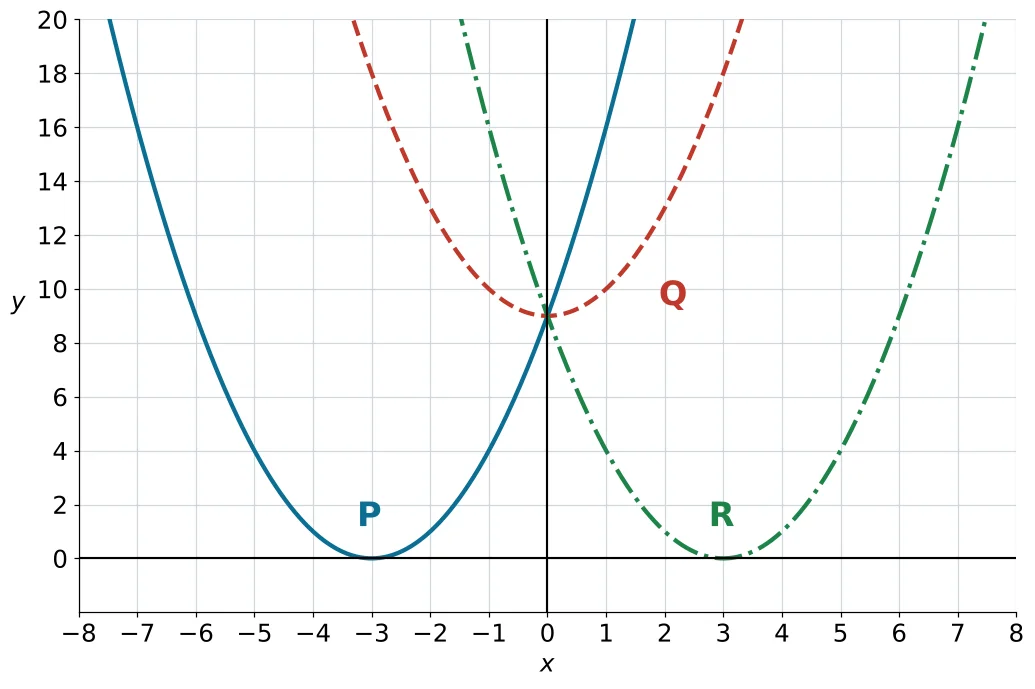
The diagram shows the graphs P, Q and R of three quadratic functions. Their equations, in no particular order, are

y=x2−6x+9,y=x2+6x+9,y=x2+9y = x^2 - 6x + 9, \quad y = x^2 + 6x + 9, \quad y = x^2 + 9
Question diagram
(a)
Factorise x2−6x+9x^2 - 6x + 9 and x2+6x+9x^2 + 6x + 9. [2]Criterion A (ii) · Level 3-4
(b)
Hence match each equation to graph P, Q or R. Justify each choice. [3]Criterion C (iii), C (iv) · Level 5-6
(c)
Explain why the graph of y=x2+9y = x^2 + 9 does not meet the xx-axis. [1]Criterion C (iv) · Level 3-4

revisionprep.com

Summary Answer

Not available for this question.

Model Answer

Not available for this question.

Marking Scheme

Not available for this question.

Examiner Insights

Not available for this question.

Question 4Criterion D + A · Band 1-6 · Medium · 7 marksrevisionprep.com

Deriving Identities from Expansion and Factorisation
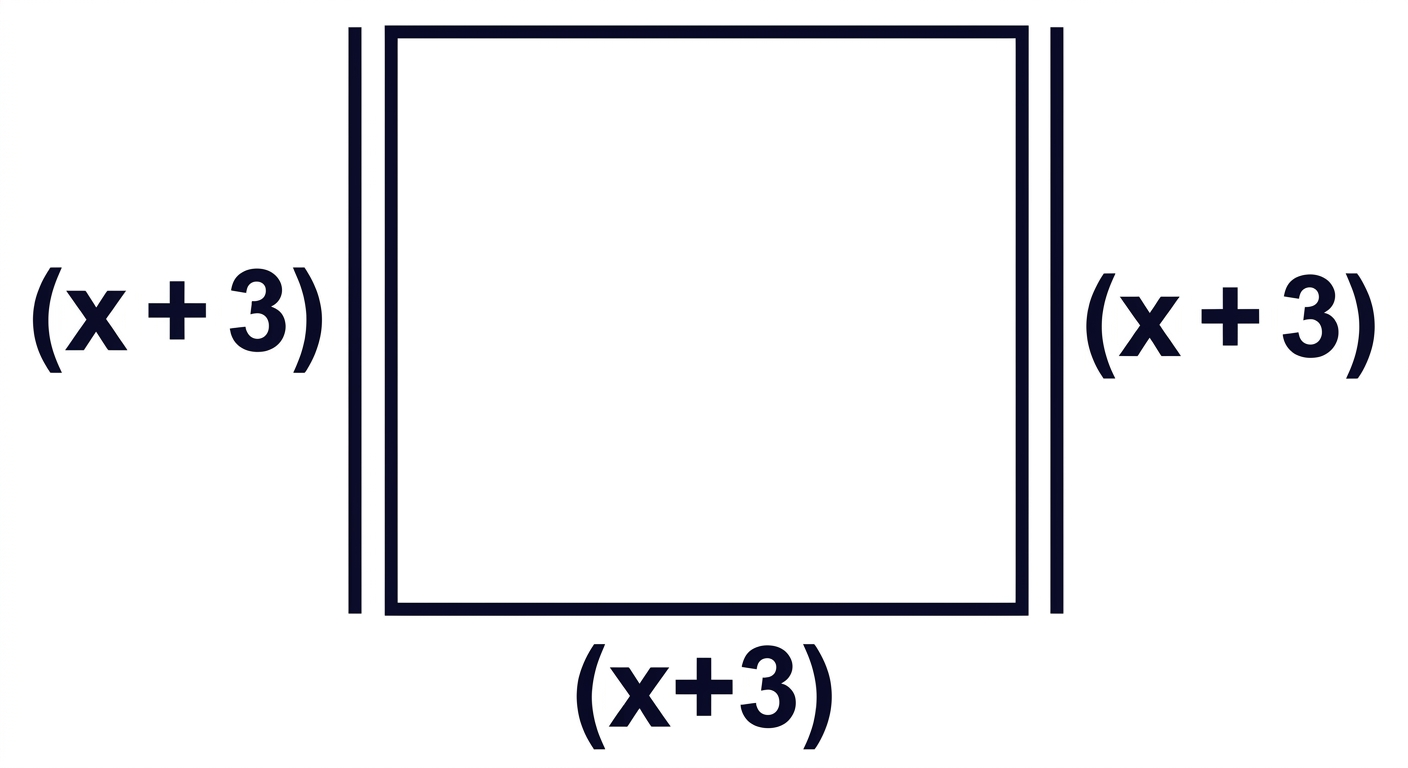
A square patio has side (x+3)(x + 3) m, as shown in the diagram.
Question diagram
(a)
Show that the area of the patio is (x2+6x+9)(x^2 + 6x + 9) m². [2]Criterion A (ii) · Level 3-4
(b)
For x=4.4x = 4.4, find the area of the patio. [1]Criterion A (iii) · Level 1-2
(c)
The patio is covered with square slabs of side 60 cm. Mo divides the area of the patio by the area of one slab. Find the number of slabs Mo would order. [2]Criterion D (ii), D (iii), D (iv) · Level 3-4
(d)
Lea says that 169 slabs are needed, because 13 slabs must be placed along each edge. Explain where Lea's number comes from, and which order is more sensible. [2]Criterion D (v) · Level 5-6

revisionprep.com

Summary Answer

Not available for this question.

Model Answer

Not available for this question.

Marking Scheme

Not available for this question.

Examiner Insights

Not available for this question.

Question 5Criterion B · Band 1-8 · Challenge · 6 marksrevisionprep.com

Recognising and Using Identities in Problems

This question investigates n(n+1)(n+2)(n+3)+1n(n+1)(n+2)(n+3) + 1, where nn is a positive whole number.
(a)
Calculate 1×2×3×4+11\times2\times3\times4 + 1,  2×3×4×5+1\ 2\times3\times4\times5 + 1 and 3×4×5×6+13\times4\times5\times6 + 1. [1]Criterion B (i) · Level 1-2
(b)
Describe how each result is related to a square number. [1]Criterion B (ii) · Level 3-4
(c)
Show that n(n+3)=n2+3nn(n+3) = n^2 + 3n and (n+1)(n+2)=n2+3n+2(n+1)(n+2) = n^2 + 3n + 2. By letting m=n2+3nm = n^2 + 3n, prove that n(n+1)(n+2)(n+3)+1n(n+1)(n+2)(n+3) + 1 is always a perfect square. [3]Criterion B (iii) · Level 7-8
(d)
Hence write 10×11×12×13+110 \times 11 \times 12 \times 13 + 1 as the square of a whole number. [1]Criterion B (ii) · Level 5-6

revisionprep.com

Summary Answer

Not available for this question.

Model Answer

Not available for this question.

Marking Scheme

Not available for this question.

Examiner Insights

Not available for this question.

Question 6Criterion A + C · Band 1-8 · Challenge · 6 marksrevisionprep.com

Deriving Identities from Expansion and Factorisation
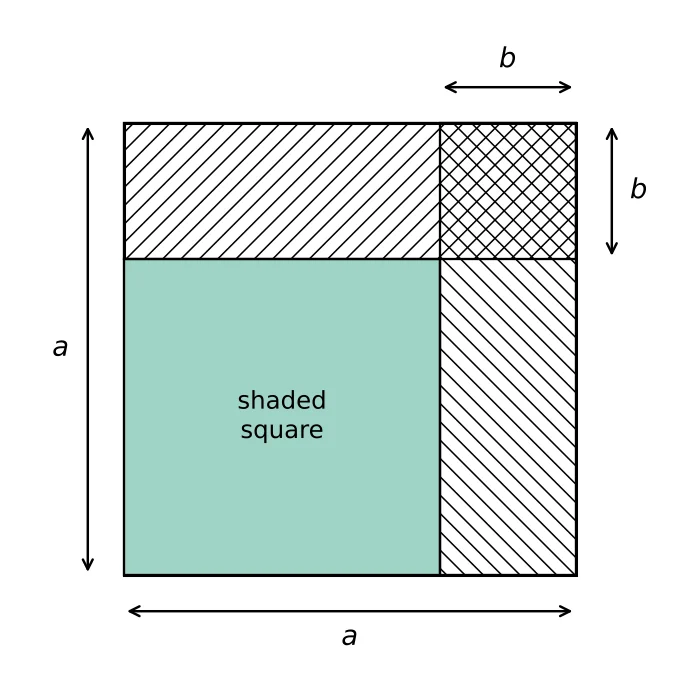
The diagram shows a square of side aa cm. Two strips, each bb cm wide, run along the top and the right-hand side of the square. The square that is left, which is shaded, has side (a−b)(a - b) cm.
Question diagram
(a)
Write down the area of the shaded square. [1]Criterion A (i) · Level 1-2
(b)
Explain, with reference to the diagram, why the area of the shaded square is also a2−2ab+b2a^2 - 2ab + b^2. [3]Criterion C (iii), C (iv) · Level 7-8
(c)
Use this identity to find the value of 9.729.7^2 without a calculator. [2]Criterion A (ii) · Level 3-4

revisionprep.com

Summary Answer

Not available for this question.

Model Answer

Not available for this question.

Marking Scheme

Not available for this question.

Examiner Insights

Not available for this question.

That's every free question here — 6 of 43.

+37 more questions, plus Mock Papers & Worksheets, are waiting in Premium.

Upgrade