You're viewing free preview questions — 4 questions previewing here — subscribe to unlock 46 more, plus the Full Question Bank, Mock Papers & Worksheets.Upgrade
Transformations — Free MYP5 Mathematics (Standard) Practice Questions

1QuestionReflectionsConcept Practice
4 marks~6 minCriterion A
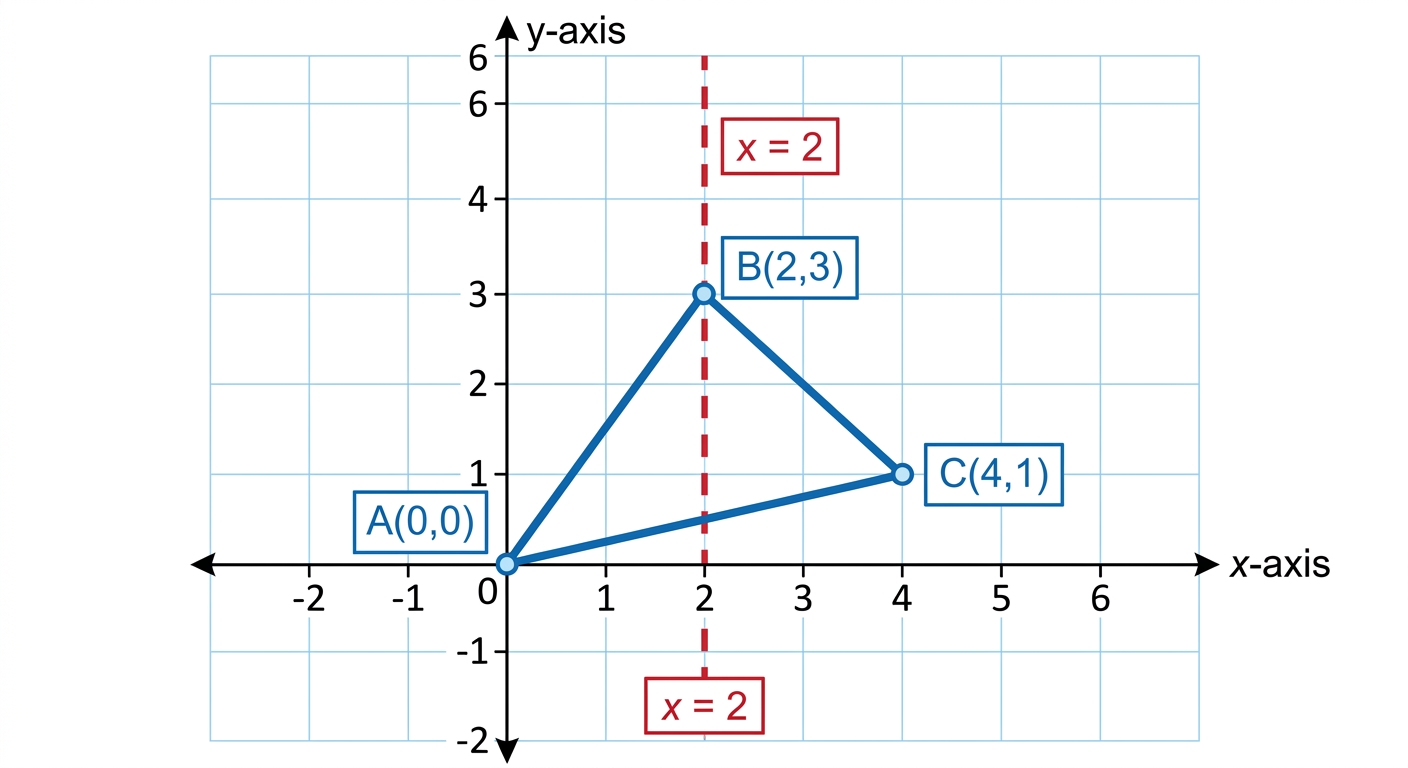
A graphic designer is creating a symmetrical logo using triangle with vertices , , and . The triangle is reflected over the line to produce triangle , which forms the mirror half of the logo.
a
Deduce the coordinate rule for reflecting any point over the line . [1]
b
Determine the coordinates of , , and . [2]
c
The designer claims the combined shape of triangle and triangle is perfectly symmetrical about . Justify whether this claim is correct. [1]

Solutions
2QuestionStretch/compressionAssessment Practice
6 marks~9 minCriterion D
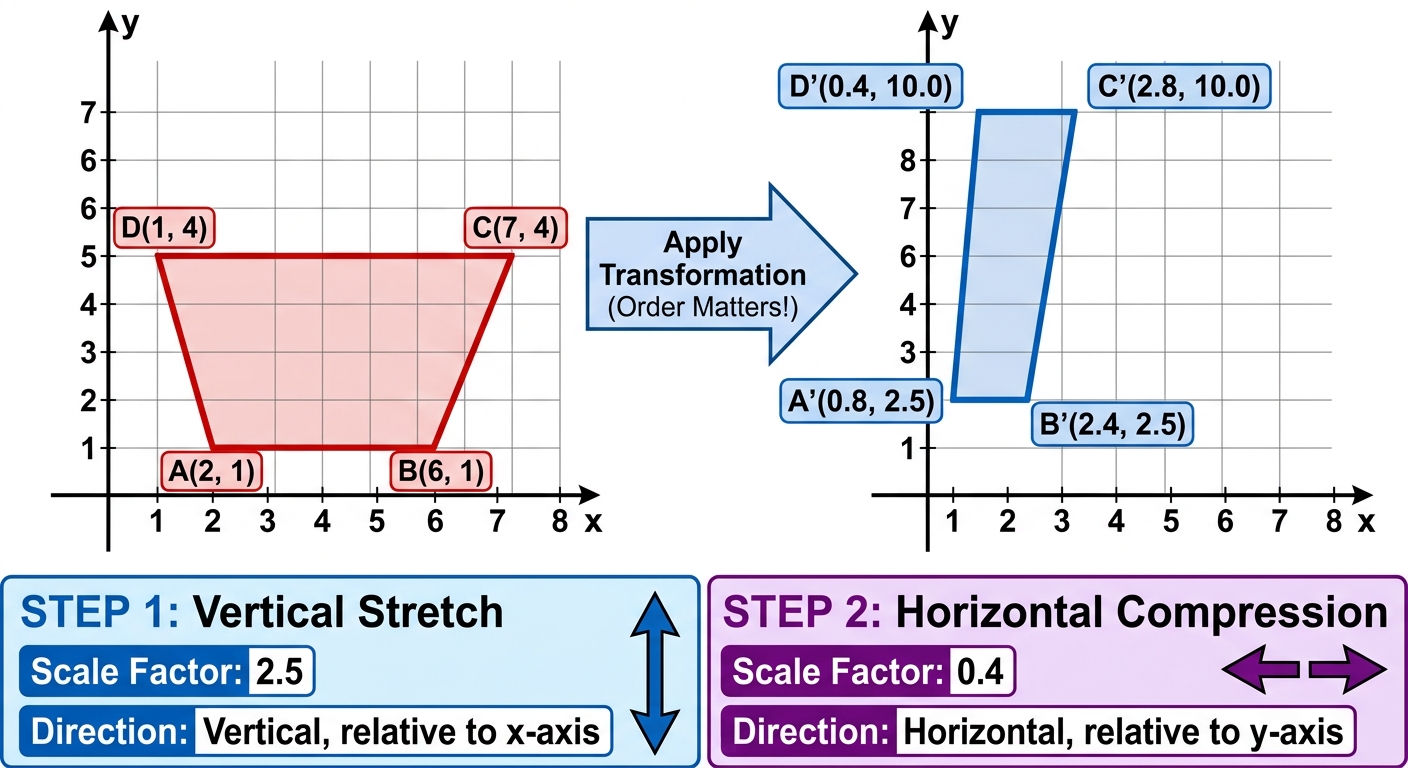
A graphic designer is resizing a logo for a billboard and a business card. The logo's outline is defined by vertices , , , and . The designer applies a vertical stretch by factor , followed by a horizontal compression by factor .
a
Determine the coordinates of the transformed vertices , , , and after both transformations are applied in the given order. [2]
b
Calculate the area of the original logo and the area of the transformed logo. Show that the two areas are equal, and explain why this result occurs. [2]
c
Advise the designer whether this transformation is suitable for both media, justifying your answer with reference to the effect of non-uniform scaling on the logo's proportions and the significance of the equal-area result. [2]
Solutions
3QuestionReflectionsConcept Practice
2 marks~3 minCriterion B
A graphic designer uses coordinate geometry to create a reflected logo. The original logo contains the point . The designer reflects the entire logo across the -axis, as shown by the pattern below.
Deduce the general rule for reflecting any point across the -axis. [1]
State the image of after reflection across the -axis. [1]
Deduce the general rule for reflecting any point across the -axis. [1]
State the image of after reflection across the -axis. [1]
Solutions
4QuestionStretch/compressionAssessment Practice
4 marks~6 minCriterion C
A sports analyst models the vertical height (in metres) of a ball's bounce using the function , where is time in seconds. A new surface increases all heights by a factor of 3 and reduces the launch height by 2 metres, giving a transformed function .
a
Deduce the equation of . [1]
b
Calculate . [1]
c
The analyst claims: "At seconds, the ball reaches a height above 50 metres, so the surface is unsuitable for regulation play." Advise the analyst whether this conclusion is supported by the model. [2]
Solutions
That's every free question here — 4 of 50.
+46 more questions, plus Mock Papers & Worksheets, are waiting in Premium.