You're viewing free preview questions — 4 questions previewing here — subscribe to unlock 41 more, plus the Full Question Bank, Mock Papers & Worksheets.Upgrade
Transformations of Graphs — Free MYP5 Mathematics (Standard) Practice Questions

1QuestionReflections Across AxesConcept Practice
2 marks~3 minCriterion A
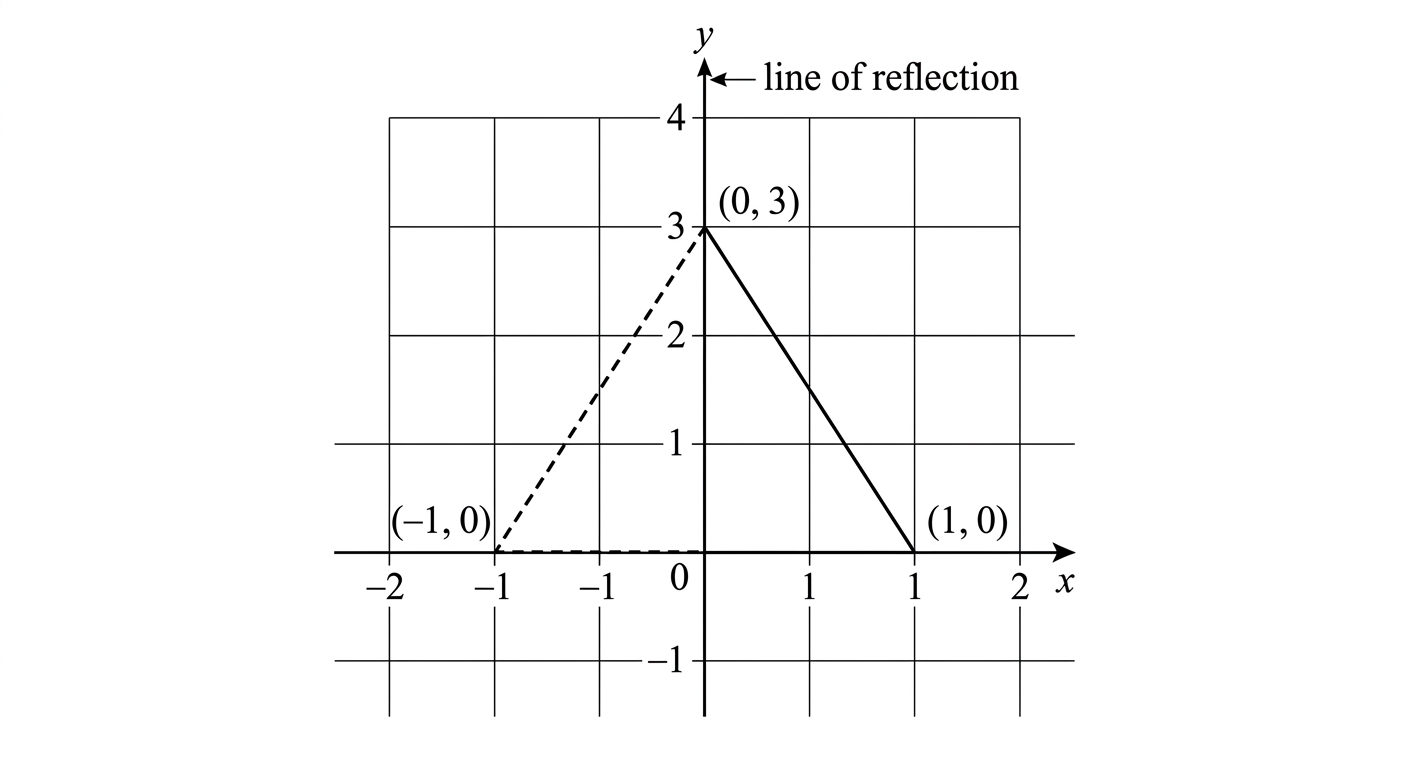
A graphic designer reflects the letter 'L', with vertices at , , and , across the -axis to create a symmetrical logo.
a
State the coordinates of the reflected vertices. [1]
b
The client requests that the combined logo — original and reflected 'L' together — forms a single, visually balanced shape. Justify whether this reflection achieves that outcome, referring to the position of the shared vertices. [1]

Solutions
2QuestionCombining Multiple TransformationsAssessment Practice
4 marks~6 minCriterion C
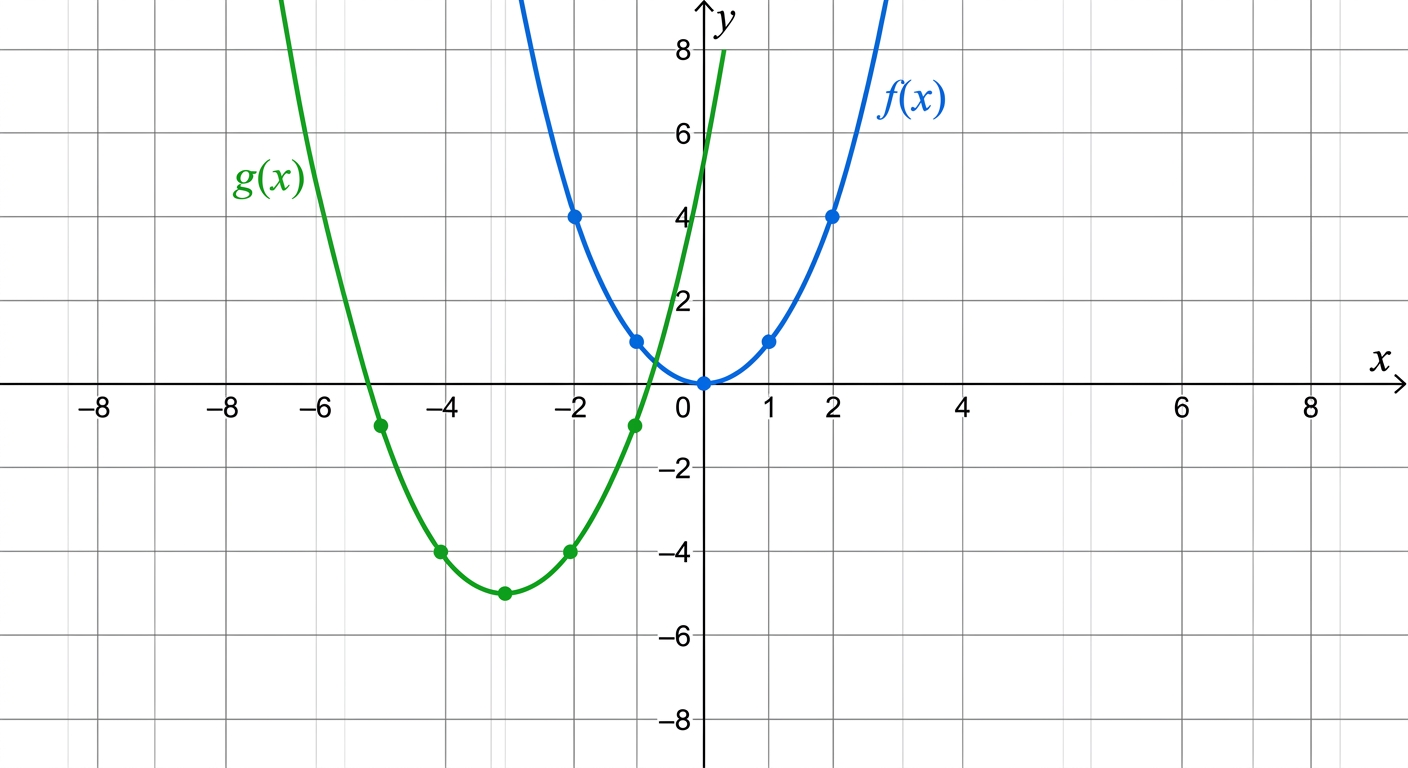
A drone follows a flight path modelled by , where is horizontal distance (metres) and is height (metres). An adjusted path is modelled by .
A safety regulation states that the drone must remain at or above metres relative to the launch reference height.
A safety regulation states that the drone must remain at or above metres relative to the launch reference height.
a
State the coordinates of the vertex of . [1]
b
Explain how the graph of is obtained from the graph of through translations. [2]
c
Evaluate and justify whether the drone satisfies the safety regulation at . [1]
Solutions
3QuestionStretching and Compressing GraphsAssessment Practice
4 marks~6 minCriterion D
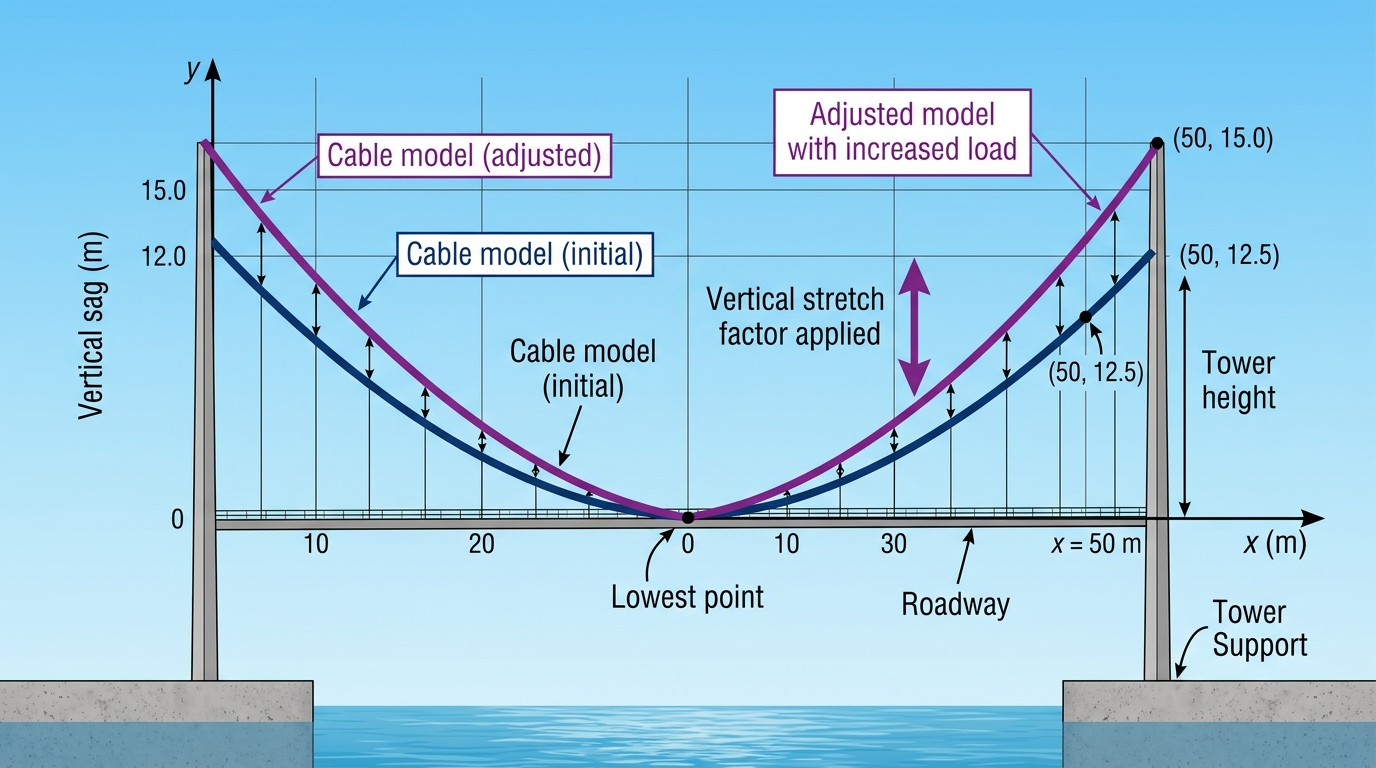
A civil engineer models the vertical sag of a suspension bridge cable using
where is the vertical sag in metres and is the horizontal distance in metres from the lowest point.
where is the vertical sag in metres and is the horizontal distance in metres from the lowest point.
a
When the load increases by 20%, the engineer applies a vertical stretch by a factor of 1.2. Determine the new function. [1]
b
The bridge has a main span of 400 m, so ranges from to . Calculate the maximum sag predicted by the new model. [1]
c
The engineer claims the quadratic model is sufficient for all design decisions. Critique this claim, referring to at least two real-world factors not captured by the model. [2]
Solutions
4QuestionCombining Multiple TransformationsAssessment Practice
2 marks~3 minCriterion B
A parabolic solar reflector dish is repositioned on a tracking mount. Its cross-section is modelled by , where is the horizontal adjustment (in metres) and is the minimum height (in metres) above the base frame.
Four positioning configurations are recorded:
:
:
Analyse the relationship between , , and the vertex of across all four configurations, and state the general rule for the vertex coordinates of . [2]
Four positioning configurations are recorded:
:
:
Analyse the relationship between , , and the vertex of across all four configurations, and state the general rule for the vertex coordinates of . [2]
Solutions
That's every free question here — 4 of 45.
+41 more questions, plus Mock Papers & Worksheets, are waiting in Premium.