You're viewing free preview questions — 4 questions previewing here — subscribe to unlock 51 more, plus the Full Question Bank, Mock Papers & Worksheets.Upgrade
Error Bounds and Approximations — Free MYP5 Mathematics (Standard) Practice Questions

1QuestionEstimation in Problem SolvingAssessment Practice
4 marks~6 minCriterion D
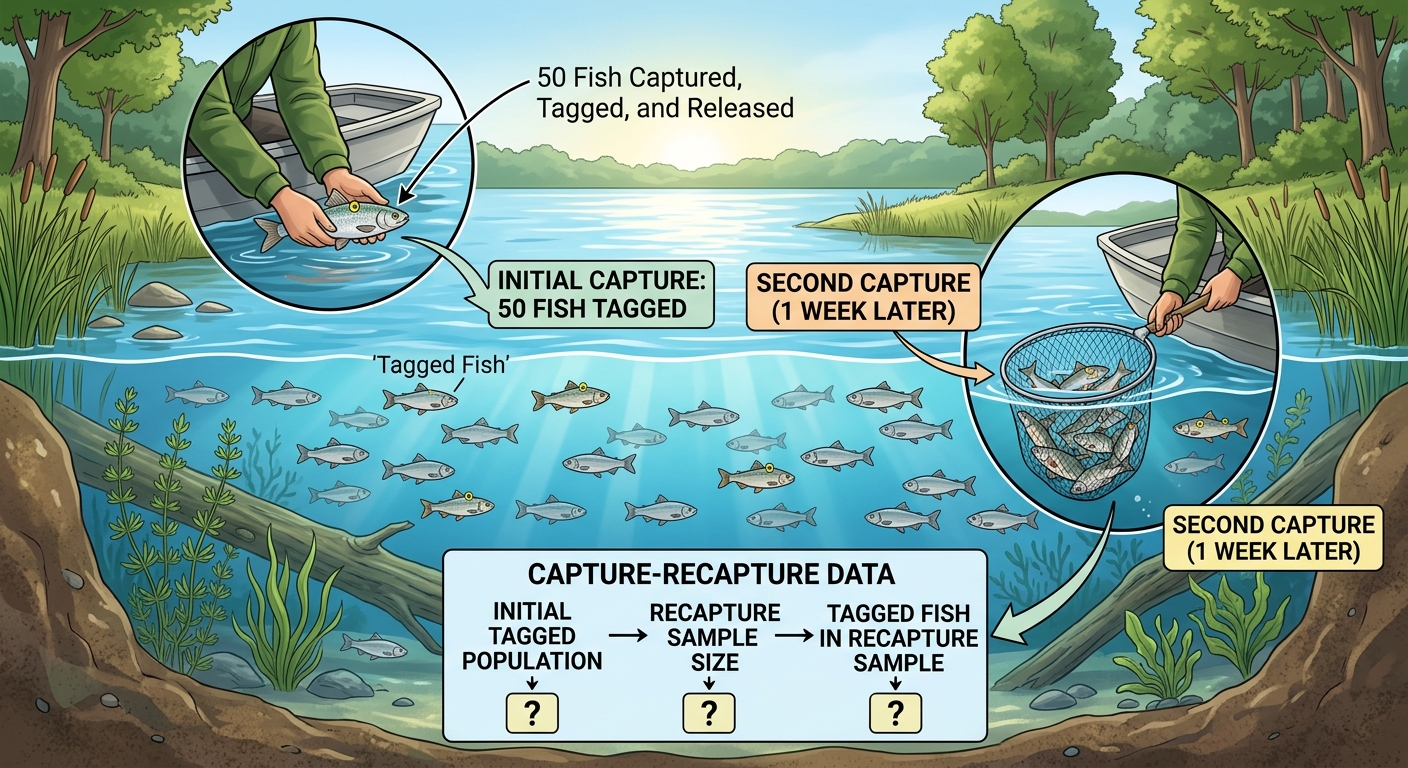
A wildlife conservationist estimates the fish population of a lake using the capture-recapture method. In the first sample, 50 fish are caught, tagged, and released. One week later, a second sample of 100 fish is caught, of which 10 are tagged.
a
Show that the estimated total fish population is 500. [1]
b
Explain two assumptions required for the capture-recapture method to produce a valid estimate in this scenario. [1]
c
The conservationist needs at least 400 fish in the lake to justify a new fishing licence. Advise the conservationist whether the population estimate from part (a) is sufficient to support this decision, and identify one specific reason why the estimate may not be reliable enough to act on. [2]

Solutions
2QuestionUnderstanding Absolute and Percentage ErrorAssessment Practice
8 marks~12 minCriterion A
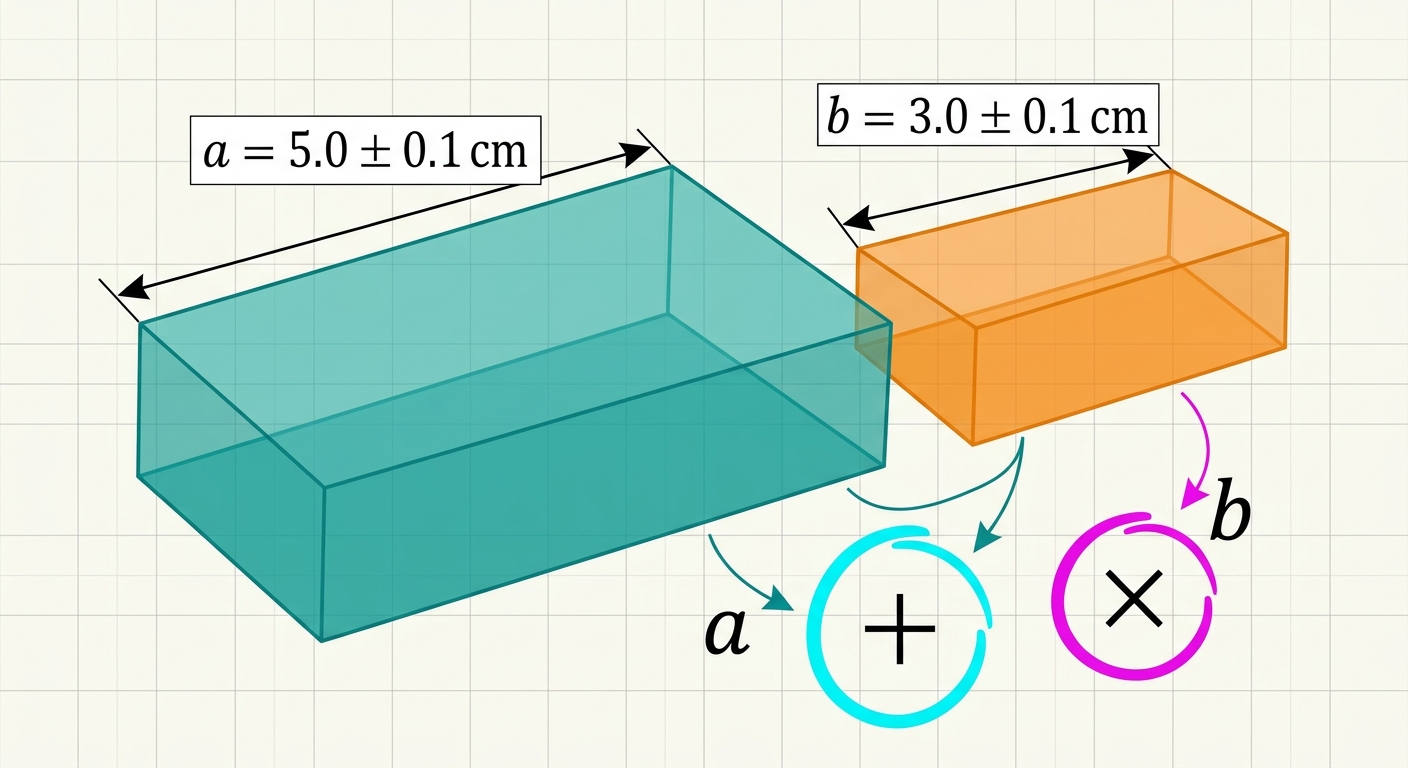
A manufacturing engineer measures two components of a mechanical assembly. Component cm and component cm.
Use: absolute error of a product , where , are measured values and , are absolute errors.
Use: absolute error of a product , where , are measured values and , are absolute errors.
a
Calculate the absolute error and percentage error for the sum and the product . [2]
b
A second engineer measures cm and cm. Deduce whether the percentage error in the product is greater than, equal to, or less than the percentage error in , and explain why. [3]
c
Prove algebraically that when two measured quantities are added, the maximum absolute error of the sum equals the sum of the individual absolute errors. Then advise the quality control team whether the assembly, with total length , should be approved for a specification requiring the total to lie within cm of 8.0 cm. [3]
Solutions
3QuestionCalculations Using Rounded ValuesAssessment Practice
2 marks~3 minCriterion B
When two numbers are each rounded to decimal places, the sum is also expressed to decimal places.
The four sums below illustrate this:
(rounded to 0 decimal places)
(rounded to 1 decimal place)
(rounded to 2 decimal places)
(rounded to 3 decimal places)
Analyse the relationship between the number of decimal places in the addends and in their sum. Hence, formulate a conjecture for the maximum possible error in the sum when both addends are rounded to decimal places. [2]
The four sums below illustrate this:
(rounded to 0 decimal places)
(rounded to 1 decimal place)
(rounded to 2 decimal places)
(rounded to 3 decimal places)
Analyse the relationship between the number of decimal places in the addends and in their sum. Hence, formulate a conjecture for the maximum possible error in the sum when both addends are rounded to decimal places. [2]
Solutions
4QuestionUnderstanding Absolute and Percentage ErrorAssessment Practice
4 marks~6 minCriterion C
A student measures the time for a ball to fall from a fixed height, repeating the experiment four times. The accepted value, determined by a precision instrument, is seconds.
Trial 1: s
Trial 2: s
Trial 3: s
Trial 4: s
Trial 1: s
Trial 2: s
Trial 3: s
Trial 4: s
a
Calculate the percentage error for Trials 2, 3, and 4. [2]
b
The student claims their method is reliable because the mean of all four trials equals the accepted value. Calculate the mean of the four trials, then justify whether this claim is valid. [2]
Solutions
That's every free question here — 4 of 55.
+51 more questions, plus Mock Papers & Worksheets, are waiting in Premium.