You're viewing free preview questions — 6 questions previewing here — subscribe to unlock 292 more, plus the Full Question Bank, Mock Papers & Worksheets.Upgrade
Back

The Big Bang and the expanding universe — Free MYP5 Physics Practice Questions

Free questions

Open in full, with answers, mark scheme and examiner insights.

Question 1Criterion A · Band 1-4 · Easy · 5 marksrevisionprep.com

Definition of the Big Bang Theory

The photograph shows a balloon with dots drawn on it before and after inflation. The dots stay the same size, but every dot moves further from every other dot as the balloon is inflated.
Question diagram
(a)
State what the dots and the rubber surface represent in this model of the universe. [2]Criterion A (i) · Level 1-2
(b)
Explain why an observer on any dot would see all the other dots moving away. [2]Criterion A (ii) · Level 3-4
(c)
Suggest one limitation of the balloon as a model of the universe. [1]Criterion A (iii) · Level 3-4

revisionprep.com

Summary Answer

Not available for this question.

Model Answer

Not available for this question.

Marking Scheme

Not available for this question.

Examiner Insights

Not available for this question.

Question 2Criterion A · Band 1-4 · Easy · 2 marksrevisionprep.com

Formation of atoms (hydrogen, helium)

The first atoms formed when free protons and electrons combined, about 380 000 years after the Big Bang.
(a)
State the charge of a proton and of an electron. [1]Criterion A (i) · Level 1-2
(b)
Explain why a proton and an electron are attracted to each other. [1]Criterion A (ii) · Level 3-4

revisionprep.com

Summary Answer

Not available for this question.

Model Answer

Not available for this question.

Marking Scheme

Not available for this question.

Examiner Insights

Not available for this question.

Question 3Criterion C · Band 3-6 · Medium · 7 marksrevisionprep.com

Universe beginning from a singularity

A model gives the average density of the universe at different sizes. Size is given relative to today (today = 1).

Relative size10.50.250.1
Density / 10−2710^{-27} kg m−3^{-3}9725769000
(a)
Describe the pattern shown by the data. [1]Criterion C (ii) · Level 3-4
(b)
A student suggests that density × (relative size)3^{3} is constant. Test this rule using all four columns of data. [2]Criterion C (ii) · Level 5-6
(c)
Use the rule to predict the density when the relative size was 0.01. [2]Criterion C (ii) · Level 3-4
(d)
Use the rule to describe what happens to the density as the relative size becomes very small, and state what this suggests about the very early universe. [2]Criterion C (ii) · Level 5-6

revisionprep.com

Summary Answer

Not available for this question.

Model Answer

Not available for this question.

Marking Scheme

Not available for this question.

Examiner Insights

Not available for this question.

Question 4Criterion D + A · Band 3-6 · Medium · 6 marksrevisionprep.com

Initial conditions (extreme temperature and density)

Scientists run computer simulations of the early universe on supercomputers. One simulation used about 20 million kWh of electricity, roughly the yearly use of 5000 homes.
(a)
Outline why scientists use computer simulations to study the initial conditions of the universe. [2]Criterion A (ii) · Level 3-4
(b)
Discuss whether the benefits of such simulations justify their environmental cost. [4]Criterion D (ii), D (iii) · Level 5-6

revisionprep.com

Summary Answer

Not available for this question.

Model Answer

Not available for this question.

Marking Scheme

Not available for this question.

Examiner Insights

Not available for this question.

Question 5Criterion A · Band 3-8 · Challenge · 9 marksrevisionprep.com

Redshift and the Doppler effect for light
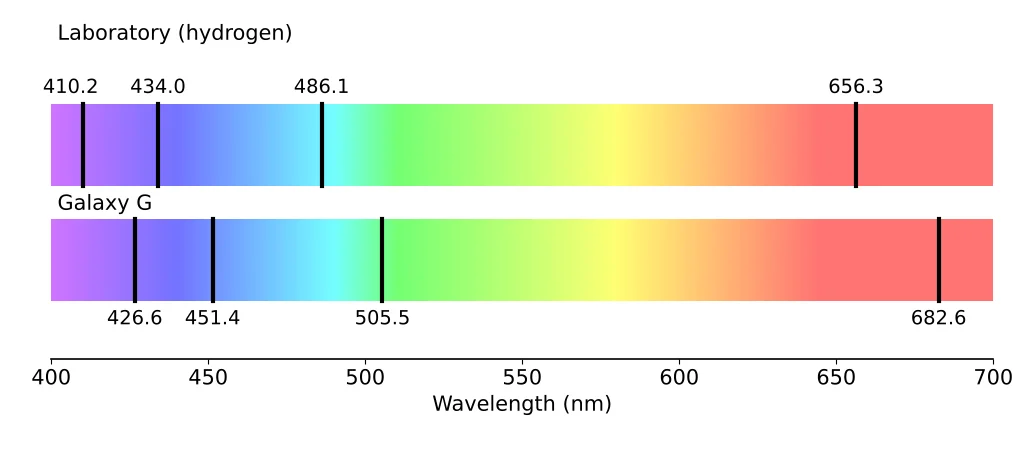
The figure shows four spectral lines of hydrogen measured in a laboratory and in the light from a galaxy G. The redshift is z=Δλλlabz = \dfrac{\Delta\lambda}{\lambda_{\text{lab}}}. Take c=3.0×10⁵c = 3.0 \times 10^{5} km s−1^{-1} and H0=70H_0 = 70 km s−1^{-1} Mpc−1^{-1}.
Question diagram
(a)
Calculate the redshift zz of galaxy G using the 656.3 nm line. [2]Criterion A (ii) · Level 3-4
(b)
Calculate the speed at which galaxy G is moving away from Earth. [2]Criterion A (ii) · Level 5-6
(c)
Use Hubble's law to calculate the distance to galaxy G. [2]Criterion A (ii) · Level 5-6
(d)
A student says: "The 410.2 nm line moved by only 16.4 nm but the 656.3 nm line moved by 26.3 nm, so the 656.3 nm line shows that G is moving away faster." Evaluate the student's statement. [3]Criterion A (iii) · Level 7-8

revisionprep.com

Summary Answer

Not available for this question.

Model Answer

Not available for this question.

Marking Scheme

Not available for this question.

Examiner Insights

Not available for this question.

Question 6Criterion B + A · Band 3-8 · Challenge · 10 marksrevisionprep.com

Hubble’s Law (qualitative understanding)
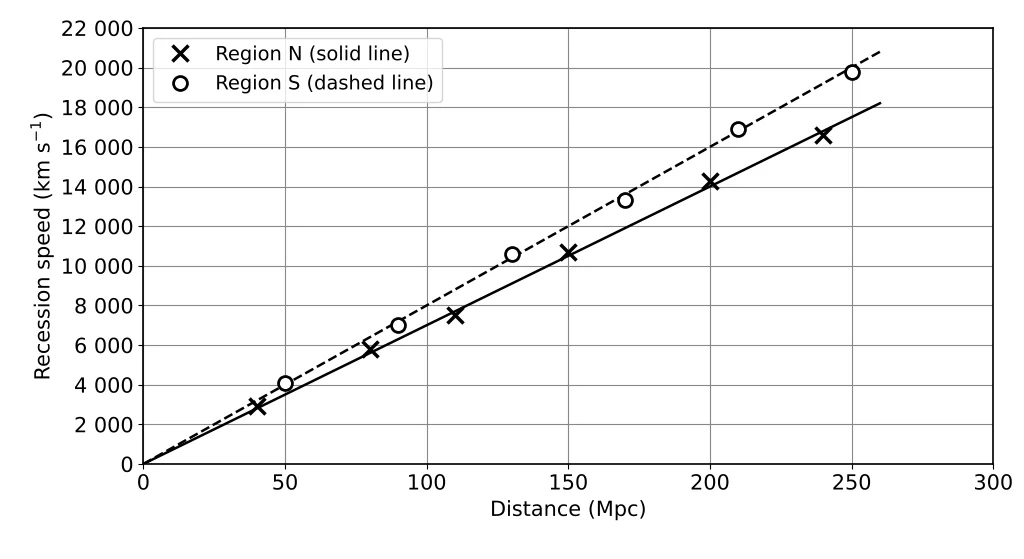
A student wants to find out whether Hubble's law is the same in every direction. She downloads the distance and recession speed of 500 galaxies from a database. The graph shows 6 galaxies from region N and 6 from region S of the sky, with a best-fit line through the origin for each region.
Question diagram
(a)
Use the lines to determine the Hubble constant for region N and for region S. [2]Criterion A (ii) · Level 3-4
(b)
The two values differ by about 14%. Formulate a hypothesis about what will happen to this difference if she repeats the comparison with many more galaxies, assuming Hubble's law is the same in every direction. Explain your hypothesis. [2]Criterion B (ii) · Level 5-6
(c)
Explain how she should choose the galaxies from each region so that the comparison is fair. [2]Criterion B (iii) · Level 5-6
(d)
Design a method, using the whole database, that lets her decide whether any difference between directions is real. Justify your choices. [4]Criterion B (iv) · Level 7-8

revisionprep.com

Summary Answer

Not available for this question.

Model Answer

Not available for this question.

Marking Scheme

Not available for this question.

Examiner Insights

Not available for this question.

That's every free question here — 6 of 298.

+292 more questions, plus Mock Papers & Worksheets, are waiting in Premium.

Upgrade