You're viewing free preview questions — 5 questions previewing here — subscribe to unlock 358 more, plus the Full Question Bank, Mock Papers & Worksheets.Upgrade
The Big Bang Theory — Free MYP5 Physics Practice Questions

1QuestionEvidence supporting Big BangConcept Practice
2 marks~3 minCriterion A
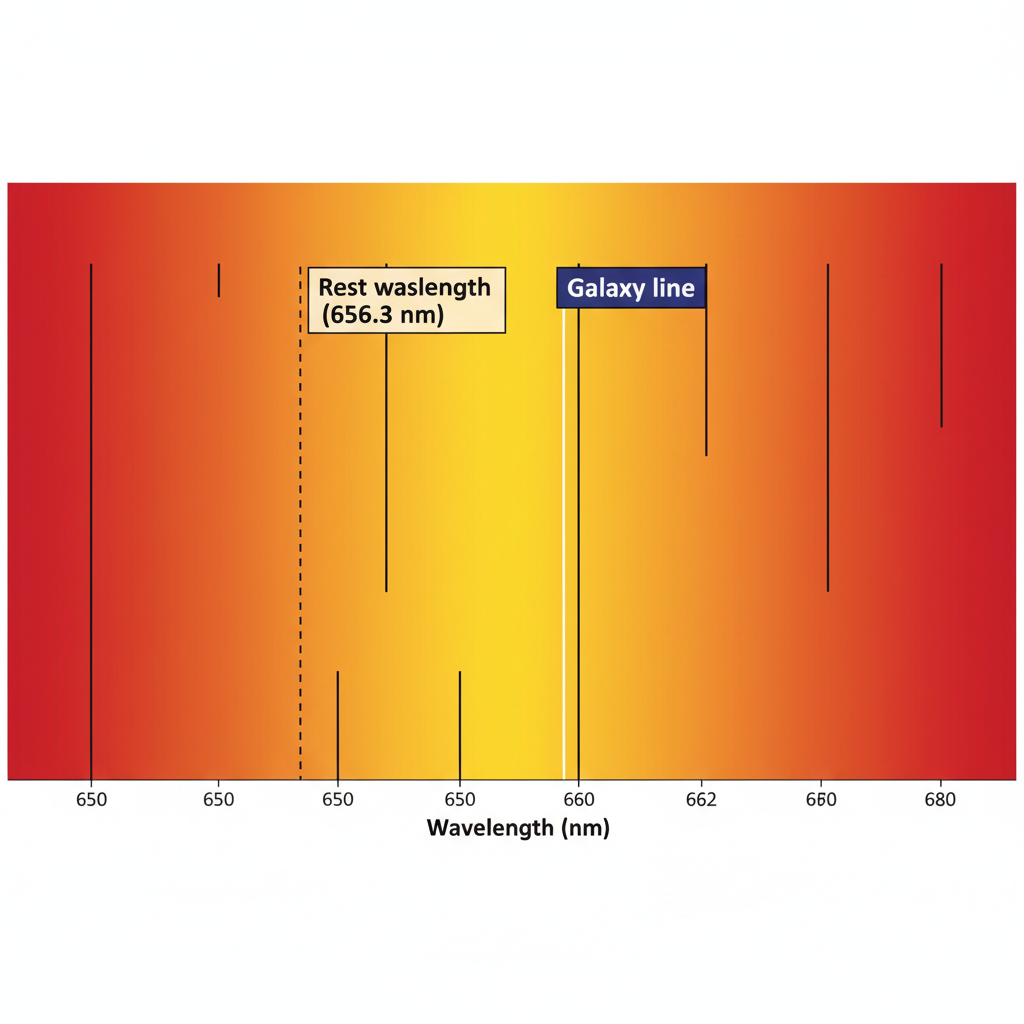
A simplified absorption spectrum from a distant galaxy shows a hydrogen absorption line at a rest wavelength of , as measured in a laboratory on Earth. The same absorption line observed in the galaxy's spectrum appears at .
a
Deduce the direction of the shift of the observed absorption line relative to the rest wavelength. [1]
b
Explain what this shift indicates about the motion of the galaxy relative to Earth. [1]

Solutions
2QuestionEvidence supporting Big BangAssessment Practice
5 marks~8 minCriterion C
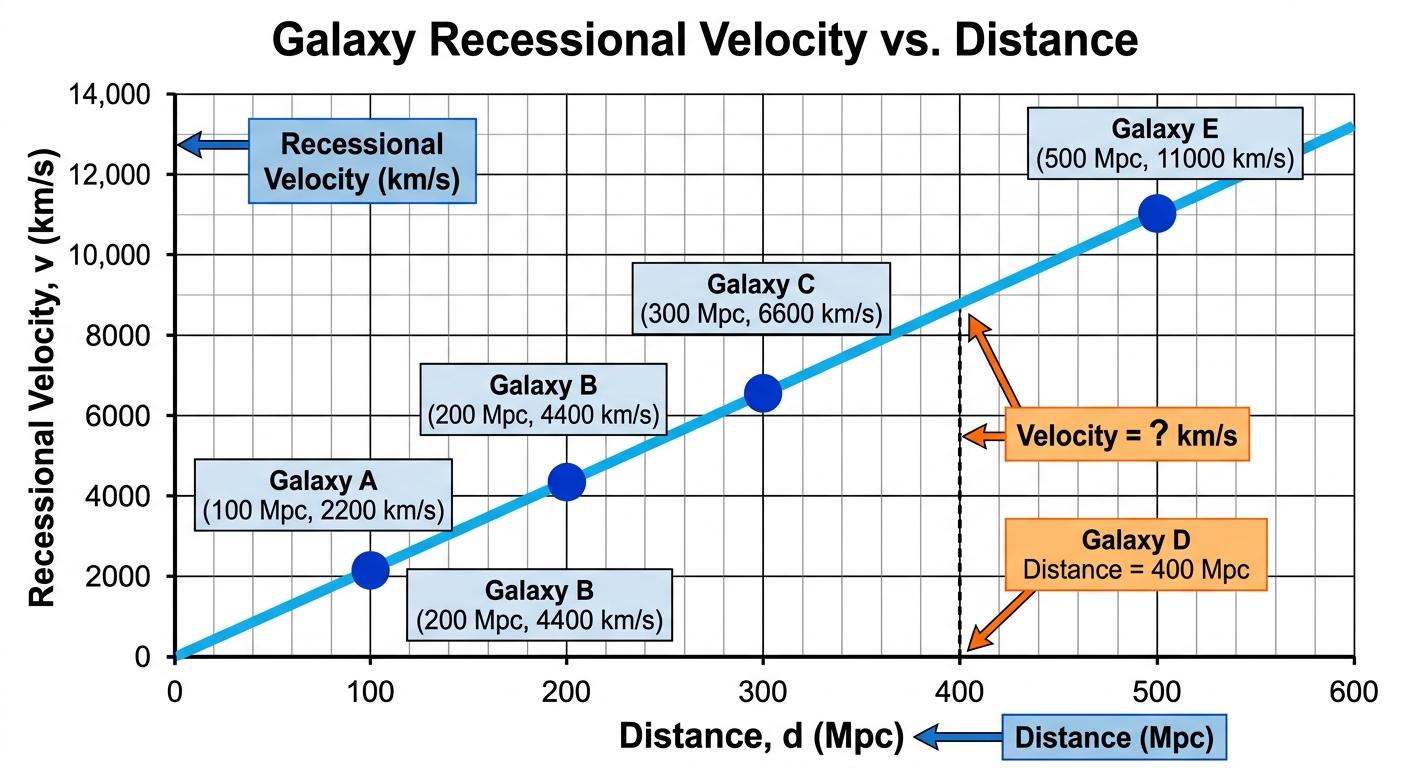
Five distant galaxies were observed as part of a study into the expanding universe. The Hubble constant relates recessional velocity to distance by .
| Distance (Mpc) | 100 | 200 | 300 | 400 | 500 |
|---|---|---|---|---|---|
| Recessional velocity (km/s) | 2200 | 4400 | 6600 | ? | 11000 |
a
Construct a graph of recessional velocity (y-axis) against distance (x-axis) for galaxies at 100, 200, 300, and 500 Mpc. Draw a best-fit straight line through the data. [1]
b
Deduce the value of from the gradient of your line, including appropriate units. [2]
c
A student claims that galaxy D, at 400 Mpc, does not fit the pattern shown by the other four galaxies. Using your value of , calculate the expected recessional velocity of galaxy D and evaluate whether the student's claim is supported. [2]
Solutions
3QuestionDefinition of CMBAssessment Practice
6 marks~9 minCriterion C
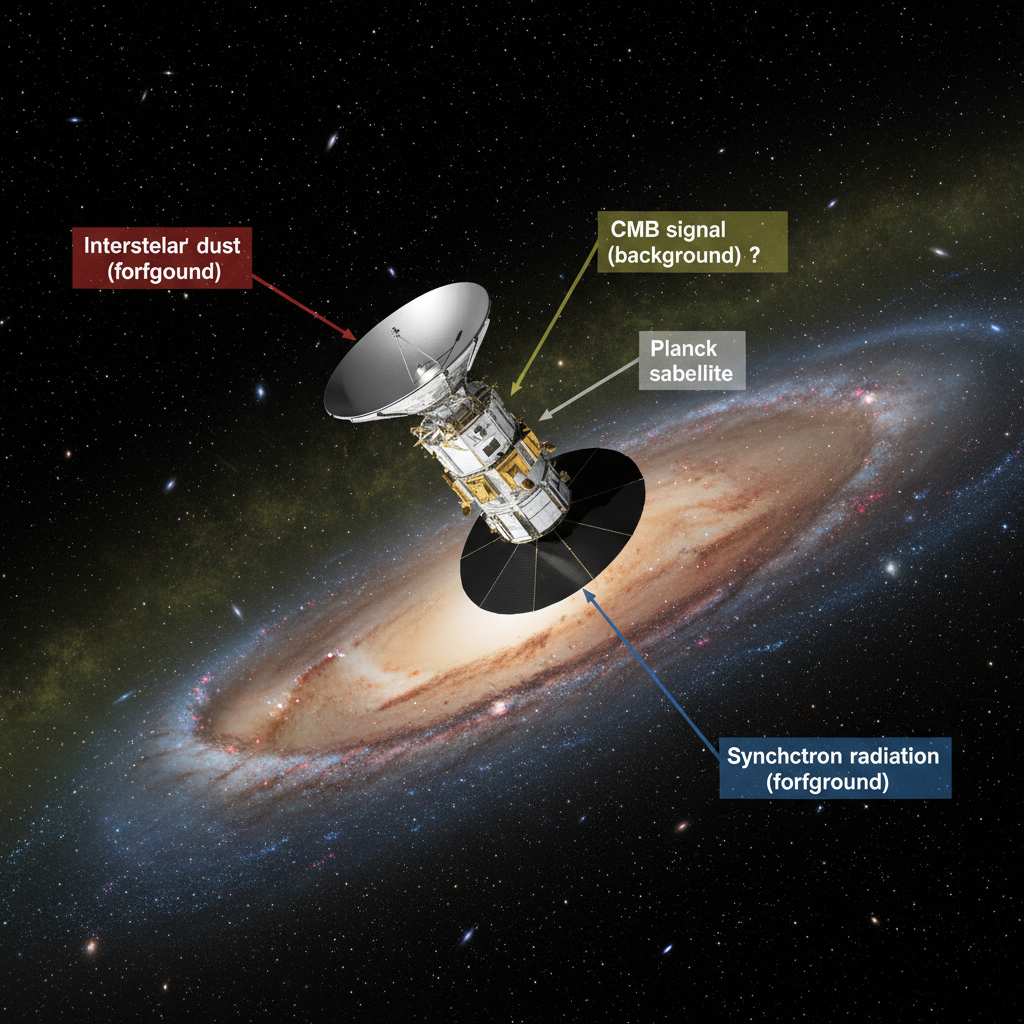
The Planck satellite maps the Cosmic Microwave Background (CMB) across multiple frequencies. Its detectors must distinguish the primordial CMB signal from foreground emissions: interstellar dust radiates in the infrared-to-microwave range, while synchrotron radiation is produced by high-energy electrons spiralling in the galaxy's magnetic field. Scientists apply multi-frequency algorithms to subtract these foregrounds, but residual uncertainties remain in the final CMB maps.
a
Define the Cosmic Microwave Background (CMB). [1]
b
Explain how interstellar dust and synchrotron radiation each interfere with the Planck satellite's detection of the CMB signal. [2]
c
Evaluate whether foreground contamination invalidates the Big Bang model or affects only the precision of cosmological measurements. [3]
Solutions
4QuestionSteady State Theory (contrast with Big Bang)Assessment Practice
6 marks~9 minCriterion A
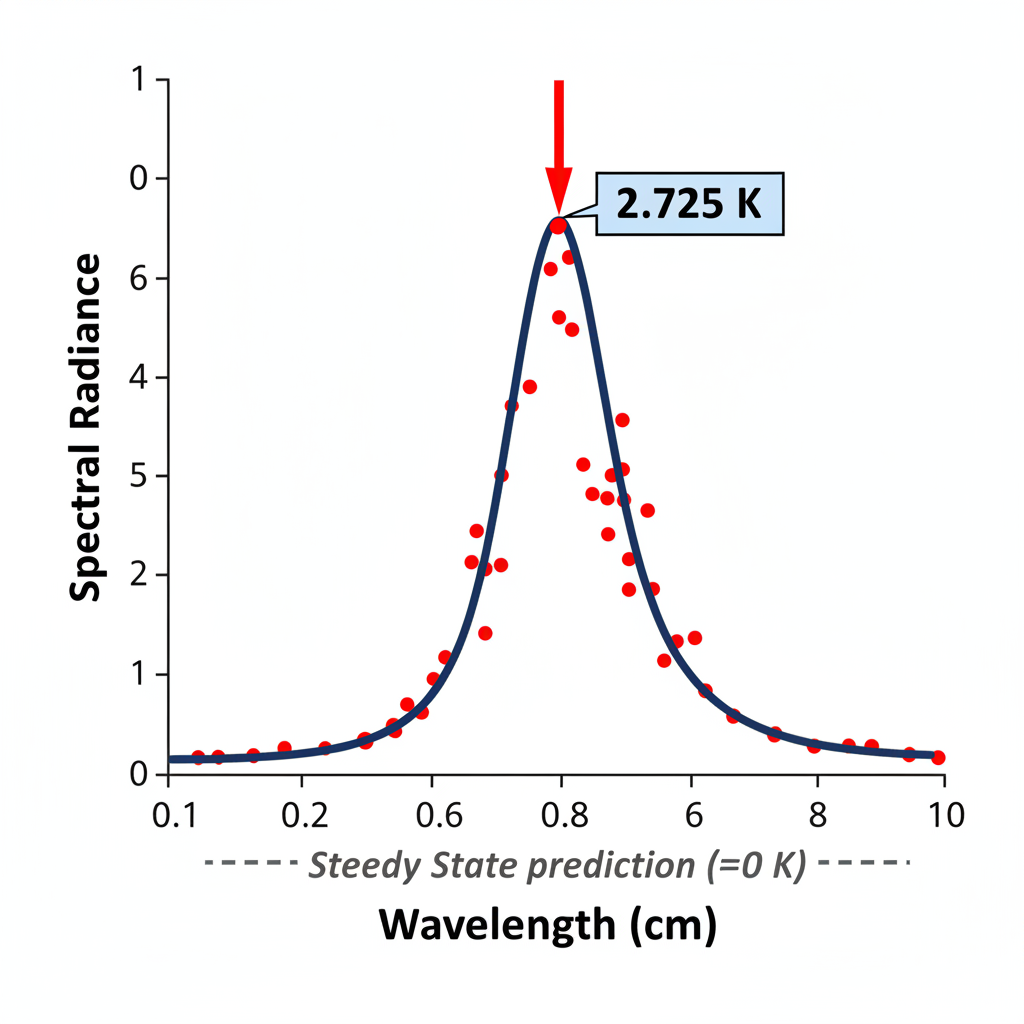
The COBE/FIRAS satellite measured the cosmic microwave background (CMB) temperature as 2.725 K. Two cosmological models make different predictions:
- Steady State model: predicts no CMB, so predicted temperature = 0 K
- Big Bang model: predicts CMB temperature = 2.7 K
Use the formula throughout:
- Steady State model: predicts no CMB, so predicted temperature = 0 K
- Big Bang model: predicts CMB temperature = 2.7 K
Use the formula throughout:
a
Calculate the percentage discrepancy between the Steady State model's prediction and the observed CMB temperature. [2]
b
Calculate the percentage discrepancy between the Big Bang model's prediction and the observed CMB temperature. [2]
c
Using your results from (a) and (b), evaluate which cosmological model is invalidated by the CMB evidence. Refer to the role of quantitative prediction in assessing scientific models. [2]
Solutions
5QuestionContinued expansion of universeAssessment Practice
6 marks~9 minCriterion D
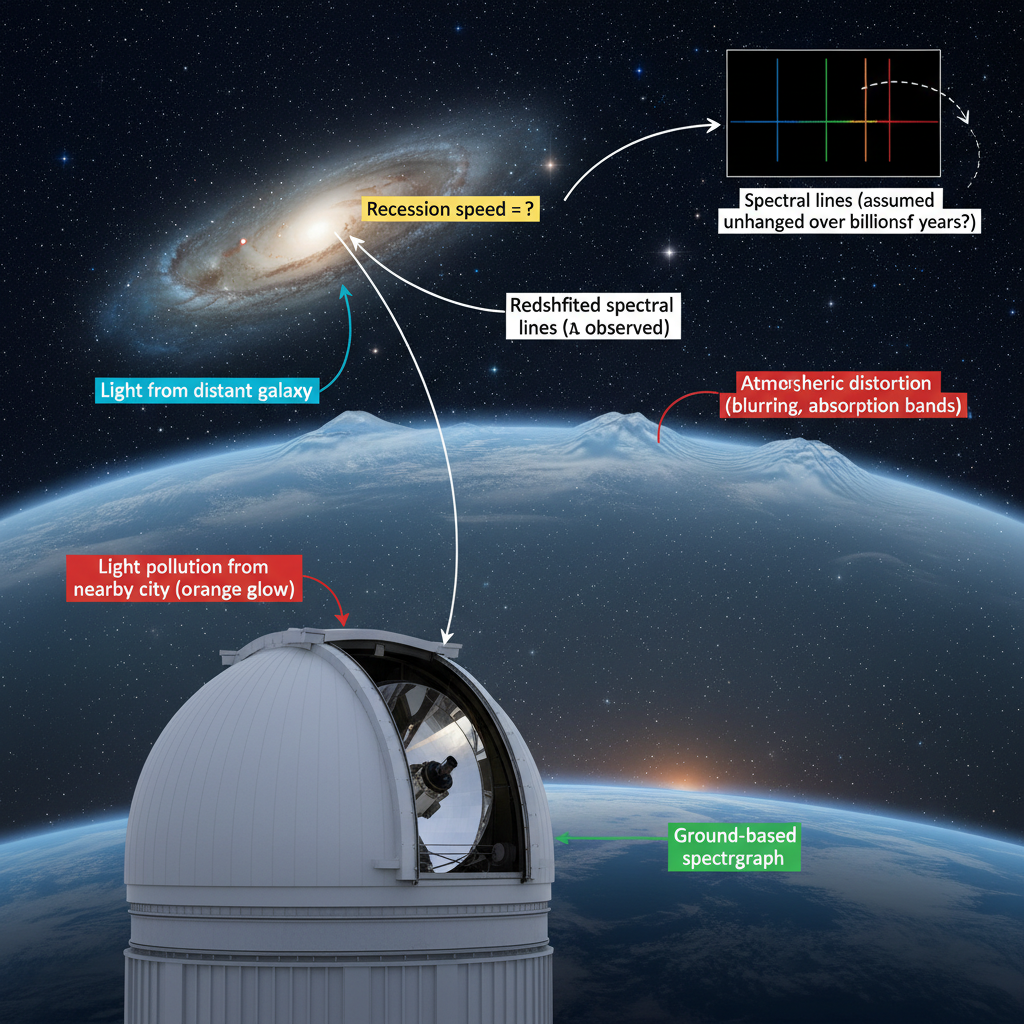
Astronomers use ground-based telescopes to measure the redshift of light from distant galaxies. By comparing the observed wavelengths of spectral lines with laboratory reference values, they calculate how fast each galaxy is receding. These recession speeds provide key evidence for the ongoing expansion of the universe.
a
Explain how recession speed data supports the conclusion that the universe is expanding. [2]
b
Discuss two limitations of ground-based spectroscopy that reduce the reliability of redshift measurements. [2]
c
Evaluate the assumption that atomic spectral lines have remained unchanged over billions of years, and assess its impact on the reliability of recession speed calculations. [2]
Solutions
That's every free question here — 5 of 363.
+358 more questions, plus Mock Papers & Worksheets, are waiting in Premium.