You're viewing free preview questions — 6 questions previewing here — subscribe to unlock 161 more, plus the Full Question Bank, Mock Papers & Worksheets.Upgrade
Back

The Solar System — Free MYP5 Physics Practice Questions

Free questions

Open in full, with answers, mark scheme and examiner insights.

Question 1Criterion A · Band 1-4 · Easy · 4 marksrevisionprep.com

Definition of a solar system

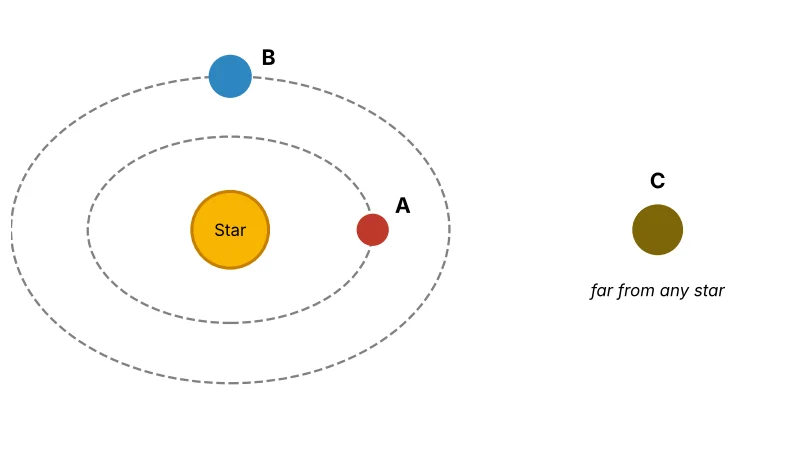
The diagram shows a star with planets A and B in orbit around it, and a rogue planet C drifting through space far from any star. Rogue planets are found by a method called microlensing.
Question diagram
(a)
State which of the planets A, B and C are part of a solar system. [1]Criterion A (i) · Level 1-2
(b)
Explain, using the definition of a solar system, why planet C is not part of one. [2]Criterion A (ii) · Level 3-4
(c)
Suggest why a rogue planet such as C is unlikely to support liquid water on its surface. [1]Criterion A (ii) · Level 3-4

revisionprep.com

Summary Answer

Not available for this question.

Model Answer

Not available for this question.

Marking Scheme

Not available for this question.

Examiner Insights

Not available for this question.

Question 2Criterion A · Band 3-4 · Easy · 5 marksrevisionprep.com

Gas giants:Jupiter, Saturn

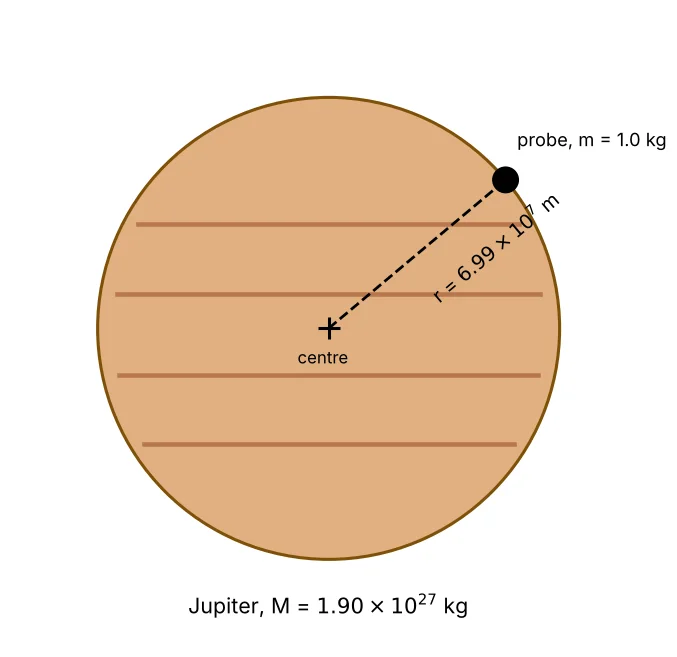
The diagram shows a 1.0 kg probe at Jupiter's cloud tops, 6.99×1076.99 \times 10^{7} m from the centre. Jupiter's mass is 1.90×10271.90 \times 10^{27} kg and G=6.67×10⁻¹¹ N m2 kg−2G = 6.67 \times 10^{-11} \text{ N m}^2 \text{ kg}^{-2}.
Question diagram
(a)
Calculate the gravitational force on the probe, using F=GMmr2F = \dfrac{GMm}{r^2}. [2]Criterion A (ii) · Level 3-4
(b)
Compare this force with the probe's weight on Earth's surface (g=9.8 N kg−1g = 9.8 \text{ N kg}^{-1}). [1]Criterion A (ii) · Level 3-4
(c)
The probe's parachute fails. Describe what happens to it as it falls into Jupiter. [2]Criterion A (iii) · Level 3-4

revisionprep.com

Summary Answer

Not available for this question.

Model Answer

Not available for this question.

Marking Scheme

Not available for this question.

Examiner Insights

Not available for this question.

Question 3Criterion B · Band 3-6 · Medium · 10 marksrevisionprep.com

Formation of the solar system (nebular hypothesis – basic idea)

In the early Solar System, dust grains and small bodies stuck together when they collided gently but bounced off or broke apart in fast collisions. A student models this in the laboratory by dropping small balls of modelling clay onto a flat clay slab and recording whether each ball sticks.
(a)
State a research question for this investigation. [1]Criterion B (i) · Level 3-4
(b)
Formulate a hypothesis and explain it using scientific reasoning. [2]Criterion B (ii) · Level 5-6
(c)
Identify the independent variable, the dependent variable and two control variables. [2]Criterion B (iii) · Level 3-4
(d)
Explain how the student should collect sufficient, relevant data. [2]

(e) Describe the procedure the student should follow, in order, naming the apparatus used. [3]
Criterion B (iii) · Level 5-6

revisionprep.com

Summary Answer

Not available for this question.

Model Answer

Not available for this question.

Marking Scheme

Not available for this question.

Examiner Insights

Not available for this question.

Question 4Criterion A + C · Band 1-6 · Medium · 6 marksrevisionprep.com

Ice giants: Uranus, Neptune

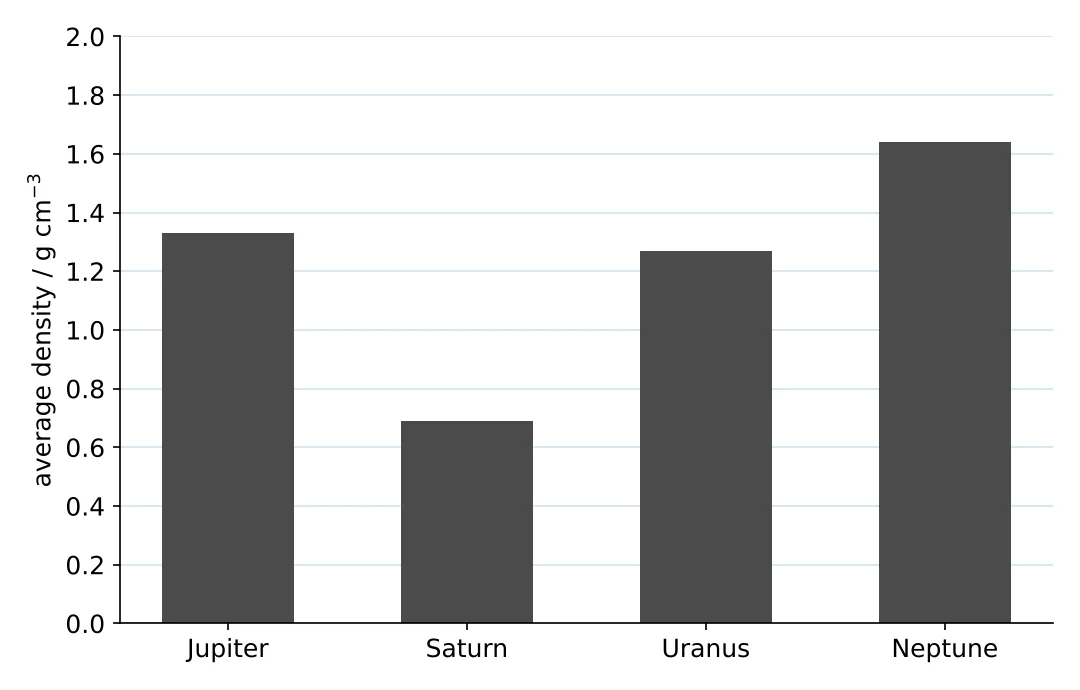
The bar chart shows the average densities of the four giant planets. Water has a density of 1.0 g cm−3^{-3}.
Question diagram
(a)
Write down the density of Neptune. [1]Criterion C (ii) · Level 1-2
(b)
Use the chart to sort the four planets into gas giants and ice giants, explaining your choice. [2]Criterion C (ii) · Level 3-4
(c)
Explain why Saturn has the lowest density. [2]Criterion A (ii) · Level 3-4
(d)
Jupiter is mostly hydrogen and helium like Saturn, but its density is close to Uranus's. Suggest why. [1]Criterion A (iii) · Level 5-6

revisionprep.com

Summary Answer

Not available for this question.

Model Answer

Not available for this question.

Marking Scheme

Not available for this question.

Examiner Insights

Not available for this question.

Question 5Criterion D + A · Band 3-8 · Challenge · 8 marksrevisionprep.com

Importance for life on Earth

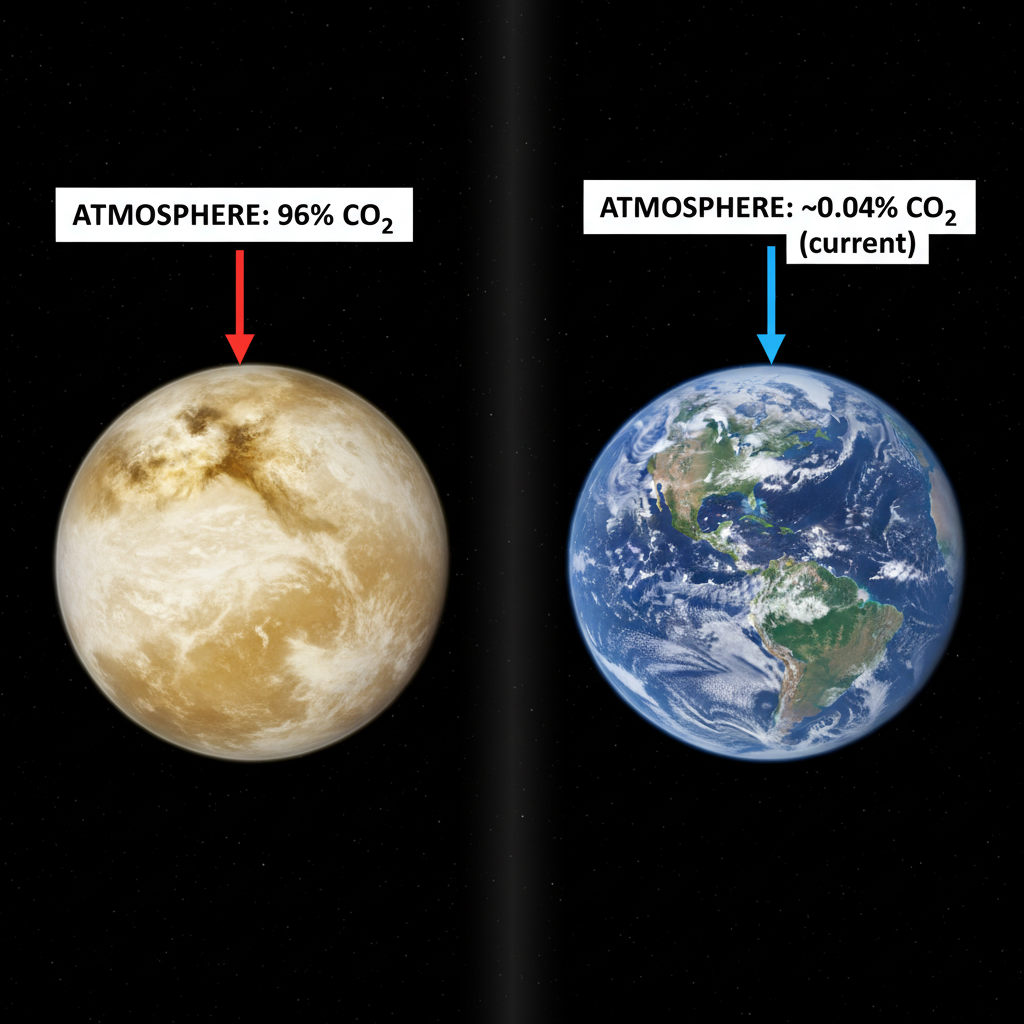
The diagram compares Venus (96% carbon dioxide, surface 462 °C) with Earth (about 0.04% carbon dioxide). Human activity is increasing the carbon dioxide in Earth's atmosphere.
Question diagram
(a)
Describe how carbon dioxide raises the temperature of a planet's surface. [2]Criterion A (i) · Level 3-4
(b)
Explain how Venus provides evidence that adding carbon dioxide to an atmosphere causes warming. [1]Criterion A (iii) · Level 5-6
(c)
Discuss one social or economic impact on Earth of continued warming. [2]Criterion D (ii) · Level 5-6
(d)
Discuss whether countries should cut their carbon dioxide emissions even though some effects of warming are uncertain. Weigh at least two different implications. [3]Criterion D (ii), D (iii) · Level 7-8

revisionprep.com

Summary Answer

Not available for this question.

Model Answer

Not available for this question.

Marking Scheme

Not available for this question.

Examiner Insights

Not available for this question.

Question 6Criterion C + A · Band 3-8 · Challenge · 7 marksrevisionprep.com

Definition of a planet

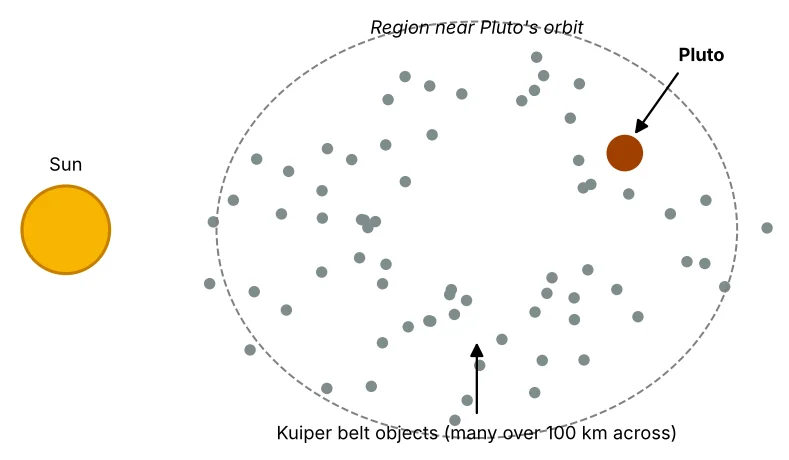
The diagram shows Pluto among the many icy bodies of the Kuiper belt. Pluto's mass ratio (its mass divided by the total mass of other bodies near its orbit) is about 0.07. Earth's is about 1.7×1061.7 \times 10^{6}.
Question diagram
(a)
Explain what a mass ratio of 0.07 tells you about Pluto's region. [2]Criterion A (ii) · Level 3-4
(b)
Compare Pluto's mass ratio with Earth's and explain what the comparison shows. [2]Criterion C (ii) · Level 5-6
(c)
Evaluate whether 'clearing the orbit' is a sensible way to separate planets from dwarf planets. [3]Criterion C (iv) · Level 7-8

revisionprep.com

Summary Answer

Not available for this question.

Model Answer

Not available for this question.

Marking Scheme

Not available for this question.

Examiner Insights

Not available for this question.

That's every free question here — 6 of 167.

+161 more questions, plus Mock Papers & Worksheets, are waiting in Premium.

Upgrade